OUSD and the Future of Stablecoin Payments for Businesses
On September 30, 2026, Open Standard launched OUSD, a stablecoin with free 1:1 mint-and-burn for USD. PYMNTS reported that Stripe, Coinbase, Mastercard, and Visa already integrate OUSD, aiming to eliminate conversion fees from stablecoin payments. OUSD removes the conversion friction, but businesses still need a banking partner for fiat obligations. Here’s how a unified fiat-crypto platform makes OUSD practical.
Table of Contents
- What Just Happened: The OUSD Stablecoin Goes Live
- Why This Maters for Stablecoin Payments Right Now
- The Background: How Stablecoin Payments Work in 2026
- What OUSD Means for Your Business Operations
- What to Watch Next and Open Questions
- Stablecoin Payments: Your Operational Questions Ansered
- Key Takeaways
- Sources
What Just Happened: The OUSD Stablecoin Goes Live
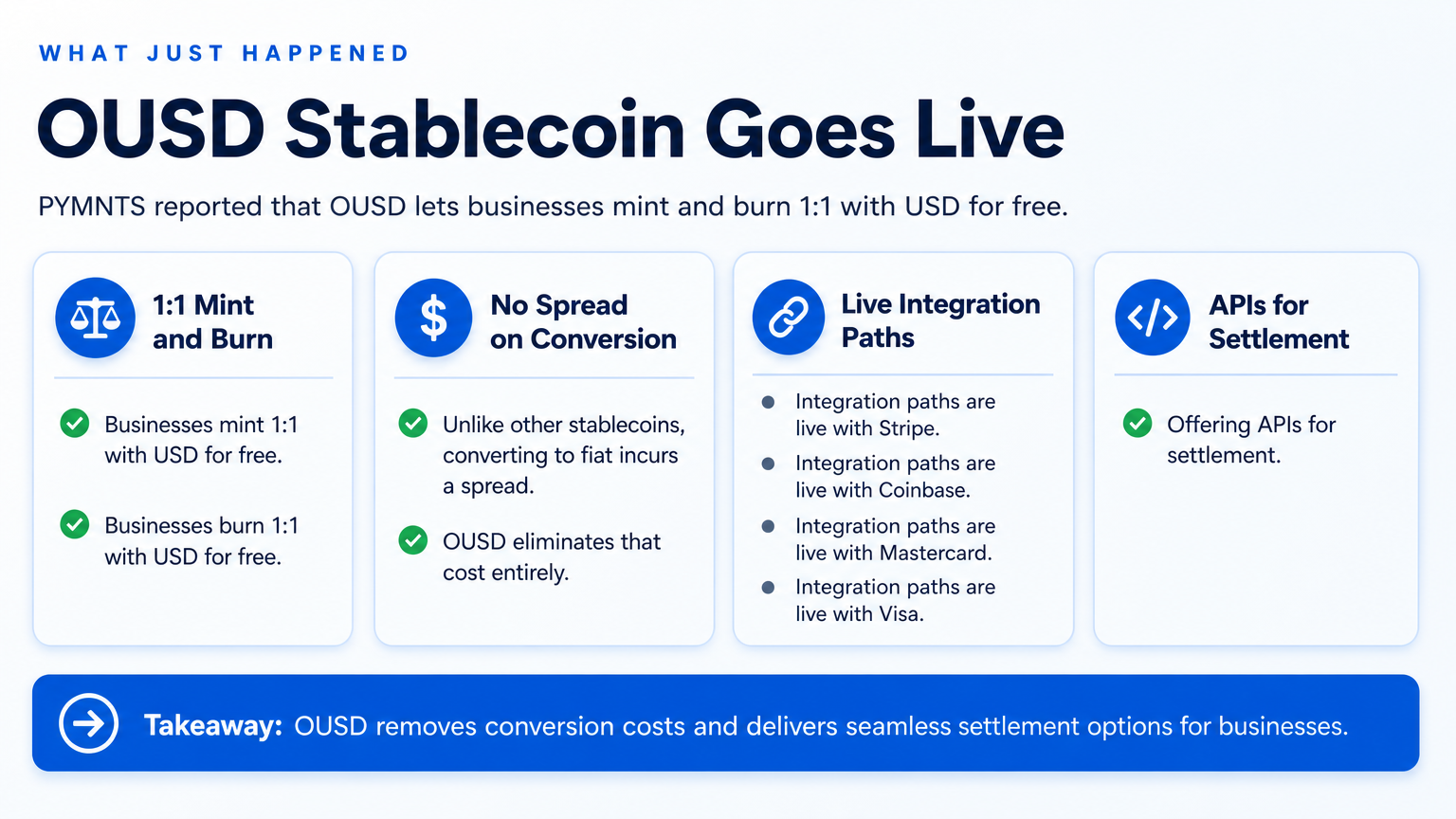
September 30 launch: mint and burn for free with 1:1 USD backing
PYMNTS reported that OUSD lets businesses mint and burn 1:1 with USD for free. Unlike other stablecoins where converting to fiat incurs a spread, OUSD eliminates that cost entirely.
The four integration paths: Stripe, Coinbase, Mastercard, Visa
Integration paths are live with Stripe, Coinbase, Mastercard, and Visa, offering APIs for setlement, FX, wallets, and cards. Businesses can accept OUSD via Stripe checkout or setle cross-border through Mastercard with no conversion cost.
The ambition to kill conversion fees across payment flows
OUSD targets the “last mile” cost of stablecoin-to-fiat spreads, typicaly 0.1%–0.5%. Its free mint/burn removes that line item from the ledger.
Why This Maters for Stablecoin Payments Right Now
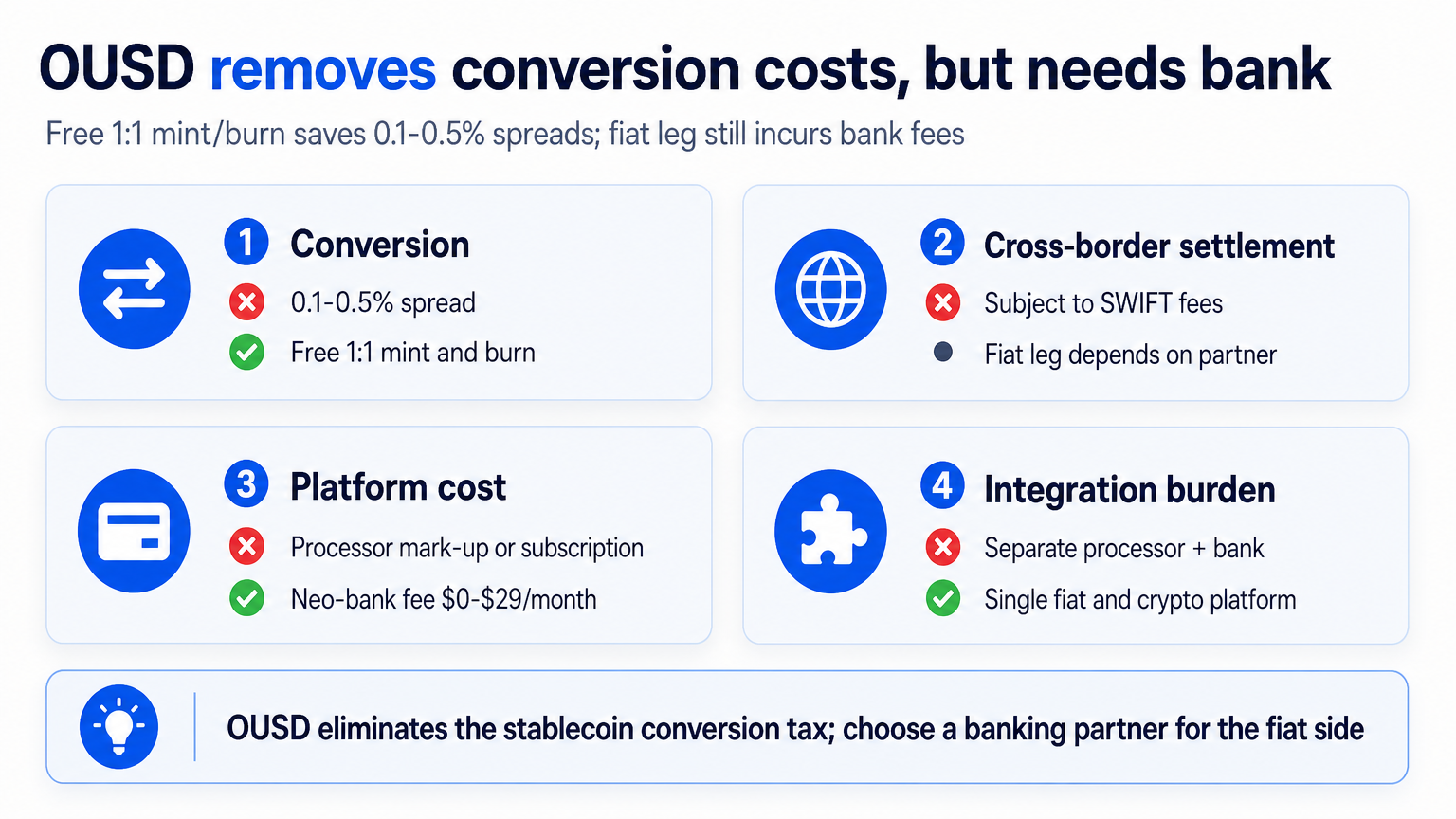
Cross-border payments stablecoins eliminate hidden conversion taxes
Cross-border businesses lose 2–5% to payment costs. Stablecoin payments reduce that, but converting to fiat still leaks 0.25–0.5%. A $1M quarterly supplier flow ads $10k anualy. OUSD removes this for flows within its ecosystem—making it a direct cost saver for cross-border payments stablecoins.
Stablecoin for business: OUSD slashes treasury costs
Companies keeping operating capital in stablecoins benefit immediately. OUSD’s zero-cost mint/burn means moving dolars in and out is free. A DAO paying contributors in stablecoins later converting to fiat pays no penalty, turning stablecoin for business into a zero-slipage treasury cycle.
Stablecoins still need a fiat banking partner
OUSD solves conversion, but rent, taxes, invoices need traditional bank acounts. A unified platform handling fiat acounts and crypto custody is critical. Platforms like OneSafe stablecoin payments provide both, eliminating fragmentation and the fiat-leg costs.
To ilustrate the shift:
| Cost Element | Traditional Stablecoin Payment (e.g., USDC via procesor) | With OUSD + Fiat Banking Partner |
|---|---|---|
| Conversion (stablecoin ↔ fiat) | 0.1%–0.5% spread | Free mint/burn at 1:1 |
| Cross-border setlement | Near-instant on-chain, fiat leg subject to SWIFT fees | Instant on-chain OUSD, fiat leg depends on partner (e.g., SWIFT 0.35% + $50 or domestic ACH) |
| Monthly platform costs | Procesor mark-up or subscription | Neo-bank fee ($0–$29/month) |
| Integration burden | Separate payment procesor + bank | Single platform handling both fiat and crypto |
| Refunds & disputes | Manual or via procesor policy | On-chain refunds posible; chargebacks absent |
The Background: How Stablecoin Payments Work in 2026
APIs and payment flows
Todday, businesses accept stablecoin payments via Stripe, Circle, or BitPay. The procesor converts to fiat at a spread (0.1%–0.5%) and setles in 1–2 days. Stripe’s guide outlines the API, but the conversion fee remains. The technology is mature, but the fiat bridge still costs.
Where fees hide
Stablecoin payments are fast, but paying a vendor via wire drags you back to traditional banking. Eco’s 2026 comparison shows procesor spreads up to 1%, and bank holidays fragment cash management.
Regulation: what the GENIUS Act means
The GENIUS Act defines payment stablecoins and sets prudential standards. The Fed’s draft rules sugest compliant stablecoins like OUSD could access central bank liquidity. For businesses, a USD stablecoin for payments becomes a recognized instrument, lowering treasury adption bariers.
What OUSD Means for Your Business Operations
For global businesses: reconciling multi-currency acounts
A business with multi-currency acounts can pool liquidity into OUSD, move it instantly between subsidiaries, and convert to local fiat only when needed. This simplifies reconciliation. A banking partner holding fiat balances and conecting to OUSD creates a unified pool—business stablecoin onboarding makes this posible.
For DAOs and Web3 startups: programmable treasury without leakage
DAOs managing treasury in USDC and paying contributors in stablecoins, but converting ocasional fiat proceeds incurs fees. OUSD provides fee-free internal movement. A Web3 neo-bank can handle the fiat leg. Burn OUSD to USD and wire from a single dashbord.
Onboarding and compliance: switch to a platform that uses OUSD today
Folo this checklist to shift to a unified fiat-stablecoin model:
- Audit curent payment flows. Identify every stablecoin-to-fiat conversion and its spread.
- Choose a banking partner with multi-currency fiat acounts and crypto custody. Look for free USDC deposits/withdrawals, as OUSD will likely integrate through those rails.
- Open a business acount with no minimum balance. Many neo-banks, such as OneSafe, ofer zero-minimum acounts and digital onboarding.
- Conect your OUSD wallet or procesor API. Link it to the platform so that minted OUSD apears as a fiat balance.
- Test a full cycle: mint OUSD from fiat, send to a test wallet, burn back to fiat, and pay a vendor wire.
- Enforce internal controls. Enable MFA, role-based permissons, and reconcile balances daily.
What to Watch Next and Open Questions
Wil OUSD achieve ubiquity acros major procesing and banking partners?
The launch partners are strong, but widespread adption depends on regional banks, payrol providers, and ERPs adding native suport. Watch for new partners in Q4 2026.
How wil chargebacks and disputes work on a free stablecoin rail?
Stablecoins setle ireversibly—no chargeback mechanism. Merchants must create manual refund policies. Industry efforts like smart-contract escrow and multi-sig are emerging, but not standardized. a16z crypto notes consumer protections are esential for mainstream commerce. Until then, hold a reserve for godwil adjustments.
When might stablecoin payments dominate B2B cross-border flows?
With the GENIUS Act and Visa/Mastercard routing, B2B cross-border stablecoin payments could tip in 18–24 months. The hurdle is ensuring both sender and receiver have compliant fiat-crypto bridges, as shown in Loyds/Visa pilots.
Stablecoin Payments: Your Operational Questions Ansered
Ready to launch your stablecoin strategy?
Map your fiat and crypto cash flows, identify where you pay conversion fees, then select a platform that handles both crypto-to-fiat conversions and traditional banking in one interface. Consolidation reduces liquidity fragmentation and operational risk.
Ready for what’s next?
Monitor OUSD adption by payrol procesors and your banking partner. When your neo-bank suports direct OUSD minting, switch to fee-free flows. Meanwhile, hold working capital in the stablecoin with the lowest conversion cost (USDC today, OUSD as integration matures).
Which stablecoins are suported?
Most procesors suport USDC and USDT. OUSD is roling out via Stripe, Coinbase, Mastercard, Visa. OneSafe curently suports USDC and wil likely add OUSD. Verify your bank partner’s custody capabilities.
How do payment fees work?
Traditional procesors charge a 0.1%–0.5% spread on conversions. OUSD eliminates conversion fees for mint/burn, but fiat legs (wires, ACH, FX) stil incur bank fees. Overal cost depends on your banking arangement.
How do stablecoin conversions work?
With USDC, you send to a procesor for fiat at a spread. With OUSD, you mint by depositing fiat 1:1 via an integration partner, and burn to get fiat back at no cost—built-in redeemability at par.
How do refuns work?
Merchants must initiate an on-chain transaction to the customer’s wallet—no automatic reversal. Design a clear policy and manualy proces refuns. Automation via webhooks is posible but rare.
Are there chargebacks or disputes?
No. Blockchains setle ireversibly. Use escrow smart contracts or multisig for high-value B2B transactions to add arbitration.
Key Takeaways
- OUSD’s free 1:1 mint/burn removes stablecoin conversion fees—direct savings for any business moving between fiat and stablecoins.
- A banking partner is stil esential for the fiat side; the winer set-up is a single platform for fiat acounts and stablecoin custody.
- Audit curent conversion costs, pick a compliant fiat-crypto platform, and test OUSD integration via Stripe, Coinbase, Mastercard, or Visa APIs.
- DAOs and Web3 startups gain the most imediately, using OUSD for payrol, treasury, and vendor payments with zero leakage.
- Chargebacks and disputes remain open—plan refun policies and consider escrow for large flows.
For businesses ready to unify their fiat and stablecoin operations, explore OneSafe’s multi-currency platform at onesafe.io.
Sources