Meta description: Lloyds and Visa settled $750,000 with stablecoins across blockchains in under an hour during a September 2026 pilot, proving bank-grade stablecoin payments are now operational.
Stablecoin payments crossed a critical threshold on September 30, 2026. Lloyds Banking Group and Visa completed a seven‑day live pilot settling $750,000 in payment obligations using stablecoins—funds that moved across blockchains and reached Visa in under an hour, including over the weekend. The test wasn't a sandbox simulation. It was real‑world settlement between a G‑SIB bank and a global card network, operating on both a private enterprise blockchain and a public chain. For finance leads at startups, DAOs, and global businesses, the pilot signals that bank‑grade stablecoin infrastructure is now operational and the gap between crypto‑native treasury management and traditional banking is closing fast.
Table of Contents
- What just happened
- Why this matters now for startups, DAOs, and global businesses
- Stablecoin payments: a quick primer
- How neo‑banking platforms turn the pilot's promise into daily cash flow
- What your business should do now
- What to watch next
- Ready to launch your stablecoin strategy?
- Key Takeaways
What just happened
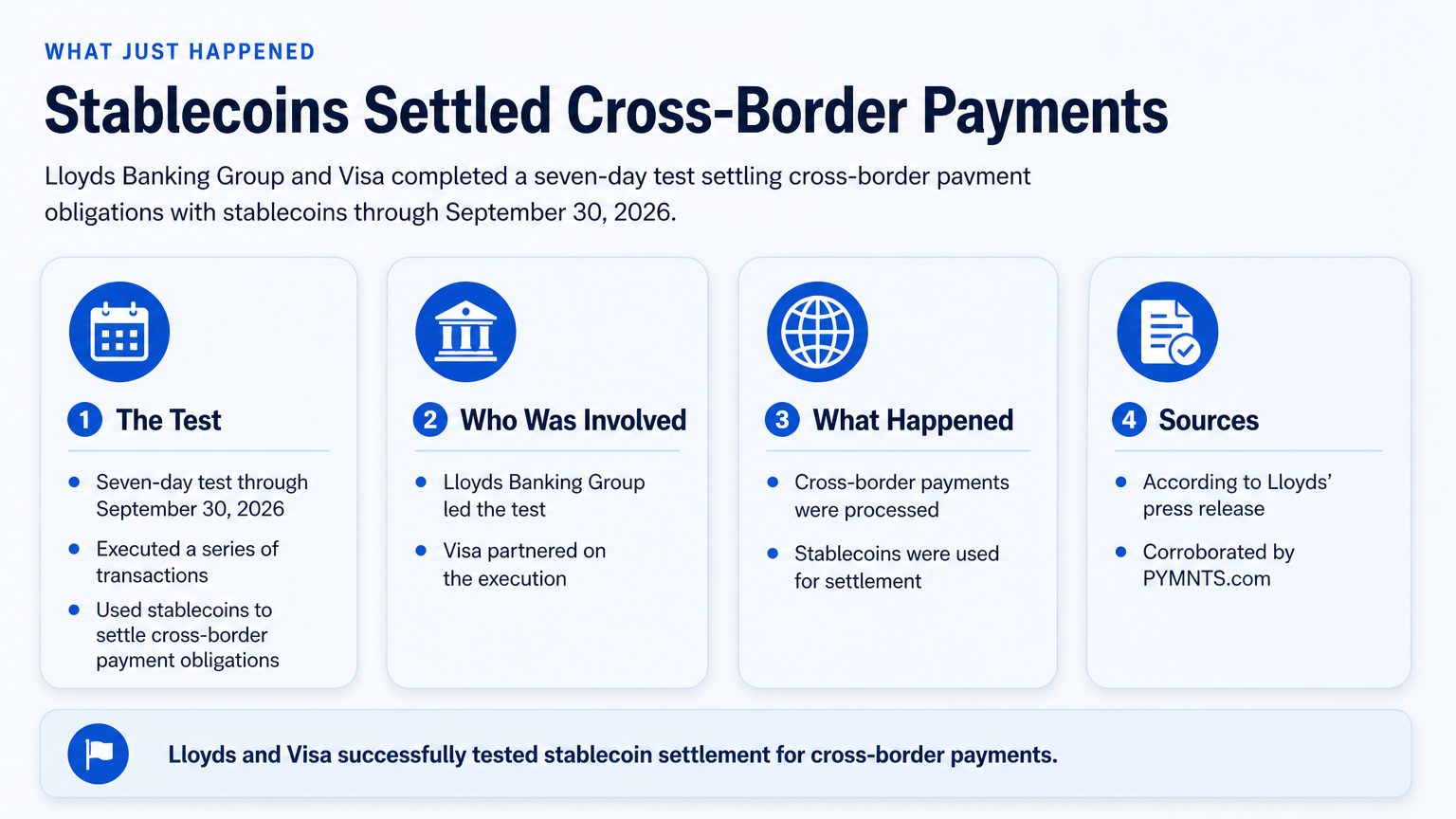
In a seven‑day test through September 30, 2026, Lloyds Banking Group and Visa executed a series of transactions using stablecoins to settle cross‑border payment obligations. According to Lloyds' press release and corroborated by PYMNTS.com, the settlement volume was booked through Lloyds' Corporate Markets branch in Jersey and transferred to Visa in the United States—finalizing in under an hour, over the weekend, when traditional correspondent banking rails are dark (PYMNTS).
The pilot involved $750,000 in total settlement value. Lloyds used its own node on Canton, a private permissioned blockchain, while Visa supported settlement on a separate public blockchain, demonstrating interoperability between two very different network environments (Lloyds Banking Group press release). The stablecoin used was USDC, issued by Circle.
Why weekend settlement changes the game
In traditional correspondent banking, cross‑border payments depend on SWIFT message queues, intermediary bank cut‑off times, and batch processing that stops on weekends. A payment initiated on a Friday afternoon may not settle until Tuesday. The pilot proved that stablecoin settlement can finalize in under an hour—any day of the week—eliminating idle liquidity and reducing foreign exchange exposure windows from days to minutes. For businesses that pay suppliers, contractors, or distributed teams globally, settling on a Saturday without a cost penalty rewrites cash‑flow assumptions.
Interoperability on display
Interoperability was the pilot's most technically ambitious feat. Lloyds settled on Canton, a network designed for institutional control and data privacy, while Visa settled on a public blockchain. The two networks communicated via a bridge, locking the stablecoin token on one chain and releasing equivalent value on the other. This blockchain interoperability settlement pattern lets a corporate treasury run on a permissioned network while paying a supplier on a public chain like Ethereum or Solana—without touching a crypto exchange directly. As Stripe's guide on stablecoins for cross‑border payments explains, heterogeneous chain settlement is a prerequisite for widespread commercial adoption. The pilot shows major banks and card networks are now building that layer into production-grade infrastructure.
Why this matters now for startups, DAOs, and global businesses
From correspondent banking delays to real‑time settlement
Most startups and DAOs still rely on wire transfers passing through two to four correspondent banks, each taking a fee and adding delay. A $50,000 cross‑border payment can take two to three business days and cost $30–$50 in wire fees plus 1–3% in FX markup. The Lloyds‑Visa pilot demonstrated that the same value can move in less than an hour with near‑zero counterparty settlement risk and dramatically lower variable costs. The Federal Reserve's March 2026 note on payment stablecoins acknowledges that "stablecoins can facilitate near‑instant, low‑cost cross‑border transactions" while cautioning about monetary policy implications (Federal Reserve note). That official recognition, combined with the Lloyds‑Visa live test, will accelerate corporate adoption.
The competitive edge
For a Web3 startup paying contributors globally or a DAO funding grant recipients, settlement speed directly affects operational agility. When a $50,000 payment arrives in minutes instead of days, the business can release project milestones faster, negotiate better rates, and reduce cash buffers. The pilot proves a major financial institution can run USDC payments for business on a schedule that aligns with how crypto‑native organizations already operate—removing the friction that forced many startups to maintain both a corporate bank account and separate crypto wallet infrastructure.
What the pilot confirms about infrastructure maturity
The pilot confirms three realities: a regulated bank can hold and manage stablecoin settlement using a private blockchain node without losing compliance oversight; a global card network can accept stablecoin settlement from a bank as valid discharge of payment obligations; and the technology bridging private and public chains is reliable enough for multimillion‑dollar daily volumes. Together, these signal that stablecoin payment infrastructure has moved from proof‑of‑concept to a stage where CFOs can plan for production deployment.
Stablecoin payments: a quick primer
How payment stablecoins work
A payment stablecoin like USDC is a token issued on a blockchain representing a claim on a reserve of traditional assets—typically cash and short‑duration U.S. Treasuries—held at regulated custodians. Each token is redeemable 1:1 for fiat currency. Unlike volatile cryptocurrencies, stablecoins are designed to maintain stable value and function as a settlement medium. Modern Treasury's explainer notes that cross‑border stablecoin payments use these tokens as a digital IOU that moves on‑chain, cutting out the need for multiple nostro accounts and message queues.
The consensus and the trade‑off
The industry consensus is that stablecoin‑based settlement offers three structural advantages: instant finality, reducing settlement risk; lower transaction costs with no intermediary banks; and no chargebacks, eliminating fraudulent reversal risks for merchants. The trade‑off is dependence on the issuer's creditworthiness and reserve quality, and that on‑chain errors—sending tokens to a wrong address—can be irreversible.
How the Lloyds‑Visa test changes institutional perception
Before September 30, most institutional stablecoin pilots involved crypto‑native companies or fintechs like Circle and Paxos. The Lloyds Visa stablecoin pilot brings a G‑SIB bank directly into the settlement flow as an originator, not just a wallet provider. That shifts institutional perception from "stablecoins are a crypto experiment" to "stablecoins are a bank‑grade settlement rail that we must integrate into treasury operations." As more banks follow the pattern—a prediction the industry is baking into 2027 planning—cross‑border stablecoin settlement will become a standard option alongside SWIFT.
How neo‑banking platforms turn the pilot's promise into daily cash flow
Bridging stablecoin settlement and fiat operations
The Lloyds‑Visa pilot demonstrated that a bank can settle with a card network on a blockchain. But for a startup or DAO, receiving a stablecoin payment is only half the problem; the other half is moving between crypto and fiat to pay taxes, payroll, and vendors who demand bank transfers. A crypto‑to‑fiat neo‑banking platform solves that by issuing segregated fiat accounts, offering on‑chain USDC deposit addresses, and allowing instant conversion between the two from a single dashboard. One example is OneSafe, a financial technology company providing a unified platform for managing fiat and crypto transactions through banking partners. Startups can deposit USDC with zero deposit fees, convert to USD, EUR, or CAD at near‑instantaneous rates, and send a wire or pay with a corporate card—all without leaving the interface.
Real‑world fee breakdown
To see the concrete advantage, compare settling a $50,000 cross‑border payment using traditional SWIFT rails versus a USDC‑based flow through a neo‑banking platform. The table below uses publicly available benchmarks and OneSafe's fee schedule as a representative example.
| Scenario | SWIFT wire (traditional) | USDC settlement via neo‑banking (e.g., OneSafe) |
|---|---|---|
| Outgoing transfer fee | $25–$50 (wire fee) | $0 (USDC withdrawal free) |
| FX markup | 1–3% on notional ($500–$1,500) | 0.25% or prevailing FX rate ($125) |
| Correspondent bank fees | $10–$30 | $0 |
| Settlement time | 2–3 business days | <1 hour (can be minutes) |
| Total cost (mid‑range) | ~$1,030 per $50k transfer | $125 per $50k transfer |
Numbers assume mid‑point of SWIFT fee ranges and OneSafe's 0.25% FX fee and free USDC withdrawal. The per‑transaction saving is over $900, and the business gets its funds the same day. Over 10 such transfers a month, that's $9,000 in direct savings.
On‑ramps, off‑ramps, and corporate cards
A neo‑banking platform converts the settlement speed Lloyds and Visa demonstrated into spendable cash by providing fiat off‑ramps: ACH transfers, domestic and international wires, bill payments, and corporate cards topped up in USDC. A DAO receiving a grant in USDC on Thursday can convert to EUR on Friday and issue a virtual card for a team member in Lisbon to pay a conference fee that afternoon. For organizations needing a DAO multi‑currency account to manage contributor payouts across jurisdictions, combining stablecoin settlement with fiat‑denominated cards reduces the treasury stack to one platform. Payment fees in a stablecoin flow are structurally simpler than traditional banking: typically an on‑chain gas fee (often negligible or covered by the platform) and a platform fee for conversions, wire withdrawals, and card issuance. Stablecoin conversions happen when a business moves from a token like USDC to fiat—the platform partners with liquidity providers to execute the conversion at the best available rate, crediting the fiat account in seconds.
What your business should do now
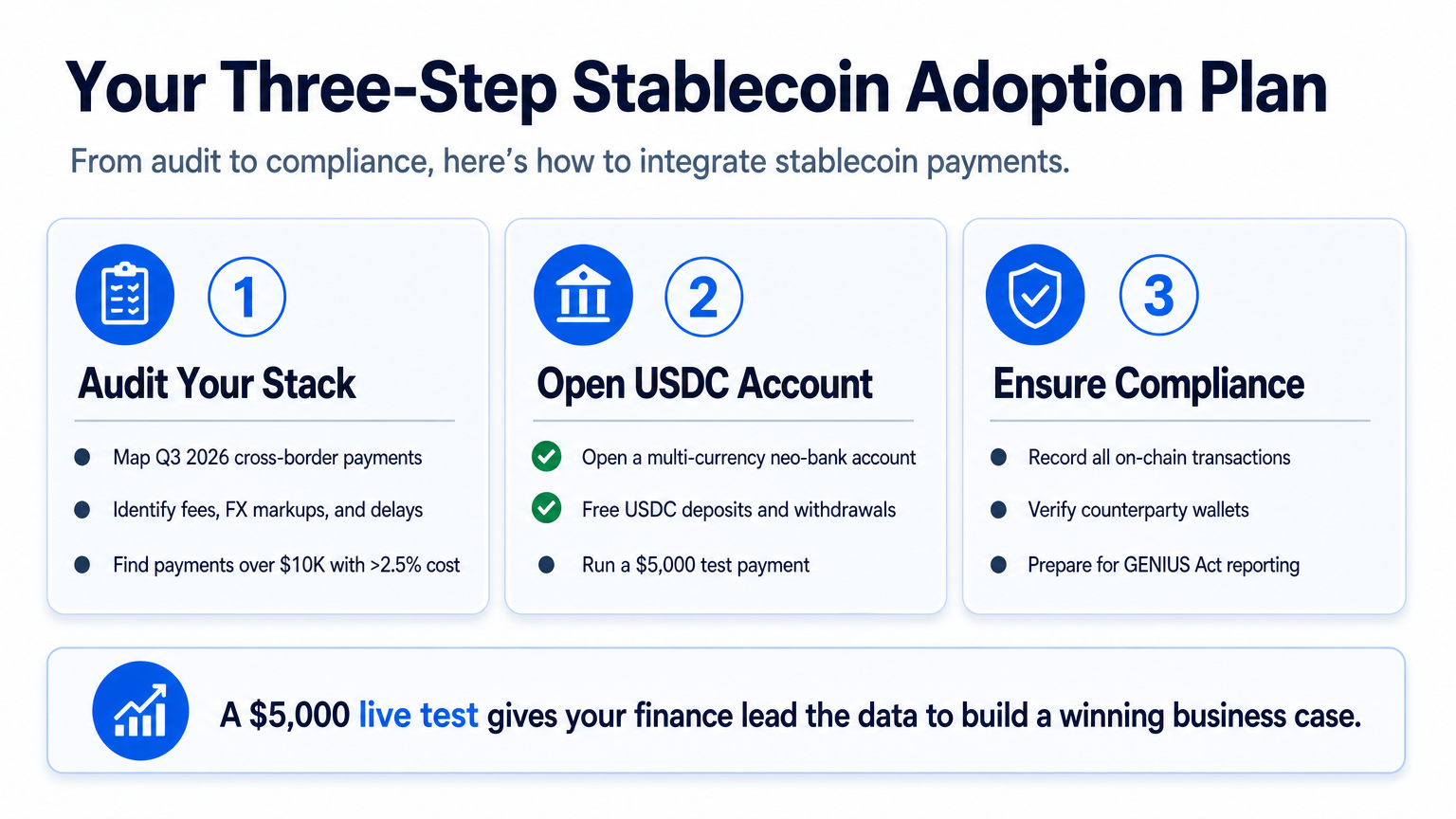
Audit your current cross‑border payment stack
Map every cross‑border payment your business made in Q3 2026: the route it took (SWIFT, ACH, card), total cost including wire fees and hidden FX markups, and settlement time. For a typical Web3 startup, you'll likely find several payments over $10,000 where the all‑in cost exceeded 2.5% and settlement took more than 48 hours. That audit creates the baseline against which you measure a stablecoin‑based alternative.
Start with a USDC‑native multi‑currency account
Open a USDC‑native multi‑currency account on a platform that combines fiat and crypto operations—not a consumer wallet, but a business account with segregated multi‑currency accounts, free USDC deposits and withdrawals, and built‑in FX conversion. Onboarding on OneSafe typically completes within a week, requires business formation documents and government‑issued ID, and costs nothing to open a base account. Run a live test: route your next planned $5,000 vendor payment through USDC instead of SWIFT and compare the actual cost and settlement time against your audit baseline.
Build a compliance‑first workflow
The stablecoin regulation GENIUS Act and the Fed's parallel work on payment stablecoin oversight mean any business holding or transacting in stablecoins will face clearer—and stricter—reporting obligations. Before scaling your stablecoin payment volume, establish a compliance workflow: maintain records of every on‑chain transaction, verify counterparty wallets using a block explorer, and ensure your platform provides downloadable transaction logs for audit purposes. The Fed's note on payment stablecoins emphasizes that institutions will need "robust transaction monitoring, recordkeeping, and reporting." Treat that as a design requirement now, not a future bolt‑on.
What to watch next
Additional bank‑blockchain partnerships
The pattern is set: a top‑tier bank runs a pilot with a card network or fintech, demonstrates interoperability, and scales to production. Expect announcements from other European and Asian banks in Q4 2026 and early 2027 mimicking the Lloyds‑Visa architecture. When a second major bank replicates the test, corporate treasury departments waiting for a "second opinion" will begin to move. Mastercard's stablecoin bet is another signal that card networks are building parallel rails.
Regulatory milestones
The GENIUS Act, if passed in its current form, will create a federal licensing framework for payment stablecoin issuers and address reserve requirements, redemption rights, and interoperability standards. The Fed's 2‑day payout rule for stablecoin providers, proposed in spring 2026, may also be finalized. Any business using stablecoins should track these developments because they will determine which stablecoins are permissible for institutional settlement and what compliance evidence must be retained. Our analysis on the Fed's stablecoin regulation draft covers the near‑term impact.
The next frontier: programmatic payments
With real‑time settlement proven, the next frontier is automating payment logic. A DAO could use a smart contract that releases USDC to a contributor the moment a multisig vote reaches quorum, then triggers an off‑ramp to fiat via a neo‑banking platform's API. That's programmatic treasury management—eliminating the manual step of initiating a wire. Lloyds showed a private blockchain can talk to a public chain; the same principle can connect a DAO's governance contract to a business bank account. The infrastructure for crypto treasury management is being built alongside the settlement rails.
Ready to launch your stablecoin strategy?
If your business has been watching the stablecoin space waiting for a signal from the establishment, the Lloyds‑Visa pilot is that signal. The infrastructure is ready, the cost advantage is quantifiable, and the regulatory framework is taking shape. Begin with a $5,000 live test between a USDC wallet and a multi‑currency business account that can off‑ramp to fiat. Compare the end‑to‑end cost and settlement time against your last wire transfer. Let that single real‑world metric drive your decision, not industry hype.
Key Takeaways
- The Lloyds‑Visa pilot settled $750,000 in cross‑border payments in under an hour across a private and a public blockchain, proving that bank‑grade stablecoin payments are operational as of September 30, 2026.
- For startups and DAOs, switching from SWIFT to USDC‑based settlement can save over $900 per $50,000 transfer while cutting settlement time from days to hours—without adding compliance risk if done through a regulated platform.
- The pilot's interoperability between Canton and a public chain sets a technical pattern that will enable programmatic treasury management and DAO multi‑currency accounts without manual bridging.
- A compliance‑first workflow that records on‑chain transactions and prepares for the GENIUS Act is essential before scaling stablecoin volumes.
- The cost advantage is immediate and measurable: a simple fee audit and a single USDC test payment will give a finance lead the data to present a business case.
Open a USDC-native business account with OneSafe and run your first cross‑border stablecoin payment today.