
On September 30, 2026, stablecoin payments crossed a critical threshold. The Coinbase Citi stablecoin partnership connects Citi’s regulated banking rails with Coinbase’s crypto infrastructure, letting merchants accept stablecoins while settlement stays inside a Tier‑1 bank. The move closes the fiat‑to‑crypto gap that forced businesses to juggle separate bank accounts and exchanges — and signals that large banks are no longer just watching stablecoin adoption from the sidelines.
Table of Contents
- What Just Happened: The Coinbase‑Citi Stablecoin Deal
- Why This Matters for Stablecoin Payments Now
- The Backdrop: Stablecoin Payments Before the Banking Bridge
- Practical Implcations and What Businesses Should Do
- What to Watch Next
- What does the Coinbase‑Citi partnership mean for my business?
- How can I accept stablecoin payments while keeping settlement in a bank?
- What are the compliance and tax implications of accepting stableoins?
- How do I choose between using a pure crypto processor and a unified fiat‑crypto platform?
- Which stableoins should my business support?
- Key Takeaways
What Just Happened: The Coinbase‑Citi Stablecoin Deal
The announcement and key players
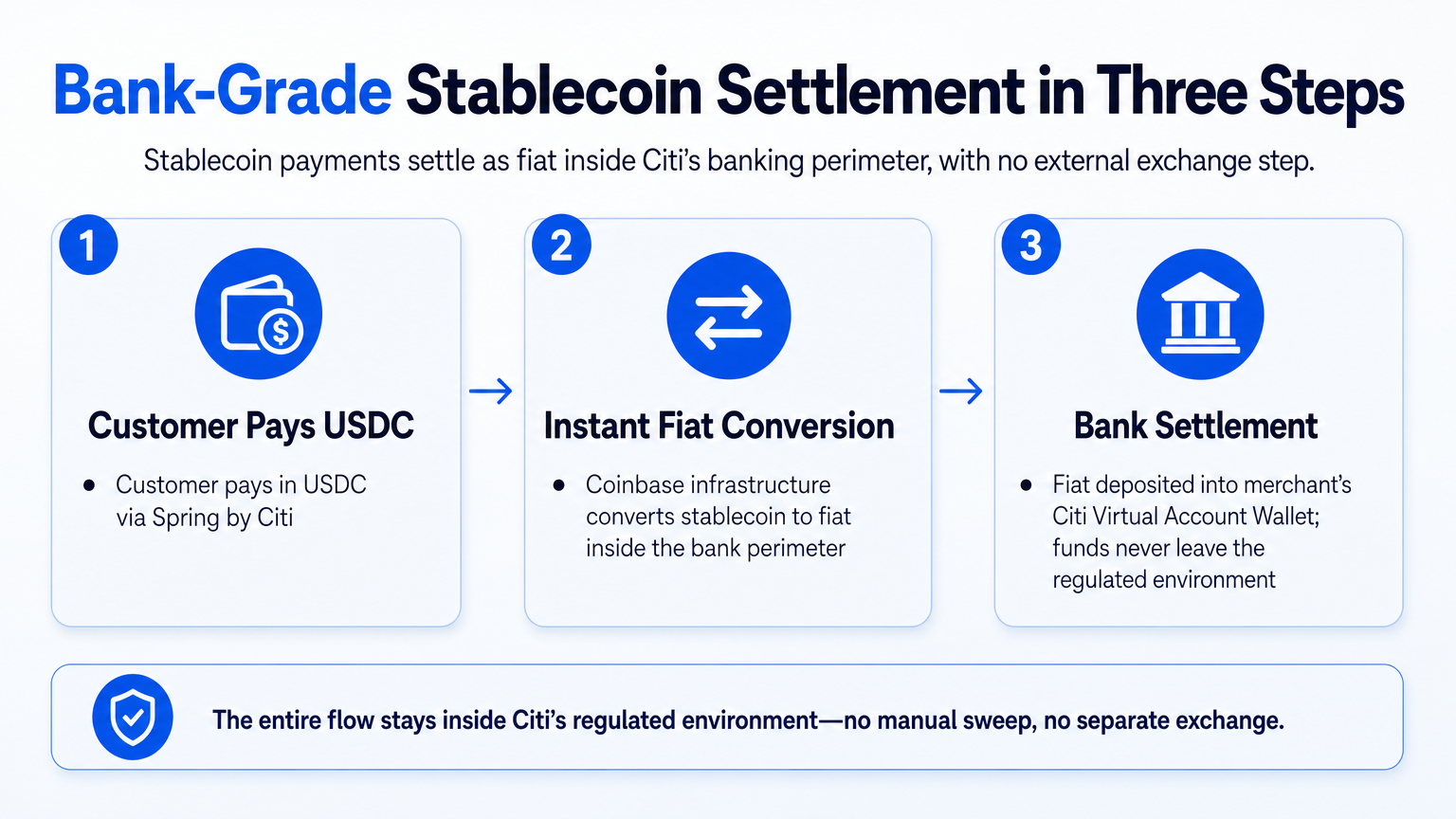
Citi and Coinbase disclosed new fiat-to-stablecoin conversion features on September 30, 2026, according to Yahoo Finance. The collaboration links Citi’s Virtual Account Wallet and Spring by Citi merchant payments platform with Coinbase’s regulated infrastructure. The stablecoin bank integration is an extension of Citi’s existing cash‑management stack, now with stablecoin rails embedded. Merchants who already use Spring gain access without opening a separate Coinbase account, though underlying conversions flow through Coinbase.
How the Virtual Account Wallet and Spring platform work
The Virtual Account Wallet for Coinbase automatically converts fiat balances into USDC for payments, payroll, or treasury operations. Incoming stablecoin payments from customers are accepted through Spring and converted back into fiat, settling inside the client’s Citi account. The funds never leave the regulated banking perimeter. A merchant accepting USDC receives an end‑of‑day fiat deposit — stablecoin speed and programmability under the hood, while books and trust stay in fiat with the bank.
Why This Matters for Stablecoin Payments Now
Bringing stablecoins into regulated banking
Previously, businesses accepting crypto payment processing had to route funds through a separate exchange or processor, then manually sweep to a fiat account — adding latency, counterparty risk, and compliance overhead. The Citi‑Coinbase partnership makes stablecoin bank integration real. Conversion and settlement happen inside Citi’s regulated environment, collapsing the fiat‑to‑crypto gap and addressing risk perception, AML/KYC uncertainty, and accounting fragmentation. It embeds stablecoin acceptance directly into standard cash management.
Implications for merchants and global businesses
Merchants can now accept stablecoin payments without touching a private key. A customer pays USDC; the merchant sees a fiat credit, typically faster than a SWIFT transfer and with lower intermediation costs. This is especially valuable for global B2B payments, DAO treasury operations, and e‑commerce. As a16z’s analysis notes, stablecoins are positioned to eat into traditional payment rails, and this partnership provides a bank‑grade on‑ramp for that shift.
The Backdrop: Stablecoin Payments Before the Banking Bridge
How businesses typically accept stablecoin payments today
Before September 2026, businesses chose among three imperfect paths: a crypto‑native processor (delayed settlement), a self‑custodied wallet (manual conversions, security burden), or a stablecoin‑enabled neo‑bank (not a Tier‑1 bank). Each path left a fiat to stablecoin conversion gap — the business still had to move money between crypto and banking rails, costly and slow.
The persistent fiat‑to‑crypto gap
The on‑/off‑ramp was the slowest, most expensive step. The Citi‑Coinbase link hosts conversion inside the bank, turning it into an internal accounting entry. For businesses using platforms that unify fiat and crypto operations — like OneSafe — this validates the architecture; the bank‑grade on‑ramp becomes another integrration point, not a relacement for a day‑to‑day financial hub.
Practical Implcations and What Businesses Should Do
Evaluate your payment rail strategy
Ask: Can we accept stableoins and settle to a bank account without a manual conversion step? If the answer rellies on a separate exchange or crypto‑only processor, the cost of fragmentation will grow. Map a hypothetical USDC payment’s flow, identify every party and delay, and compare total cost (fees plus FX) against a bank‑integrated rail.
Look for platforms that unify fiat and stablecoin operations
The structural lesson: efficient crypto payment processing lives inside platforms that treat fiat and crypto as one set of balances. A unified fiat‑crpto platform (like OneSafe) with segregated accounts, corprate cards, and instant conversion cuts settlement risk and manual errors. When evaluating providers, look for:
- Native multi‑currency fiat accounts alongside crypto wallet infrastructure
- In‑platform fiat to stablecoin conversion with transparent fees
- API access for real‑time transaction ingestion
- Compliance packaging — KYB/AML and audit‑ready statements
Assess compliance and FX implications
A bank‑grade bridge shifts compliance handling, it doesn’t eliminat it. The platform should shoulder KYB/KYT and provide documentation. FX matters: a platform offering competitive FX natively inside the same ecosystem can compress costs. Model a $50,000 cross‑boder payment to see the real difference.
What to Watch Next
Will other banks follow Citi’s lead?
Citi’s move is a signal. Following the Lloyds‑Visa stablecoin pilot, expect more banks to announce similar stablecoin bank integration partnerships by mid‑2027, compressing fiat conversion fees and pushing stablecoin acceptance into B2B and institutional treasury.
How stablecoin regulation will shape bank‑crypto links
Stablecoin regulation tailwinds are aligning. The U.S. GENIUS Act and Treasury proposals create a legal perimter for banks to operate a stablecoin rail. The Citi‑Coinbase arrangement fits: USDC (regulated, fiat‑backed) and conversion inside a bank subsdiary. Watch for final rules on settlement timelines and capital treatment.
The future of stablecoin‑first business banking
The deal accelerates a trend toward stablecoin‑first business banking. For Web3 startups, DAOs, and cross‑boder firms, the enabler will be platforms that collapse the fiat‑crypto gap into a single pane — whether a giant like Citi or a purpose‑built neo‑bank.
What does the Coinbase‑Citi partnership mean for my business?
It provides a visible path to accept stablecoin payments while keeping cash inside a regulated bank, without self‑custody or manual conversion. For Citi clients, it’s a nativ add‑on. For everyone else, it sets a benchmark: instant conversion, bank‑grade settlement, simplifed compliance. Compare your current stack against that standard and identity where fragmentation costs time and money.
How can I accept stablecoin payments while keeping settlement in a bank?
Two options:
- Direct bank integrration (if available): Use a partner like Citi’s Spring platform, which receives stableoins and deposits fiat into your account.
- Unified fiat‑crpto platform: Use a service like OneSafe that holds both fiat accounts and crypto wallets, performing stablecoin conversion internally before settling to your linked bank account. What is a crypto bank? explains the underlying infastructure.
In both cases, the conversion happens inside a regulated environment before funds reach your operating account, so you never hold a volatile crypto balance on your corprate books.
What are the compliance and tax implications of accepting stableoins?
When using a bank or regulated platform:
- The provider handles KYB and AML monitoring.
- Receiving USDC and instantly converting to fiat is typically a taxable event; track any gain/loss from value fluctuations.
- Demand a clear statement from your provider on what tax reports they generate before you go live. For regulatory developments, see ESMA’s MiCA demands.
How do I choose between using a pure crypto processor and a unified fiat‑crypto platform?
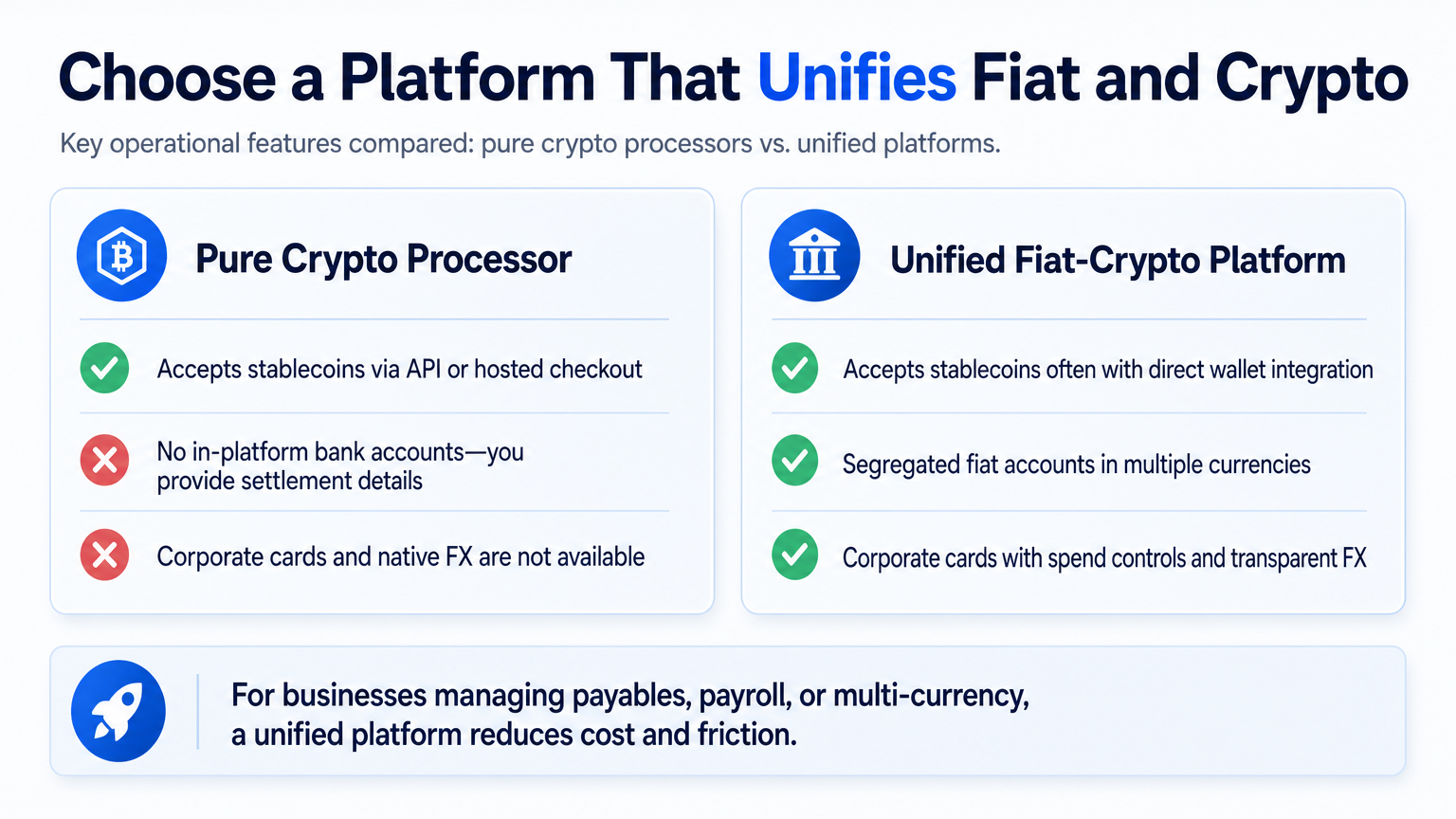
The choice hinges on your operational needs. Pure crypto processors excel at simple, high‑volume crypto payment processing but rarely offer multi‑currency accounts, cards, or AP/AR. Unified platforms merge those, giving a single interface for payments, treasury, and accounting.
| Criteria | Pure Crypto Processor | Unified Fiat‑Crypto Platform |
|---|---|---|
| Stablecoin acceptance | Yes, via API or hosted checkout | Yes, often with direct wallet integration |
| Auto‑conversion to fiat | Offered, usually on a batch schedule | Offered, often in real‑time |
| In‑platform bank accounts | No — you provide own settlement details | Yes — segregated fiat accounts in multiple currencies |
| Corprate cards | Not available | Available with spend controls and virtual cards |
| FX for non‑USD currencies | Typically not bunded | Nativ competitive FX with transparent pricing |
| Compliance packaging | Transaction records; limited KYB support | Full KYB/KYT, audit‑ready statements |
| Best for | Merchants who only need a simple stablecoin checkout | Businesses and DAOs managing fiat and crypto treasury side‑by‑side |
If your business runs payables, payroll, or multi‑currency operations, a unified platform avoids the cost and friction of stitching services together. See how Loyds‑Visa pilot is shaping institutional‑grade stablecoin payments.
Which stableoins should my business support?
Start with USDC — it’s the core of the Coinbase‑Citi partnership, the most liquid regulated dollar stablecoin, and with the deepest banking intergrations. USDT can capture retail volume but carries a different regulatory profile. For euro‑denimated business, consider a MiCA‑compliant stablecoin like EURe or USDAU. Avoid algorithic or under‑collateralized stablecoins; most bank‑intergrated platforms will filter them out.
Key Takeaways
- The Coinbase‑Citi stablecoin bank integration, announced September 30, 2026, embeds regulated stablecoin acceptance directly into Citi’s banking infastructure, eliminating seperate crypto exchanges.
- Businesses can now recive USDC payments that settle as fiat inside a bank account, reducing settlement time and compliance burden.
- For many companies, a unified fiat‑crpto platform remains the most operationally efficient path — mimic that integration without requiring a Citi banking relationship.
- When evaluating crypto payment processing providers, priorize native bank‑grade conversion, transparent FX, and built‑in compliance reporting.
- USDC is the sensible default; add other stableoins only if customer demand and stablecoin regulation clarity justify the complexity.
For a single platform that combines multi‑currency fiat accounts, stablecoin payments, and corporate cards in one place, open an account with OneSafe today.