On October 13, 2026, web3 payments took a sharp, pragmatic turn. The Russian settlement system A7, created by Bank PSB, is set to unveil A7 International—a service that lets businesses pay foreign invoices in USDT, with funds arriving as standard SWIFT transfers in the required fiat currency (HackerNoon/Chainwire, October 12, 2026). This marries a state-backed stablecoin onramp with legacy banking, turning cross-border crypto into a crypto settlement rail for trade. It’s not a hypothetical proof-of-concept; it’s an operational bridge.
Table of Contents
- What Just Happened: A7’s USDT-SWIFT Service Goes Live
- Why This Matters for Web3 Payments Right Now
- Web3 Payments 101: What Newcomers Need to Know
- What This Means for Your Business—Implications and Actions
- What to Watch Next: Open Questions and Risks
- Key Takeaways
What Just Happened: A7’s USDT-SWIFT Service Goes Live
The announcement from Bank PSB’s A7 system
According to the Chainwire press release distributed on October 12, 2026, the A7 International service will allow a business operating through Bank PSB’s A7 platform to settle a foreign counterparty’s invoice by sending USDT. The recipient receives the funds via a standard SWIFT wire transfer in the currency specified on the invoice—dollars, euros, yuan, or otherwise. The fee will remain fixed, though the exact amount wasn’t specified in the pre-launch disclosure. The service is primarily designed for foreign trade operators, with individuals also eligible.
How the service works: USDT in, SWIFT out
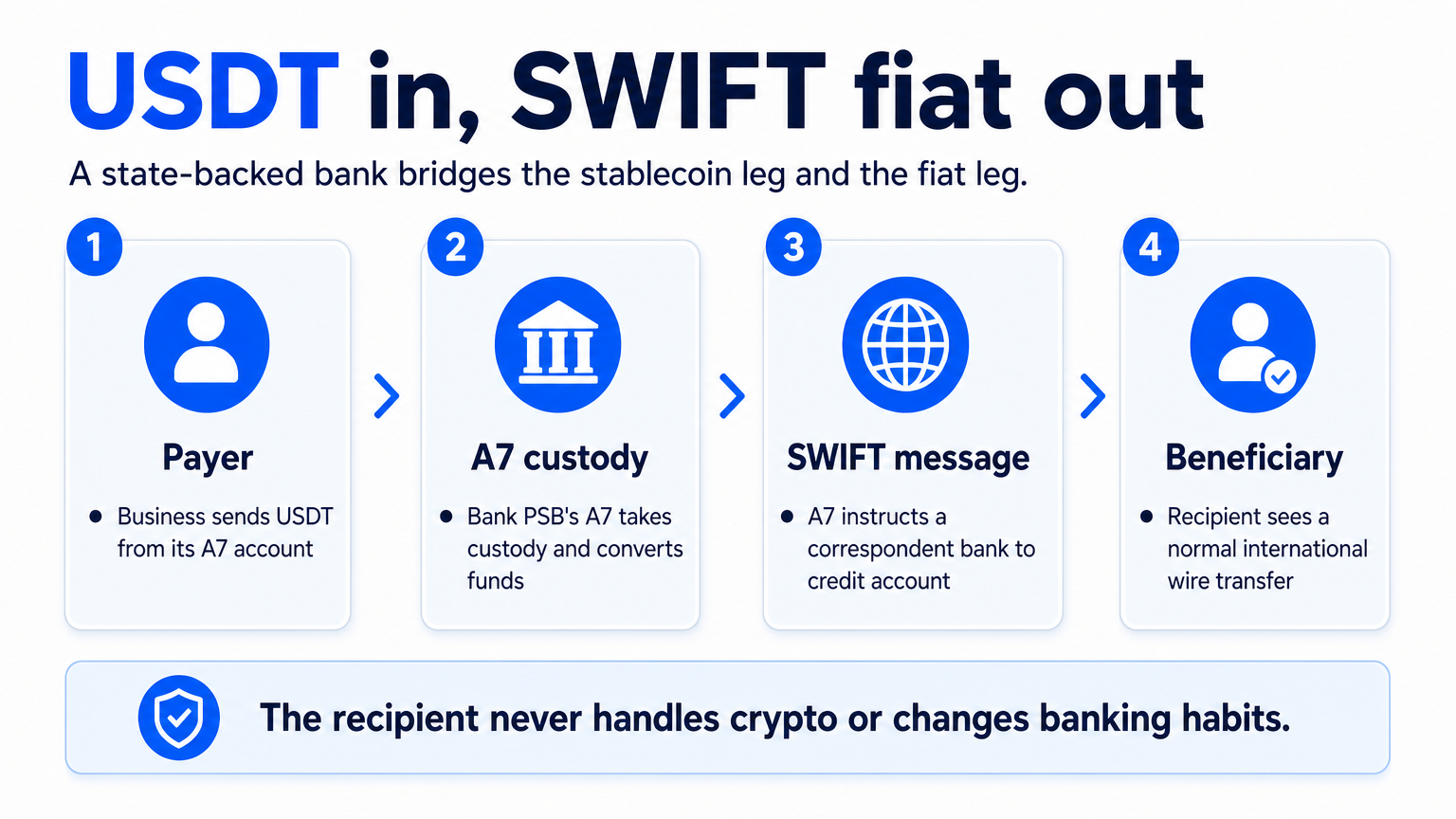
A payer initiates a payment in USDT. A7, operated by Bank PSB, takes custody of that USDT, performs any necessary conversion, and then issues a SWIFT message to credit the beneficiary’s bank account in the required fiat currency. The beneficiary sees only a normal international bank transfer; they never touch crypto. The payer avoids the headache of finding a crypto-friendly counterparty bank while still using USDT for the initial leg. This is not direct blockchain settlement; it’s a USDT-to-SWIFT gateway with a state bank acting as the trusted middleman.
Why This Matters for Web3 Payments Right Now
A concrete bridge between crypto and legacy finance
For years, the gap between stablecoins and traditional banking has been bridged by exchanges, OTC desks, and fintechs offering crypto-to-fiat conversion. A7 deepens that integration by putting a bank’s balance sheet and SWIFT membership directly behind USDT payments. It treats crypto settlement as a legitimate input for international payments, not a speculative afterthought. For businesses, it signals that even legacy financial institutions see stablecoins as settlement tools. It also normalizes the idea that web3 payments don’t require both endpoints to be on-chain; a hybrid corridor can be just as effective for trade.
Speed, cost, and the new geography of cross-border transfers
International wires through SWIFT can take days and carry high intermediary bank fees. USDT transfers settle in minutes on blockchains like Tron or Ethereum, often for a few dollars. By front-loading the crypto leg, A7 compresses time and cost while preserving the universal reach of SWIFT. For Russian foreign trade operators facing limited correspondent banking relationships, this creates a new cross-border crypto corridor. The broader lesson is that hybrid architectures can shatter the old trade-offs between speed, cost, and accessibility.
Web3 Payments 101: What Newcomers Need to Know
From blockchains to stablecoins: the basic stack
Web3 payments refer to the movement of value using blockchain networks, typically without a traditional bank as an intermediary. The core stack includes a blockchain, a wallet, and a token—often a stablecoin pegged to fiat. Stablecoins such as USDT and USDC provide price stability. Unlike bank wires, transactions are peer-to-peer, settle globally within seconds or minutes, and can cost a fraction of a cent depending on the network. Infrastructure includes payment gateways like tools listed on QuickNode and guides on enabling web3 payments via thirdweb.
Why ‘pure’ decentralization isn’t the only path
The crypto movement’s ideological roots are in removing centralized intermediaries. Yet A7 demonstrates a hybrid reality that already exists: a state bank issues a SWIFT transfer on the back of a USDT payment. Some web3 advocates argue this corrupts permissionless finance. But international trade still depends on trust, compliance, and correspondent banking networks. Today’s landscape includes both fully decentralized protocols and centralized bridges. OneSafe neo-banking already occupies this middle ground, combining crypto-to-fiat conversion with SWIFT integration under one roof.
What This Means for Your Business—Implications and Actions

For global startups and DAOs: rethinking your payment stack
If you run a startup paying suppliers in multiple countries or a DAO managing contributor payrolls, the A7 development makes one thing clear: hybrid payments are commercially live. Locking yourself into purely crypto-native rails can limit counterparties; sticking only to fiat banking means missing the speed and cost advantages of stablecoins. The smart move is to choose the best rail per transaction—USDT for the initial leg, SWIFT or domestic wires for the final mile—depending on the counterparty’s banking situation.
How OneSafe neo-banking fits into the picture
This is where OneSafe neo-banking becomes essential. Businesses can hold multi-currency fiat accounts alongside crypto wallets, convert between them, and send international wires. For a DAO paying a marketing agency abroad, the workflow can look similar to A7: fund the payment in USDC, convert, and send a SWIFT wire in dollars. The difference is that OneSafe operates under its own compliance framework, with KYB and MFA security and built-in OFAC sanctions screening—without being tethered to a single state’s political system. OneSafe’s published fees ($25 wire withdrawal, 0.35% + $50 SWIFT, free USDC deposits) give a concrete benchmark for hybrid crypto settlement costs.
| Feature | A7 International (as described) | OneSafe neo-banking |
|---|---|---|
| Core mechanism | USDT in, SWIFT wire out via Bank PSB | Multi-currency fiat accounts + crypto wallets; SWIFT, ACH, wires |
| Target users | Foreign trade operators, individuals eligible | Global businesses, startups, DAOs |
| Crypto support | USDT (presumed) | USDC, USDT, 8+ tokens for card top-ups |
| Fiat currencies | Unspecified, mentioned dollars/euros/yuan | USD, EUR, CAD (more coming) |
| Compliance backbone | Russian state bank, potentially sanctions-exposed | OFAC sanctions screening, KYB required, MFA mandatory |
Details for A7 based solely on the October 12, 2026 Chainwire press release; OneSafe details from published pricing and compliance documentation.
What to Watch Next: Open Questions and Risks
Sanctions, compliance, and the USDT-SWIFT dilemma
The most immediate concern is sanctions exposure. Russia faces extensive restrictions, and a service that funnels USDT through a state-backed bank into SWIFT could attract scrutiny. The press release does not specify which correspondent banks will process the SWIFT leg, but any global bank handling those wires must perform sanctions screening. Compliance friction could be severe, and receiving businesses may find accounts frozen if the origin is flagged. This underscores the need for risk-aware compliance in any international crypto settlement corridor. OneSafe’s built-in OFAC screening and prohibition on sanctioned jurisdictions is a baseline many businesses will now demand. The recent FSB stablecoin regulation warning highlights that regulators already recognize systemic risks in hybrid arrangements.
Will other states or banks follow A7’s lead?
The A7 launch may signal a wave of state-backed stablecoin transfers integrated with legacy banking. A second recent development reinforces this shift: in October 2026, OneSafe’s compliance briefing noted the FASB’s proposal to treat stablecoins as cash equivalents (OneSafe, October 2026). If the A7 model proves stable, banks in jurisdictions seeking to bypass dollar dominance or offer faster settlement could introduce similar USDT-to-SWIFT bridges. That may accelerate tighter KYC rules for stablecoin issuers or mandatory travel rule compliance. The unanswered question is whether the model spreads through official or parallel banking channels—and whether web3 payments becomes an extension of traditional finance or an alternative to it.
Key Takeaways
- The A7 USDT-SWIFT service, unveiled on October 13, 2026, proves that hybrid web3 payments—stablecoin in, fiat wire out—are operational tools for international trade.
- Businesses should re-evaluate payment stacks to include both crypto and fiat rails; purely on-chain or purely fiat strategies are limiting.
- Compliance and sanctions risks are acute with state-backed hybrid corridors; choose platforms with transparent KYB/AML frameworks.
- OneSafe neo-banking already offers a similarly powerful hybrid experience without geopolitical and regulatory baggage.
- Watch for regulatory responses and copycat services, which could accelerate crypto settlement normalization.
Start bridging your fiat and crypto payment flows today—open a OneSafe account built for global businesses and DAOs.