Table of Contents
- title: "Stablecoin Payments Surge in B2B Payroll & Vendors" description: "Stablecoin B2B payments hit $230–340B in 2026. Payroll and vendor settlements shift to USDC, cutting costs 95% via neo-banking like OneSafe."
- What the Data Shows
- Why It Matters for Finance Leaders
- Stablecoin Payments 101
- The Payroll Use Case
- Cost Comparison: Traditional Wire vs. Stablecoin Payroll
- What’s Next
- OneSafe’s Edge for Stablecoin‑Native Businesses
- Sources
title: "Stablecoin Payments Surge in B2B Payroll & Vendors" description: "Stablecoin B2B payments hit $230–340B in 2026. Payroll and vendor settlements shift to USDC, cutting costs 95% via neo-banking like OneSafe."
Stablecoin Payments Surge in B2B Payroll & Vendors
Stablecoin payments have shifted from a consumer checkout experiment to the operational backbone of business treasury. According to an Alvarez & Marsal analysis published via bloomingbit on October 6, 2026 (first reported by the Korea Economic Daily on October 5), more than $230 billion to $340 billion in stablecoin flows went to businesses in the first eight months of 2026. The leading use cases are service fees, payroll, and compensation—not speculative trading. That volume represents over half of all stablecoin payment volume, making stablecoin cross-border payments a mainstream B2B rail.
What the Data Shows
The analysis reveals that B2B stablecoin payments—driven by payroll and service-fee settlements—have reached a scale that ranking pages written just months ago could not have quantified. Payroll and compensation are the fastest-growing segment, proving that stablecoin payroll is moving from proof-of-concept to production. U.S. firms pay salaries in Tether (USDT); global startups regularly settle contractor invoices in USD Coin (USDC).
Why It Matters for Finance Leaders
Finance teams face a triple squeeze: distributed workforces across dozens of jurisdictions, margin pressure that demands every basis point be clawed back, and the need for real‑time liquidity without tying up working capital in correspondent bank floats. A traditional international wire costs 2–5% in visible and hidden fees and settles in 3–5 business days. By contrast, stablecoin cross-border payments settle in minutes, 24/7, for pennies.
Companies aren’t “buying crypto” to speculate; they’re using stablecoins as a settlement rail. Corporate stablecoin adoption no longer requires a hero CFO—it’s a pragmatic decision to cut costs and speed up cash flow.
Stablecoin Payments 101
A stablecoin payment starts when a business holds USDC in an on‑chain wallet and sends it to a recipient’s address. The recipient can then off‑ramp to local currency through a neo‑banking platform that offers built‑in conversion. Settlement is final on‑chain in minutes.
Stablecoin FX conversion is where the real savings kick in. While correspondent banking chains eat into principal with intermediary fees and 3%‑plus FX spreads, a stablecoin transaction costs a fraction of a cent (especially on Layer‑2 networks) and the FX conversion can be as low as 0.15% on platforms like OneSafe. That’s a 20× reduction in direct costs, plus the working‑capital benefit of instant settlement.
Regulatory clarity is also arriving: the U.S. GENIUS Act would set federal standards for stablecoin issuers, while the EU’s MiCA and Asian sandboxes formalize rules. This oversight gives treasurers the confidence to treat stablecoin payments as audit‑ready infrastructure.
The Payroll Use Case

Setup
Open a unified fiat‑crypto business account that can hold both USD and USDC in the same interface. Neo‑banking for stablecoins platforms like OneSafe provide multi‑currency accounts (USD, EUR, CAD) alongside free USDC wallets. Account opening is digital and typically completed within a week.
Onboarding & Last‑mile
You don’t need every employee to use crypto. Most stablecoin payroll platforms support a model where the employer sends USDC and the recipient designates a local bank account to receive fiat—the platform handles the conversion. Services like Riseworks and Toku integrate directly with existing payroll systems. The employer stays compliant by collecting standard W‑8/W‑9 or local tax forms.
Automation
On payday, the platform triggers a batch transfer of USDC to smart‑contract wallets representing each employee. The smart contract can atomically swap USDC to local fiat and initiate a bank payout, or simply hold the USDC for the employee to off‑ramp at their leisure. This eliminates manual batch‑file uploads.
Tax & Reporting
Authorities treat stablecoin payments as compensation at fair market value. The IRS requires employers to report the USD equivalent on W‑2s or 1099s; employees owe income and employment taxes as usual. Modern platforms provide transaction timestamps and USD‑peg values that make reporting straightforward—existing tax frameworks suffice.
Cost Comparison: Traditional Wire vs. Stablecoin Payroll
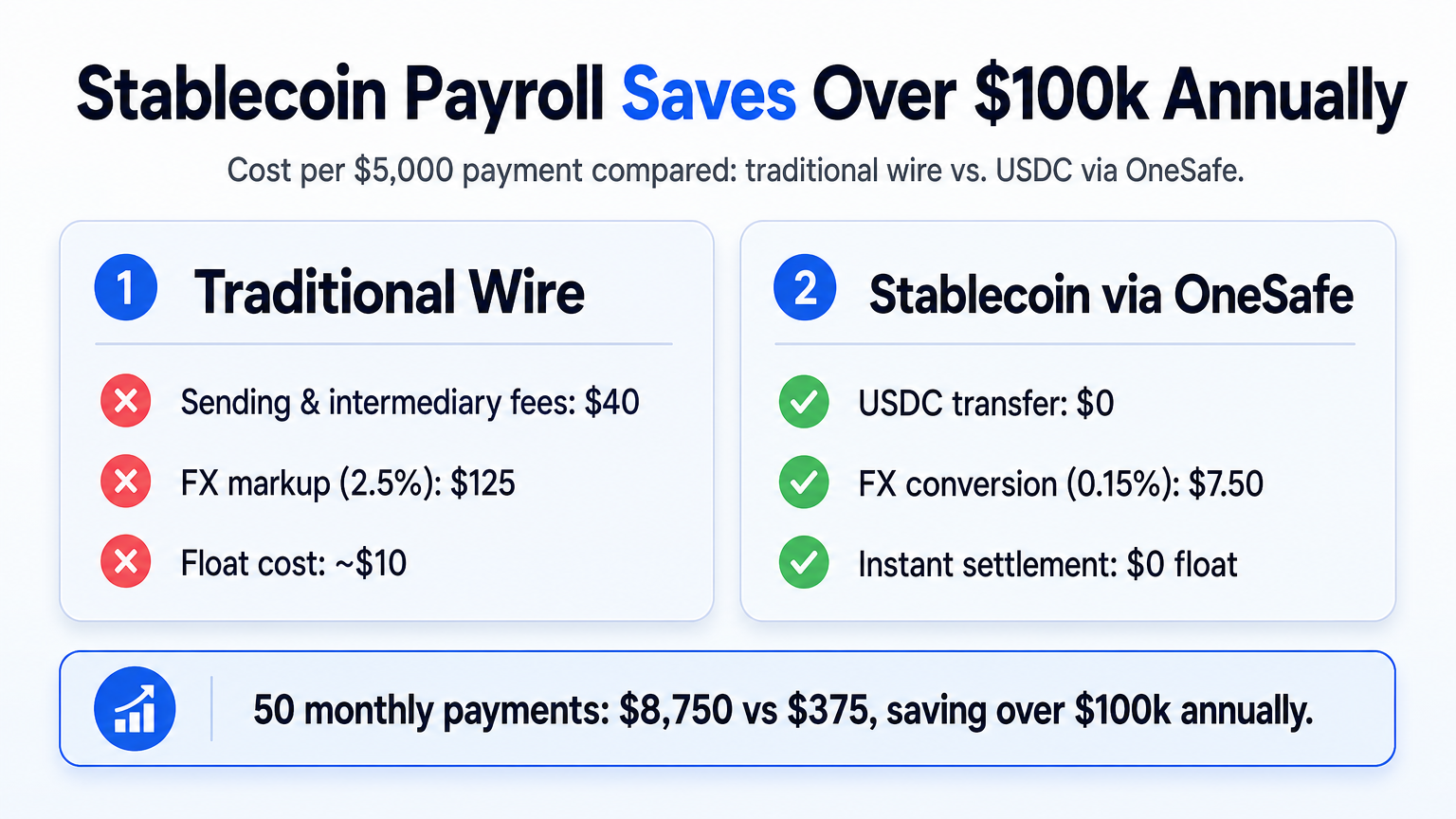
A company with 50 international contractors paying $5,000 each monthly can cut costs dramatically.
| Cost Item | Traditional Wire (per payment) | Stablecoin via OneSafe (per payment) |
|---|---|---|
| Wire sending fee | $25 | $0 (USDC free) |
| Intermediary bank fee | $15 | $0 |
| FX conversion markup (2.5% vs. 0.15%) | $125 | $7.50 |
| Float cost (3–5 days opportunity) | ~$10 (estimated) | $0 (instant settlement) |
| Total per $5,000 payment | ~$175 | $7.50 |
| Monthly total (50 payments) | $8,750 | $375 |
A growing business with $250,000 in monthly international payroll saves over $100,000 annually.
What’s Next
- Regulation: The GENIUS Act would clarify stablecoin classification. Once enacted, it will unlock further corporate adoption.
- Banks entering: U.S. Bank and Marqeta are already piloting stablecoin‑settled payroll (as reported in the Stablecoin Payments Now round‑up in October 2026). If traditional banks embed stablecoin payroll into corporate cash management, adoption could leap. However, their slower innovation cycles give nimble neo‑banking platforms a lasting advantage.
- Interoperability: USDC exists on over 15 blockchains. Multi‑chain support lets businesses choose the rail that best fits their recipients. Chain‑agnostic liquidity, where a business holds USDC on one chain and the recipient receives value on another automatically, is the next wave.
OneSafe’s Edge for Stablecoin‑Native Businesses
OneSafe stablecoin accounts unify fiat and crypto in a single interface. Hold USD, EUR, CAD, and USDC, pay invoices in fiat or stablecoins, and automate payroll—all without pre‑funding multiple accounts.
- Security: Digital assets are secured through Fireblocks, institutional‑grade custody, with mandatory multi‑factor authentication.
- Global reach & compliance: Available worldwide (except OFAC‑sanctioned countries and certain U.S. states) with digital KYB onboarding completed in days.
- Cost: Free USDC transactions, 0.15% FX conversions, and transparent international wire pricing.
Explore how a unified fiat‑crypto account can streamline your international payroll and vendor settlements at OneSafe’s business platform.
Sources