CoinShares and Safe now let DAOs earn stablecoin yield without giving up custody. Here’s how to assess, allocate, govern, and report on it.
On October 12, 2026, CoinShares announced an integration with Safe Labs and Railnet to offer stablecoin yield strategies through Safe’s Earn widget, keeping users’ positions in self-custody and allowing withdrawals at any time (Crypto News, Oct 12, 2026). For DAOs and startups, this rewrites crypto treasury management: instead of moving funds to a centralized exchange or DeFi protocol and giving up control, treasury managers can deploy idle stablecoins while assets stay in their own multisig.
Table of Contents
- What Just Happened: The CoinShares-Safe Integration
- Why This Matters for Crypto Treasury Management Right Now
- The Background: Yield, Self-Custody, and Treasury Operations
- Concrete Implications: What Finance Leads Should Do Now
- What to Watch Next: Open Questions and Indicators
- What is crypto treasury management?
- How does a self-custody stablecoin yield integration change the treasury landscape?
- What are the risks of connecting a treasury to a yield-generating smart contract?
- How can finance leaders build controls around this new yield option?
- How does yield generation affect a DAO’s treasury reporting and accounting?
- What should my DAO do today to evaluate such opportunities?
- Key Takeaways
What Just Happened: The CoinShares-Safe Integration
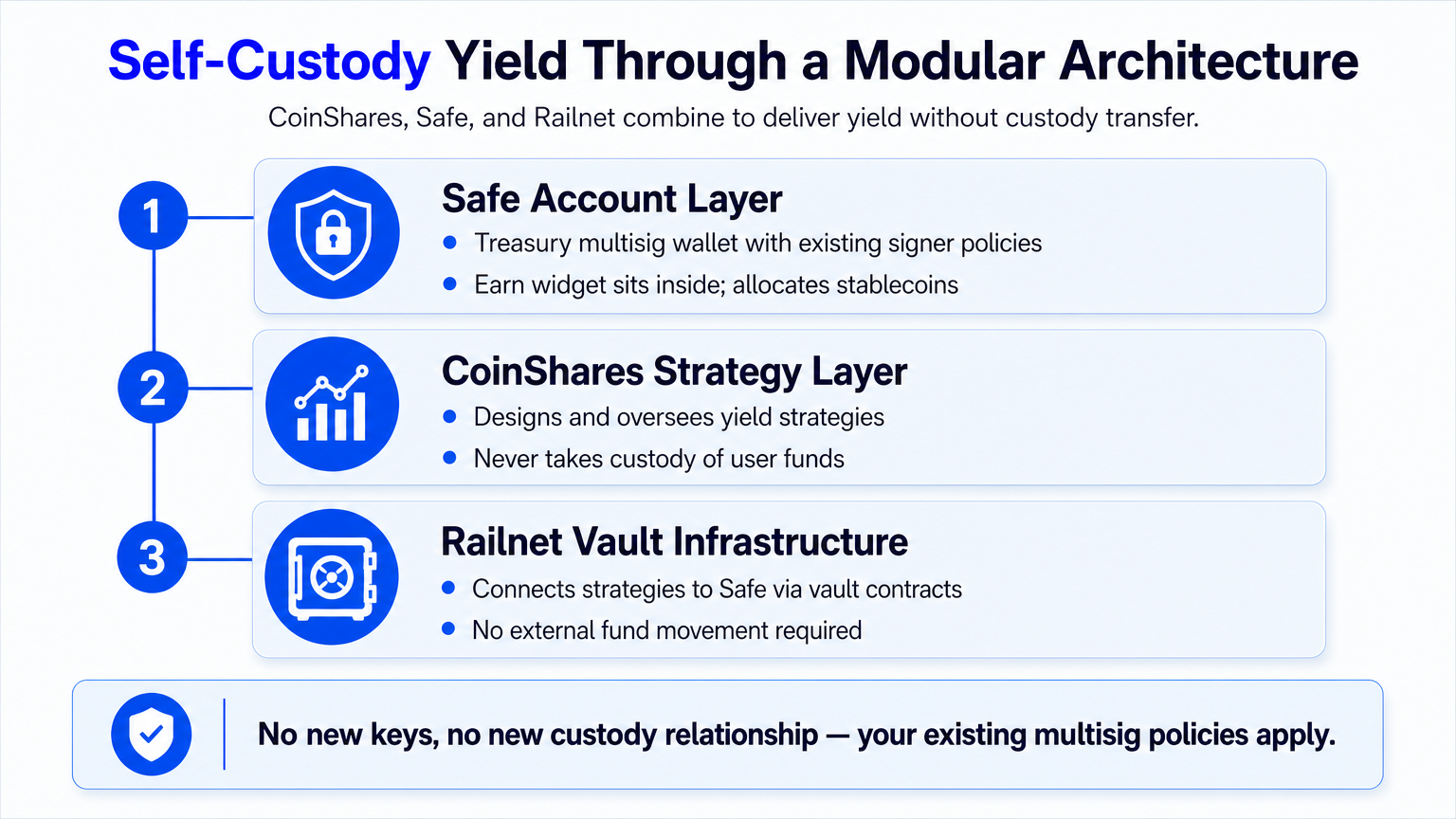
On October 12, 2026, CoinShares outlined an integration with Safe Labs and Railnet that brings stablecoin yield strategies to Safe wallet users. CoinShares designs and oversees the yield strategies and risk selection but never takes custody of user funds. Safe users access the strategies through the Earn widget, deposit and withdraw at any time, and retain full self-custody throughout. Railnet supplies the vault infrastructure connecting CoinShares’ strategies to the Safe interface. US persons are excluded, and yields vary based on market conditions and strategy performance (Crypto News, Oct 12, 2026).
CoinShares Capital Markets (Jersey) Limited acts as strategy designer and risk manager, but the company explicitly stated it neither takes custody nor gains discretionary control over user funds (Crypto News, Oct 12, 2026).
The architecture has three layers. Safe Labs provides the account interface where treasury teams already manage multisig wallets and approvals. The Earn widget sits inside that interface, letting authorized signers allocate a portion of a Safe’s stablecoin balance to a CoinShares-designed strategy. Railnet’s vault infrastructure connects the strategy’s smart contracts to the Safe wallet without requiring users to move funds externally. For a DAO treasury, the existing signer set and threshold policies apply: no new keys, no new custody relationship.
The model promises yield on idle stablecoins, retention of self-custody, and no lockup periods—users can request withdrawals at any time. What it excludes: availability to US persons, guaranteed returns, and any deposit insurance or principal protection. CoinShares selects strategies and manages risk, but smart-contract, counterparty, and market risks sit with the user. This is not a savings account—it’s a structured product delivered through self-custody infrastructure.
Why This Matters for Crypto Treasury Management Right Now
DAOs and crypto startups routinely hold large stablecoin balances—operating reserves, runway for payroll, grants, and liquidity. In traditional treasury management, that cash would earn interest. In crypto treasury management, it has mostly sat idle in multisigs, earning nothing. CeFi and DeFi options required surrendering custody or accepting opaque smart-contract risk. The CoinShares integration changes that: a regulated asset manager designs yield strategies that can be accessed without transferring custody. With short-term fiat yields low, a variable but non-zero yield on stablecoin balances becomes a legitimate treasury allocation question.
Every DAO treasury manager faces the same tension: the yield you don’t earn is a cost, but the complexity you add is a risk. The Safe Earn widget promises yield inside the wallet the team already uses, collapsing that tension. Operational overhead is minimal—allocate, monitor, withdraw—and governance overhead is zero because the same multisig rules apply.
The move signals a broader shift: treasury-as-a-service with self-custody. Safe provides the account layer, Railnet the connectivity layer, CoinShares the strategy layer. The DAO keeps the asset layer. That modular architecture could extend to other asset managers, strategies, and wallet providers, and it directly challenges the assumption that yield requires custody.
The Background: Yield, Self-Custody, and Treasury Operations
Crypto treasury management began as a custody problem. Early DAOs used single-signature wallets or hardware devices—secure but operationally brittle. The rise of Safe multisigs brought shared governance. Then DeFi yield tempted treasuries, but each allocation meant moving funds out of the core wallet, fracturing security and complicating accounting. A 2021 Citi report on cryptocurrencies for treasuries flagged this tension early: “the decision to hold digital assets will require treasury to rethink cash management, forecasting, custody, and risk.” Six years later, that rethinking is still underway.
A typical DAO treasury in 2026 looks like this: a primary Safe multisig holding the bulk of stablecoin and token reserves, one or more operating wallets for recurring payments, and a fiat account—often via OneSafe—for payroll, vendors, and tax obligations. Funds move between these layers as needed. Most assets sit in the Safe, earning nothing. A DAO with $5 million in USDC idle for six months forgoes tens of thousands of dollars in potential yield.
Platforms like OneSafe provide the fiat accounts, corporate cards, and crypto-to-fiat conversion that connect on-chain treasuries to traditional rails. Their role becomes more important, not less, when yield is realized and funds need to be converted and spent. For a closer look at fiat-crypto treasury operations, see OneSafe’s analysis of hybrid payment systems.
Before this integration, self-custody yield meant direct DeFi interaction: approving smart contracts, managing multiple token standards, monitoring position health, understanding liquidation risk. For non-technical treasury signers, that burden is unacceptable. BPI analysis of DeFi stablecoin yields has pointed out that actual DeFi yields often diverge sharply from advertised rates once gas, slippage, and protocol risk are priced in. The CoinShares-Safe model abstracts that complexity behind a strategy designer while leaving custody with the treasury.
Concrete Implications: What Finance Leads Should Do Now
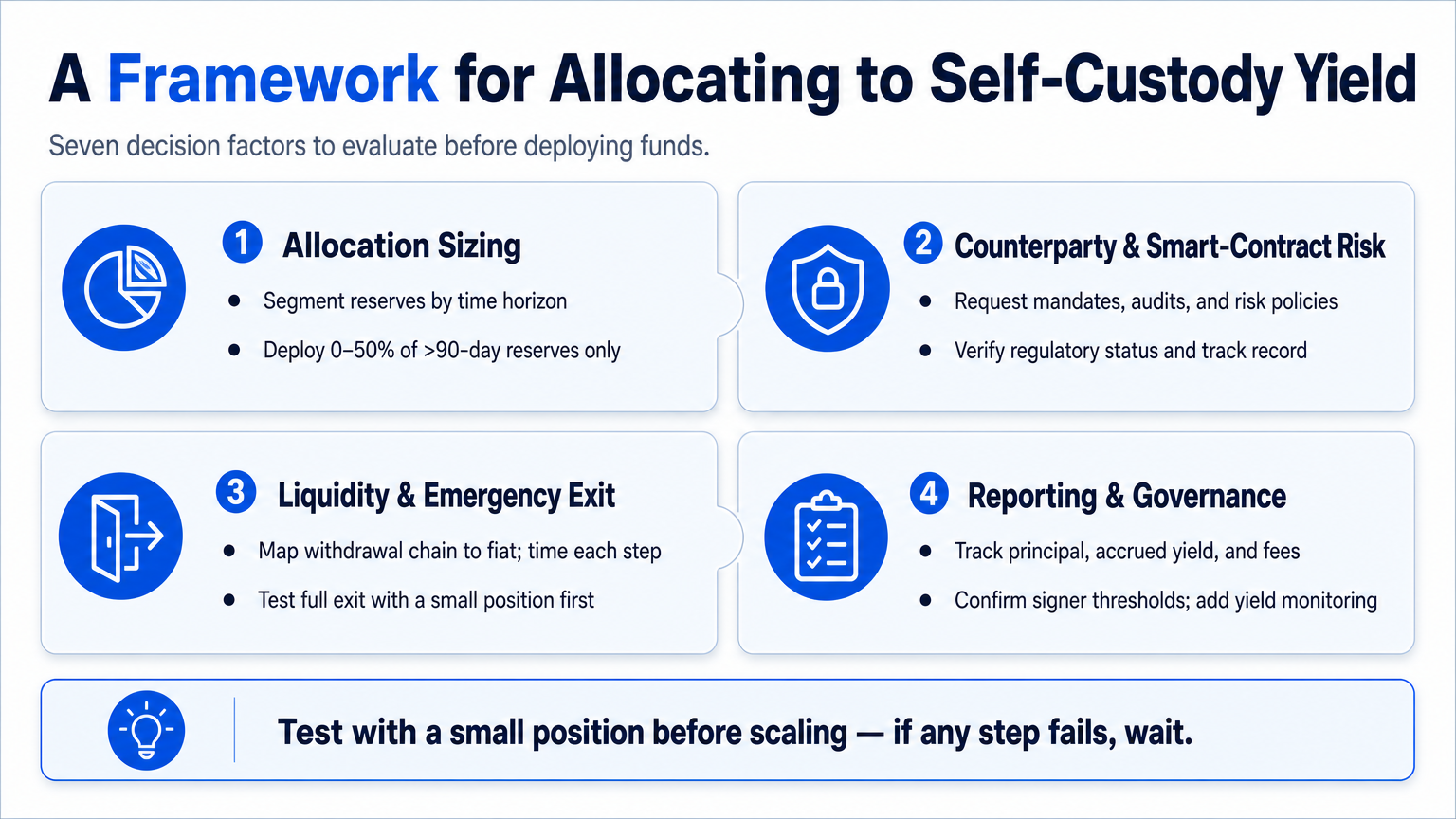
Assess your allocation. Segment stablecoin balances by time horizon: operating cash needed within 30 days, reserves for 30–90 days, and runway beyond 90 days. Deploy no more than 25–50% of stablecoin reserves with a >90-day horizon, and never more than the treasury could tolerate being temporarily illiquid even with no formal lockup.
Vet counterparty and smart-contract risk. This is not a principal-protected product. CoinShares is the strategy designer, not a guarantor. Railnet’s vault contracts are a smart-contract risk surface, and underlying strategies carry their own risks. Request the strategy mandate document, Railnet audit reports, CoinShares’ risk management policy, and any legal opinions on the custody structure. For context, see the stablecoin yield regulatory landscape.
Map yield positions to fiat flows. Yield accrues on-chain; payroll and vendors are paid in fiat. Map the full withdrawal chain—Earn widget to Safe, off-ramp to OneSafe or equivalent, conversion, payment—and time each step. Build buffers into allocation policy. For teams using crypto payroll, the interaction between yield positions and payroll timing is critical.
Define a withdrawal policy and emergency exit. Document who can withdraw, trigger conditions, and how quickly the position can be exited. Test the exit path with a small position first, and verify that funds return to the Safe within the expected timeframe.
Update treasury reporting and accounting. Yield turns static stablecoin balances into income-generating assets. Track principal deployed, accrued yield, realized yield, fees, and fair value at reporting dates. If your DAO follows FASB stablecoin accounting guidance, yield may need to be recognized as it accrues. Consult your auditor before deploying funds.
| Decision Factor | What to Evaluate | Action |
|---|---|---|
| Allocation sizing | Stablecoin reserves by time horizon | Deploy 0–50% of >90-day reserves only |
| Counterparty risk | CoinShares strategy mandate and track record | Request documentation; verify regulatory status |
| Smart-contract risk | Railnet vault audits and bug bounty program | Review audit reports; verify auditor credentials |
| Operational liquidity | Withdrawal timeline to fiat payment | Map and time the full chain; build buffers |
| Emergency exit | Full withdrawal test with small position | Execute a test withdrawal before scaling |
| Accounting treatment | Income recognition, fair value reporting | Consult auditor; establish reporting templates |
| Governance | Existing multisig policies apply? | Confirm signer thresholds; add yield monitoring |
What to Watch Next: Open Questions and Indicators
Safe is the dominant multisig wallet for DAOs, but other wallet providers—Argent, Fireblocks, institutional MPC solutions—may face pressure to offer similar in-wallet yield access. Asset managers beyond CoinShares may seek to plug into Earn-style interfaces. The key indicator is competing announcements within the next six months.
Regulatory reaction is likely the biggest constraint. The US-person exclusion shows CoinShares assessed the product as legally risky in the US. EU MiCA and statements from the FCA, ESMA, or SEC will determine whether this model scales or remains niche.
Adoption is observable on-chain: public DAO allocations to the Earn widget, growth in Railnet vault total value locked, and tooling integrations. The strongest signal will be a well-known DAO treasury dashboard showing a material allocation to a CoinShares strategy through Safe.
Operational platforms like OneSafe may evolve to display yield positions, accrued returns, and projected cash flows alongside fiat and wallet balances. Whether platforms build that integration layer—or whether DAOs continue stitching together multiple dashboards—will determine how operationally sustainable these strategies become.
What is crypto treasury management?
Crypto treasury management is the set of practices, tools, and policies used to custody, allocate, monitor, and report on digital asset holdings—typically stablecoins, protocol tokens, and cryptocurrency positions—alongside fiat treasury operations. It includes multisig governance, on-chain transaction policies, fiat on/off-ramps, risk assessment, and increasingly yield optimization.
How does a self-custody stablecoin yield integration change the treasury landscape?
It eliminates the custody trade-off that used to define the yield decision. Before October 2026, earning stablecoin yield usually meant moving funds to a third party and accepting their custody or smart-contract risk. The CoinShares-Safe model lets treasuries earn yield while assets stay in their existing multisig under existing signer policies, changing the risk question from “custody vs. yield” to “smart-contract risk vs. yield.”
What are the risks of connecting a treasury to a yield-generating smart contract?
Primary risks are smart-contract vulnerability, strategy underperformance, and operational failure. Railnet vault contracts or underlying strategy contracts could have bugs; yields are variable and not guaranteed; withdrawals can be delayed by network congestion. Regulatory risk also exists if yield-bearing crypto products are reclassified. None of these involve CoinShares taking custody, but all require active monitoring.
How can finance leaders build controls around this new yield option?
Require the same multisig approval threshold as any material treasury movement. Designate a treasury manager or working group for weekly reviews of strategy performance, withdrawal queue depth, and security advisories affecting Railnet or underlying protocols. Cap allocation as a percentage of stablecoin reserves and require governance to explicitly renew the allocation quarterly or after any material change to the strategy design or risk profile.
How does yield generation affect a DAO’s treasury reporting and accounting?
Yield turns a static balance sheet into an income-generating one. Financial statements should track principal allocated to yield strategies, accrued but unrealized yield, realized yield, and fees. Under accrual accounting, yield is recognized as it accrues on-chain, not when converted to fiat or moved back to the main Safe. This requires regular on-chain snapshots, reconciliation between the Safe interface and the accounting ledger, and documented accounting treatment for audit purposes. The FASB’s evolving position on stablecoin accounting may influence whether yield-bearing positions qualify for cash-equivalent treatment or require fair-value measurement.
What should my DAO do today to evaluate such opportunities?
Start with a treasury audit: document stablecoin balances, time horizons, and current yield. Define the governance process and documentation required for a yield strategy allocation. Request the CoinShares strategy documentation and Railnet audit reports. Run a small test allocation—an amount you can afford to lose entirely—and monitor at least one full withdrawal cycle before scaling. Document how yield positions will appear in your treasury dashboard, how withdrawals will flow to fiat, and how accounting will handle accruals. If any step fails or produces unsatisfactory answers, wait.
Key Takeaways
- The CoinShares-Safe integration (October 12, 2026) enables DAOs to earn stablecoin yield from self-custody wallets with no custody transfer and no lockup periods.
- Finance leads should segment stablecoin reserves by time horizon and deploy only a limited portion of longer-term holdings after thoroughly vetting smart-contract and strategy risks.
- A withdrawal policy, emergency exit test, and updated treasury reporting framework must be in place before any allocation—yield without operational readiness is a liability.
- The exclusion of US persons and variable yield terms signal that regulatory and market risks remain material; treat this as an evolving opportunity, not a solved product.
- Platforms that bridge fiat and crypto operations—like OneSafe—become more critical when yield enters the picture, as realized returns must flow through payment and conversion rails.
For DAOs and startups ready to streamline the fiat side of their treasury operations—with multi-currency accounts, crypto on/off-ramps, and secure payment rails—explore how OneSafe connects your on-chain and off-chain finances.