On November 22, 2026, Crypto Briefing reported that Aptos was named the sole Move-based chain in PayPal’s PYUSD0 stablecoin rollout. For finance teams evaluating stablecoin payments, the development is less about one token and more about a structural shift: payment issuers are now designing for multiple chains at launch.
This article explains what happened, the basics newcomers need, and what the news does—and does not—change for your payment stack.
Table of Contents
- What happened?
- Stablecoin payments 101 for newcomers
- Why Aptos and PYUSD change the conversation
- What it means for your business
- What changes and what stays the same
- Open questions and what to watch next
- Key Takeaways
What happened?
On November 22, 2026, Crypto Briefing reported that Aptos was named the sole Move-based chain in PayPal’s PYUSD0 stablecoin rollout. PayPal did not, in that report, disclose issuance volume or a launch date for the token.
PYUSD0 arrives on a Move-based chain
What is PYUSD0 and why did PayPal launch it on Aptos?
PYUSD0 is the PayPal stablecoin at the center of the November 22 rollout. The source report is light on instrument detail, so treat PYUSD0 as a watch item, not a default replacement for USDC or USDT until PayPal publishes reserve composition and audit practice. The reported fact is limited to Aptos being the only Move-based chain named in the rollout; the strategic read is that PayPal wants the issuer-control and lower-cost properties Move offers. Aptos—a Layer 1 that uses the Move programming language originally designed for the Diem project—treats assets as first-class resources, which advocates argue reduces certain transfer and duplication bugs compared with account-based blockchains.
Why the launch matters for the payment landscape
PayPal is an incumbent payments company, not a crypto-native issuer. Its continued expansion of the PayPal stablecoin onto another chain sends a signal that multi-chain stablecoin distribution is now table stakes for enterprise issuers. For merchants, that matters because chain-specific fees, wallet support, and settlement latency will now differ even within the same issuer’s stablecoin line. It is one more reason to choose payment infrastructure that does not hard-code a single chain.
Stablecoin payments 101 for newcomers
How do stablecoin payments work for businesses?
A business holds a stablecoin in a wallet or account, sends it to a counterparty’s wallet address, and the transfer settles on-chain in seconds to minutes. The recipient can hold the stablecoin or convert it to local fiat through an on/off-ramp provider. Unlike a wire, the transfer itself does not depend on correspondent banks; it depends on blockchain validators, network fees, and the liquidity available at the conversion point. Circle describes stablecoin payments as the next phase of digital commerce because the settlement leg is internet-native.
What makes a stablecoin stable?
Stablecoins maintain a 1:1 peg because the issuer holds liquid reserves—usually short-term US Treasury bills, Treasury repos, or cash equivalents—and stands ready to redeem tokens at par. That is not a guarantee; it is a redemption design. Mastercard’s stablecoin primer frames stablecoins as digital assets designed to reduce volatility relative to other cryptocurrencies. Algorithmic and under-collateralized designs exist, but commercial stablecoin payments mostly use fiat-collateralized tokens for treasury, payroll, and settlement because their reserve backing is easier for auditors to verify.
How businesses are already using stablecoins for cross-border payments
Can stablecoins be used for B2B payments?
Yes, and the use case is already mature in specific corridors. Businesses use stablecoins to settle invoices with overseas vendors, pay contractors, and move treasury between subsidiaries without waiting for SWIFT. Crypto payments for business no longer require the seller to hold volatile assets end to end. A supplier in one country can receive USDC in minutes and off-ramp to local currency; the accounting entries still need to capture the fiat value at settlement. Visa’s earlier move toward stablecoin settlement showed acceptance rails growing beyond crypto-native merchants.
The regulatory picture at a high level
Are stablecoin payments regulated?
The short answer is yes, but unevenly. Payment stablecoin issuers in major jurisdictions face reserve, redemption, and licensing expectations; the exact federal framework in the US remains unsettled as of this writing. J.P. Morgan research notes that stablecoin adoption and stablecoin regulation are closely linked, with clarity affecting institutional participation. For a deeper look at the US state-versus-federal tension, see OneSafe’s earlier stablecoin regulation update.
Why Aptos and PYUSD change the conversation
From Ethereum to Solana to Aptos: the multi-chain stablecoin map
USDC and USDT remain concentrated on Ethereum and, increasingly, Solana and other low-cost networks. PayPal’s PYUSD already had a listed presence on Solana, according to Solana’s PYUSD page. Adding Aptos as the sole Move-based chain in PYUSD0 creates a third architecture in the usable map: EVM chains, Rust-based Solana, and Move-based Aptos. For a treasury team, that means multi-chain payments are no longer a crypto-native edge case. As blockchain implementation becomes treasury reality, the question shifts from “should we use stablecoins?” to “which chain do our counterparties and custodians actually support?”
What PayPal’s move signals about enterprise-grade confidence
PayPal has an existing compliance stack, banking relationships, and merchant distribution. It does not need a new chain for marketing. The November 22 announcement suggests that Aptos passed some threshold for institutional custody, validator diversity, or execution cost in PayPal’s assessment. This is a leading indicator, not a guarantee: enterprise confidence becomes reality only when payment processors and banks add native support.
How a new stablecoin affects fees, liquidity, and choice for merchants
Fees follow liquidity. If PYUSD0 on Aptos launches with thin order books, the reported network fee may be low but the actual cost of converting to USDC or fiat could exceed a low-fee Ethereum Layer 2 or Solana route. Merchants should measure all-in cost: network fee, conversion fee, and fiat withdrawal fee. The decision rule is deep liquidity beats novelty for most business payments. A similar dynamic appeared when Tether added new collateral structures: the token matters less than the conversion path back to working capital.
How does a multi-chain stablecoin affect payment operations?
A multi-chain stablecoin setup does not change the core payment flow—same token, different transport layer—but it changes operations. Teams need a wallet and custodian that can handle each chain’s address format and fee token, reconciliation must track which chain settled which invoice, and treasury needs a unified record. The more chains you use, the more important a single ledger becomes.
What it means for your business
A concrete example: paying a remote global team in stablecoins
Suppose a 40-person remote company pays 12 contractors monthly. It holds $220,000 in USD and €30,000 in Euro accounts. Payroll approves $90,000 in USDC for contractors; the finance team converts USD to USDC through an off-ramp-friendly platform, sends to contractor wallets on a chain they already use, and records each payment against the invoice in the same system. If a contractor needs local fiat, they convert on their end. The company’s ledger shows USD out, USDC settlement, and fiat reconciliation in one place.
That is the practical difference between a wallet-only tool and a financial operating system. A wallet can send tokens; a treasury platform also shows the fiat account, the conversion, the invoice, and the accounting export. Teams that have managed large USDC mints know that the on-chain transfer is the easy part; maintaining cash flow visibility across fiat and crypto balances is the hard part.
The trade-offs you should weigh (chain risk, acceptance breadth, conversion paths)
- Chain risk: a newer chain may have lower total value locked, a thinner validator set, and fewer custodians.
- Acceptance breadth: USDC and USDT remain more widely accepted than PYUSD0 for B2B invoices.
- Conversion paths: if PYUSD0 on Aptos forces a multi-hop route—PYUSD0 to USDC to fiat—the all-in cost rises.
- Operational cost: every additional chain adds reconciliation and security review overhead.
How to choose a stablecoin and chain without overcomplicating your stack
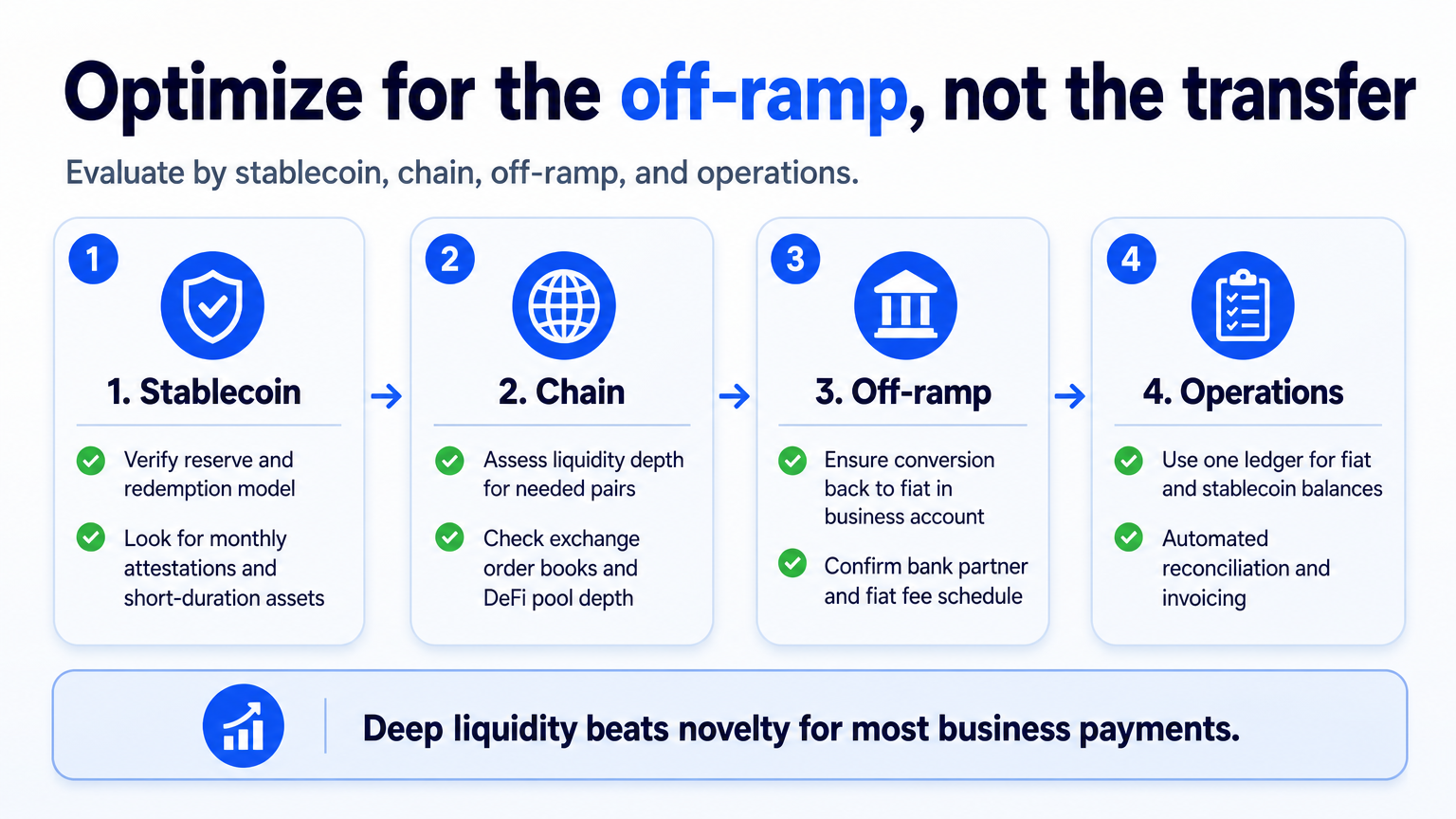
Start with the stablecoin for counterparty acceptance and reserve transparency; choose the chain for liquidity and integration; then keep one platform for fiat and crypto. Default to one or two chains rather than every supported network. The decision rule: optimize for the off-ramp, not the transfer.
| Evaluation step | Key question | Real-world signal |
|---|---|---|
| Stablecoin | Is the reserve and redemption model publicly verifiable? | Monthly attestations; short-duration assets |
| Chain | How deep is liquidity for the stablecoin pair you need? | Exchange order books; DeFi pool depth |
| Off-ramp | Can you convert back to USD, EUR, or CAD in your business account? | Bank partner and fiat fee schedule |
| Operations | Does one ledger show fiat and stablecoin balances together? | Automated reconciliation and invoicing |
What should businesses consider when choosing a stablecoin payment provider?
Look for custody separation, compliance tooling, fee transparency, fiat off-ramp and on-ramp, accounting exports, and whether the provider is a bank or a technology company partnering with banks. A non-bank platform can still offer multi-currency accounts and crypto custody, but deposit insurance and custody semantics differ from a licensed bank, so read the terms before moving large working capital.
What changes and what stays the same
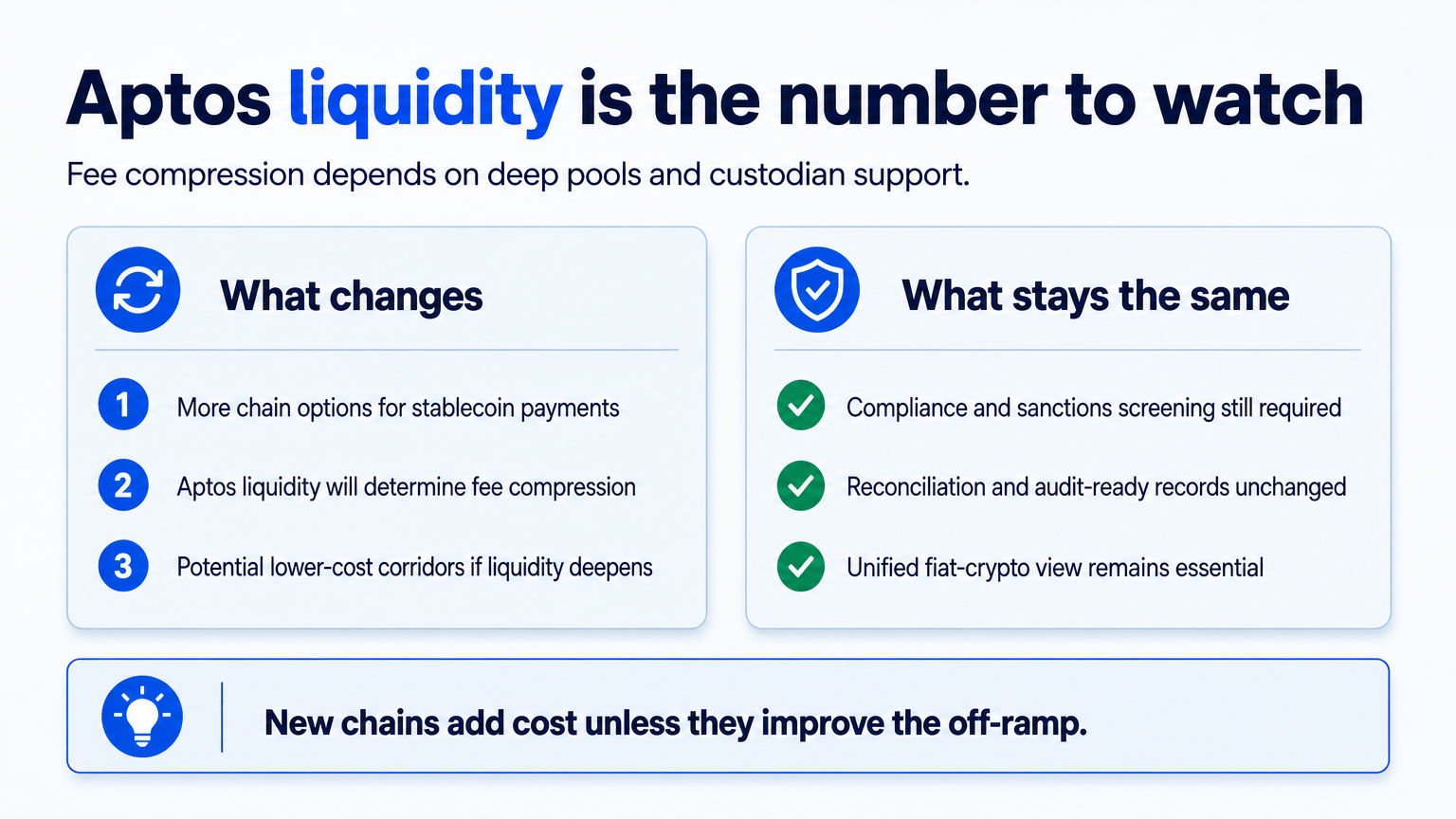
What changes: more options, chain-specific liquidity, possible fee compression
Aptos liquidity is the number to watch before switching rails. If PYUSD0 on Aptos draws deep pools and custodian support, merchants gain a lower-cost alternative to Ethereum mainnet for certain payment corridors. If liquidity stays thin, the launch changes little in practice.
What stays the same: necessity for compliance, reconciliation, and a unified view of fiat and crypto
Regulatory expectations, sanctions screening, and audit-ready records do not disappear because settlement is faster. A business still needs to know who it paid, on which chain, at what fiat value, and how that maps to invoices.
How can I manage both fiat and stablecoin transactions seamlessly?
Use one platform that treats fiat and crypto as two views of the same treasury rather than separate systems. OneSafe, a financial technology company that provides neo-banking services for global businesses and DAOs through banking partners, combines multi-currency accounts with crypto on/off-ramps, ACH and wire transfers, bill payments, and invoicing in one interface. The goal is a single reconciliation surface, not a wallet plus a bank tab.
Open questions and what to watch next
Will PYUSD displace USDC or USDT for commercial payments?
Not immediately. The USDC vs PYUSD contest will turn on reserve transparency, top-exchange and custodian support, and off-ramp reach. USDC and USDT hold the incumbent advantage of existing liquidity and counterparty habit. Watch whether PayPal extends PYUSD0 beyond Aptos and whether payment processors add it to standard settlement rails.
How will regulators treat non-USD-collateralized stablecoins issued by fintechs?
The question remains open. Regulators have focused most on USD-backed stablecoins because they dominate cross-border stablecoin volume. If fintech-issued tokens backed by other assets grow, expect scrutiny on reserve quality, redemption rights, and chain-level compliance. Nothing in the November 22 report suggests PYUSD0 changes that trajectory yet.
When will business banking platforms add native PYUSD on Aptos support?
No date is announced. Business banking platforms will add support only after institutional custody, liquidity, and compliance tooling exist for the Aptos blockchain. Before that, the practical route is to hold and pay in well-supported stablecoins and value PYUSD0 as a watch item.
For teams that need to keep clients updated as these questions resolve, Joyrise analyzes your site, then writes and publishes SEO articles to Webflow, WordPress or Shopify every day; your first article is written before you pay. Still, the treasury decisions above remain yours to make.
Key Takeaways
- As of November 22, 2026, Aptos is the sole Move-based chain in PayPal’s PYUSD0 stablecoin rollout, but PayPal has not disclosed issuance volume or launch date.
- PYUSD0 is a watch item, not an immediate replacement for USDC or USDT in B2B stablecoin payments.
- Choose chains and stablecoins by off-ramp liquidity, reserve transparency, and counterparty acceptance — not by brand or novelty.
- A multi-chain stablecoin world increases operational complexity; businesses need a single ledger for fiat and crypto reconciliation.
- Most treasury workflows stay the same: compliance, sanctions screening, invoicing, and audit trails still apply even when settlement is faster.
If your treasury now spans fiat and multiple stablecoins, create a unified account for fiat and stablecoin operations.