On November 23, 2026, the USDC Treasury minted $250 million in new USDC, aiming to reinforce market liquidity. The on-chain tracker Whale Alert reported the event, and Cryptonews.net confirmed the mint was designed to bolster liquidity as traders navigated mixed signals across digital asset markets. For anyone responsible for crypto treasury management—whether a corporate crypto treasury, a DAO treasury, or a Web3 startup’s stablecoin reserves—this supply increase reshapes near-term decisions on allocation, yield, and counterparty risk. It is not just a headline; it is a real-time signal to review stablecoin positions and operational readiness.
Table of Contents
- Crypto Treasury Management: A Quick Primer
- Why This Mint Matters for Treasury Operators
- Three Moves Treasury Teams Should Evaluate Now
- What Doesn’t Change: The Non-Negotiables
- The Toolkit for Agile Crypto Treasury Management
- Can idle stablecoin balances earn yield?
- Open Questions and What to Watch Next
- Key Takeaways
Crypto Treasury Management: A Quick Primer
Crypto treasury management is the end-to-end oversight of an organization’s digital asset holdings—including stablecoins, protocol tokens, and wrapped assets—alongside traditional fiat reserves.
What is crypto treasury management?
Crypto treasury management is the practice of safeguarding, allocating, and putting to work an organization’s cryptocurrency and stablecoin balances. Its core functions—custody, liquidity oversight, payments, and reporting—mirror fiat treasury, but with added layers: on-chain settlement, 24/7 markets, and a dual environment where value moves between blockchains and bank accounts. This applies equally to a corporate crypto treasury holding USDC for payroll and a DAO treasury management setup with millions in governance tokens.
How is treasury management for crypto different from traditional treasury management?
Three differences stand out. First, markets never close; a 2 a.m. Sunday liquidity event can impact positions immediately, requiring always-on crypto liquidity management. Second, custody is both a technical and procedural challenge—assets may sit in self-custodied wallets with multisig controls or with qualified custodians like Fireblocks, not in a single bank account. Third, the integration of fiat and crypto introduces counterparty structures (exchanges, stablecoin issuers, DeFi protocols) that don’t exist in traditional treasury. The most agile organizations now unify both on platforms that give real-time visibility across all assets.
Why This Mint Matters for Treasury Operators
A $250 million mint indicates Circle is responding to institutional demand for deeper liquidity pools. For treasury managers, this ripples through several operational layers.
A liquidity injection for a 24/7 market
Newly minted USDC typically flows into exchanges, market makers, and DeFi protocols, tightening spreads and reducing slippage. In a 24/7 market, that extra liquidity can mean a $5 million treasury redemption or rebalancing executes with minimal price impact—even outside traditional trading hours. As the PwC guide for stablecoin treasurers notes, market depth is a prerequisite for integrating stablecoins into core treasury operations. (PwC: Stablecoins for treasurers)
Ripple effects on on-chain and off-chain operations
For a DAO or Web3 startup, increased USDC supply can make on-chain vendor payments more predictable because the stablecoin’s peg is reinforced by deeper backing. Off-chain, it can alter the fiat-to-crypto conversion spread that a business sees when it uses its crypto on-ramp off-ramp. If the supply surge momentarily depresses USDC’s dollar premium, teams converting stablecoins to fiat for payroll might get slightly less than $1.00—though USDC’s redemption mechanism usually absorbs such imbalances quickly.
What does a stablecoin supply increase mean for my treasury?
A stablecoin supply increase like this one signals that liquidity conditions are loosening and more market participants are positioning in USDC. For your treasury, that can mean:
- Tighter bid–ask spreads on USDC pairs, reducing the cost of rebalancing or exiting positions.
- Potentially more attractive short-term yield opportunities in lending protocols as new supply seeks utilization.
- A need to reassess stablecoin treasury composition: if your allocation is heavily weighted to a single stablecoin, a supply boost can momentarily shift risk/reward dynamics, especially regarding issuer and counterparty risk.
Three Moves Treasury Teams Should Evaluate Now

Instead of waiting for markets to settle, finance leads can use this event as a catalyst to run three precise checks.
1. Reassess stablecoin allocation and counterparty exposure
A $250 million mint reminds us that stablecoin issuers are not static entities. Increase monitoring cadence on Circle’s attestations and the collateral composition backing USDC. If your treasury holds more than, say, 60% of liquid reserves in a single stablecoin, now is the moment to model a diversification scenario—splitting among multiple qualified stablecoin issuers or shifting some idle balances into short-term U.S. Treasury-backed instruments to reduce single-issuer risk.
2. Explore short-term yield while preserving instant access
With fresh USDC flooding into DeFi lending markets, yields on protocols like Aave or Compound can briefly rise as supply outpaces borrowing demand—creating a window for treasuries to earn a few extra basis points without locking up assets. The critical trade-off: yield must never come at the expense of instant liquidity. Only consider strategies where you can withdraw within the same block or after a short timelock, and always segregate yield-seeking balances from operational cash. For an in-depth look at how automated tools are enabling this, see AI Agents and Stablecoins Rewrite Crypto Treasury Management.
3. Stress-test your on/off-ramp speed
If your treasury suddenly needed to convert $1 million in USDC to fiat to cover a vendor payment within four hours, could you? The liquidity injection might tighten spreads, but only if your crypto on-ramp off-ramp infrastructure can execute quickly. Test the actual latency—from wallet initiation to fiat in the bank account—using your current provider. As Visa’s recent stablecoin settlement pilot demonstrated, integrated fiat-crypto rails are shrinking these windows. (Stablecoin Payments Go Live: What Visa’s Move Means for Your Business)
The following table summarizes the three moves and their key trade-offs.
| Move | Immediate Check | Trade-off to Weigh |
|---|---|---|
| Reassess stablecoin allocation | Review issuer attestations and reserve composition. | Diversification can add operational complexity and more counterparty relationships. |
| Explore short-term yield | Compare deposit rates on institutional-grade DeFi protocols. | Higher yield may require accepting brief withdrawal delays or smart-contract exposure. |
| Stress-test on/off-ramp speed | Time a real $10,000 USDC-to-fiat conversion end-to-end. | Speed may come with higher conversion fees if not negotiated upfront. |
What Doesn’t Change: The Non-Negotiables
Market events can shift tactics, but they do not loosen the fundamentals of secure treasury management.
What does secure treasury management look like for crypto?
Secure treasury management for crypto rests on three pillars: institutional-grade custody, strict segregation of duties, and continuous transaction monitoring with real-time alerts. At a minimum, enforce multi-factor authentication (MFA) on all access points and require multiple approvals for any transaction above a preset threshold.
How can organizations secure crypto assets?
Use hardware security modules (HSMs) or MPC-based wallets to eliminate single points of key compromise; keep the bulk of long-term holdings in cold storage with only operational float in hot wallets; and integrate all signing flows with a governance layer that logs and authorizes every action. For more on MPC technology, see What Is MPC? Multi-Party Computation Explained.
What are some risks associated with crypto treasuries?
Operational risks—lost keys, failed transactions, smart-contract bugs—are the most common. Counterparty risks arise from stablecoin issuers, exchanges, and lending protocols. Regulatory risk is acute as frameworks evolve; the U.S. Treasury has proposed rules defining stablecoin issuance, which could alter treatment of certain reserves. Market risk, while less severe for stablecoins, still appears during de-pegs or rapid interest rate changes.
What are the biggest risks in running a crypto treasury?
The three biggest are: (1) custodial failure or private key compromise, which can lead to irreversible loss; (2) concentration risk—over-reliance on a single stablecoin, exchange, or protocol; and (3) regulatory non-compliance, which can freeze funds or trigger enforcement. Among recent lessons, the Crypto Treasury Management After the Bitcoin Crash analysis highlights how liquidity crunches expose concentration risk brutally.
Reporting standards don’t relax
Regardless of market conditions, crypto treasuries must produce accurate, auditable reports that track fiat and digital assets in a single view. Accounting standards for digital assets continue to evolve, but transparent valuation and real-time reconciliation remain non-negotiable.
The Toolkit for Agile Crypto Treasury Management
Responding to a single mint requires a technology stack that connects custody, liquidity, and fiat settlement. A unified digital asset treasury platform can compress the time between event detection and action. For example, OneSafe combines multi-currency fiat accounts, free USDC deposits and withdrawals, and digital asset custody via Fireblocks under one interface, allowing treasury teams to convert stablecoins to fiat and initiate cross-border wires without hopping between systems. When speed matters, integration is the lever.
For further foundational understanding of the asset class, What Is a Digital Asset? A Practical Business Guide offers a clear reference.
Separately, teams that also handle content marketing can use Joyrise to grow organic traffic while you sleep: Joyrise analyzes your site, then writes and publishes SEO articles to Webflow, WordPress or Shopify every day. Your first article is written before you pay.
Can idle stablecoin balances earn yield?
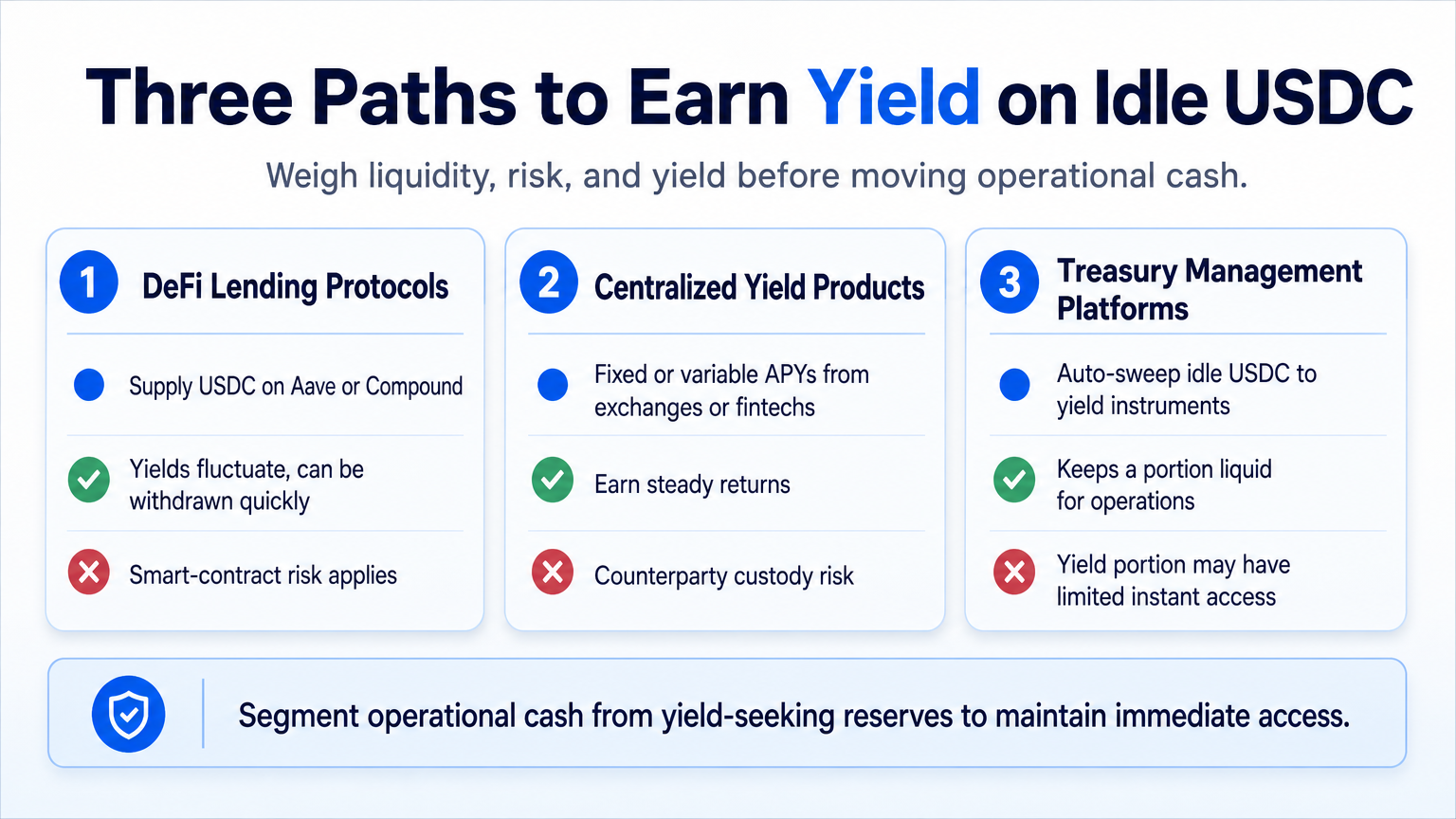
Yes. The most common routes are:
- DeFi lending protocols like Aave or Compound, where you supply USDC to borrowers and earn interest. Yields fluctuate and can be withdrawn quickly, though smart-contract risk applies.
- Centralized yield products from exchanges or fintech platforms, which may provide fixed or variable APYs in exchange for custody of stablecoins, introducing counterparty risk.
- Treasury management platforms that automatically sweep idle USDC into yield-bearing instruments while keeping a portion liquid for operations.
Before moving idle balances into any yield strategy, weigh liquidity requirements. Funds needed for payroll or near-term vendor payments should not be locked in products with withdrawal delays. Segment operational cash from yield-seeking reserves and require same-day or instant redemption. The earlier stress-test applies here as well: if you need to convert stablecoins to fiat quickly, a yield strategy with a timelock could leave you stranded.
Open Questions and What to Watch Next
The $250 million mint leaves several questions unanswered.
- Will the additional supply be absorbed by organic demand, or will it take time to filter through lending markets, keeping yields temporarily elevated?
- How will forthcoming stablecoin regulation at the state level interact with such supply expansions, especially if issuers face new reserve requirements?
- Could a series of similar mints across multiple stablecoins signal a broader shift in institutional crypto treasury management, where corporate treasuries hold larger portions of working capital in tokenized dollar equivalents?
Treasury leaders should watch Circle’s weekly attestation reports, monitor on-chain analytics for actual distribution of the newly minted USDC, and track DeFi total value locked (TVL) in major lending markets for sudden jumps that could signal increased competition for yield.
Key Takeaways
- The $250 million USDC mint on November 23, 2026, injected immediate liquidity into crypto markets, giving treasury operators a fresh signal to reassess stablecoin allocations and counterparty exposure.
- Crypto treasury management is distinct: it requires 24/7 liquidity oversight, dual fiat-crypto operational thinking, and rigorous custody controls that go far beyond traditional banking norms.
- The three most impactful immediate actions are re-evaluating stablecoin concentration, exploring short-term yield without locking liquidity, and pressure-testing the speed of your crypto on-ramp off-ramp.
- Security fundamentals—multisig, MFA, segregation of duties, and cold storage—remain the non-negotiable bedrock, no matter how alluring a yield opportunity appears.
- Integrated platforms that combine fiat banking and crypto custody can significantly shorten the time needed to act on market events, turning a news alert into an executed treasury move in hours, not days.
Ready to unify your fiat and crypto treasury operations on a single, secure platform? Open an account with OneSafe and start managing your stablecoin reserves with zero USDC deposit or withdrawal fees.