On November 19, 2026, Visa and Triple A announced a tie-up that extends Visa Direct’s stablecoin prefunding across Asia Pacific, according to a Yahoo Finance report. Eligible clients can now fund cross-border payouts in digital dollars, weaving stablecoin payments into mainstream business infrastructure. The partnership does not mean Visa issues a stablecoin—it enables select partners to prefund Visa Direct accounts with stablecoins, which are converted and paid out in local fiat. The backend settlement layer now accepts stablecoin liquidity, narrowing the gap between on-chain treasuries and traditional payout rails for founders, finance leads, and DAO operators.
Table of Contents
- Stablecoin Payments 101: Why Businesses Are Paying Attention
- What Visa’s Tie-Up Means for Your Business
- What Changes Now vs. What Stays the Same for Stablecoin Payments
- Open Questions and What to Watch Next
- Key Takeaways
- Sources
- Further reading
Stablecoin Payments 101: Why Businesses Are Paying Attention

What makes stablecoins different from other cryptocurrencies?
Stablecoins are digital assets designed to maintain a stable value, typically pegged 1:1 to a fiat currency like the U.S. dollar. Unlike bitcoin or ether, which can swing 10% in a day, stablecoins (USDC, PYUSD) aim for price constancy. They’re backed by reserves—cash, short-term Treasuries—and increasingly governed by regulatory frameworks that require transparent attestations. A business holding USDC isn’t speculating; it’s using a digital representation of dollars that settles on public blockchains 24/7. That makes them practical for payments, not trading.
The Cross-Border Payment Advantage: Speed and Cost
Traditional wires route through multiple correspondent banks, take 2–5 business days, and cost $25–$50+ in fees and hidden FX markups. Stablecoin payments remove that friction: a USDC transfer on a layer‑2 network settles in minutes with network fees often under $1. Finality is near-instant, and transfers work on weekends and holidays. As the Federal Reserve noted in March 2026, payment stablecoins can deliver “faster, cheaper, and more transparent cross-border payments” compared to legacy rails.
| Feature | Traditional SWIFT Wire | Stablecoin Payment (USDC) |
|---|---|---|
| Settlement time | 2–5 business days | Minutes, often under 15 min |
| Typical cost (incl. intermediaries) | $25–$50+ | Network fee often <$1 |
| Operating hours | Banking hours, cutoffs | 24/7/365 |
| Finality | Delayed, reversible | Near-instant on-chain finality |
Why do stablecoins suit cross-border payments? They sidestep correspondent networks entirely. A stablecoin transfer moves value directly on a blockchain—no intermediary banks deducting fees, no delayed settlement, no SWIFT batch windows. This is especially attractive for recurring, lower-value B2B payouts where wire costs erode margins.
The Regulatory Pulse: The GENIUS Act and Beyond
What is the GENIUS Act and how does it affect stablecoin payments? The Guiding and Establishing National Innovation for U.S. Stablecoins Act (introduced 2025, rules expected through 2026) proposes a federal framework for payment stablecoins. Instead of treating issuers as banks, it mandates reserve transparency, redemption rights, and operational standards. For businesses, this would bring clarity—compliant stablecoins would operate under one national standard, reducing state-level money‑transmitter patchworks. If enacted, it could lower compliance friction for cross-border stablecoin payments. The SEC’s recent defense of its stablecoin oversight role signals the regulatory perimeter is being drawn, but directionally it points toward more certainty for corporate treasurers.
What Visa’s Tie-Up Means for Your Business
Who Benefits Most: Global Startups, Web3 Teams, and DAOs
Organizations that already straddle fiat and crypto—remote-contractor startups, Web3 teams with token compensation, DAOs with on-chain treasuries—gain the most. They can now fund payouts in USDC and have recipients receive local currency through Visa Direct’s rails without holding multiple local accounts.
For DAOs, a direct connection between an on‑chain treasury and a mainstream payout network reduces overhead. Instead of manually swapping stablecoins to fiat and tracking wires over days, a DAO can prefund a Visa Direct partner with USDC from its multisig and let the network handle the final leg. It isn’t fully decentralized, but it shrinks the gap between guild payments, contributor rewards, and real‑world bills.
Can stablecoins help my DAO manage payments? Yes. Stablecoins let treasuries retain dollar-pegged value on‑chain, avoiding forced conversions. Paired with a platform that offers customizable roles, multisig controls, and automated payouts, a DAO can distribute rewards or expenses directly from its treasury with settlement in minutes. Automated workflows can even trigger payouts when on‑chain conditions are met.
Real-World Example: Simplifying Contractor Payouts with Stablecoins
A Singapore Web3 startup pays a Vietnamese developer a monthly retainer. Previously, they’d convert fiat to USDC via an exchange, send to the developer’s wallet, and the developer would swap to VND with 0.5–1% spread and withdrawal delays. Now, the startup prefunds a Visa Direct partner with USDC and instructs a payout to the developer’s local bank account. The developer receives VND directly at competitive rates, often in minutes. The startup benefits from USDC payments on the backend without requiring the recipient to touch crypto. A unified platform can then reconcile those payouts automatically into the startup’s accounting software, replacing spreadsheets.
The Hidden Challenge: Integrating Stablecoins Into Your Existing Stack
Most businesses run on fiat accounting and tax filings. Plugging a stablecoin leg into that stack adds reconciliation complexity—tracking cost basis, handling FX translations, and keeping compliant records for auditors who may not be crypto-native. The need is a unified environment where stablecoin payments coexist with ACH, wires, and corporate card spend, so a USDC-initiated payment can be tracked against the same general ledger as a fiat vendor payment.
How do I accept stablecoin payments? Accept them directly to a wallet, then use an on/off‑ramp provider. More seamlessly, a neo‑banking platform that supports both fiat accounts and fiat to crypto on‑ramp functions can generate unique deposit addresses, auto‑convert incoming stablecoins to fiat by predefined rules, and feed the data into your accounting system. Automating a rule to convert 90% of USDC receipts to USD upon arrival reduces manual treasury management.
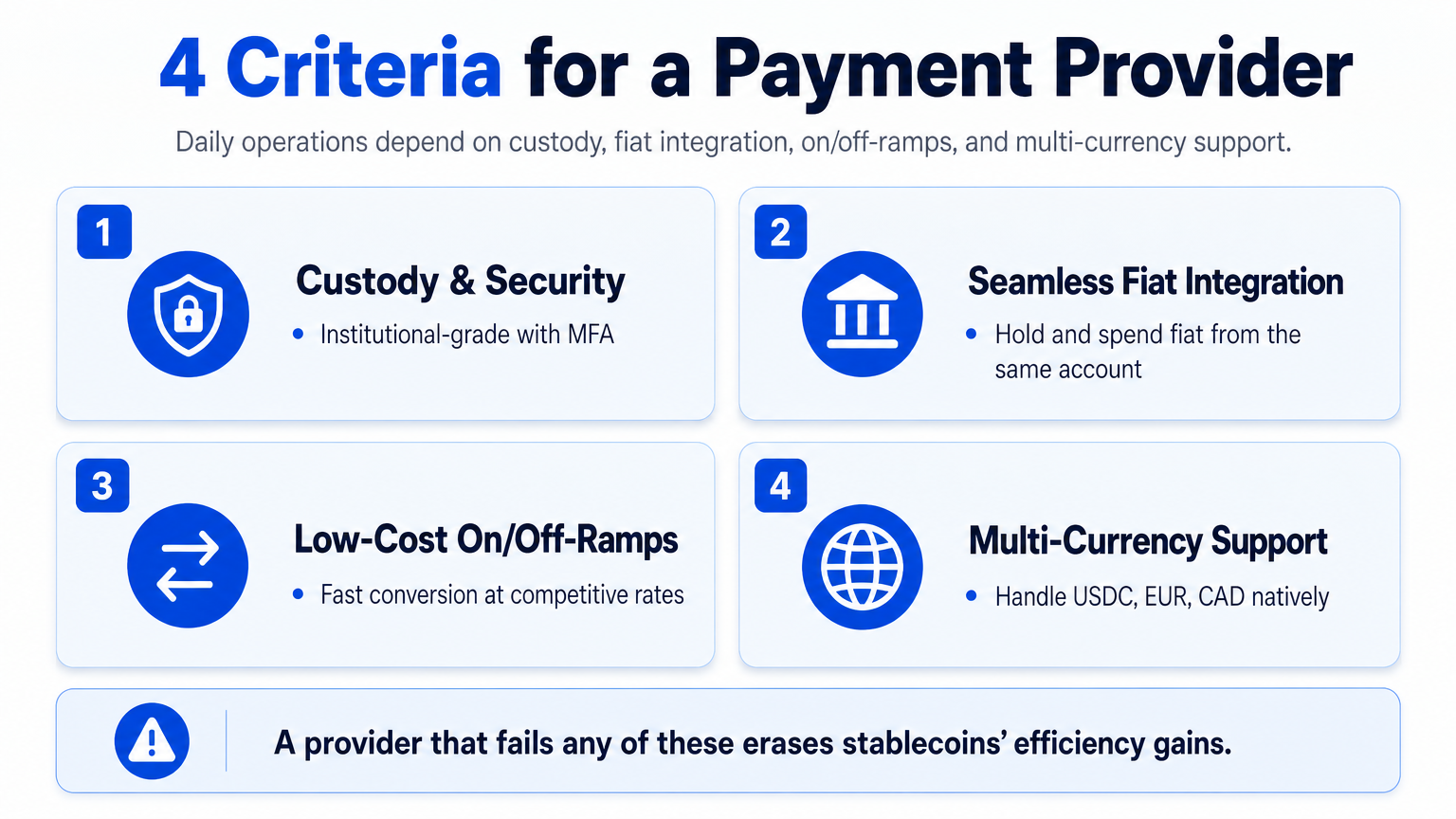
How do I choose a stablecoin payment provider? Focus on four criteria that impact daily operations: (1) custody and security (institutional-grade, multifactor authentication), (2) fiat integration (can you hold and spend fiat from the same account?), (3) on/off‑ramp costs and settlement speed, and (4) multi‑currency support (handle USDC, euro, CAD natively without double conversions). A provider that fails on any of these will erode stablecoins’ efficiency gains.
What Changes Now vs. What Stays the Same for Stablecoin Payments
Faster Adoption, but Compliance Hurdles Remain
Visa’s move accelerates stablecoin payments for business by making a familiar payout network compatible with digital dollar funding. More enterprises will experiment, drawing in liquidity providers and compressing spreads. However, KYB/AML checks still apply to fiat ramps, and the stablecoin issuer’s own compliance posture matters—using fully reserved, regulated USDC defines your counterparty risk better than an algorithmic or offshore stablecoin. The GENIUS Act would standardize expectations, but until then, businesses navigate a fragmented landscape. The World Bank’s recent endorsement of stablecoin payments highlights the upside while implicitly raising the bar on AML and sanctions screening.
On/Off-Ramps Are Still the Bottleneck
Even if Visa accepts a stablecoin prefund, a business must first convert fiat into stablecoins (on‑ramp) and, after receiving payments, may need to convert back to fiat for payroll or rent (off‑ramp). These steps still involve banks, exchanges, or neo‑banking platforms with their own fees, delays, and banking‑hour limits. The on‑ramp remains the most friction‑prone part—a wire to an exchange can take a day, nullifying the stablecoin transfer’s speed. Until real‑time fiat funding channels (FedNow, instant SEPA) pair widely with stablecoin rails, end‑to‑end speed will be anchored to the slowest leg. Many businesses pre‑fund a stablecoin buffer to turn variable delays into a predictable treasury operation.
The Role of Platforms Like OneSafe in Bridging the Gap
Global businesses without the resources to build in‑house middleware need a platform that unifies fiat accounts, crypto wallets, and corporate cards. OneSafe, for instance, provides multi‑currency accounts (USD, EUR, CAD) alongside free USDC deposits and withdrawals, with automated payout workflows for contractors in fiat or stablecoins. Its Fireblocks‑backed custody and mandatory multi‑factor authentication cover security requirements, while virtual corporate cards and accounting sync let a stablecoin‑funded treasury directly feed vendor payments. This kind of Web3 treasury management capability makes it feasible for a lean startup to run a true fiat–crypto hybrid operation. For companies seeking to grow organic traffic while streamlining payments, Joyrise can analyze your site and publish SEO articles to Webflow, WordPress, or Shopify daily, with your first article written before you pay.
Is It Safe to Use Stablecoins for Business?
Security depends on the entire stack, not just the stablecoin. Holding USDC in a non‑custodial wallet shifts key‑management risk onto you. A custodial solution secures assets with institutional‑grade infrastructure (MPC wallets, insurance) but introduces counterparty risk. The safest approach for a business is a regulated custodian that segregates client assets and provides transparent attestations, paired with strong internal access controls (multisig approvals, MFA). Combining a reputable stablecoin issuer with qualified custody and compliance platforms brings the risk profile closer to a traditional bank balance while retaining 24/7 blockchain settlement.
Open Questions and What to Watch Next
Will Other Payment Giants Follow?
Visa’s move pressures Mastercard, SWIFT, and regional networks to articulate their stablecoin strategies. Several payment firms have run stablecoin settlement pilots, but a live commercial tie‑up in Asia changes the competitive dynamic. The next logical step is a network that lets recipients directly receive stablecoins rather than requiring fiat conversion, compressing costs for crypto‑native businesses.
How Will Regulation Evolve?
The stablecoin regulation landscape is at a tipping point. With the GENIUS Act in the U.S., the EU’s MiCA framework in force, and Canada proposing its own rules, stablecoins are being classified as payment instruments or securities with prudential requirements. Businesses should watch final rules on issuer reserve composition and redemption timelines—those will determine which stablecoins are viable for sustained B2B use.
What About Multi-Currency Stablecoin Integration?
Most cross‑border flows are dollar‑denominated, but euro stablecoins (EURC) and eventually SGD‑ or JPY‑pegged stablecoins will introduce FX exposure. Platforms that offer native multi‑currency accounts and let you convert between stablecoins at competitive rates—without double‑hopping through fiat—will become essential. A virtual card funded in USDC that can swipe in euros without a separate conversion step reduces both cost and operational churn. The race toward multi‑currency stablecoin integration may be the next infrastructure push after the on‑ramp bottleneck is resolved, as highlighted by Canada’s proposed rules for stablecoin payments.
Key Takeaways
- Visa’s stablecoin tie‑up with Triple A makes settlement practical for businesses funding cross‑border payouts in Asia Pacific, but it still relies on partners to bridge fiat and crypto.
- The main operational win for global startups and DAOs comes from consolidating fiat and stablecoin treasury management on a single platform, not the payment rail alone.
- On/off‑ramps remain the biggest friction; maintaining a stablecoin working capital buffer turns variable delays into a predictable process.
- Security depends on the whole stack—choose a provider with institutional‑grade custody, MFA, and transparent compliance.
- Regulatory clarity is advancing, making it easier to select compliant stablecoins, but final rules on reserves and redemption will shape the B2B landscape.
Take the first step toward unifying your fiat and stablecoin operations—explore how OneSafe can help your global business run a real‑time treasury.
Sources
- Stablecoin Payments: The Complete B2B Guide
- Stablecoin Payments for Global Businesses: The Complete 2026 ...
- Stablecoin Payments Explained: A Guide for Businesses
Further reading