On October 12, 2026, Yellow Card’s stablecoin launch gave global startups and DAOs infrastructure they can actually bank on. The fintech’s new Global Accounts platform provides dedicated IBANs, multi-currency wallets, and direct fiat-to-stablecoin conversion—a signal that stablecoin payment rails have moved from crypto-native experiment to mainstream operational layer. For companies wrestling with cross-border treasury fragmentation, this launch makes a unified fiat–crypto treasury a deployable reality today.
Table of Contents
- Yellow Card stablecoin launch: what it means
- Why stablecoin payments are critical for global businesses
- How stablecoin payments settle between bank accounts and blockchains
- Regulatory changes that make business stablecoin adoption safer
- What to look for in a stablecoin payment provider
- How to run a stablecoin payment pilot without adding complexity
- What to Watch: Stablecoin Payments in 2027
- Key Takeaways
Yellow Card stablecoin launch: what it means
Yellow Card’s October 12 announcement, reported by TechAfrica News, introduces a platform that combines a multi-currency wallet with dedicated IBANs, fiat-to-stablecoin conversion on both deposit and withdrawal, and stablecoin treasury management in a single dashboard—functions that previously required three separate providers.[^1]
A business receives a European-style IBAN for USD or EUR payments; incoming fiat can be held as fiat or instantly converted to USDC. When the business needs to pay, it can send stablecoins directly or convert back to local currency for wire transfer. Dedicated IBANs mean segregated account structures, giving each business cleaner transaction trails for compliance and reconciliation.
Yellow Card’s core market historically has been Africa (1.4 million users), where it proved stablecoin resilience in high-friction markets. Extending that infrastructure globally provides a template for payment rails that are genuinely borderless from day one, not retrofitted from a US- or EU-first design.
Why stablecoin payments are critical for global businesses
Cross-border payment friction is a silent growth killer
Legacy correspondent banking forces 2–5-day wire waits, 3–5% hidden FX markups, and idle prefunded accounts across jurisdictions. For startups paying remote teams in ten countries or a DAO distributing grants worldwide, that fragmentation multiplies treasury complexity. McKinsey notes that stablecoin infrastructure collapses multi-hop correspondent chains into a single near-instant on-chain transfer, reducing cost and settlement risk—a promise that has become operational necessity in 2026.[^2]
From niche experiment to embedded business layer
On-chain settlement volume exceeded $2.5 trillion in 2025, with B2B use cases growing faster than consumer remittances, according to Visa.[^3] Circle’s partnerships with Stripe and SAP, and Samsung’s September 2026 move to put USDC wallets on 82 million phones, have embedded stablecoin payments into mainstream business software stacks.[^4] In October 2026, the question for finance leads is no longer “why stablecoins?” but “how quickly can I plug them in without breaking reconciliation?”
How stablecoin payments settle between bank accounts and blockchains

The flow has three legs. Fiat enters through an on-ramp—a bank wire triggers issuance of a dollar-pegged stablecoin like USDC by a licensed issuer, with 1:1 reserves held in a segregated account. Settlement then happens on-chain: the stablecoin transfers to a recipient’s wallet over a public blockchain in seconds for fractions of a cent. The recipient can hold the stablecoin or off-ramp it back to fiat via a provider that debits the token and credits a bank account. Every step leaves an immutable audit trail, making reconciliation more transparent than traditional correspondent banking where intermediary hops obscure cost and timing.[^5]
For treasury managers, the architectural shift is that a platform unifying on/off-ramps, wallet custody, and fiat accounts collapses a fragmented three-provider workflow into a single interface. OneSafe, for example, pairs segregated multi-currency accounts with Fireblocks-secured crypto custody, letting teams see fiat and stablecoin positions side by side and run payouts without exporting private keys to a separate hot wallet.
Regulatory changes that make business stablecoin adoption safer
The GENIUS Act proposes a federal US framework for payment stablecoins, defining reserve requirements and issuer oversight. The EU’s MiCA rules have imposed compliance deadlines: ESMA now requires specific reserve and reporting standards, while France plans to tax stablecoin swaps from 2027.[^6] Coinbase’s CFTC legal win in August 2026 clarified jurisdictional boundaries, reducing risk for operational treasuries.[^7] A stablecoin payment provider that works with regulated banking partners and conducts KYB and transaction monitoring now operates inside a defined legal perimeter, lowering the risk of frozen accounts or retroactive enforcement that previously made CFOs cautious.
What to look for in a stablecoin payment provider
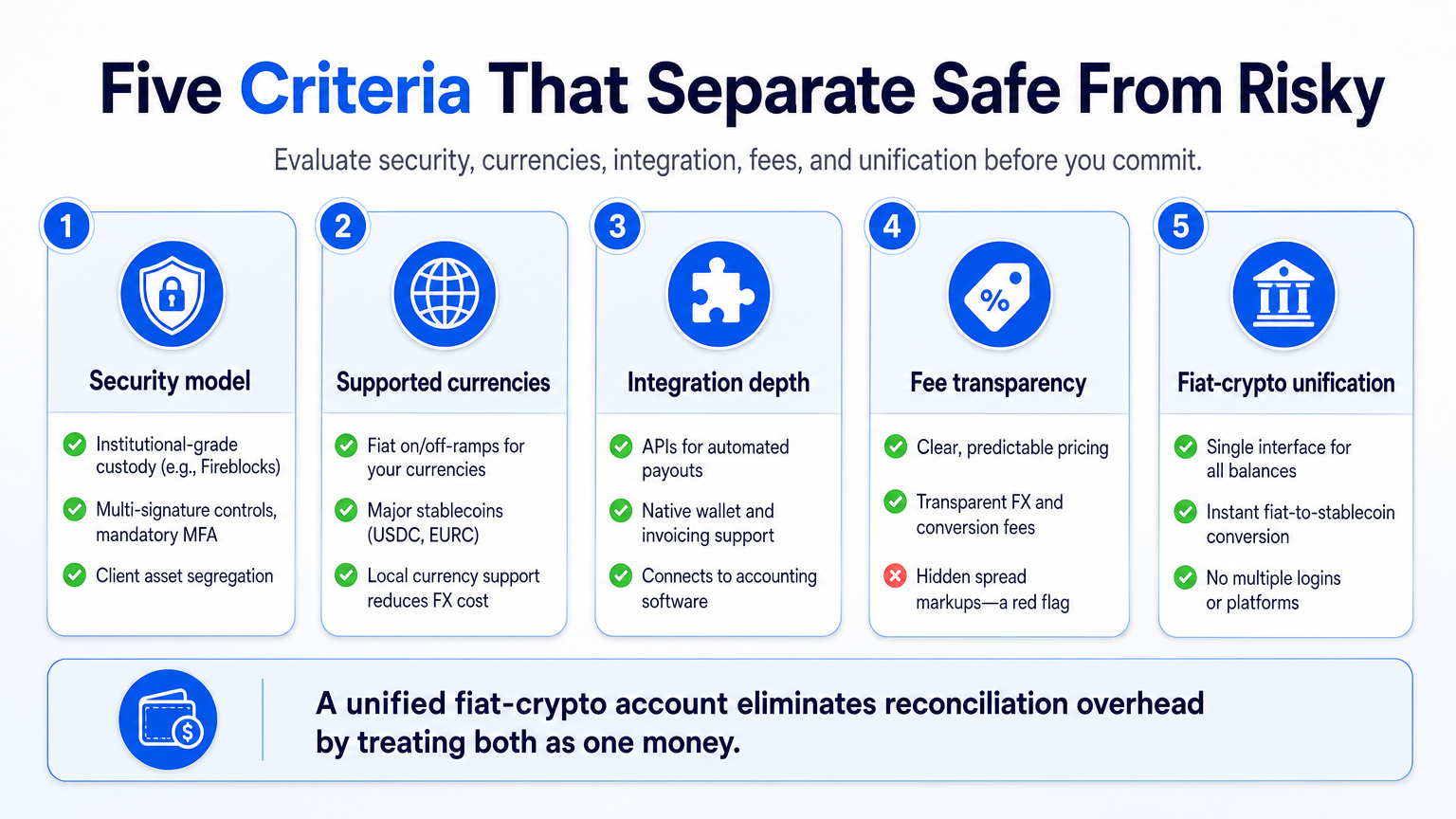
Evaluating a provider demands concrete criteria. Five categories separate a useful stablecoin business account from a risky workaround.
| Criterion | What to verify |
|---|---|
| Security model | Institutional-grade custody (e.g., Fireblocks), multi-signature controls, mandatory MFA, client asset segregation from operational float. |
| Supported currencies | On/off-ramps in your fiat currencies (USD, EUR, ideally local) and major stablecoins (USDC, possibly EURC). |
| Integration depth | APIs for automated payouts and reconciliation, plus native support for wallets, invoicing, and accounting software—not just a manual portal. |
| Fee transparency | Clear, predictable pricing for deposits, wires, FX, and crypto conversions. Hidden spread markups are a red flag. |
| Fiat-crypto unification | A single interface showing fiat and stablecoin balances together, with instant conversion and on-chain payments without juggling multiple logins. |
A unified fiat–crypto account eliminates reconciliation overhead by treating fiat and stablecoins as different formats of the same money. As the guide on Web3 Crypto: A Business Guide to Finance in 2026 explains, the winning finance stack replaces multiple banking relationships with a single ledger handling both wire and USDC payouts natively.
How to run a stablecoin payment pilot without adding complexity
A pilot should test the core loop—pay a real vendor or contributor in USDC—without touching existing bank relationships. A three-step approach:
- Open a business account that supports both fiat and stablecoins (multi-currency wallet, fast KYB, free USDC deposits/withdrawals). For instance, OneSafe provides a segregated USD account and a USDC wallet with no crypto deposit fees, enabling instant fiat-to-stablecoin conversion and on-chain payouts.
- Identify one low-risk recurring payment to a freelancer, vendor, or DAO contributor who already accepts USDC; route only that stream to the new account.
- Run the pilot for 60 days, measuring end-to-end settlement time, total all-in cost (including FX and conversion), and reconciliation effort. Hard data, not hype, justifies scaling.
Leave integration into the main ERP or accounting system until the pilot demonstrates a clear net benefit. For a deeper framework on setting up business accounts without disruption, see Can I Open a Bank Account Just for Business? Yes—Here’s How.
What to Watch: Stablecoin Payments in 2027
Will local-currency stablecoins fragment or bridge markets?
Yellow Card’s support for multiple local currencies alongside USD/EUR stablecoins raises a strategic question: will localized stablecoins fragment liquidity into shallow pools, or will they become last-mile on-ramps that funnel value into USDC and EURC rails? France’s forthcoming swap tax suggests fiat-pegged tokens face different treatment by domicile, reinforcing the likelihood of a multi-token world rather than a single dominant stablecoin.
The looming battle: Web3 business banking vs. legacy banks bolting on stablecoin APIs
Traditional banks are beginning to add on-chain settlement capabilities through APIs layered onto batch-processing core systems. Web3 business banking platforms like OneSafe, built from the ground up for real-time settlement and programmable smart contract logic, hold an architectural advantage. As regulation settles, the differentiator will shift from “who provides a wallet” to “who offers the deepest treasury stack spanning fiat payables, on-chain payroll, and automated reconciliation.” For business leaders, integration depth, not just the presence of a stablecoin on/off-ramp, will define the best choice.
Key Takeaways
- Yellow Card’s October 12, 2026 launch of Global Accounts with IBANs and stablecoin conversion marks maturation of fiat-to-stablecoin rails for global businesses.
- Stablecoin cross-border payments are now essential for startups and DAOs facing wire delays, hidden fees, and multi-currency fragmentation.
- Regulatory clarity (GENIUS Act, ESMA deadlines, CFTC ruling) provides a compliance floor that makes payment stablecoins materially safer.
- Selecting a stablecoin payment provider demands structured evaluation across security, currencies, integration depth, fee transparency, and fiat-crypto unification.
- A pragmatic pilot (one payment stream, 60 days) delivers cost and time data while protecting the core treasury stack from disruption.
Access a unified fiat–crypto business account that supports USDC payouts and multi-currency treasury management at OneSafe.
[^1]: TechAfrica News, “Yellow Card Launches Global Accounts for Cross-Border Payments and Stablecoin Management,” October 12, 2026. Link [^2]: McKinsey & Company, “The stable door opens: How tokenized cash enables next-gen payments.” Link [^3]: Visa, “Stablecoins and the future of onchain finance.” Link [^4]: OneSafe blog, “Samsung Stablecoin Payments Put USDC on 82M Phones—Now What?” Link [^5]: Stripe, “How Stablecoin Payments Infrastructure Works.” Link [^6]: OneSafe blog, “Stablecoin Regulation: ESMA’s New Compliance Deadline.” Link; OneSafe blog, “Stablecoin Regulation: France to Tax Swaps from 2027.” Link [^7]: OneSafe blog, “Stablecoin Regulation Update: Coinbase’s CFTC Win & Your Business.” Link