Ecommerce banks combine multi-currency accounts, corporate cards for ecommerce, and crypto on/off-ramps. Learn how to open an online business account in days.
Table of Contents
- What is an ecommerce bank?
- How Ecommerce Banking Works
- Options and Tradeoffs
- What are the fees associated with ecommerce banking?
- How to Choose and Set Up Your Ecommerce Banking Stack
- Common Mistakes
- Next Steps for Ecommerce Businesses
- Key Takeaways
What is an ecommerce bank?
Ecommerce Bank vs. Traditional Business Bank
An ecommerce bank is a financial services provider designed for businesses that sell online, operate internationally, or manage both fiat and cryptocurrency revenue. It typically offers a multi-currency business account, corporate card programs, cross-border payment processing, and often a direct link to crypto on/off-ramps — all accessed through a digital dashboard.
A traditional business bank like Commerce Bank remains oriented toward physical infrastructure and consumer tools. In October 2026 alone, Commerce Bank acquired a middle-market investment bank, Nolan & Associates (The Business Journals, Oct 5, 2026), and purchased a six-story office building in Naples for $24.1 million (Gulfshore Business, Oct 6, 2026). It also partnered with Greenlight on a family finance app (ATM Marketplace, undated). These moves underscore a legacy strategy of advisory services and real estate assets, not the high-velocity, multi-currency, crypto-adjacent demands of modern ecommerce. Traditional banks also tend to have opaque FX markups, manual onboarding that can take weeks, and branch dependency. Ecommerce banks deliver instant virtual corporate cards, transparent FX fees (e.g., 0.25% or less), and fully digital identity verification — usually done in under a week.
Commonly Confused Terms
- Neo-bank: A digital-first provider that partners with a licensed bank for deposit accounts and cards (e.g., OneSafe).
- Fintech: Broader technology-driven financial products; not all fintechs offer full banking services.
- Banking-as-a-Service (BaaS): Backend infrastructure letting non-banks embed financial services.
A partner-bank structure gives you the agility of a neo-bank with the regulatory coverage of a chartered institution. For more on that evolution, see neo-banking for online sellers.
How Ecommerce Banking Works
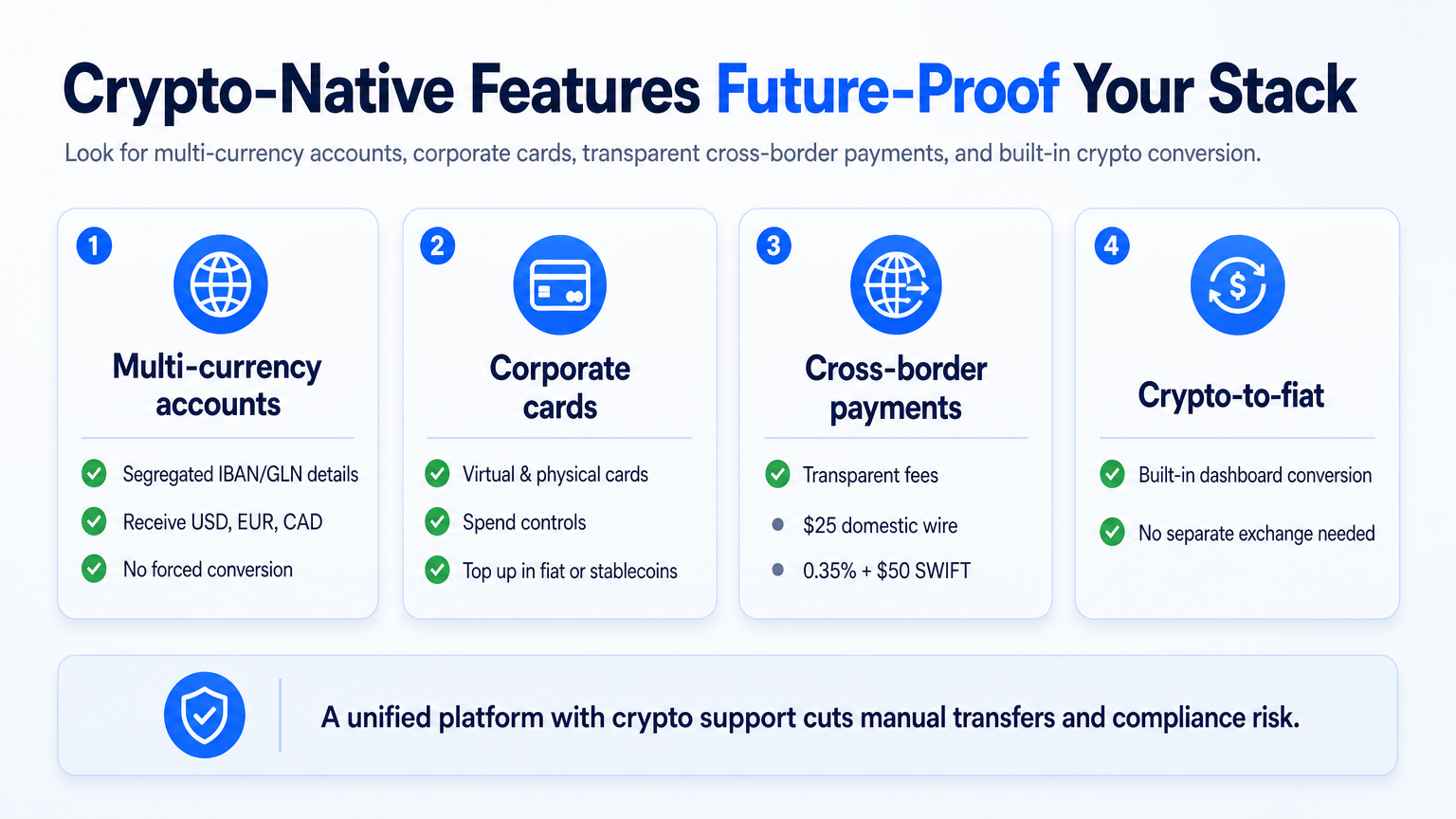 An ecommerce banking platform aggregates multiple banking partners, payment rails, currency engines, and sometimes crypto custody into a single interface. You get a unified ledger for ACH, wires, competitive FX, and corporate cards — all from one login. Native crypto support eliminates moving funds between an exchange and a bank: convert USDC to USD instantly, then pay a supplier via ACH, cutting settlement times and manual reconciliation. A crypto-friendly business banking provider actively supports crypto flows, reducing the risk of frozen accounts.
Features to look for in ecommerce banking solutions
- Multi-currency accounts with segregated IBAN/GLN details to receive USD, EUR, CAD without forced conversion.
- Corporate card for ecommerce: Virtual and physical cards with spend controls; top up in fiat or stablecoins.
- Cross-border payment processing with transparent fees (e.g., $25 wire, 0.35% + $50 for SWIFT).
- Crypto-to-fiat conversion built into the dashboard, not spread across platforms.
- Automated payment workflows for vendor bills, payroll, or contributor payouts, integrated with accounting tools.
- Role-based permissions for distributed teams or DAOs to control access.
- Compliance and custody using institutional-grade infrastructure like Fireblocks and mandatory MFA.
If you settle revenue in crypto, pay contractors in stablecoins, or hold a digital treasury, a crypto-native platform future-proofs your finance stack. Without it, you risk manual transfers, exchange rejections, and a messy compliance trail. As stablecoin rules tighten — ESMA’s new compliance deadline affects EU-issued stablecoins — deep integration matters.
Options and Tradeoffs
Traditional Banks with Digital Channels
Big banks (e.g., Bank of America’s ecommerce gateway) offer basic accounts, but international wires go through legacy correspondent banks, often with hidden FX markups and no crypto support. They can work for low-volume domestic sellers, but scaling globally exposes the gaps.
Standalone Fintech Payment Processors
Companies like Mercury provide ecommerce banking and cards with modern APIs. They excel for tech startups but may not support crypto or DAO treasury models directly; you often still need a separate exchange.
Integrated Neo-banking Platforms (like OneSafe)
Platforms such as OneSafe combine multi-currency fiat accounts, crypto on/off-ramps, corporate cards, and automated payment solutions under one compliance roof. Built on partner banks and Fireblocks custody, they deliver crypto-friendly business banking without requiring regulatory expertise. Their fee model is transparent: fiat deposit/withdrawal 0.15%, wire $25, SWIFT 0.35% + $50, USDC deposits/withdrawals free, and corporate card FX at 3%. Virtual cards have no extra monthly cost. The tradeoff: you’re relying on a fintech, though partner banks hold your fiat.
How DAOs and Web3 startups manage business finances
DAOs need customizable roles mapping to governance, automated payout workflows in stablecoins and fiat, secure custody (like Fireblocks), and fiat on/off-ramps. OneSafe’s features address this, offering a regulated bridge for treasury management. As regulations evolve — France will tax stablecoin swaps from 2027 — DAOs need a compliant, auditable way to handle both sides. For a deep dive, read Web3 crypto finance in 2026.
What are the fees associated with ecommerce banking?
| Fee Type | Traditional Bank (Typical) | Neo-banking Platform (OneSafe Example) |
|---|---|---|
| Account Opening | Free (sometimes with min deposit) | Free (or $150 for early access) |
| Monthly Maintenance | $15–$50 (waivable with balance) | Free or $29+/month for premium |
| Fiat Deposit/Withdrawal | Often free (via ACH) | 0.15% |
| Domestic Wire (out) | $15–$30 | $25 |
| International Wire (SWIFT) | $40–$65 + FX markup | 0.35% + $50 |
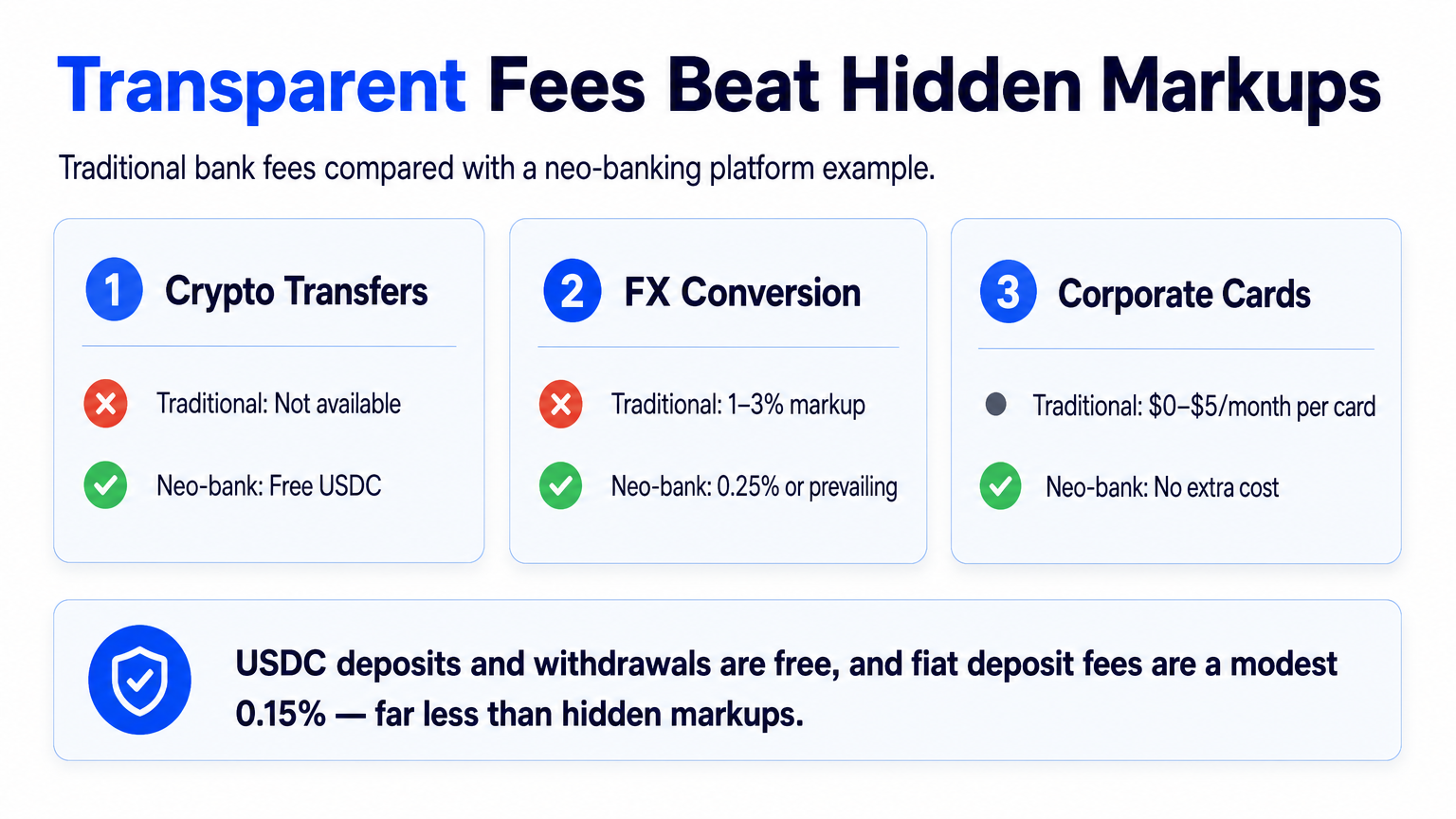
| FX Conversion | 1–3% markup | 0.25% or prevailing rate; 3% on corp card FX |
| Crypto Deposit/Withdrawal (USDC) | Not available | Free |
| Virtual Corporate Cards | $0–$5 per card/month | No extra cost |
For a multi-currency online business account with crypto, USDC transfers cost nothing, and fiat deposit fees are a modest 0.15% — far less than hidden markups.
How to Choose and Set Up Your Ecommerce Banking Stack
Audit your revenue corridors: list the countries you bill from/to, currencies held, and any crypto usage. Then compare ecommerce banking solutions on:
- Banking partner vs. fintech: Prefer a platform working with a licensed bank, with clear deposit insurance.
- FX clarity: Ensure published conversion fees, not “market rate.”
- Crypto integration depth: Check if stablecoin deposit/withdrawal is free and conversion instant.
- Card program: Look for virtual cards with per-transaction limits and stablecoin top-ups.
- Compliance: Multiple signatory roles, mandatory MFA, SOC 2 or similar audits.
Practical Example: Onboarding with OneSafe
Onboarding is fully digital. Provide formation documents, a government photo ID, and (for U.S. companies) your EIN. The process completes within one week; many applicants start in under 10 minutes. No physical paperwork. Once approved, issue virtual corporate cards instantly, set up multi-currency accounts in USD, EUR, CAD, and receive USDC without a separate wallet. Support: support@onesafe.io.
How do I open an online business account, and how long does it take?
Opening an online business account follows standard KYB: gather formation docs and ID, apply online, and pass verification. With a traditional bank, this takes 2–4 weeks; with a neo-banking platform, 3–7 business days. Have your EIN and proof of address ready. Avoid platforms promising “instant” accounts with no documentation — that’s a red flag. For why separating finances matters, see the risks of mixing personal and business accounts.
Common Mistakes
- “A neo-bank is just like a regular bank.” No — your fiat is held by a partner bank, not the fintech. Know who holds your deposit.
- “Crypto-friendly means FDIC insured.” FDIC covers only fiat in member banks, not crypto.
- “The cheapest FX fee is best.” Some bury costs in a fixed wire fee plus spread. Calculate total cost on a $10k transfer.
- “I don’t need multi-currency if I use Stripe.” Stripe converts at its own rates; a multi-currency account lets you time conversions.
- “My bank can’t freeze my account for crypto.” Banks can and do freeze accounts; a crypto-friendly provider actively supports those flows.
Next Steps for Ecommerce Businesses
Legacy institutions double down on real estate and consumer apps; agile platforms build native, multi-currency, crypto-inclusive infrastructure. Stop patching together Stripe, a brick-and-mortar bank, and a separate exchange. Audit your payment corridors and test a digital banking platform with a small balance — watch month-end reconciliation shrink.
Key Takeaways
- An ecommerce bank gives you multi-currency accounts, global payments, and crypto on/off-ramps in one interface.
- Legacy banks still invest in physical branches, not the cross-border or crypto-native infrastructure online sellers need.
- The best ecommerce banking solutions offer transparent FX, free USDC transfers, virtual corporate cards for ecommerce, and role-based permissions — onboarding in under a week.
- DAOs and Web3 startups need segregated custody, multisig-aware permissions, and automated fiat/crypto payment workflows.
- Always confirm where fiat is held and that digital asset custody uses institutional-grade security.
Ready to unify your business finances? Open a OneSafe account today to manage fiat and crypto from a single dashboard — no branch visit required.