Table of Contents
- description: "Bybit's OpenPayd deal highlights the consolidation of fiat and crypto rails, reshaping web3 payments infrastructure for businesses and DAOs."
- What Just Happened: Bybit and OpenPayd's Integrated Fiat-Crypto Play
- Why It Matters for Web3 Payments Infrastructure
- Web3 Payment Basics for Founders and Finance Leads
- Implications for Businesses and DAOs
- What to Watch Next
- Key Takeaways
description: "Bybit's OpenPayd deal highlights the consolidation of fiat and crypto rails, reshaping web3 payments infrastructure for businesses and DAOs."
Bybit OpenPayd Deal Sparks Web3 Payments Evolution
On September 24, 2026, The Paypers reported that Bybit selected OpenPayd for global fiat settlement and on/off-ramp services. For finance leads and DAO operators evaluating web3 payments infrastructure, the deal signals a structural shift: fiat banking, FX, and crypto settlement are consolidating behind a single API instead of living in separate, manually reconciled stacks.
What Just Happened: Bybit and OpenPayd's Integrated Fiat-Crypto Play
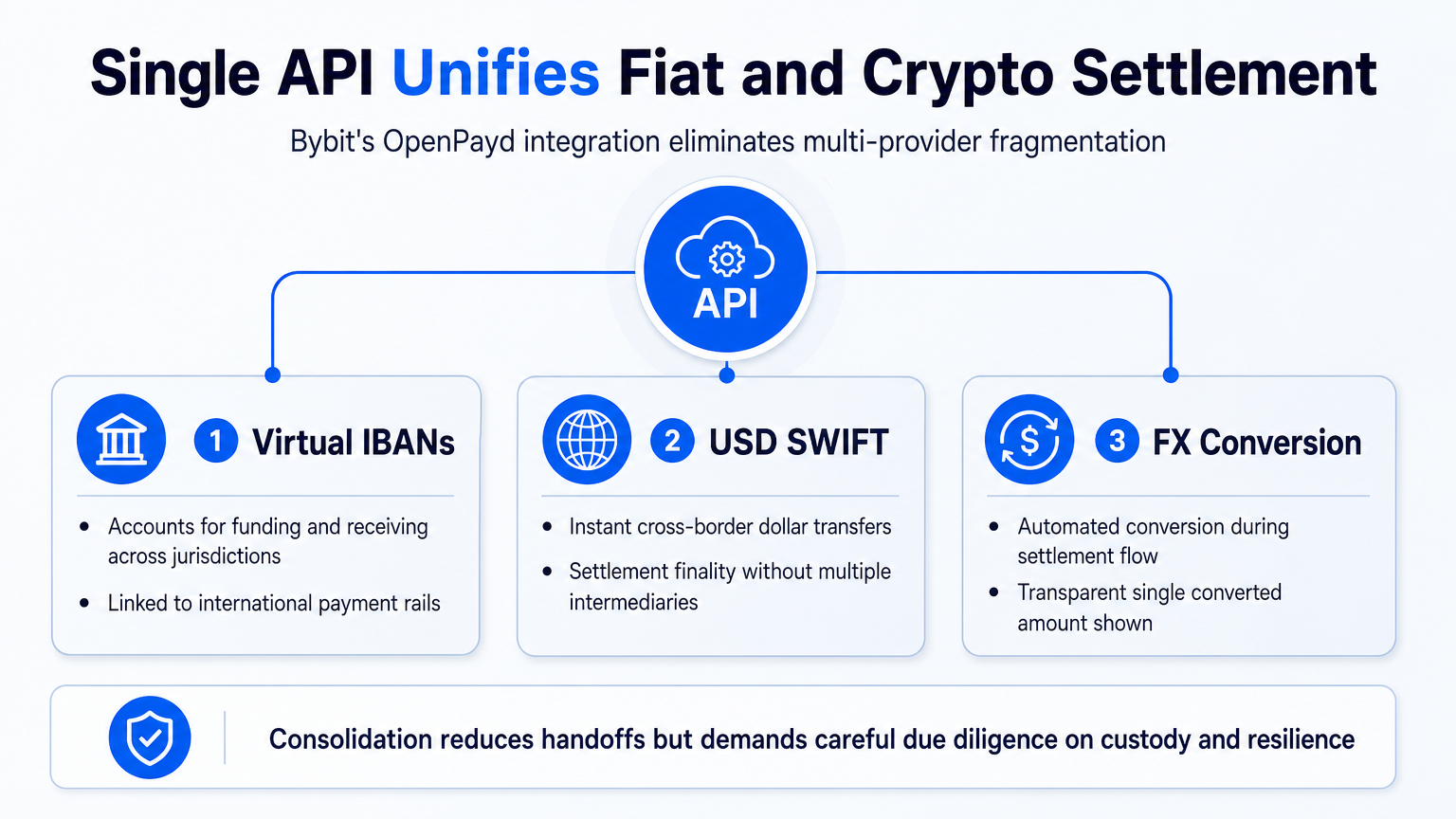
Bybit chose OpenPayd for global fiat operations, settlement flows, and on/off-ramping through a single API integration. The arrangement provides account infrastructure, USD SWIFT, and FX under one provider. It supplies virtual IBANs linked to international payment rails, supporting institutional settlement and retail on/off-ramping. The source frames the core problem directly: high‑volume deposits, withdrawals, and treasury movements across jurisdictions add operational complexity and reconciliation pain when routed through multiple providers.
What makes this notable for web3 payment infrastructure is the architecture: an exchange can now collect, convert, and settle funds through one fiat‑crypto layer instead of treating banking, FX, and crypto conversion as separate vendor problems.
Why It Matters for Web3 Payments Infrastructure
Consolidating Fiat and Crypto Rails
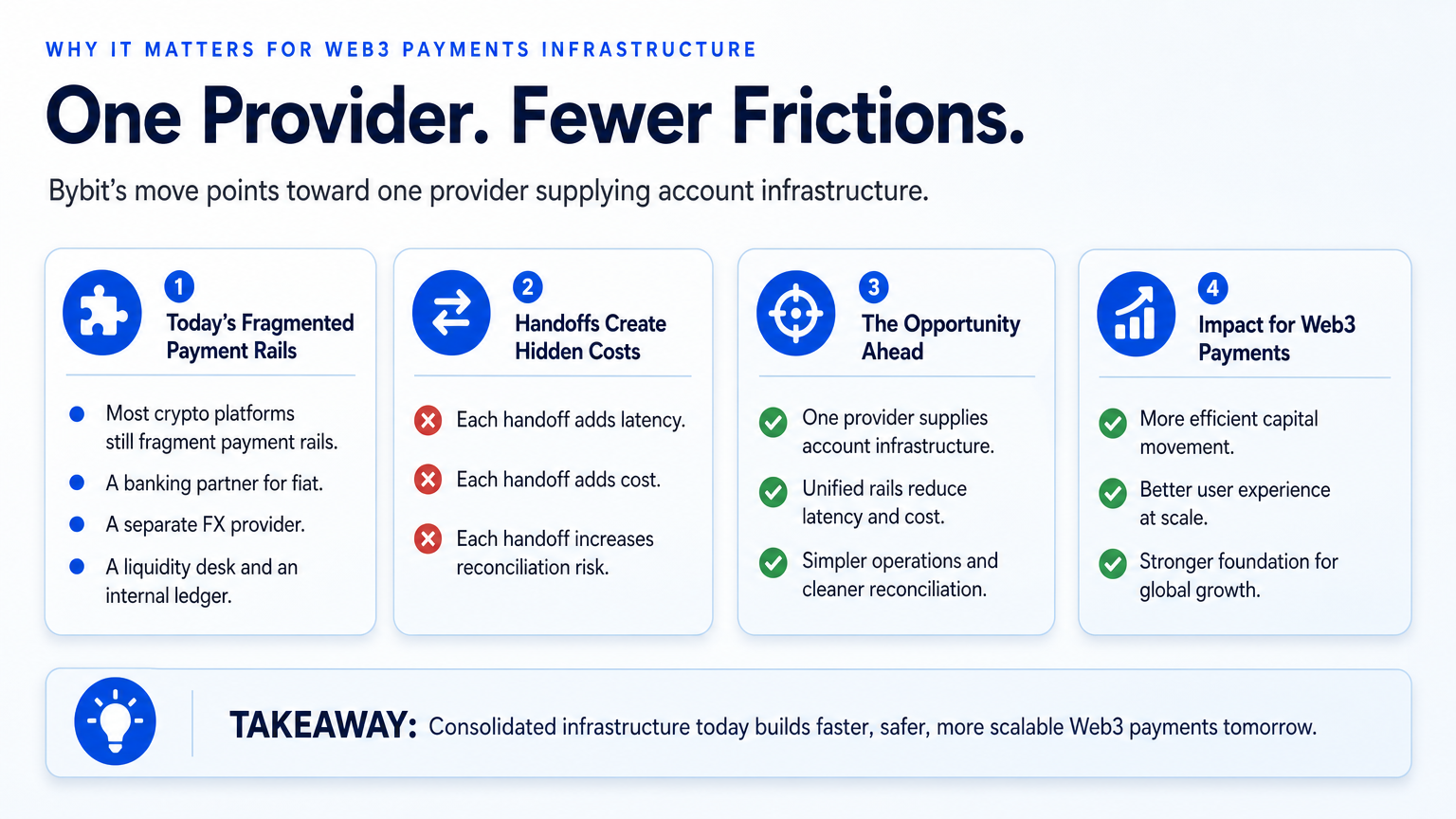
Most crypto platforms still fragment payment rails: a banking partner for fiat, a separate FX provider, a liquidity desk, and an internal ledger. Each handoff adds latency, cost, and reconciliation risk. Bybit’s move points toward one provider supplying account infrastructure, USD settlement, and FX via a single API—a meaningful simplification for cross‑border flows. PwC’s analysis reinforces that settlement speed is only as strong as the slowest rail; reducing the number of coordination points helps, though compliance and banking partnerships remain.
How It Differs from Traditional Stack Fragmentation
In a legacy setup, treasury teams juggle separate providers for multi‑currency accounts, FX, SWIFT, card acquiring, and crypto ramps—each with its own settlement window and fee schedule. The Bybit‑OpenPayd model mirrors what Paystand calls blockchain payments for CFOs: fewer intermediary steps, clearer settlement status. The tradeoff is concentration risk. With one provider across multiple critical flows, due diligence on custody, licensing, and operational resilience becomes essential.
Web3 Payment Basics for Founders and Finance Leads
Web3 payments are on‑chain transfers—often using stablecoins—with fiat on/off‑ramps for conversion. For a practical walk‑through, see How Do You Get a Web3 Account?. A typical flow: payer sends stablecoin on‑chain, settled in minutes, then receiver off‑ramps through a provider. The bottleneck is the off‑ramp’s speed and transparency.
A blockchain payment is a transfer recorded on a distributed ledger without central clearing. Stripe’s overview and Investopedia’s explainer detail the mechanics: transaction broadcast, consensus validation, immutable recording—sidestepping correspondent banking chains.
Stablecoins solve volatility, but their utility depends on off‑ramp providers with real banking relationships. Mastercard’s SoFi deal shows card networks linking stablecoin issuance to acceptance; the open question remains settlement reliability and who guarantees the off‑ramp.
Dynamic currency conversion (DCC) in Web3 mirrors the traditional model: an FX provider quotes a conversion rate when moving between fiat and stablecoin, embedding the spread. Bybit’s OpenPayd API handles FX inside the settlement flow, so users see a single converted amount. The practical lesson: always ask what rate is used and whether the markup is disclosed before confirming a transfer.
Implications for Businesses and DAOs
Evaluating Your Payment Provider
Before choosing a web3 payment infrastructure partner, finance leads should work through a short checklist:
- Custody model: Are digital assets in segregated wallets, and who is the custodian?
- Fiat rails: Which jurisdictions, wires, and currencies are actually supported?
- On/off‑ramp coverage: Can the same provider handle crypto deposits and fiat withdrawals?
- Fee transparency: Are spreads, wire fees, FX markups, and network costs disclosed separately?
- Compliance posture: Does the provider run KYB, sanctions screening, and transaction monitoring?
- DAO controls: Can roles and permissions be customized so no single person controls treasury movement?
The decision rule: get the full fee schedule and custody model in writing before you route treasury volume through a provider. Headline rates rarely capture the true cost of moving money across fiat and crypto.
The table below uses OneSafe’s published pricing as one reference. OneSafe is a financial technology company, not a bank; banking services are provided by its partners.
| Cost component | Published OneSafe fee or rate | Where hidden costs often sit |
|---|---|---|
| Fiat deposit / withdrawal | 0.15% | Bundled into quoted FX rate |
| Domestic wire withdrawal | $25 | Intermediary bank fees |
| Wire deposit | $10 | Same-day cutoff timing |
| SWIFT deposit / withdrawal | 0.35% + $50 | Correspondent bank charges |
| FX conversion | 0.25% or prevailing FX rate | Spread baked into rate |
| Corporate card FX | 3% | Foreign transaction settlement |
| Crypto USDC deposit / withdrawal | Free | Network or gas fees on some chains |
The between‑the‑lines costs—SWIFT intermediary fees, FX spreads, card foreign transaction charges—are where on/off‑ramping gets expensive. A unified platform can reduce those handoffs, but only if the fee schedule is explicit.
Why DAOs Should Care
A DAO treasury rarely separates fiat and crypto cleanly. Contributor payments may go out in stablecoins, grants arrive in fiat, and diversification means moving between both. Fragmented providers create multiple sign‑off processes and inconsistent reporting. Unified fiat‑crypto management aligns operational control with on‑chain governance through customizable roles and permissions. For deeper treasury structuring, see Crypto Treasury Management After Ripple's $13T Bet. OneSafe’s approach—combining fiat accounts, corporate cards, crypto ramps, and DAO‑specific permissioning—shows what the consolidation looks like from the buyer’s side.
What to Watch Next
Regulators are tightening the fiat side of on/off‑ramping. Sanctions screening, travel rule, and KYB obligations increasingly apply to providers touching both banking and crypto; if rules fragment across jurisdictions, the single‑API model becomes harder to maintain.
Consolidation may spread beyond exchanges. Any business handling fiat‑crypto settlement at volume—payment processors, payroll providers, DAO tooling platforms—has the same incentive to reduce rail fragmentation. Neobanks and Fintech: The Definitive Guide maps how that sector is converging with crypto‑native needs.
Regulatory friction can invert the convenience argument. If a unified provider loses a banking partner, clients that consolidated onto that provider may need to rebuild multiple rails quickly. The near‑term test is whether Bybit can demonstrate settlement reliability through the OpenPayd API, not just announce a feature.
Key Takeaways
- Bybit’s selection of OpenPayd consolidates fiat settlement, USD SWIFT, and FX into a single API, simplifying web3 payment infrastructure across institutional and retail on/off‑ramps.
- Consolidating fiat and crypto rails reduces reconciliation overhead but concentrates risk—buyers must scrutinize custody, licensing, and fee schedules deeply.
- Stablecoins bridge fiat and crypto only when the off‑ramp provider has real banking relationships and transparent conversion terms.
- Finance leads should evaluate providers on custody, fiat rail coverage, fee transparency, compliance, and DAO‑specific permissions before moving treasury volume.
- The next watchpoint is regulatory pressure on on/off‑ramp providers, which could accelerate consolidation or force exchanges to maintain redundant settlement rails.
For a unified platform built for businesses and DAOs that manage both fiat and crypto, explore OneSafe's financial infrastructure.