Is Web3 legitimate? Yes—Fortune 500 firms and DAOs use decentralized protocols for payments and governance. Here’s how to verify it yourself.
Table of Contents
- What Real-World Signals Prove Web3's Legitimacy Right Now?
- Why Do People Ask 'Is Web3 a Scam?' — Understanding the Risks
- How to Separate Legitimate Web3 Services from Fraud
- How Are Real Businesses Managing Fiat and Crypto Together?
- FAQ: Your Top Questions on Web3 Legitimacy, Answered
- Key Takeaways
What Real-World Signals Prove Web3's Legitimacy Right Now?
Apple, Google, and the institutional talent grab
In September 2026, Apple listed a role for an Apple Pay financial product strategy lead requiring knowledge of stablecoins and blockchain, while Google sought an Industry Principal Architect in Hong Kong with expertise in stablecoin payment networks and real-world asset tokenization. These moves signal that the world’s most valuable tech companies are building real payment infrastructure, not betting on a scam. This mirrors earlier moves by Mastercard, SoFi, and Circle to lay institutional-grade stablecoin payment rails.
Global DAOs and startups are operating on-chain — here’s how many
Governance tokens, multi-signature treasuries, and automated payroll in stablecoins are not science fiction. Thousands of DAOs already manage funds, vote on proposals, and pay contributors on-chain. One platform, OneSafe, reports processing over $800 million in transaction volume for more than 1,000 businesses across 30-plus countries — demonstrating operational cash flow, not speculation.
Regulatory milestones that are forcing banks to pay attention
In 2026, Italy mandated crypto banking sanctions screening, and multiple U.S. banks launched stablecoin pilots. Research shows over 75% of U.S. banks are now onboarding crypto-related clients, a tipping point captured in the crypto banking tipping point analysis. Treasury departments, compliance teams, and auditors are building the frameworks that turn Web3 into a supervised financial layer.
Why Do People Ask 'Is Web3 a Scam?' — Understanding the Risks
The scam distinction: human actors vs. decentralized tech
Scams exploit human trust, not code. Web3 isn’t a scam any more than email is because of phishing. A Web3 security guide by Ledger categorizes common threats — fake airdrops, impersonators on Discord, seed phrase theft — and each one is a social-engineering or central-point failure, not a protocol flaw.
Recent security failures and what they teach us (WaterPlum, Discord block)
The September 2026 WaterPlum campaign, linked to North Korea, stole over $10.7 million by faking recruiter profiles and infecting machines with malware. In the same month, Philippine ISPs blocked Discord, disrupting Web3 businesses overnight, as reported by BitPinas. Both incidents underscore that security in Web3 is a people-and-process problem, demanding rigorous access controls, multi-factor authentication, and vendor vetting.
How to Separate Legitimate Web3 Services from Fraud
A founder's checklist: custody, compliance, and real bank partners
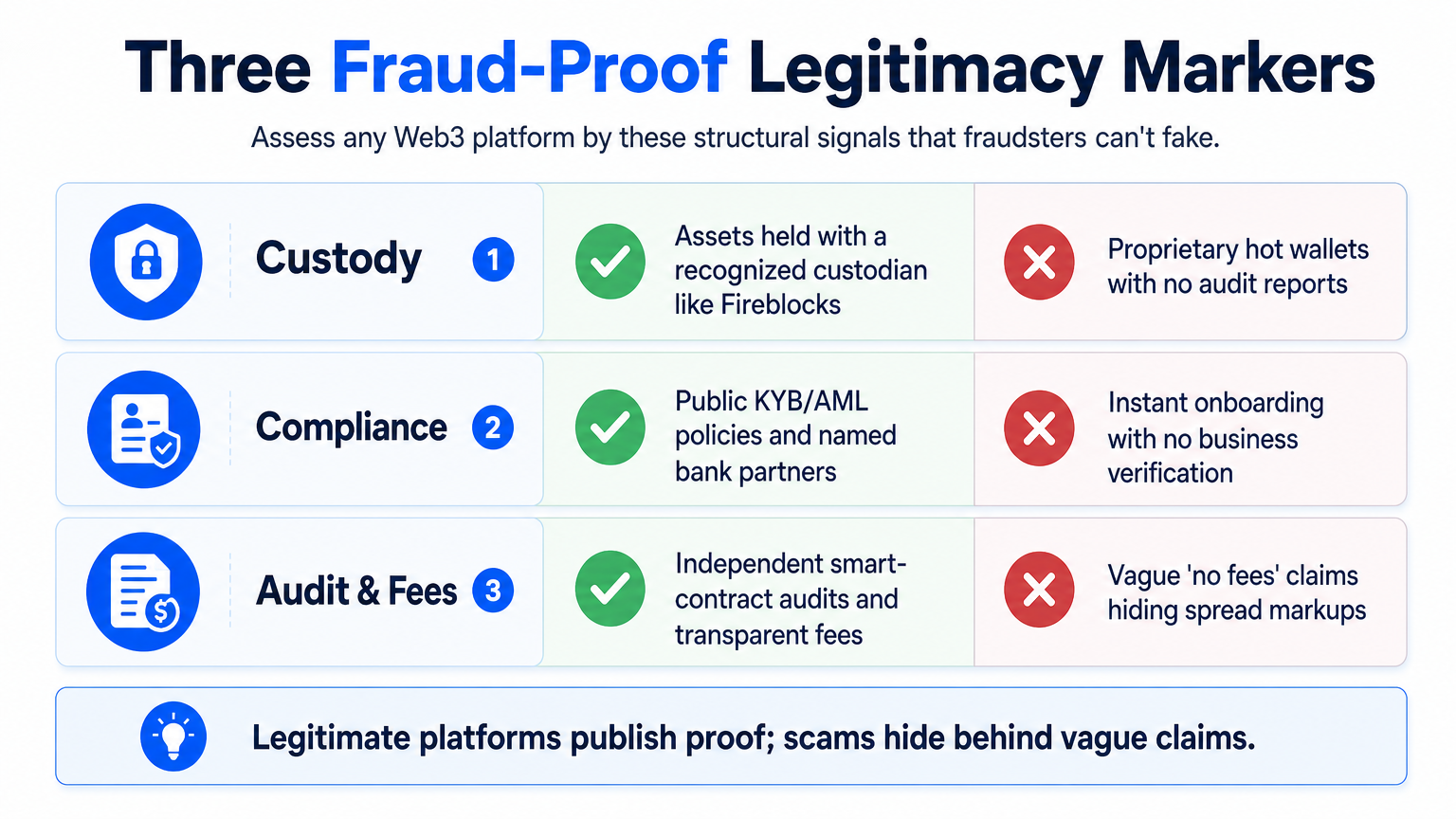
Assess any Web3 service with three structural markers fraudsters can’t fake:
- Custody and infrastructure — Are digital assets held with a recognized custodian like Fireblocks, or on a proprietary “hot wallet” the company controls?
- Compliance posture — Does the service have public know-your-business (KYB) and anti-money-laundering (AML) policies, and does it name the banking partners it works with?
- Audit and reporting — For smart-contract protocols, independent audits are a bare minimum. For financial platforms, segregated accounts and transparent fee schedules are non-negotiable.
When evaluating web3 compliance platforms, look for documentation that maps exactly how funds move between fiat and crypto. The absence of a named partner bank is a red flag, not a quirk.
Red flags every finance lead should recognize in a Web3 platform
| Legitimacy Signal | Red Flag |
|---|---|
| Named partner banks and segregated fiat accounts | “Banking partner” never disclosed; fiat held in commingled wallets |
| Digital asset custody via Fireblocks or equivalent institutional-grade MPC solution | Proprietary, self-hosted hot wallets with no third-party audit reports |
| Public compliance documentation, KYB process within days | Instant onboarding with no business verification |
| Transparent fee table for wires, FX, and crypto conversions (e.g., 0.15% fiat deposit, 0.25% FX) | Vague “no fees” claims that hide spread markups |
| Support channels reachable by email, live chat during business hours | Telegram-only support with no company address |
| Company registered in a jurisdiction with active financial supervision | Anonymous team, domiciled in secrecy havens with no regulatory footprint |
For a more detailed framework, see the guide to evaluating Web3 payments companies.
How Are Real Businesses Managing Fiat and Crypto Together?
Why a unified neo-banking approach matters for legitimacy
Startups and DAOs rarely keep finances in two separate worlds; they pay contractors in USDC one day and settle a vendor invoice in USD the next. A unified platform that blends fiat accounts, wire rails, and on-chain crypto custody eliminates the dangerous practice of manually moving funds between a bank and an exchange. This isn’t a convenience — it’s a compliance and security necessity. Neobanking and fintech infrastructure that natively handles both fiat and crypto reduces the surface area for mistakes and fraud.
What a compliance-first Web3 banking partner looks like in practice
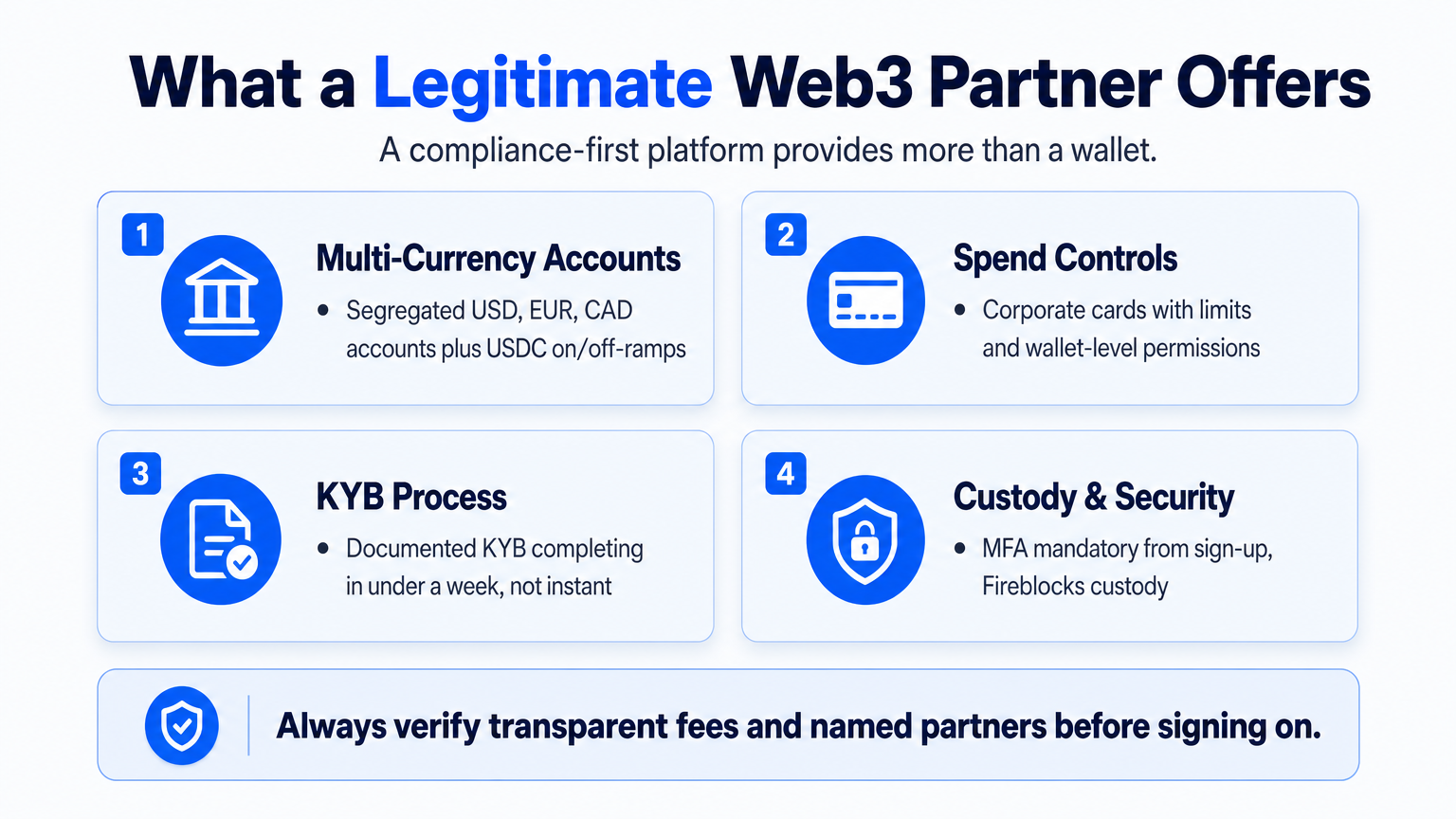
A legitimate crypto business bank or financial technology partner doesn’t just offer a wallet. It provides:
- Segregated multi-currency accounts (USD, EUR, CAD) alongside USDC on/off-ramps.
- Spend controls via corporate cards with limits.
- A documented KYB process that typically completes in under a week — not instant, no-questions-asked access.
- Multi-factor authentication mandatory from sign-up, and digital asset custody secured on an institutional platform like Fireblocks.
When choosing a crypto banking for startups solution, verify that the platform’s fee structure is transparent (e.g., 0.15% fiat deposit fee, free USDC deposits, wire fees clearly stated). Legitimate platforms publish these numbers; scams hide them.
FAQ: Your Top Questions on Web3 Legitimacy, Answered
Is Web3 legitimate or just a scam?
Web3 is a legitimate technology stack. Ethereum processes billions monthly, and Apple and Google are hiring stablecoin teams. Scams exist on these rails, just as they do on email, but the technology itself is not a scam.
What proof shows Web3 is not a scam?
Proof includes institutional custody solutions, regulatory frameworks like MiCA and U.S. bank pilots, and Fortune 500 stablecoin hiring. The Apple and Google moves in September 2026 show two of the most skeptical gatekeepers allocating headcount to tokenized finance. Additionally, platforms are processing hundreds of millions in combined fiat and crypto volume for real startups and DAOs.
Why do people think Web3 is a scam?
High-profile hacks, Ponzi-like token schemes, and anonymity create a lawless narrative. The WaterPlum attack and constant “rug pulls” amplify that perception. People often conflate the behavior of scammers with the infrastructure they misuse. In reality, web3 scams stem from weak operational security and insufficient regulation, not blockchain flaws.
How can I tell if a Web3 service is legitimate?
Verify named partner banks, institutional-grade custody (like Fireblocks), a transparent KYB process, and public fee schedules. Legitimate services operate with the same financial controls as regulated fintechs, adding native crypto capabilities. Avoid platforms that promise “no fees” without a clear spread or lack a physical business address and support email.
Are there real businesses using Web3 successfully?
Yes. DAOs manage treasuries on-chain with multi-signature governance, paying contributors in stablecoins and converting to fiat when needed. Global startups use Web3-native financial platforms to receive payments, pay suppliers, and hold working capital in both fiat and crypto. The recorded volume — over $800 million through one platform — shows web3 real-world use cases far beyond speculation.
How do I protect my company from Web3 scams?
Mandate hardware wallets for large crypto holdings, require multi-factor authentication on every financial account, verify smart contract addresses against official sources, and never approve token approvals to unknown contracts. On the banking side, work only with platforms that maintain segregated accounts and named banking partners. Operational discipline — fast key revocation and regular permission audits — is your strongest shield.
Can I run a legal business entirely on Web3 rails?
In many jurisdictions, yes, provided you handle AML/KYC and tax reporting. A hybrid approach is most practical: use on-chain treasury management for crypto flows while maintaining compliant fiat accounts via a neo-banking partner. This lets you transact in stablecoins and seamlessly off-ramp to USD, EUR, or CAD under one compliance umbrella.
What makes a Web3 banking platform safer than self-custody?
Self-custody places the entire security burden on your team — one lost private key can mean total loss. A platform with institutional custody on Fireblocks uses multi-party computation to split key control, preventing any single point of failure. Add mandatory MFA, KYB, and bank-grade encryption, and you have a system that mirrors traditional safeguards while preserving crypto functionality.
Is Web3 regulated enough to protect my company?
Regulation is fragmented but accelerating. The EU’s MiCA framework, Italy’s crypto banking sanctions screening rule, and U.S. state-level crypto charters are closing gaps. For a company, protection comes from choosing partners in well-regulated jurisdictions with compliance programs beyond the minimum — not from relying on a single global safety net.
Key Takeaways
- Web3 legitimacy is anchored in institutional adoption: Apple and Google hiring stablecoin teams in September 2026 should end the “is it real?” debate.
- Scams are a human-layer problem, not a blockchain problem; mitigate with phishing awareness, access controls, and vendor due diligence.
- Verify a Web3 service’s legitimacy through a short checklist: named partner banks, institutional-grade custody, transparent KYB, and clear fee schedules.
- Real businesses and DAOs operate on-chain today, using unified fiat-crypto platforms to manage treasury, payroll, and payments — proving crypto banking for startups is a working category.
- Protection is procedural: hardware wallets, MFA, permission audits, and segregation of custody give you the same safety profile as a traditional treasury operation.
Start managing fiat and crypto from a single, compliant platform built for Web3-native businesses — open your OneSafe account today.


![How to Open a Business Bank Account for LLC [Neobank Workflow]](https://cdn.prod.website-files.com/65202616cfa1bf1882f3db51/6ab564b075bebde25f443ac9_6ab564aee90c0fd31d6d37f5_how-to-open-business-bank-account-for-llc-neobank-header.png)