Meta description: Learn how to evaluate Web3 payments companies in 2026—covering web3 payment infrastructure, crypto payment solutions, fees, DAO needs, and Big Tech’s stablecoin moves.
In 2026, evaluating Web3 payments companies isn’t just about finding a crypto gateway. It’s about choosing a financial operating system that unifies stablecoin settlements, fiat rails, and DAO treasury controls without breaking compliance or accounting. This guide gives founders and finance leads a concrete evaluation framework—covering custody, real fees, and what Big Tech’s recent stablecoin hiring means—so you can pick a provider strategically, not from a generic list.
Table of Contents
- What are Web3 payments?
- What makes a Web3 payments company different?
- The landscape: three categories
- The Big Tech effect: opportunity, not threat
- How to choose a Web3 payments company: an evaluation framework
- What’s the real cost of using a Web3 payments provider compared to a traditional bank?
- How does a DAO manage fiat and crypto payments together?
- What changes with Big Tech entering stablecoin payments?
- Are Web3 payments secure and compliant?
- Migrating from traditional banking: a phased approach
- Mistakes and myths that cost you
- First-round evaluation checklist
- Key takeaways
- Sources
What are Web3 payments?
Web3 payments use blockchain-based rails (primarily stablecoins like USDC) to move value globally without card networks or correspondent banks, offering near-instant settlement, programmability, and always-on availability. The common building blocks—gateways, on‑ramp/off‑ramp services, wallets—are well known. The shift now is from whether to use crypto rails to how to integrate them alongside fiat operations without duplicating treasury functions.
What makes a Web3 payments company different?
A modern provider is a full-stack financial operating system: multi-currency fiat accounts, stablecoin convertibility, corporate cards, and on-chain treasury controls in one interface. The best let you receive USDC, split it between fiat accounts and a DAO’s wallet, and pay suppliers in EUR—all with a unified audit trail. This convergence blurs the line between neobanks and fintech platforms.
Big Tech’s stablecoin hiring validates the infrastructure
On Sept. 20–21, 2026, Apple and Google posted roles demanding deep stablecoin and tokenized deposit expertise (Apple Pay financial product lead; Google’s Web3 Industry Principal Architect). Neither plans its own stablecoin, but they’re integrating stablecoin settlement into Apple Pay and Google Pay. This is a permanent utility shift—not a speculative cycle—and web3 payment infrastructure becomes the standard plumbing that startups can already leverage.
The landscape: three categories
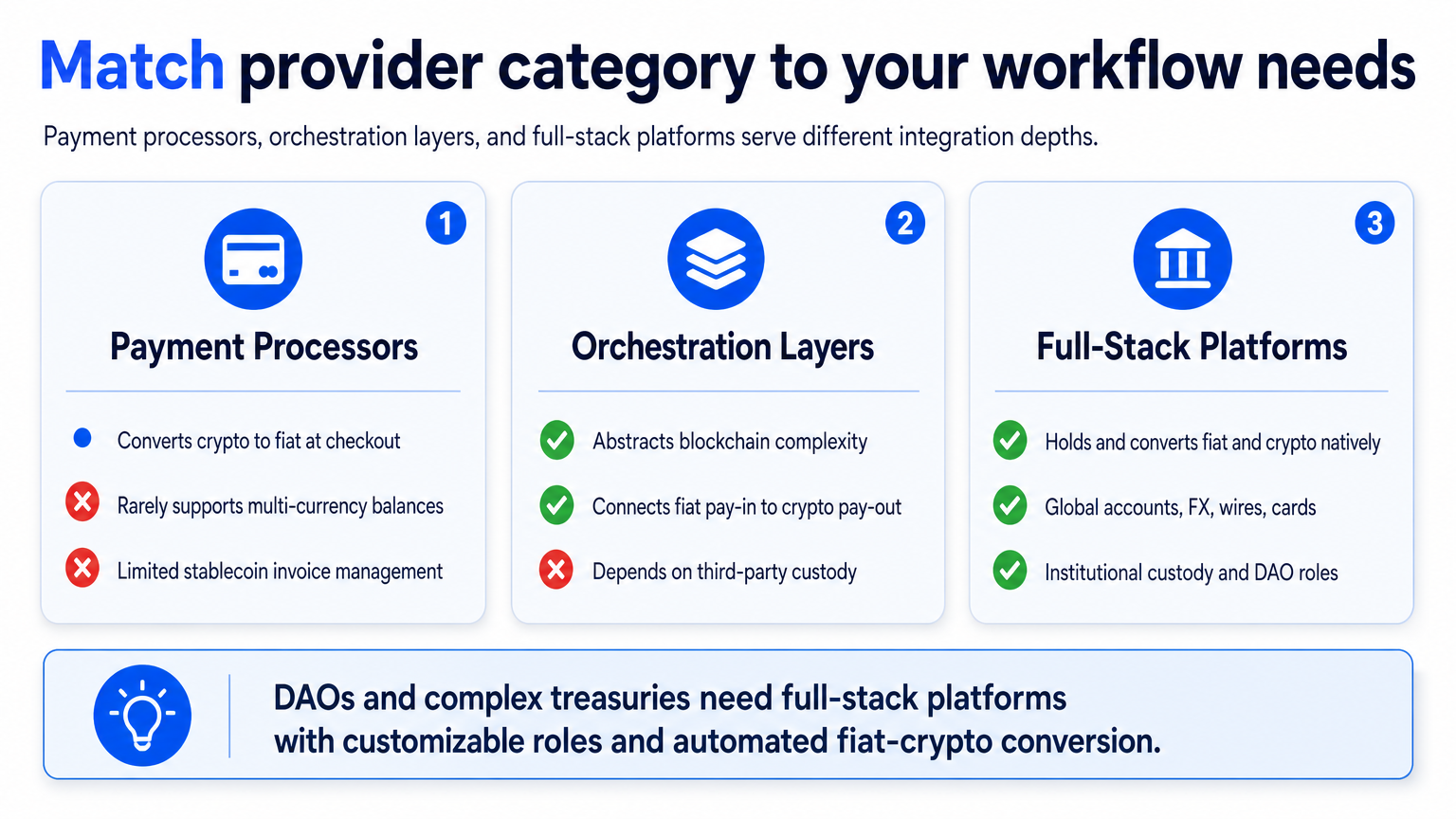
- Payment processors (blockchain payment gateways): e.g., BitPay, Coinbase Commerce. They convert inbound crypto to fiat and settle to a bank. Good for checkout, but rarely support multi-currency balances or invoice management in stablecoins.
- Orchestration layers: e.g., Stripe’s crypto on‑ramp. They abstract blockchain complexity, connecting fiat pay-in to crypto pay-out, but depend on partners for custody.
- Neo-banking / full-stack platforms: Provide global business accounts that natively hold and convert between fiat and crypto. They offer global accounts, FX, wires, corporate cards, and crypto on‑ramp off‑ramp, typically with institutional custody. OneSafe falls here—a fintech (not a bank) that partners with regulated institutions to offer segregated fiat accounts and Fireblocks-secured digital asset custody, serving 1,000+ businesses across 30+ countries.
DAOs often need a neo-banking platform with customizable roles and automated fiat-crypto conversion; institutional treasuries need segregation and ERP integrations. Evaluating payment providers requires matching these archetypes to your actual workflows.
The Big Tech effect: opportunity, not threat
Apple and Google’s talent hunt unlocks mass distribution. When stablecoin settlements work invisibly inside everyday apps, the addressable market for web3 payments companies explodes. Startups can already access the same institutional-grade infrastructure—Fireblocks MPC custody that Bitpace integrated for cross-border stablecoin transfers (The Paypers, Sept. 23, 2026)—through neo-banking platforms. Choosing a provider with Fireblocks-backed custody and unified fiat-crypto accounts means your rails are ready when Big Tech flips the switch.
How to choose a Web3 payments company: an evaluation framework
Security & custody
Ask: “Where are private keys generated, and who controls them at rest?” Acceptable answers are MPC distributed across independent parties or HSMs in Tier III/IV data centers. OneSafe uses Fireblocks’ MPC-CMP, removing single-point compromise. Verify segregated, policy-controlled vaults and mandatory multi‑factor approval for all transactions.
Regulatory reality
No platform is licensed everywhere. Get a current list of supported jurisdictions and active services (fiat custody, crypto conversion, card issuance). KYB typically requires incorporation papers, government ID, and tax ID; OneSafe’s digital flow can complete within a week but isn’t available in OFAC‑sanctioned countries. Stablecoin rules still evolve, so choose a provider that actively monitors sanctions lists and can adapt to new travel rule requirements without locking funds.
Fee structures: real numbers
Many advertise “0% crypto conversion” but hide costs in wire fees or FX spreads. Below is a comparison using OneSafe’s published pricing:
| Transaction Type | OneSafe Cost | Typical Traditional Bank | Hidden Web3 Pitfalls |
|---|---|---|---|
| Domestic wire (ACH) | 0.15% deposit/withdrawal | $15–$30 flat | “Free” but 2%+ FX on conversion leg |
| International wire (SWIFT) | 0.35% + $50 | $35–$65 + correspondent fees | “Network fee” only, ignores intermediary charges |
| FX conversion (fiat) | 0.25% or prevailing rate | 1%–3% | Undisclosed spread |
| Corporate card FX | 3% | 2.75%–3.5% | Bundled statement without itemization |
| Crypto deposit/withdrawal (USDC) | Free | N/A | Some charge 0.5%–1% per transfer |
| Account maintenance | Free / $29/mo premium | $15–$50/mo | Free trial then $99/mo |
For a business moving $100k monthly, a traditional bank can cost $1,200+ in fees/FX. A properly structured web3 payments platform halves that, provided you avoid hidden spreads on crypto conversion. Always demand a full fee schedule including crypto‑to‑fiat FX markup.
Onboarding & support
A “one-week” onboarding is realistic only if you have all documents ready. OneSafe’s fully digital process starts in 10 minutes and typically finishes within 7 days; human fraud review still applies. For ongoing support, ensure 24/7 access and an unblockable email (e.g., support@onesafe.io), not just a chatbot.
DAO-native needs
DAOs can’t use a single‑login payment processor. Look for:
- Customizable roles (initiator, approver, auditor) with transaction limits.
- Multi‑sig governance—integration with on‑chain SAFE wallets for large moves.
- Automated workflows for recurring stablecoin payroll that converts to fiat, all with transparent logs. OneSafe’s DAO account structure supports these features, with Fireblocks custody and on/off‑ramp automation. (See how to get a web3 account as a DAO.)
What’s the real cost of using a Web3 payments provider compared to a traditional bank?
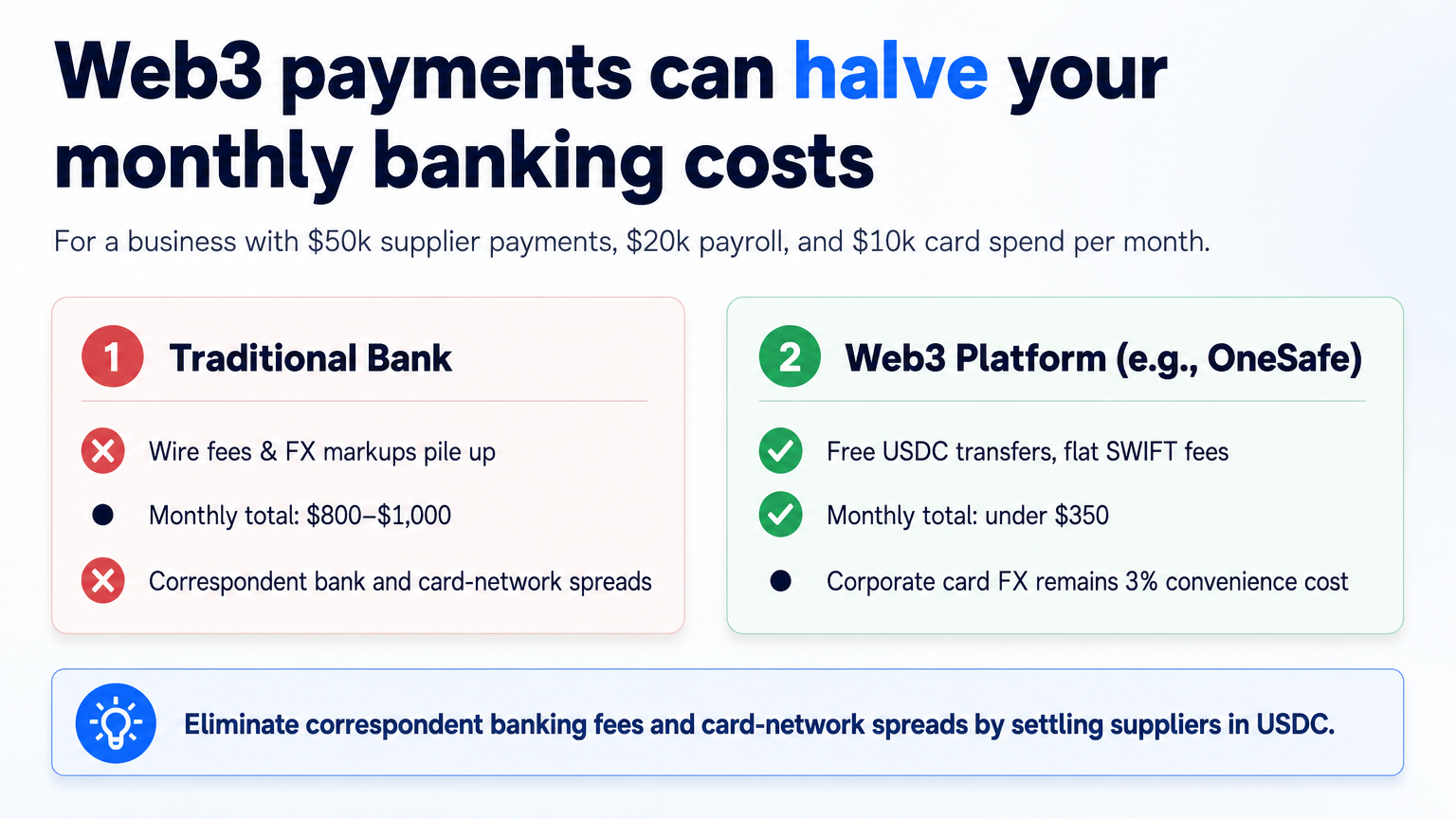
Using the table above: a business with $50k international supplier payments, $20k cross-border payroll, and $10k corporate card spending per month might pay $800–$1,000 in bank wire fees, FX markups, and maintenance. A web3 payments infrastructure like OneSafe, with free USDC transfers, 0.25% FX, and flat SWIFT fees, can drop that below $350. Stablecoin rails eliminate correspondent banking fees and card-network spreads. The real savings come from settling suppliers in USDC, not wire transfers. However, corporate card FX (3%) is still a convenience cost—use it for small purchases, not large FX needs.
How does a DAO manage fiat and crypto payments together?
A DAO’s treasury is usually in stablecoins, but bills are in fiat. Without a unified platform, you’d manually swap on a DEX, move fiat to a multi‑sig bank account, and handle payroll—a fragmented, unauditable mess. A neo-banking platform built for crypto-native entities holds treasury USDC in a Fireblocks vault, auto‑converts a pre‑set amount to fiat on schedule, and executes payments with role-based approvals. OneSafe, for instance, lets the core team assign a “spender” with a $5k daily limit, an “approver” for larger amounts, and an “auditor” with view-only access—mirroring on-chain governance while staying fiat‑compliant. This hybrid capability is increasingly critical, as the shift toward crypto treasury management shows.
What changes with Big Tech entering stablecoin payments?
Stablecoin settlement inside Apple Pay and Google Pay makes the infrastructure ambient—vendors receive USDC‑denominated payments without “accepting crypto.” The consumer front‑end becomes commoditized; the back‑end custody, compliance, and seamless fiat/crypto conversion become the durable moat. Platforms that already deliver a full-stack financial operating system are positioned to plug into these Big Tech rails, turning the moat from “processing crypto payments” to “running the financial OS that routes, converts, and reconciles fiat and stablecoins in a single account.” That’s where providers with Fireblocks custody and a global banking partner network, like OneSafe, benefit.
Are Web3 payments secure and compliant?
Yes—when built on institutional infrastructure. A provider must separate client fiat from corporate funds, hold digital assets in regulated, insured custody (Fireblocks’ insurance is a start, but read the fine print), and enforce MFA and real‑time AML screening. The recent Italy crypto banking sanctions screening rule shows how local regulations can force sudden transaction checks. Always ask: “Who is the licensed entity holding my fiat, and is the custody a bailment or a custodial trust in my company’s name?”
Migrating from traditional banking: a phased approach
Don’t rip out your bank. Start with a parallel setup:
- Open a web3 business account (e.g., OneSafe) with a small fiat deposit; keep your legacy bank for critical recurring payments.
- Route new crypto revenue through the new account, directing USDC client payments and converting a portion to fiat.
- Test one vendor payment via stablecoin or international wire, comparing speed and cost.
- Shift payroll and corporate card spending once you’ve validated settlement times and accounting integration.
- Maintain a bridge balance in the legacy bank until all direct debits migrate. This prevents disruption—see the full guide to opening a web3 account.
Accounting & reconciliation
Each crypto transaction has a blockchain entry with a fee in the native token. Your platform must provide exportable logs linking fiat‑ledger entries with on‑chain events. OneSafe’s accounting integration maps each conversion to a line item. Reconcile daily—crypto volatility during conversion windows can create small gains/losses that must be recorded. If reporting can’t separate “crypto transfer fee” from “FX conversion cost,” you’ll lose hours untangling the P&L.
Mistakes and myths that cost you
FDIC insurance does not cover digital assets
FDIC pass‑through insurance applies only to fiat in an FDIC‑insured bank, in your company’s name, under specific custodial arrangements. Digital assets in a Fireblocks vault are not insured beyond the custody provider’s policy. OneSafe holds fiat in segregated accounts at partner banks, but stablecoin balances rely on Fireblocks’ security—not FDIC. Never assume “all‑in‑one” means “all insured.”
An ‘all‑in‑one’ platform is not a bank
A neo‑banking platform (like OneSafe) is a technology company using banking partners. Your fiat account is subject to the partner bank’s schedule and limitations; the platform glues crypto and fiat together in UX, not in regulatory structure. Always know which partner bank holds your fiat and whether you have direct recourse. (See neobanks vs fintech.)
First-round evaluation checklist
| Category | Question |
|---|---|
| Custody | Will digital assets be in an MPC‑based vault (e.g., Fireblocks)? Is the vault segregated from the provider’s corporate assets? |
| Banking partner | Which regulated bank holds my fiat? In what jurisdiction? Is the account in my company’s name? |
| Fee transparency | Show me a full fee schedule, including FX markup and any spread on crypto conversions. |
| DAO capabilities | Can I assign granular roles with limits? Does the platform integrate with multi‑sig wallets? |
| Onboarding | What documents do I need, and what is your current average KYB turnaround? |
| Support | What is the escalation path for a stuck wire? Do you provide a direct email for urgent issues? |
Red flags: inability to show a live segregated fiat account alongside crypto in one dashboard; “global” account that supports only two fiat currencies and no stablecoin conversion; “no fees” claims with undisclosed spreads; no documented role‑based access for teams/DAOs; requirement to hold crypto in a hot wallet without institutional custody. In 2026, you should not compromise on these.
Key takeaways
- Evaluate custody not UI—demand an MPC‑based architecture with segregated digital assets.
- Model total cost with real fee schedules; hidden FX markups and wire fees often eclipse advertised savings.
- Big Tech’s stablecoin hiring confirms the primitives are ready; choose a provider running on institutional rails to plug into future Apple/Google flows without rebuilding.
- DAOs need role‑based governance and automated fiat‑crypto conversion, not a generic gateway.
- Migrate in phases: route new crypto revenue first, then shift payroll after validating reconciliation.
Ready to unify your global fiat and crypto operations? Open a OneSafe account today.
Sources