On September 24, 2026, SoFi began settling debit and credit card transactions with Mastercard using its own stablecoin, SoFiUSD—without changing how customers pay. The migration, reported by Cointelegraph via TradingView, puts an expected $25 billion in annualized volume onto a blockchain-based settlement rail. It’s the most concrete signal yet that crypto banking is separating settlement from legacy banking rails, and it has immediate implications for any business that holds working capital in stablecoins.
Table of Contents
- What just happened: SoFi puts card settlement on a stablecoin rail
- Why this matters for crypto banking now
- Background: how card settlement works today—and what’s changing
- Concrete implications for businesses, startups, and DAOs
- Where crypto banking platforms like OneSafe already align
- What to watch next: open questions and regulation
- What is crypto banking and how does stablecoin settlement change it?
- How does stablecoin settlement work with corporate cards?
- What does SoFi’s move mean for my startup or DAO?
- Can I get a crypto banking platform that supports stablecoin settlement rails today?
- What are the benefits of on-chain settlement for a global business?
- Is my business ready for stablecoin-native banking?
- Key Takeaways
What just happened: SoFi puts card settlement on a stablecoin rail
SoFi shifted its entire card program to settle with Mastercard in SoFiUSD, a stablecoin it issues. A SoFi spokesperson told Cointelegraph that the move provides an alternative blockchain-based settlement rail without removing intermediaries. Cardholders swipe or tap as usual; the change is entirely in the back-end. SoFi expects to process over $25 billion in annualized volume.
The development stands alongside Visa’s April 2026 disclosure that its stablecoin settlement pilot reached a $7 billion annualized run rate across nine blockchains. Together, these moves prove stablecoin settlement is scaling in production with two of the world’s dominant card networks.
Why this matters for crypto banking now
The payment stack separates from banking rails—and that’s good for business
Traditional card settlement uses batch processing and correspondent banks that move money only on weekdays. Stablecoin settlement decouples value transfer from that schedule. A business holding USDC in a crypto account can use that same capital to settle card obligations, eliminating the need to pre-fund multiple fiat accounts across countries. The result: less float, lower counterparty risk, and around-the-clock liquidity.
For crypto banking platforms, this is a structural shift. The infrastructure bridging fiat and crypto is evolving from a simple on/off-ramp into a settlement-native architecture. A crypto-friendly business account with stablecoin support and corporate card issuance can now plug directly into networks where settlement happens on-chain.
Stablecoins are becoming infrastructure, not just assets
As Visa’s overview of stablecoins describes, stablecoins are moving from trading instruments to the “plumbing” of a new payments ecosystem. The SoFi-Mastercard integration shows stablecoins can serve as the settlement layer while card networks handle authorization, branding, and consumer touchpoints. The upgrade isn’t about replacing Visa and Mastercard; it’s about replacing the banking rails between them with a natively compliant, 24/7 settlement currency.
Background: how card settlement works today—and what’s changing
Four-party model and the settlement delay
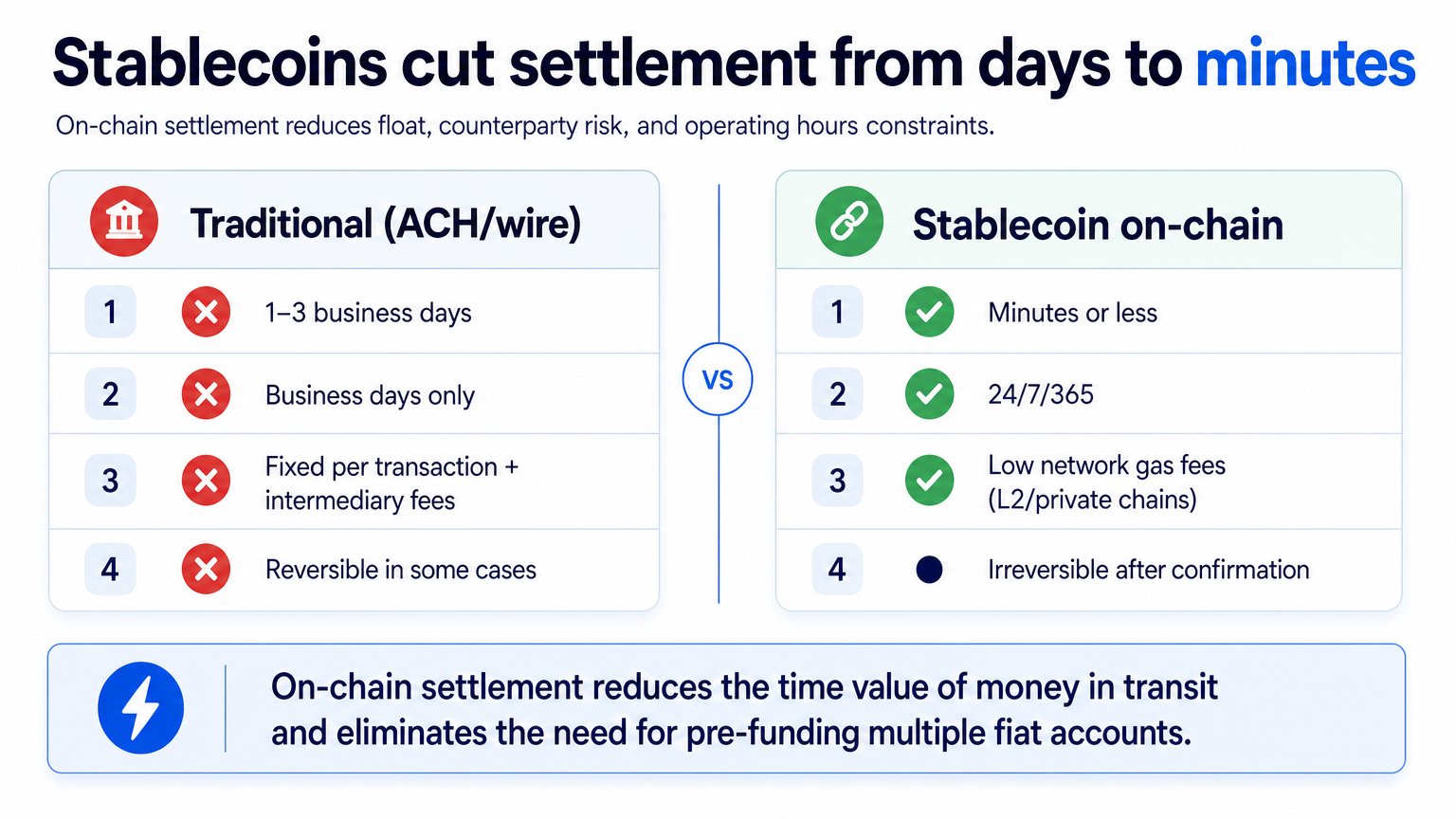
A typical card transaction involves the cardholder, merchant, issuing bank, and acquiring bank. Settlement between issuer and acquirer usually happens in batches via ACH or wire transfers, taking one to three business days. During that window, funds sit in limbo and both sides carry credit risk.
Where stablecoins fit: a cleaner, round-the-clock rail
Stablecoin settlement replaces the interbank fiat transfer with a stablecoin transfer on a blockchain. Because blockchains operate 24/7 and reach finality in minutes or seconds, the delay collapses. The Federal Reserve’s March 2026 note on payment stablecoins points out that near-instant settlement reduces counterparty risk and operational overhead. SoFi’s arrangement uses a private blockchain environment, but the mechanism is the same: value moves directly on a shared ledger without corresponding bank hops.
| Settlement Mechanism | Speed | Operating Hours | Typical Fee Structure | Finality |
|---|---|---|---|---|
| Traditional (ACH/wire) | 1–3 business days | Business days only | Fixed per transaction + intermediary fees | Reversible in some cases |
| Stablecoin on-chain | Minutes or less | 24/7/365 | Network gas fees (low for Layer 2 / private chains) | Irreversible after confirmation |
On-chain settlement reduces the time value of money in transit and eliminates the need for pre-funding multiple fiat accounts.
Concrete implications for businesses, startups, and DAOs
Settlement speed and liquidity
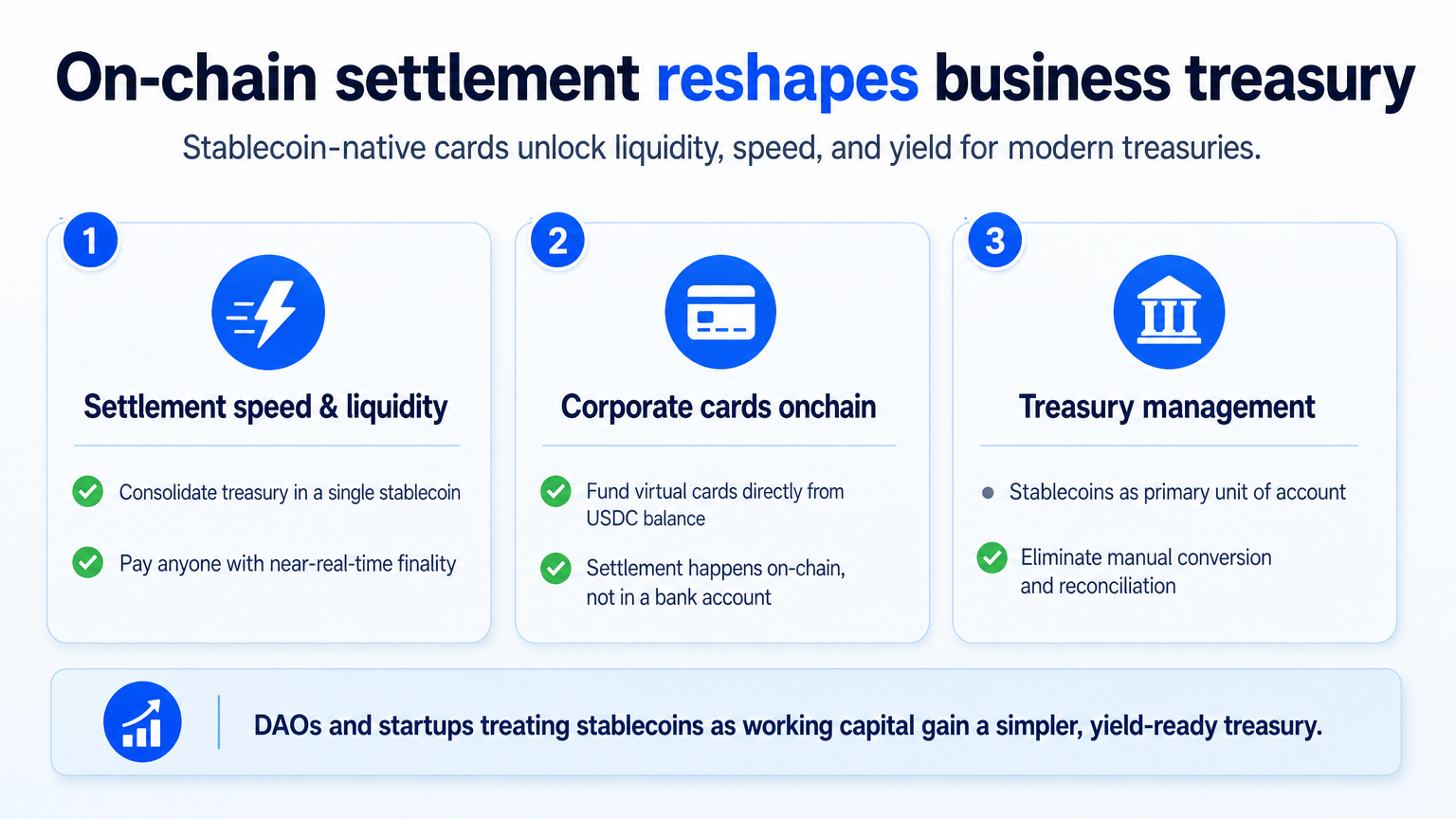
A startup paying contractors across time zones can consolidate treasury in a single stablecoin and pay anyone with near-real-time finality, avoiding extra cash buffers in each currency. Paired with a business crypto account that holds USDC and pays out in local fiat, the efficiency gain is immediate.
Corporate cards onchain
SoFi’s pilot proves a card portfolio can settle in stablecoins. That opens the door to corporate crypto cards backed by a stablecoin balance rather than a traditional bank account. A business issues virtual cards, sets spend limits, and funds them with USDC—the settlement happens on-chain behind the scenes. The cardholder experience stays the same, but treasury benefits: cash remains onchain and can work in a yield strategy instead of sitting idle.
Treasury management when stablecoins are payment and investment
DAOs and Web3-native organizations already treat stablecoins as working capital. Settling card obligations directly from a stablecoin treasury means funds no longer sit in a separate bank account just for payment runs. As explored in Crypto Treasury Management After Ripple’s $13T Bet, automated workflows that treat stablecoins as the primary unit of account become simpler when settlement removes manual conversion and reconciliation.
Where crypto banking platforms like OneSafe already align
OneSafe provides multi-currency accounts (USD, EUR, CAD) with integrated stablecoin on/off-ramps—USDC deposits and withdrawals are free. A startup can receive a client payment in USDC, hold it, and later use that same balance to fund a corporate card or pay a supplier, all within the platform. The on/off-ramp bridges traditional banking and emerging stablecoin settlement networks.
Its corporate cards can be topped up with eight or more tokens, including stablecoins. Today, they settle through traditional rails, but the architecture anticipates on-chain settlement. Even now, funding a card from a stablecoin balance and spending through Mastercard gives businesses a preview of the speed and simplicity that full on-chain settlement will unlock.
For DAOs, OneSafe layers crypto-friendly accounts with customizable roles and permissions, enabling on-chain control while interfacing with fiat payment rails. As stablecoin settlement spreads, DAO treasuries will be able to execute an on-chain vote that triggers a real-world payment without off-ramping first.
What to watch next: open questions and regulation
Will other banks and networks follow?
SoFi’s model depends on a bank-issued stablecoin. Visa’s pilot proves infrastructure is scaling across nine blockchains. The question is whether other issuers partner with existing stablecoin providers or wait for a regulatory framework to issue their own.
What does the FDIC’s recent clarification enable?
The FDIC has signaled a more accommodating stance, but no rule yet greenlights stablecoin settlement across the banking system. SoFi leans on a stablecoin it controls. A broader framework covering issuance, redemption, and reserves would give more banks comfort to follow, potentially allowing non-bank fintechs to offer stablecoin-settled cards through banking partners.
How will stablecoin settlement affect cross-border banking?
If card networks extend stablecoin settlement to international transactions, end-to-end settlement could compress to minutes at a fraction of today’s cost. For global businesses and neo-banking for startups, stablecoin payments would shift from a niche option to a core treasury tool.
What is crypto banking and how does stablecoin settlement change it?
Crypto banking, as outlined in Crypto Bank and Crypto Banking 101, refers to platforms that let businesses hold, move, and spend both fiat and digital assets from one interface. Historically, these platforms focused on custody and conversion: convert Bitcoin to dollars, then pay a bill. Stablecoin settlement transforms that model by making stablecoins a final settlement currency. Instead of converting to fiat for every transaction, a business pays in a stablecoin that settles on-chain, cutting the settlement cycle from days to minutes and removing the need to pre-fund a patchwork of fiat accounts.
How does stablecoin settlement work with corporate cards?
When a corporate card transaction occurs, the issuer must pay the merchant’s bank. In a stablecoin settlement model, the issuer transfers stablecoins—not fiat—to the network’s settlement account, which credits the acquirer. The cardholder sees a normal transaction, but the back-end settlement moves on a blockchain rail. For businesses using corporate crypto cards from a platform like OneSafe, if the card is funded from a stablecoin balance, the entire lifecycle—funding, authorization, settlement—can remain onchain, dramatically reducing float and reconciliation work.
What does SoFi’s move mean for my startup or DAO?
For a startup or DAO that already manages treasury in stablecoins, SoFi’s migration signals that card spending can soon be a native onchain operation. You may be able to hold working capital in USDC and issue cards that draw directly on that balance, without converting to a bank account first. That eliminates a conversion step and keeps cash in one global pool. For DAOs, on-chain settlement aligns with transparent, vote-driven treasury management.
Can I get a crypto banking platform that supports stablecoin settlement rails today?
Direct stablecoin settlement for card networks is still emerging. However, several platforms offer the necessary building blocks: a business crypto account with stablecoin on/off-ramps, corporate cards fundable with stablecoins, and integrated fiat/crypto custody. OneSafe provides free USDC deposits and withdrawals, corporate cards topped up in stablecoins, and segregated global accounts. While cards still settle through traditional rails, the architecture is ready for on-chain settlement when card networks and banking partners enable it.
What are the benefits of on-chain settlement for a global business?
On-chain settlement delivers three concrete advantages: speed (minutes instead of days), liquidity efficiency (hold a single stablecoin instead of multiple fiat buffers), and reduced counterparty risk (immediate finality, not subject to bank hours or reversals). For a business paying suppliers, freelancers, or cross-border invoices, these translate into lower working capital requirements and a simpler, more transparent treasury.
Is my business ready for stablecoin-native banking?
Use this quick checklist:
- Does your business hold a portion of its treasury in stablecoins like USDC?
- Are you comfortable managing private keys or using a custodial platform with strong security (e.g., Fireblocks-backed custody)?
- Do you have a business crypto account that handles fiat and crypto in one dashboard?
- Can you map your payment flows to a model where a corporate card is funded from a stablecoin balance?
- Are you aware of the regulatory status of stablecoins in your operating countries?
If most answers are yes, you’re well positioned. Start with small stablecoin payment workflows and watch for card products that announce direct stablecoin settlement. A flexible platform that already supports stablecoin on/off-ramps and corporate cards will make adoption seamless when those rails go live.
Key Takeaways
- SoFi migrated its entire card portfolio to settle in SoFiUSD on September 24, 2026, putting $25 billion in annualized volume on a blockchain rail—the largest production deployment of stablecoin settlement to date.
- Stablecoin settlement separates the card experience from banking rails, letting businesses use stablecoins for card obligations without leaving the onchain environment.
- For startups and DAOs, stablecoin-native corporate cards promise 24/7 near-instant settlement, reduced float, and a single global liquidity pool.
- Crypto banking platforms that combine fiat accounts, stablecoin on/off-ramps, and corporate card issuance—like OneSafe—are already structured to take advantage of this shift as card networks expand on-chain settlement.
- Regulatory frameworks are still evolving, but the scale of Visa’s $7 billion pilot and the FDIC’s gradual accommodation suggest stablecoin settlement could become a standard business payment option within the next year.
Explore how a unified fiat-and-crypto account can prepare your business for the next stage of payments at OneSafe’s platform.