
India’s latest enforcement action is a live stress test for web3 payments. On November 1, 2026, The Economic Times reported that the RBI and FIU are actively examining offshore crypto cards that let Indian residents spend digital assets at local merchants. Several users have already reported card deactivations, and the crypto cards regulation India is attempting could reshape global off-ramps.
Table of Contents
- What Just Happened
- Why This Matters for Web3 Payments
- The Background: How Offshore Crypto Cards Worked in India
- Implications for Web3 Startups and DAOs
- Recommended Actions for Compliant Web3 Payments
- What to Watch Next
- FAQ
- Key Takeaways
- Sources
What Just Happened
RBI and FIU target crypto cards (The Economic Times, Nov 2, 2026)
Authorities are reviewing potential violations of the Payment and Settlement Systems Act and the Foreign Exchange Management Act (FEMA). The cards under investigation are typically issued by offshore fintechs outside India’s licensing perimeter and marketed as a workaround for the RBI’s hostility toward crypto payments. Regulators see a parallel payments system that obscures the origin of funds and evades capital controls.
Card deactivations and potential FEMA violations
Multiple users confirmed to The Economic Times that their cards stopped working between late October and early November 2026. The coordinated deactivations suggest payment networks and issuing banks received direct pressure to block the instruments. The FEMA dimension is serious: when an Indian resident uses an offshore card to settle a domestic rupee transaction, the underlying crypto-to-fiat conversion happens outside India, potentially amounting to an unauthorized foreign exchange transaction. Each swipe could be a separate FEMA violation.
Why This Matters for Web3 Payments
To a Web3 startup founder in Bangalore paying a contractor in USDC, these cards looked like a bridge between the crypto economy and daily commerce. To the RBI, the same card looks like a tool that bypasses India’s restrictions on crypto payments. This gap is the central tension in web3 payments compliance everywhere. The RBI web3 payments red line is not new, but the enforcement is now reaching the card networks themselves.
Crypto-backed cards are framed as innovation; regulators see a bypass of capital controls and KYC/AML rules. Businesses must default to regulatory-safe rails. For a company that processes payroll in stablecoins, the moment crypto touches fiat is the moment it enters a regulated perimeter. Offshore crypto-to-fiat cards hide that conversion inside a foreign entity and offer no audit trail that satisfies a compliance officer.
The Background: How Offshore Crypto Cards Worked in India
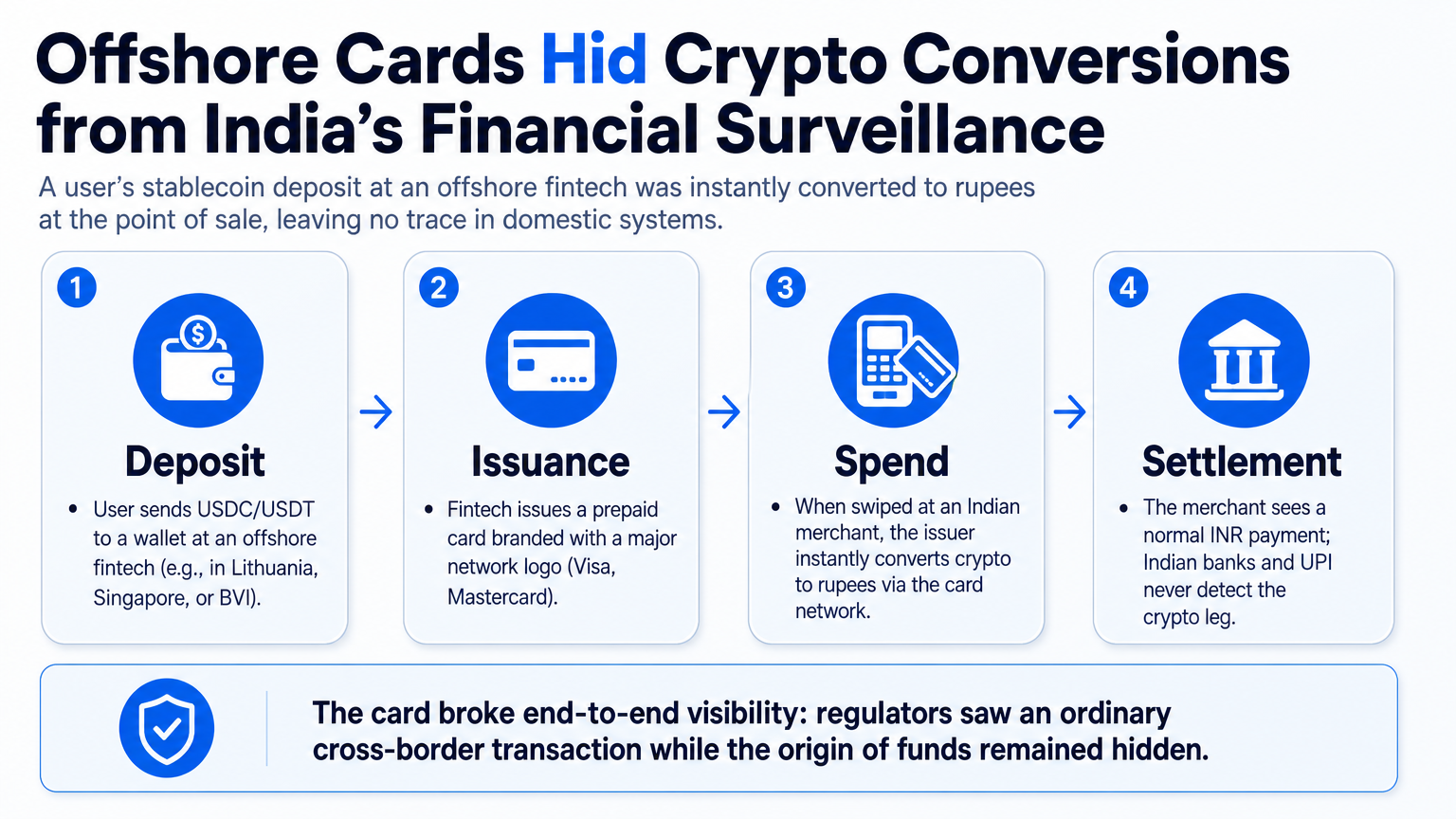
A user deposited USDC or USDT into a wallet controlled by an offshore fintech—often registered in Lithuania, Singapore, or the British Virgin Islands. The fintech issued a prepaid card branded with a major network logo. When the user swiped at an Indian merchant, the issuer instantly converted crypto to rupees and settled through the card network. The merchant saw a standard INR payment; it never knew crypto was involved.
Traditional Indian banks and UPI never saw the crypto leg. The settlement looked like an ordinary cross-border card transaction. From a transaction-monitoring perspective, these crypto to fiat cards left no footprint in India’s financial surveillance apparatus. The RBI Bulletin has repeatedly emphasized the need for end-to-end visibility into payment flows, and these cards broke visibility at the origin of funds.
Implications for Web3 Startups and DAOs
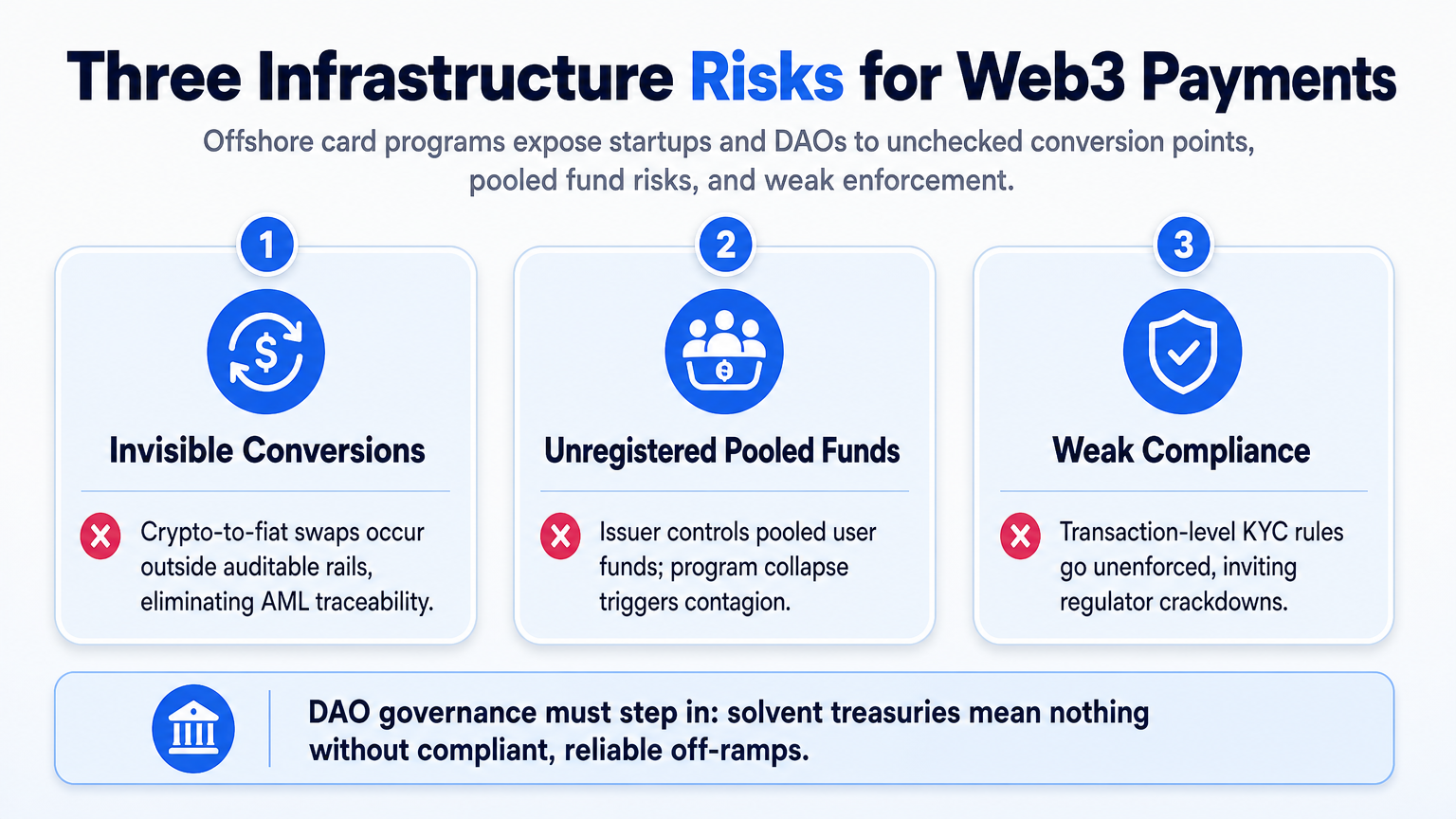
If a Web3 startup or DAO funded contributor cards through an offshore issuer, it now faces contagion risk. When regulators investigate the issuer, they trace the wallets. India’s FIU can share intelligence through the Egmont Group, potentially triggering inquiries in the business’s home jurisdiction. DAO treasury compliance becomes live when a contributor loses access to living expenses.
Many DAOs have contributors who independently obtained offshore crypto cards. If the card program collapses, the DAO faces a people problem: team members cannot access compensation they already earned. Solvent on-chain treasuries become theoretical without compliant off-ramps. DAOs should expect governance debates over whether to restrict which wallets and off-ramps contributors may use. A DAO seen to endorse non-compliant rails in a jurisdiction that prohibits them could face legal exposure that pierces the veil of decentralization.
This incident exposes three web3 payment infrastructure risks: invisible conversion points, pooled funds controlled by unregistered issuers, and weak transaction-level compliance enforcement.
Recommended Actions for Compliant Web3 Payments
Audit every crypto-fiat conversion point
Map every point where crypto becomes fiat. For each: Where is the issuer incorporated? Is it licensed where the fiat is spent? Does the transaction generate an auditable record connecting source wallet to final payment? If not, remediate it. Regulators are asking for basic transaction visibility, not advanced compliance.
Choose regulated on/off-ramps
Look for platforms registered with relevant financial intelligence units, with segregated client accounts, support for the fiat currencies your team needs, transparent fees, and role-based permissions for DAOs. This is crypto-friendly business banking in practice: fewer intermediaries between the on-chain asset and final fiat spend, with clear audit trails.
Re-think card programs
Compliant corporate card programs issue through partner banks and maintain the transaction history required by AML standards. For virtual card issuance, use providers that support free virtual cards with custom permissions.
Example: OneSafe bridges fiat and crypto under one compliance framework
OneSafe provides neo-banking services for businesses, Web3 startups, and DAOs through partnerships with regulated banks. It supports multi-currency accounts in USD, Euro, and CAD, corporate cards with spend limits, and crypto-to-fiat conversions under a unified compliance framework. Digital asset custody is secured on Fireblocks, and all users must complete identity verification and enable MFA. DAOs get customizable roles, permissions, and automated payment workflows, so contributors can be paid in USDC and convert to fiat through auditable rails.
What to Watch Next
India’s action is unlikely to remain isolated. Countries with strict capital controls—including Nigeria, Indonesia, and Turkey—have already signaled discomfort with offshore payment instruments that circumvent domestic banking channels. If India successfully forces these cards out, expect stablecoin spending regulation to tighten in multiple emerging markets simultaneously.
The FATF’s Travel Rule may also apply. When an offshore issuer converts crypto to fiat at the point of sale, it is performing a virtual-asset-to-fiat exchange. Under a strict reading, the issuer should share identifying information about the cardholder with the merchant acquirer’s institution. If regulators begin enforcing this, compliance costs for unregistered card programs would become prohibitive.
Teams that need to turn these updates into consistent web3 payments news without adding editorial overhead can use Joyrise: your blog, written and published every day. Joyrise plans, writes, and publishes illustrated SEO articles to your Webflow blog every day, and you can read your first article before you pay.
FAQ
What happened with crypto cards in India?
The RBI and FIU began investigating and deactivating offshore-issued crypto cards that allowed residents to convert digital assets into rupees without routing through India’s regulated banking system, as reported by The Economic Times on November 1, 2026.
Why did the RBI and FIU take action?
They identified the cards as potential violations of payment system regulations and FEMA because they created an unmonitored parallel payments channel that concealed cross-border movement of funds.
How were these cards bypassing Indian payment regulations?
A stablecoin deposit at an offshore fintech was instantly converted to rupees at the point of sale, leaving no crypto-related footprint in India’s financial surveillance systems.
Does this affect businesses outside India?
Yes. Any Web3 business or DAO that funds contributor cards through an offshore issuer—or whose team members use such cards—faces potential regulatory contagion through intelligence-sharing networks like the Egmont Group.
What can Web3 startups and DAOs do to stay compliant?
Audit every crypto-to-fiat conversion point, replace unregistered card programs with regulated infrastructure, document the compliance trail, and vote on treasury policies requiring compliant rails.
Are there legal alternatives for spending crypto on daily business expenses?
Yes. Regulated platforms that provide corporate cards through partner banks and maintain KYC/AML documentation offer the same utility without the exposure that brought down offshore card programs.
Could this trigger similar enforcement in other countries?
Very likely. Countries with strict capital controls and active FATF evaluation cycles have a structural incentive to detect and block unregistered payment instruments.
Key Takeaways
- Map every conversion point now: Crypto-to-fiat touchpoints need auditable issuer and license checks.
- Card deactivations are a warning, not an isolated event: The RBI web3 payments enforcement will spread.
- Invisibility was the point: Crypto to fiat cards were designed to be invisible to domestic regulators, making them indefensible under AML and FEMA scrutiny.
- DAO governance must address off-ramp compliance now: Token-governed treasuries should restrict contributor conversion rails.
- Auditable alternatives exist: Regulated platforms with partner-bank compliance make the transition achievable.
Explore how your business or DAO can manage fiat and crypto finances on a single, compliant platform—open a OneSafe account and start onboarding today.
Sources