Table of Contents
- description: "Google's bank-grade crypto custody service uses key fragmentation. Here's what the announcement means for crypto banking, startups, and DAOs."
- What Just Happened: Google’s Bank Crypto Custody Announcement
- Why This Matters Right Now for Crypto Banking
- Crypto Banking 101: The Custody Challenge for Businesses
- Key Fragmentation Explained: A New Security Paradigm?
- Concrete Implications for Startups and DAOs
- What to Watch Next: Open Questions and the 2027 Timeline
- Key Takeaways
description: "Google's bank-grade crypto custody service uses key fragmentation. Here's what the announcement means for crypto banking, startups, and DAOs."
Google Enters Crypto Banking: Key Fragmentation and What’s Next
Google’s October 28, 2026 presentation of a bank-grade crypto custody service is the most consequential crypto banking development so far this cycle. Reported by OneBullEx on November 1, 2026, the service uses key fragmentation to split cryptographic keys so no single party ever holds a complete key. For startups and DAOs running business crypto accounts, it changes the custody conversation. This analysis separates the reported facts from the open questions.
What Just Happened: Google’s Bank Crypto Custody Announcement
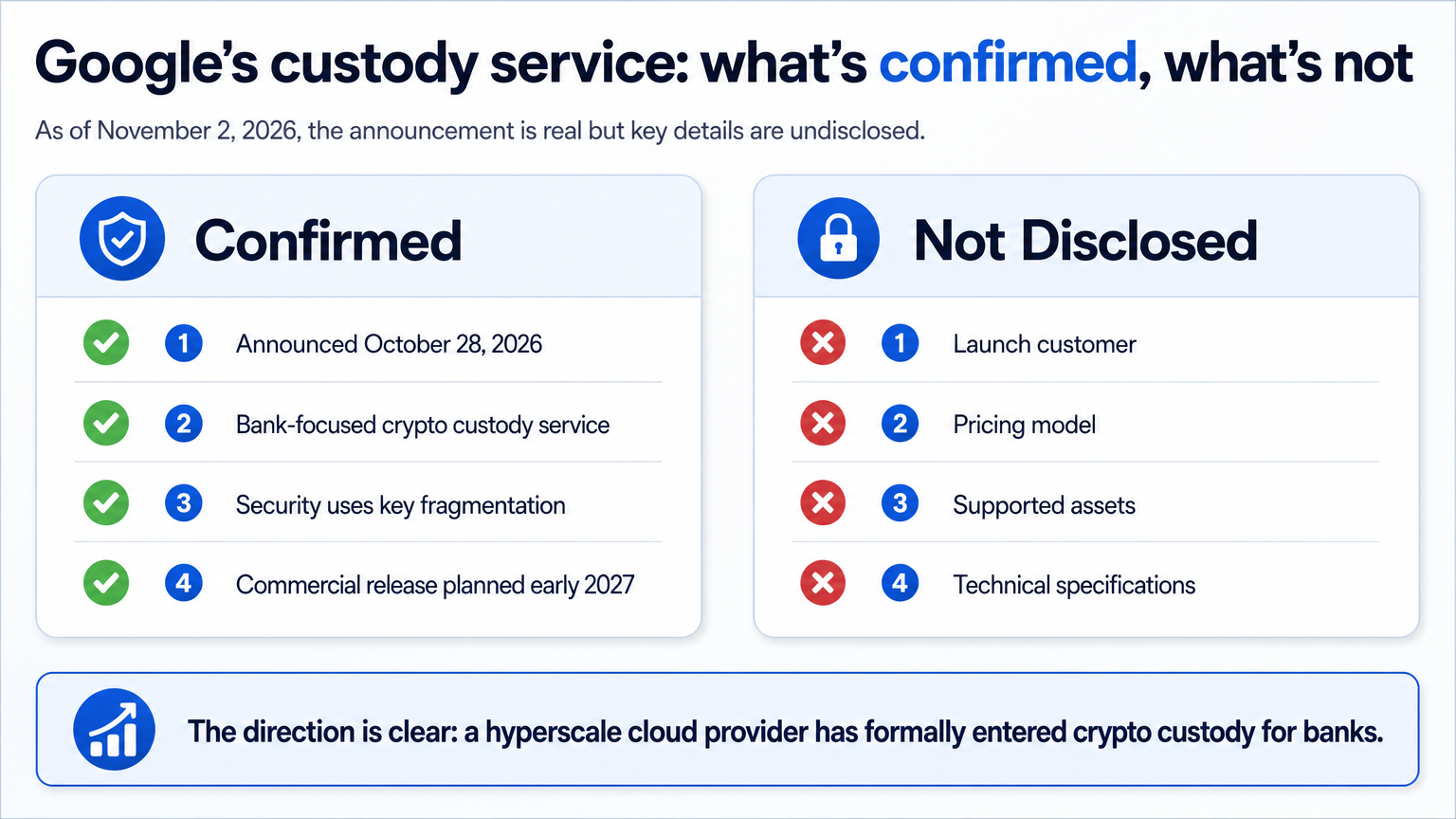
The Google crypto custody announcement is a bank-focused infrastructure play, not a retail wallet. As of November 2, 2026, Google has not published a full technical document, a pricing sheet, or a named customer. What changed is the direction: a hyperscale cloud provider has formally entered crypto custody for banks.
October 28, 2026: the presentation that turned heads
According to OneBullEx on November 1, 2026, Google presented a crypto custody service for banks on October 28, 2026, with commercial release planned for early 2027. The announcement positions Google as a direct entrant into institutional digital-asset infrastructure, a market long dominated by specialized custodians rather than hyperscale cloud providers.
Key fragmentation as the security backbone
The core of the offering rests on a key fragmentation mechanism, a security architecture designed to split cryptographic keys into multiple components so that no single party ever holds a complete key. Google described this fragmentation approach as central to its custody design, but the precise implementation remains undisclosed.
What’s still unknown: pricing, assets, and clients
As of November 2, 2026, details like launch customer, pricing, assets, and technical specs remain undisclosed.
| Item | Status as of November 2, 2026 |
|---|---|
| Announcement | October 28, 2026 |
| Reported by | OneBullEx, November 1, 2026 |
| Service | Crypto custody for banks |
| Core security architecture | Key fragmentation—splits keys into parts; no single party holds a full key |
| Commercial release | Planned early 2027 |
| Launch customer | Not disclosed |
| Pricing model | Not disclosed |
| Supported assets | Not disclosed |
| Technical specifications | Not published |
Why This Matters Right Now for Crypto Banking
Big Tech validates institutional crypto—and raises the bar
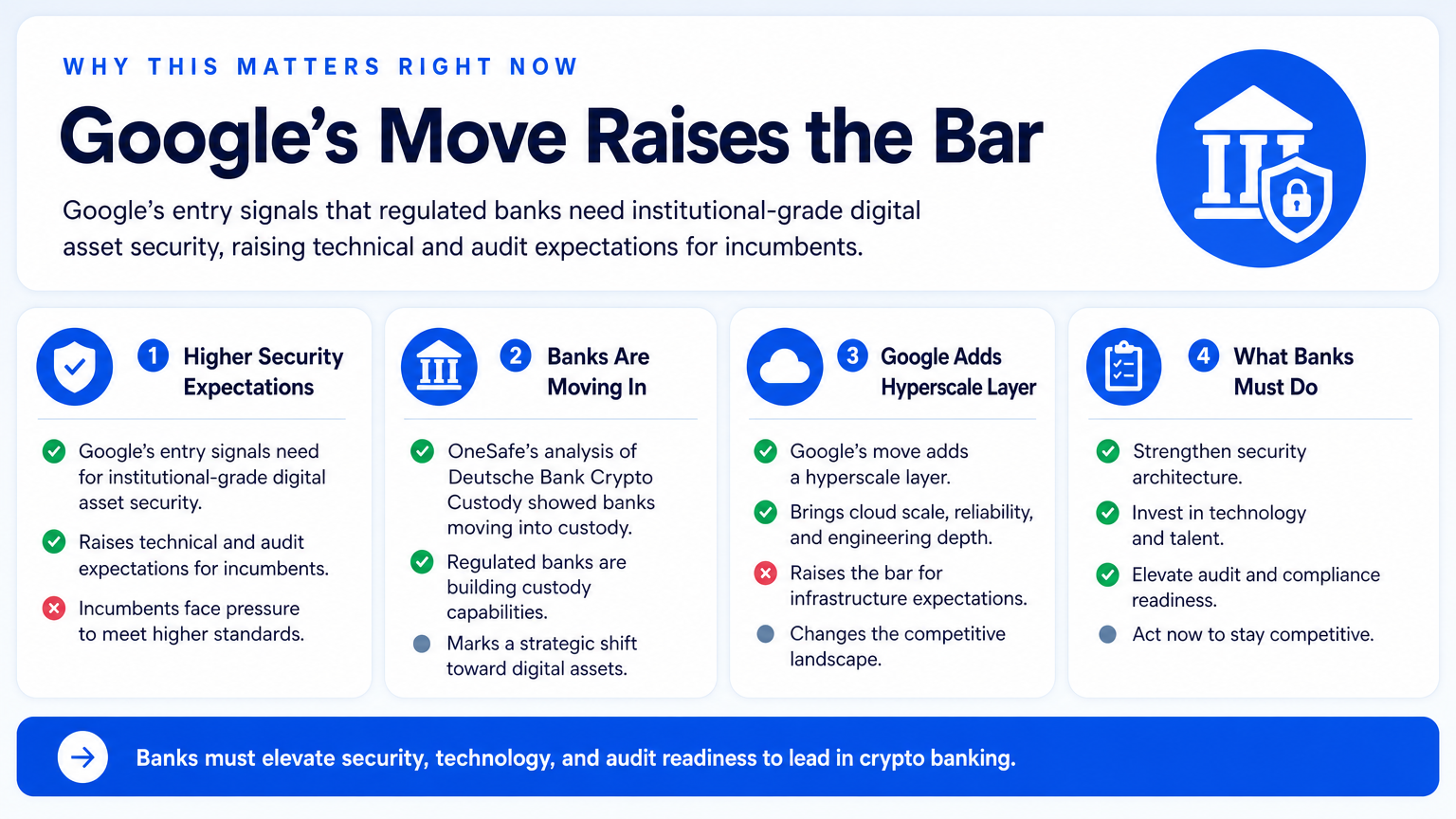
Google’s entry signals that regulated banks need institutional-grade digital asset security, raising technical and audit expectations for incumbents. OneSafe’s analysis of Deutsche Bank Crypto Custody showed banks moving into custody; Google’s move adds a hyperscale layer. For the startup and DAO angle, see Google Crypto Custody: What It Means for Crypto Banking.
The line between fintech and bank custody is blurring
For platform users, the distinction between a neobank, a bank custodian, and a cloud provider is becoming operational. A non-bank platform might rely on a banking partner and Fireblocks today; if banks adopt Google’s custody layer, the underlying rails may change invisibly.
Why did Google decide to enter bank crypto custody now?
Google hasn’t stated a rationale. The strategic logic: custody is high-trust, high-margin; banks hold fiat rails; key fragmentation differentiates. The timing follows a year of custody failures and regulatory tightening, but the “why” remains analysis.
Crypto Banking 101: The Custody Challenge for Businesses
What is crypto banking and who is it really for?
Crypto banking is a practical term covering platforms that let organizations manage fiat and crypto in one interface—business crypto accounts, payments, conversions, and custody. It’s for businesses and DAOs, not retail: global companies with multi-currency payroll, Web3 startups holding stablecoin revenue, and DAOs needing role-based approvals.
How we got from wallets to neobanks
The compression: self-custody wallets gave way to exchange balances, then to crypto-friendly financial platforms. The current stack—illustrated by neobanks for startups—combines banking partners, compliance tooling, and digital asset custody. The user gets one interface; the operator manages a chain of partners.
Custody isn’t just security; it’s a trust and compliance anchor
Custody anchors audit, recovery, and legal segregation. The $6.3B Binance heist in 2026 showed that when key material or controls fail, balance-sheet risk becomes existential. OneSafe’s What the $6.3B Binance Heist Means for Crypto Banking explains how that reshaped expectations. Google’s entry is less about wallets and more about crypto custody for banks under regulatory scrutiny.
Where platforms like OneSafe already sit in the stack
OneSafe, a financial technology company—not a bank—provides neo-banking services for global businesses, startups, and DAOs, with banking services from partners. Its platform combines fiat and crypto, digital asset custody on Fireblocks, and mandatory MFA. That posture—fintech interface, bank partners, Fireblocks custody—illustrates what Google’s bank-focused custody does and does not replace: it sits deeper in the stack.
Key Fragmentation Explained: A New Security Paradigm?
How splitting keys works—and why it’s different from multisig or MPC
Conceptually, key fragmentation splits the cryptographic key material into multiple components, so no single party holds a complete key. That differs from multisig (multiple independent keys) and MPC (distributed signing computation). Google hasn’t published whether it’s a variant of MPC, hardware-backed, or something else. The distinction changes recovery assumptions, audit scope, and vendor risk.
Advantages on paper: no single point of failure
The design goal: no single point of failure. If an insider, server, or HSM is compromised, no complete key exists to steal—an upgrade over any architecture with a single complete key.
Real-world unknowns: implementation, audit, and recovery
As of November 2, 2026, Google hasn’t published fragment count, storage geography, HSM details, audit firm, or recovery process. Until then, key fragmentation is an unproven architecture.
How does key fragmentation improve security over existing methods?
On paper, key fragmentation improves security by removing the complete key from any single location. Compared with a single HSM, it reduces blast radius. Compared with multisig, it can reduce coordination complexity. Compared with MPC, the gain depends on implementation—if it’s just MPC rebranded, marginal gain may be small. The honest answer: security improvement is plausible but unproven without audit details.
Concrete Implications for Startups and DAOs
What does this mean for startups and DAOs that rely on non-bank crypto banking platforms?
Near term, nothing changes. Google’s bank-focused service has no self-serve model and is planned for early 2027. Startups and DAOs on a non-bank platform like OneSafe will keep relying on partner banks and Fireblocks. Medium-term, if banks adopt Google’s custody, those platforms’ banking partners may face new security and pricing options, potentially improving security or causing interoperability gaps.
Will business pricing change? The custody cost curve
Pricing is undisclosed. Hyperscale infrastructure has historically lowered unit costs, but bank-grade custody carries audit, insurance, and compliance overhead. Near-term pricing on existing platforms won’t drop immediately; long-term cost compression depends on Google’s pricing model.
Interoperability: how Google Wallet could plug into platforms like OneSafe
Google hasn’t announced integration with Google Wallet or non-bank platforms. If it later exposes APIs to bank partners, a platform like OneSafe could add it as an additional custodian alongside Fireblocks. For now, the question is open.
What finance leads should ask their providers today
Ask your provider:
- Who actually holds your fiat funds, and who is the named digital asset custodian?
- Is custody provided by Fireblocks or another named infrastructure provider, and what is the audit trail?
- What is the recovery procedure if a signing key is lost, and who authorizes it?
- Are crypto and fiat balances operationally segregated and visible in one ledger?
- Does the provider support role-based permissions and automated payment workflows for DAO or treasury teams?
OneSafe’s Crypto Treasury Management After the Binance Hack shows how treasury controls and custody interact after a loss event.
How should business finance leaders evaluate their crypto banking and custody stack?
Evaluation starts with the custody layer, not the dashboard. If your provider can’t name its custodian, banking partner, and recovery path, the interface convenience is irrelevant. Compare pricing across fiat deposits, wires, FX, and stablecoin on/off-ramps. OneSafe, for example, secures assets on Fireblocks and publishes its fee schedule. After Google’s announcement, ask: “If our bank partner adopts a new custody architecture, how will you handle migration and audit continuity?”
What to Watch Next: Open Questions and the 2027 Timeline
Regulatory response from the OCC, SEC, and beyond
The announcement omitted regulatory approvals. As early 2027 approaches, the OCC and SEC will be watched. OneSafe’s Stablecoin Regulation: MENA Growth Alert tracks uneven custody and stablecoin rules. For broader regulatory and market context, Cryptocurrency pricing, market & regulation news tracks institutional developments. The wildcard: will U.S. regulators treat key fragmentation as an enhancement or unproven architecture needing safeguards?
Partnership announcements and first-mover banks
For ongoing crypto banking news, The Block: Bitcoin, Ethereum & Crypto News | Live Prices ... covers institutional custody developments. The first concrete signal will be a named bank client. Google did not disclose one on October 28, 2026. Partnership announcements in early 2027 will show whether this lands with smaller crypto-forward banks, large custodians, or both.
The standards war: key fragmentation vs. MPC vs. HSMs
The longer-term question: will key fragmentation become a standard, coexist, or collapse into MPC/HSMs after audits? Google’s entry makes the discussion urgent because a hyperscaler can set architectural expectations even before formal standardization.
What are the biggest unanswered questions about Google’s custody service?
- Which assets, jurisdictions? Not disclosed.
- Fragment count, storage locations, HSM details? Not published.
- Pricing model? Not disclosed.
- Integration with banking APIs and platforms? Not announced.
- Auditor, recovery procedure? Not specified.
These are not secondary details; they determine whether key fragmentation security works outside a slide deck.
For daily coverage as this develops, Joyrise: your blog, written and published every day plans, writes and publishes illustrated SEO articles to your Webflow blog every day; read your first article before you pay.
Key Takeaways
- Google’s bank crypto custody announcement is real but incomplete; no pricing, assets, launch customer, or technical spec published as of November 2, 2026.
- Key fragmentation removes any single complete key on paper; security value depends on undisclosed implementation, audit, and recovery details.
- Startups and DAOs should not expect immediate changes to their business crypto accounts; Google’s service is bank-focused and planned for early 2027.
- Finance leads should evaluate the custody layer first—named custodian, banking partner, and recovery path—not just the interface or monthly fee.
- Watch for a first named bank client and regulatory guidance in 2027; those will matter more than additional technical announcements.
If your team wants a unified fiat and crypto platform built for global businesses, startups, and DAOs, open a OneSafe account.