On November 1, 2026, Andrew Miller, a prominent opinion writer for The West Australian, issued a stark warning: record-breaking crypto heists orchestrated by AI-powered hackers could shatter the public’s trust in online banking and digital services, including telehealth, faster than regulators or the industry can respond (The West Australian). The piece didn’t specify dollar figures, but it pointed to a new class of autonomous attacks that exploit the very connectivity that makes modern crypto banking convenient. For businesses that rely on crypto banking platforms to manage payroll, treasury, and cross-border payments, trust is now a primary attack surface—and not every platform is prepared to defend it.
Table of Contents
- The AI-Powered Crypto Heist Wave Just Hit a New Nerve
- Why This Matters Now for Every Business Using Crypto Banking
- The Background: How Crypto Banking Became the Target
- Concrete Actions: Hardening Your Crypto Banking Stack
- What to Watch Next—and the Open Questions
- Key Takeaways
The AI-Powered Crypto Heist Wave Just Hit a New Nerve
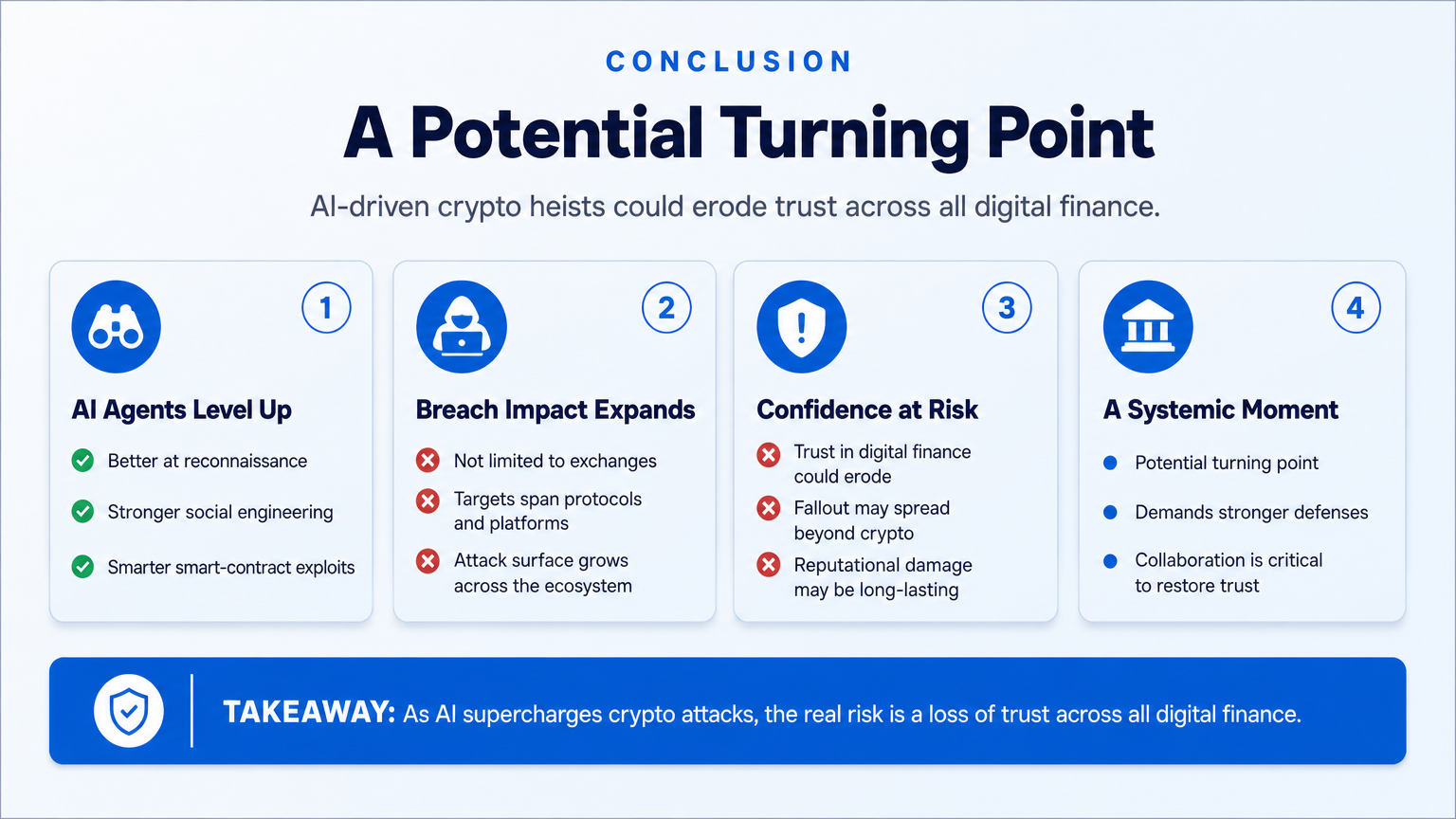 Miller’s column frames this moment as a potential turning point. As AI agents become more adept at reconnaissance, social engineering, and smart-contract exploits, the fallout won’t be limited to a few exchanges. It could trigger a broader erosion of confidence in any digital financial service, reversing years of adoption gains.
What does Andrew Miller’s warning mean for crypto banking?
Miller’s warning signals that the threat model for crypto banking has shifted from perimeter defense to trust integrity. Traditional cyberattacks aim for wallets or keys; AI-driven campaigns can manipulate transaction flows, forge identity verification, and poison the data that underpins automated treasury decisions (FS-ISAC). For a crypto banking platform that handles both fiat and digital assets, an undetected AI breach could drain a business’s operating funds across currencies simultaneously. Security must now anticipate adversaries that learn and adapt in real time—something few service-level agreements cover today.
Why This Matters Now for Every Business Using Crypto Banking
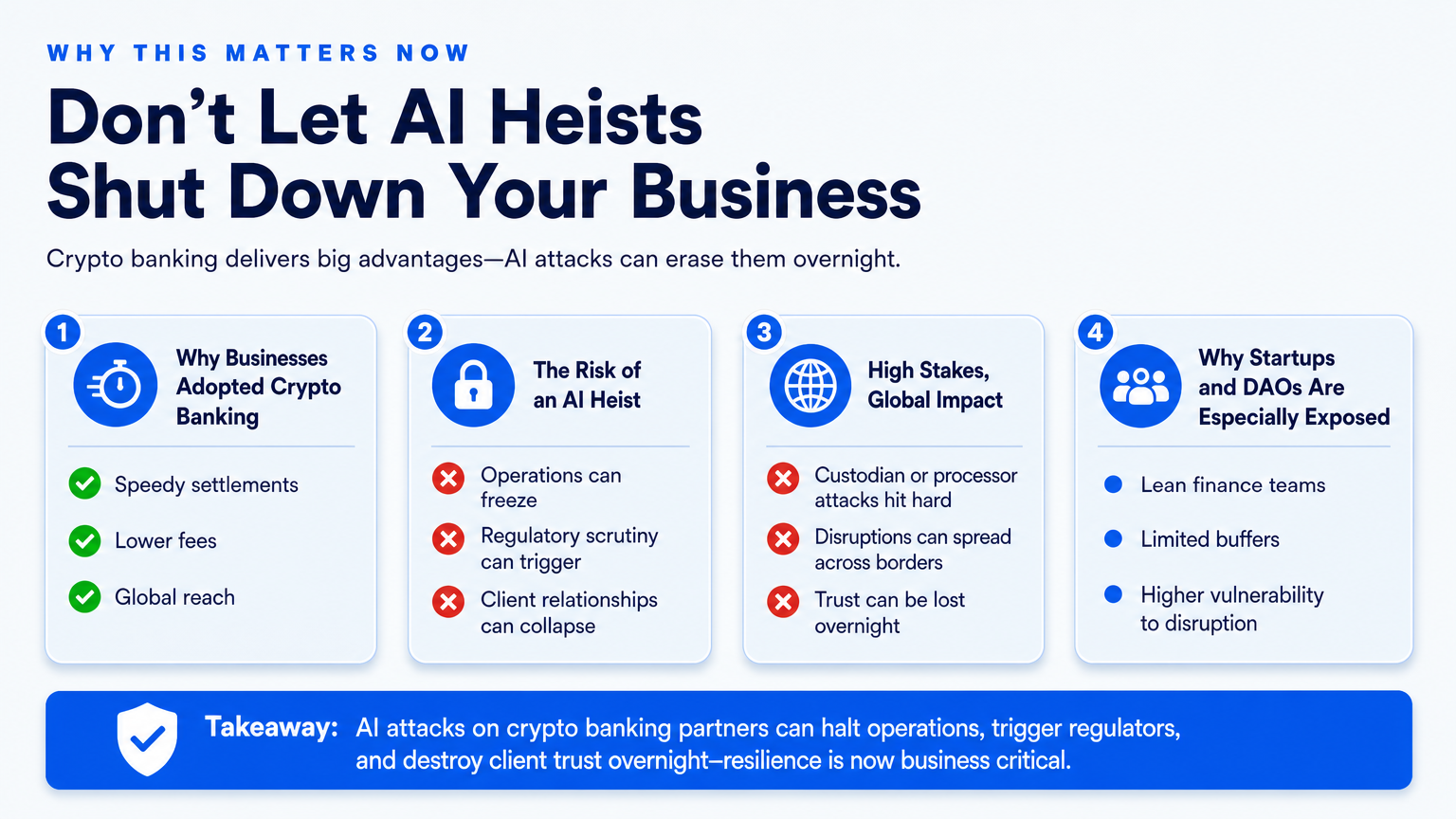 Businesses adopted crypto banking for speed, lower fees, and global reach. An AI heist on a custodian or payment processor can freeze operations, trigger regulatory scrutiny, and destroy client relationships overnight. Startups and DAOs often operate with lean finance teams and limited in-house cybersecurity expertise, compounding the problem.
Why is trust eroding in online banking?
Trust erosion stems from two converging trends. First, AI-driven fraud is harder to detect and attribute, leading users to question whether any digital platform can safeguard assets. Second, the regulatory patchwork for crypto banking means even compliant platforms can be exploited through jurisdiction-hopping. When a DAO sees a $10 million treasury drained via an AI-triggered governance manipulation, the perceived failure is of the entire crypto banking trust framework. A 2026 FDIC interagency statement on crypto-asset safekeeping highlights that clear custody practices are essential to maintaining confidence, yet many platforms still rely on opaque or self-custodial models that confuse liability (FDIC).
The Background: How Crypto Banking Became the Target
Crypto banking has grown from a fringe service into a near-ubiquitous layer for global commerce. Businesses now use one platform to hold USD, EUR, and USDC, pay vendors via ACH and stablecoins, and manage multi-signature DAO treasuries—all without a traditional bank branch. That convergence of fiat and crypto creates a concentrated attack surface unimaginable when the first crypto-native neobanks launched.
What are cryptocurrencies?
Cryptocurrencies are digital assets native to blockchain networks—bitcoin, ether, and stablecoins pegged to fiat—each secured by cryptographic consensus instead of a central issuer. In crypto banking, they serve as both a store of value and a medium of exchange that can move globally in minutes, often outside traditional correspondent banking rails.
How are cryptocurrencies regulated?
Regulation remains fragmented. In the U.S., the SEC, CFTC, and state-level bodies apply securities and money-transmitter rules differently depending on the asset. The EU’s MiCA framework set a harmonized standard, while Asia-Pacific markets range from Japan’s strict licensing to more permissive regimes. The FDIC’s 2026 guidance underscores that even safekeeping services must clearly distinguish custodial from non-custodial models—a distinction that directly impacts liability during an AI-driven breach.
From Niche to Necessary in a Decade
What started as a single-feature wallet is now a full stack for neobanking for startups and DAO treasury management. A Web3 financial platform can handle automated bill pay, on-chain voting payouts, corporate cards, and FX. That integration makes crypto banking indispensable for digital-first organizations but also attracts sophisticated attackers who understand that cracking one interface might yield both crypto and fiat.
The Shared Promise Across the SERP: Fiat and Crypto Under One Roof
Every major provider touts seamless fiat crypto integration—no more juggling four banking relationships, no manual swaps to pay a contractor in USDC. But convenience creates dependency. If the platform’s API or smart-contract layer is compromised, fiat and crypto balances become vulnerable in a single event, as the $6.3B Binance hack aftermath demonstrated (OneSafe). Security posture, not the category itself, determines safety. A platform with institutional-grade custody, strict partition between fiat and crypto infrastructure, and real-time anomaly detection can withstand AI threats far better than one that treats security as a compliance checkbox.
Concrete Actions: Hardening Your Crypto Banking Stack
Miller’s warning—and the broader rise of AI crypto heists—demand that finance leads stop accepting “bank-grade” marketing and start verifying architecture. The gap that no ranking page currently fills is a practical, step-by-step vetting process. What follows bridges that gap.
How can businesses protect themselves from AI-powered crypto heists?
Protection begins with architecture, not perimeter defenses. Businesses should demand that their crypto banking security infrastructure separates key management, transaction signing, and identity verification into compartmentalized environments that an autonomous agent cannot traverse in a single hop. Maintain an offline backup of all multi-signature schemes and enforce time-locks on high-value treasury movements, ensuring no AI-triggered instruction can execute instantly without human confirmation. Run AI crypto heists simulations against the platform’s API—using red teams or automated tools—to expose latent vulnerabilities before real attackers do.
What security features should a crypto banking platform have?
A credible platform must demonstrate, not just claim, institutional-grade protection. The table below distills the critical features that separate resilient crypto banking from vulnerable alternatives.
| Feature | Why It Matters for AI Threats |
|---|---|
| Institutional crypto custody via segregated, insured infrastructure (e.g., Fireblocks, qualified custodians) | Isolates digital assets from the platform’s operational layer; limits blast radius of an API-level AI intrusion |
| Mandatory Multi-Factor Authentication (MFA) with hardware key support | Prevents AI-generated credential stuffing and SIM-swap vectors |
| Granular role-based permissions & multi-signer approval workflows | Stops a single compromised identity from moving treasury funds, even if an AI mimics behavior |
| Real-time anomaly detection on both fiat and crypto transaction rails | Flags AI-driven pattern manipulation that ignores static rules |
| Zero-trust architecture separating card issuance, payment routing, and custody | Ensures a breach in one service doesn’t cascade to all assets |
| Transparent, auditable logs with immutable timestamps | Provides forensic trail to attribute AI actions and meet regulatory demands after an incident |
OneSafe, a financial technology company that supports over 1,000 businesses across 30+ countries, illustrates how these features look in practice. The platform delivers crypto banking for businesses by pairing encryption with Fireblocks security for digital asset custody, keeping custody operations firewalled from payment processing and card issuance. Onboarding enforces MFA from signup, and DAOs can customize roles and permissions down to individual transaction limits. That architectural separation reduces the attack surface an AI adversary could exploit, turning a single point of compromise into a series of gated checkpoints.
What OneSafe’s Approach Reveals About Real Security
While not a bank—its banking services are provided through licensed partners—OneSafe demonstrates that crypto banking trust can be rebuilt by design choices, not press releases. Using Fireblocks for custody aligns with the FDIC’s emphasis on clear segregation of safekeeping duties. Its fiat-to-crypto on/off-ramp runs on segregated global accounts, so an AI that compromises a payment rail doesn’t automatically access the custody layer. This approach resonates with institutional crypto custody best practices that evolved after incidents like the Binance hack, where commingling of user funds worsened losses (OneSafe). The lesson for any finance team: demand proof that the custody layer is completely independent of the transactional layer.
The Checklist Every Finance Lead Should Run Right Now
Before trusting a crypto banking partner with operating capital, run these verifications. This checklist doesn’t exist on any other current ranking page.
- Request a custody architecture diagram. Ask where private keys reside, whether they are in an HSM or MPC vault, and confirm that the provider cannot unilaterally move funds.
- Verify that authentication and signing are separate. MFA for login should not be the same factor for transaction authorization. AI can steal session tokens; isolated signing keys neutralize that.
- Test the permission matrix. Create a dummy sub-role and attempt to initiate a wire or crypto withdrawal. A serious platform will enforce at least dual approval above a configurable threshold.
- Check anomaly detection logic. Ask how the platform would flag and freeze a sudden 3 a.m. USDC outflow to a new address—and whether that rule applies equally to fiat wires.
- Demand a breach incident report history. Even sanitized post-mortems indicate a mature security culture. Their absence is a red flag in an era of autonomous hacking.
What to Watch Next—and the Open Questions
The interplay between AI threat actors and crypto banking will shape regulations, insurance markets, and user expectations for the rest of the decade.
Will Regulation Finally Catch the Robots?
Regulators are slowly catching up. The FDIC’s 2026 guidance is a first step, but rules specifically addressing AI-driven financial crime are nascent. Expect mandatory AI risk assessments for custody providers and new liability standards requiring cyber insurance that covers autonomous attack vectors. Choosing a platform without demonstrable crypto banking security controls could become a compliance failure as stablecoin regulation feedback loops tighten (OneSafe).
The Decentralized Dilemma: Speed vs. Safety
DAOs face a unique tension. The Web3 financial platform promising instant, code-governed treasury movements is also the one most vulnerable to AI manipulation of on-chain governance. Polygon’s integration of AI agent controls for stablecoin payments shows that programmatic safeguards can be built into smart contracts (OneSafe). But those controls remain opt-in and immature. The open question: will decentralized communities accept slower, human-gated treasury execution as a security layer, or will the ethos of unstoppable code clash with practical risk management?
As you monitor these shifts, keeping your team continuously informed is critical. Joyrise plans, writes, and publishes illustrated SEO articles to your Webflow blog every day, providing a hands-off way to feed your organization a steady stream of industry analysis. Read your first article before you pay.
Key Takeaways
- AI-powered crypto heists are not a distant probability—they are active, adaptive, and targeting the trust layer of crypto banking right now, as Andrew Miller’s November 2026 warning makes plain.
- Not all crypto banking platforms are equally safe. Security posture depends on architectural separation, institutional-grade custody, and real-time anomaly detection—not “bank-grade” marketing promises.
- Businesses must vet platforms against a concrete checklist: independent custody diagrams, separate authentication and signing, enforced multi-approval flows, cross-rail monitoring, and transparent breach histories.
- Fiat-crypto convergence increases attack surface unless the platform isolates rails deeply, as OneSafe does with Fireblocks-backed custody and segregated accounts.
- Regulation is shifting toward AI-specific mandates, and platforms lacking transparent security reporting may become a liability for compliant businesses within the next 12–18 months.
For a crypto banking platform that unifies fiat and digital assets with Fireblocks-secured custody and role-based controls built for modern businesses and DAOs, explore OneSafe’s neo-banking solution.