The $6.3 billion theft that hit Binance in late October 2026—and the $3.64 billion customer withdrawal rush that followed—has rewritten crypto banking risk overnight. Until now, DAOs, startups, and global teams often treated exchange-hosted wallets as a natural extension of a business bank account, valuing speed over structural safety. On November 1, 2026, that assumption collapsed. With the FBI linking the attack to North Korea’s TraderTraitor group, the conversation shifted from “what’s the cheapest on‑ramp” to “what does safe custody actually mean?” (Reuters via Global Banking & Finance Review, November 1, 2026).
Table of Contents
- What Just Happened: The $6.3B Binance Heist
- Why the Binance Hack’s Impact on Banking‑Style Services Is Immediate
- Crypto Banking 101
- The Security Gap Exposed
- Concrete Steps for Businesses and DAOs to Safeguard Their Treasury
- What to Watch Next in Crypto Banking
- What happened in the Binance heist?
- How does crypto banking work?
- What are the risks of crypto banking for businesses?
- How can businesses protect their crypto assets?
- What should I look for in a secure crypto banking platform?
- Are DAOs at higher risk in crypto banking?
- What is the role of third‑party custody in crypto banking?
- How do I choose a crypto banking provider after a major breach?
- Key Takeaways
What Just Happened: The $6.3B Binance Heist
On October 30, 2026, attackers drained $6.3 billion from Binance. The exchange covered roughly 95% of the loss and resumed withdrawals on November 1; within hours, $3.64 billion left the platform. Even with the bulk recovered, the event stands as the largest financial robbery in crypto history. The ensuing crypto bank heist recovery—while remarkable by industry standards—relied entirely on Binance’s internal reserves, not a statutory safety net. The remaining $315 million gap is a stark warning: full restitution is never guaranteed.
Why the Binance Hack’s Impact on Banking‑Style Services Is Immediate
For any organization that held USDC on an exchange as if it were a bank deposit, the breach is a forcing function. Business crypto banking safety now turns on one question: are client assets legally segregated or are they part of the platform’s hot‑wallet pool? The Binance hack’s impact on banking parallels the effect a traditional bank run has on counterparty trust, except here there’s no deposit insurance, no resolution authority, and no guaranteed segregation. When funds are commingled, a treasury’s survival depends on the platform’s willingness and ability to make good from its own balance sheet—an assumption that cannot be the foundation of institutional crypto custody.
Crypto Banking 101
Crypto banking platforms unify fiat accounts (multi‑currency, wire, cards) with crypto custody, payments, and conversion. A single interface lets a DAO receive stablecoin grants and convert them to payroll fiat, or a startup pay remote contractors without a chain of correspondent banks. While this neo‑banking crypto security layer sounds convenient, the Binance heist exposes that the underlying custody architecture varies dramatically.
The Security Gap Exposed
Where centralized platforms fall short
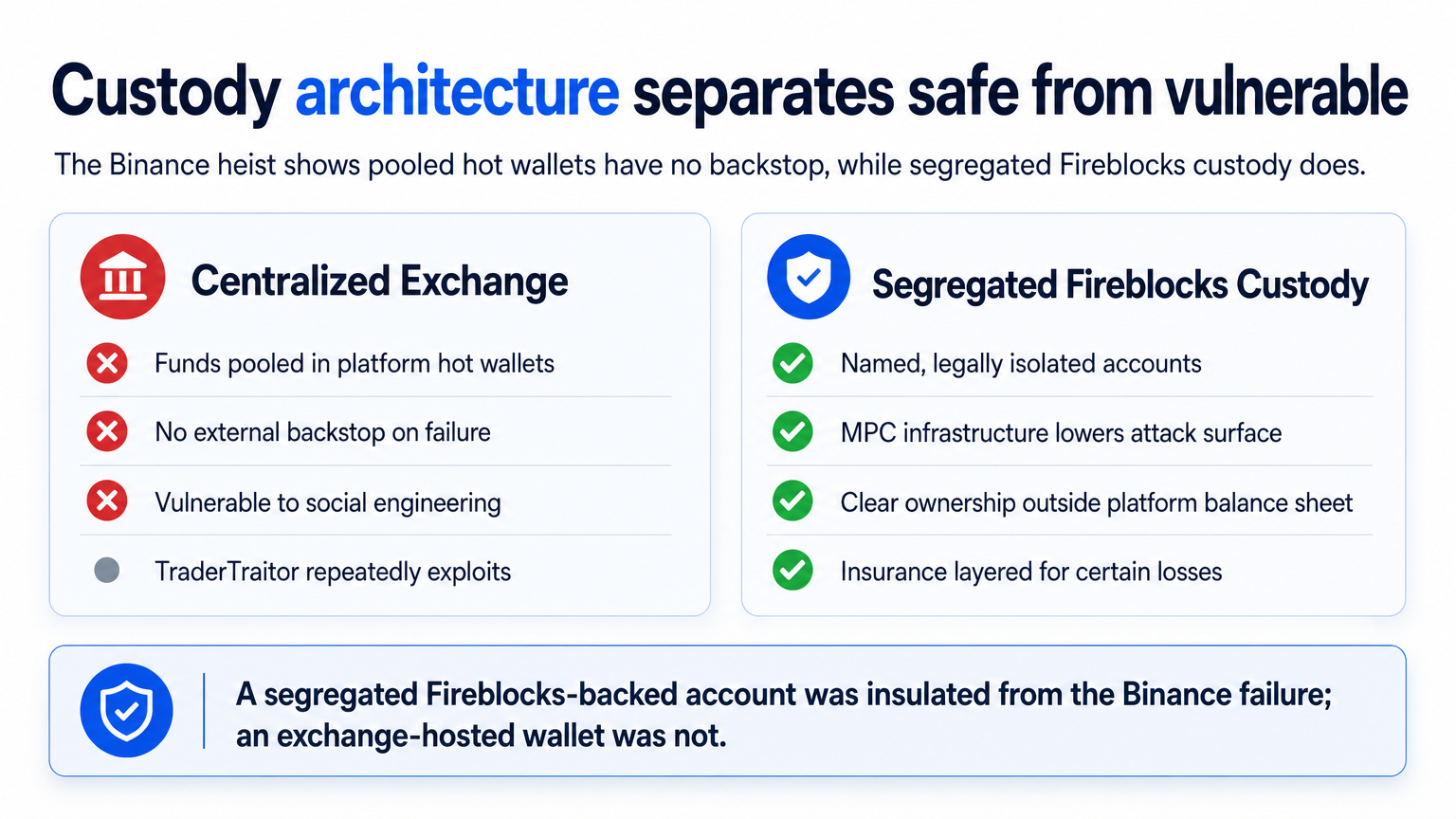
Most crypto banking services still rely on a centralized exchange model: customer funds flow through pools of hot wallets controlled by the platform. When those controls fail, there is no external backstop. The TraderTraitor group has repeatedly exploited social engineering and supply‑chain weaknesses, proving that even highly visible platforms are vulnerable.
Why segregated custody and insurance matter
A fundamentally different approach separates the money‑movement layer from the storage layer. Platforms that use Fireblocks custody—multi‑party computation (MPC) infrastructure with named, segregated accounts—keep client assets outside the platform’s operational hot wallets. This architecture reduces the attack surface and introduces a clear ownership chain that stands apart from the platform’s balance sheet. Some custodians also layer on insurance covering certain loss scenarios, adding a secondary safety net.
The Binance heist is the clearest proof yet that crypto banking security 2026 demands evaluation of actual custody architecture, not marketing claims. A treasury held in a segregated Fireblocks-backed account was structurally insulated from this failure; an exchange-hosted wallet was not. For a deeper look at how institutional‑grade custody is reshaping the market, see our Google Crypto Custody: What It Means for Crypto Banking analysis.
Concrete Steps for Businesses and DAOs to Safeguard Their Treasury
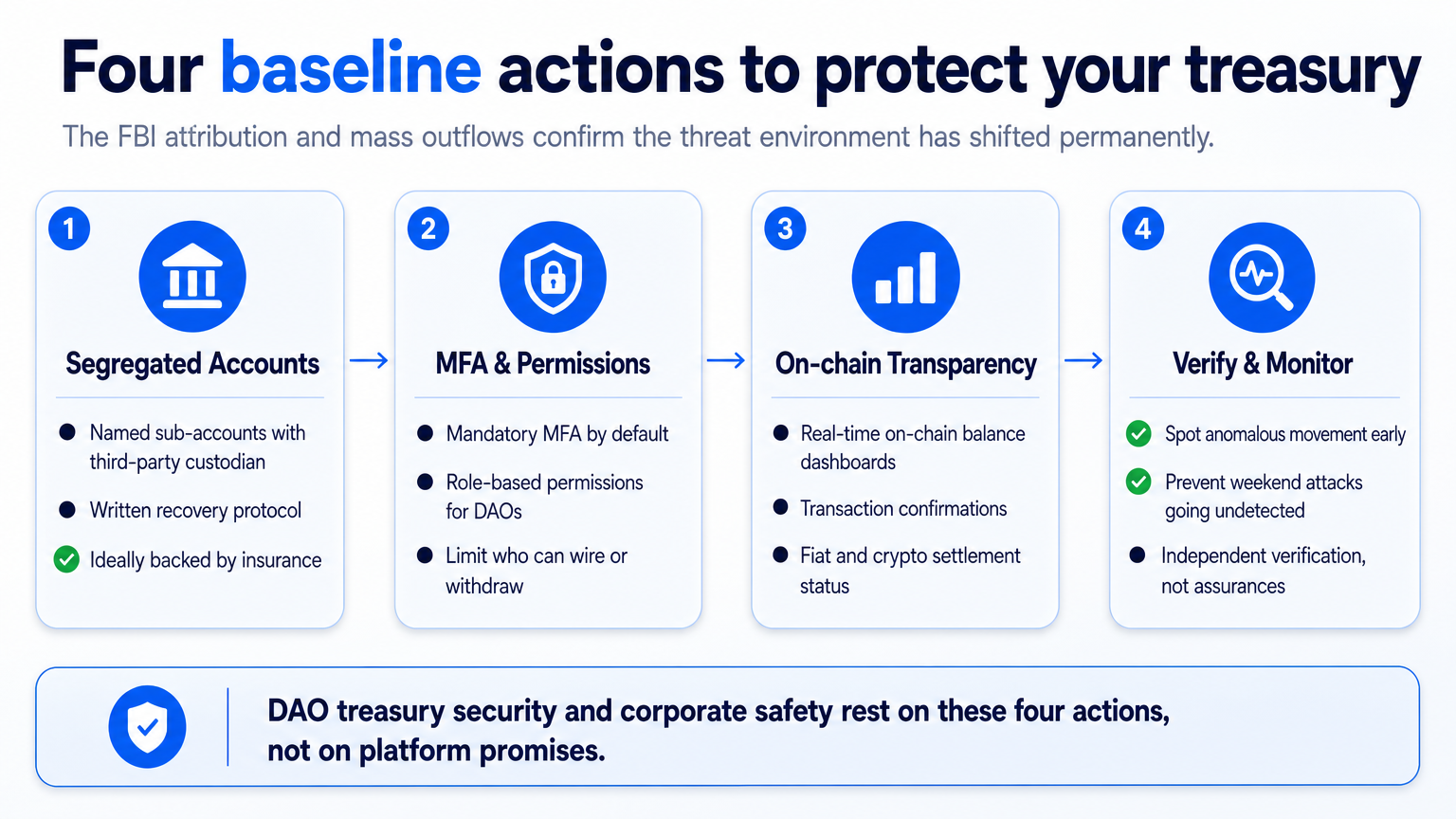
The FBI’s attribution and the mass outflows confirm that the threat environment has shifted permanently. DAO treasury security and corporate safety now rest on these baseline actions:
Demand segregated accounts and clear recovery guarantees
If the platform were breached tomorrow, would your assets be legally isolated from its operational funds? A yes must come with named sub‑accounts, a third‑party custodian (e.g., Fireblocks), and a written recovery protocol—ideally backed by insurance. Avoid any provider that cannot articulate precisely how client assets are held and what happens in a total loss scenario.
Enforce mandatory multi‑factor authentication and granular permissions
Every crypto banking login must enforce MFA by default. For DAOs and multi‑signer teams, role‑based permissions that limit who can initiate wires, approve crypto withdrawals, or change security settings are essential.
Require real‑time on‑chain transparency
If you can’t verify your treasury on‑chain in real time, the platform’s assurances mean little. A credible provider offers dashboards that show on‑chain balances, transaction confirmations, and settlement status for both fiat and crypto legs. Real‑time monitoring helps spot anomalous movement before a weekend‑long attack goes undetected.
What to Watch Next in Crypto Banking
Regulatory signals are intensifying. The FBI’s linkage to a North Korean group will almost certainly accelerate proposals for stricter AML rules and exchange security standards. Expect guidance that explicitly differentiates between exchange‑held and custodial‑held assets, directly affecting any crypto banking platform evaluation. The stablecoin ecosystem faces renewed scrutiny as theft of this magnitude—largely in major stablecoins—raises questions about freeze‑and‑burn powers and whether stablecoin regulation can serve as a backstop. See our analysis Stablecoin Regulation: Under Microscope After Binance Hack and the US Crypto Policy Tracker from Latham & Watkins for live regulatory moves.
On the security front, expect audits focused on MPC and key‑management systems. The Crypto Security in 2026 guide details defensive measures that will become table stakes. For teams tracking this fast-moving sector, Joyrise plans, writes and publishes illustrated SEO articles to your Webflow blog every day—read your first article before you pay.
What happened in the Binance heist?
Attackers linked to North Korea’s TraderTraitor group stole $6.3 billion. Binance covered ~95% and resumed withdrawals November 1, 2026; $3.64 billion fled in the initial hours.
How does crypto banking work?
Crypto banking platforms combine fiat accounts and crypto wallets, letting businesses hold, send, and convert between dollars and stablecoins from a single interface.
What are the risks of crypto banking for businesses?
The most acute risk is loss due to commingled hot‑wallet custody. Assets become part of a platform’s general pool—no statutory protection applies. Additional crypto‑to‑fiat banking risks include conversion counterparty failure, account takeover, and regulatory uncertainty.
How can businesses protect their crypto assets?
Use a platform with segregated, third‑party‑custodied accounts (like Fireblocks), mandatory MFA, granular permissions, and real‑time on‑chain visibility. Keep only operational float on exchanges; store long‑term treasury in cold or MPC‑based custody.
What should I look for in a secure crypto banking platform?
A proper crypto banking platform evaluation starts with custody, not UX:
| Evaluation Factor | Why It Matters | What to Look For |
|---|---|---|
| Custody model | Determines asset ring‑fencing. | Named segregated accounts, third‑party institutional custodian, clear legal ownership. |
| Recovery guarantees | Defines what happens after a breach or insolvency. | Written recovery protocol, insurance coverage, and a formal guarantee structure. |
| Authentication & authorization | Prevents account takeover. | Mandatory MFA, WebAuthn/security key support, role‑based permissions. |
| Transparency | Enables independent verification. | Real‑time on‑chain reserve proofs, transaction logs, settlement confirmations. |
| Regulatory posture | Affects stability and recourse. | Clear jurisdictional licensing, AML/CFT compliance, disclosed banking partners. |
Are DAOs at higher risk in crypto banking?
Yes. DAOs often lack a single legal entity to assert ownership, complicating recovery. DAO treasury security demands segregated, on‑chain verifiable accounts and strong signer authentication.
What is the role of third‑party custody in crypto banking?
Third‑party custodians like Fireblocks hold digital assets in a separate, dedicated infrastructure. This reduces the attack surface, provides legal separation, and often includes insurance coverage—moving the trust from “the exchange” to “the custodian.”
How do I choose a crypto banking provider after a major breach?
Start with custody architecture and recovery guarantees. Verify the provider’s custodial partner, the segregation of accounts, and the terms of any insurance. Test authentication flow, review permission controls, and check independent on‑chain visibility. Only then evaluate conversion fees. The Binance heist teaches that the cheapest platform is the one that loses you everything. For a complete treasury management framework, see Crypto Treasury Management After the Binance Hack and the compliance implications in DeFi Compliance Alert: FBI Links Binance Hack to DPRK.
Key Takeaways
- The $6.3B Binance heist, the largest in crypto history, triggered $3.64B in withdrawals and exposed the critical gap between exchange hot wallets and institutional crypto custody.
- Segregated Fireblocks custody with insurance offers materially stronger protection than pooled exchange wallets.
- Every business and DAO must verify their provider’s custody model, enforce MFA, and demand real‑time on‑chain transparency.
- Crypto banking security 2026 demands that custody architecture and recovery guarantees become the first screen in any platform evaluation.
Protect your global treasury with a crypto banking platform that delivers segregated custody, mandatory MFA, and a unified fiat‑and‑crypto experience—open a OneSafe account today.