Crypto Banking After the $6.3B Binance Hack
On November 1, 2026, North Korean crypto hackers executed the largest theft in history, draining $6.3 billion from Binance, as Forbes reported the same day. The Binance hack 2026 crystallized an uncomfortable truth: crypto banking security cannot be an afterthought. As we analyzed immediately after the event, the method and target signal a shift in risk for any organization holding digital assets on consumer-grade exchange infrastructure. The question is no longer whether a platform can be breached, but whether your business banking architecture can contain threats when it does.
Table of Contents
- The $6.3B Binance Heist: What Just Happened
- Why This Hack Matters for Crypto Banking Clients
- Inside Crypto Banking Security: Where the Gaps Actually Live
- What Businesses and DAOs Should Do Right Now
- What to Watch Next: Regulation, Enforcement, and Platform Responses
- Key Takeaways
The $6.3B Binance Heist: What Just Happened
Attribution and scope: North Korea’s state-backed operation
The theft was attributed by intelligence sources cited in Forbes to a group linked to North Korea’s Reconnaissance General Bureau. Attackers used social engineering, API manipulation, and blind spots in Binance’s transaction monitoring to move assets across blockchains within hours. Unlike hot-wallet hacks, this operation apparently leveraged privileged access to core settlement systems. The $6.3 billion loss exceeds the cumulative value of publicly known crypto exchange hacks from 2014 to 2025.
Why Binance’s breach matters even if you were not affected directly
Binance provides custody, trading, and settlement to institutional clients, DAOs, and crypto-native businesses. When that benchmark crumbles, trust erodes across crypto banking. Regulators will accelerate enforcement, insurers will reprice coverage, and payment partners may retreat—creating downstream frozen operations and broken supply chains for any company using crypto rails. Teams must re-examine counterparty concentration now.
Why This Hack Matters for Crypto Banking Clients
The false sense of security in large, centralized platforms
Scale brings complexity, and complexity multiplies attack surfaces. Retail exchanges are built for speed and liquidity, not the segregated custody corporate treasuries need. Business funds kept on exchanges are orders of magnitude more vulnerable than assets on a platform built for institutional crypto custody.
How business funds are exposed differently than personal wallets
A startup or DAO must keep operational capital liquid. On a typical exchange, those funds sit in omnibus hot wallets commingled with millions of users. If the exchange is breached, there is no legal or technical segregation to wall off a business. A startup holding $500,000 USDC on a retail exchange for vendor payments faces the same exposure as a day trader—a position no longer defensible after November 1.
What makes OneSafe’s security different from a standard crypto exchange?
OneSafe is a financial technology platform, not an exchange. It integrates Fireblocks custody for digital assets, using multi-party computation and hardware isolation to remove single points of compromise. Client assets are segregated by design, not commingled with trading books. Mandatory MFA and role-based permissions for DAOs add approval controls that prevent swift exfiltration after social engineering.
Inside Crypto Banking Security: Where the Gaps Actually Live
Custody models: segregated accounts vs. hot wallet commingling
Exchanges use omnibus hot wallets and off-chain ledgers; that shared pool is a honeypot. A secure crypto banking platform maintains legally and technically segregated accounts through institutional custodians. That separation matters in breach and insolvency scenarios. For DAO banking, that legal clarity alone justifies migrating off exchange infrastructure.
The role of third-party custodians like Fireblocks
Fireblocks uses MPC-based key management: private key shards are distributed across secure enclaves, so no single server or human can sign alone. Its institutional network also applies automatic risk assessment before transaction finalization. Outsourcing custody to an audited specialist transfers part of the security burden the way a bank hires cash-in-transit services.
Authentication, encryption, and why MFA alone is not enough
MFA is a baseline. The Binance hack likely involved privileged API keys, proving authentication must extend beyond login. Strong crypto theft protection layers on transaction-level approval thresholds, withdrawal velocity limits, hardware roots-of-trust, and continuous device verification. Mastercard’s Crypto Secure already grades transactions by risk before settlement, and forward-thinking platforms bake similar intelligence into payment rails.
How can a crypto banking platform protect my business from hacks like the Binance theft?
Three structural defenses:
- Custodial segregation – your assets sit in distinct on-chain addresses, inaccessible to broad hot-wallet drains.
- Multi-signature and policy controls – no single staff member or process can move funds without quorum approvals and withdrawal limits.
- Third-party custody by an audited provider – Fireblocks shifts key management to hardened SOC 2 Type II environments with penetration testing and theft coverage.
Are my funds insured or segregated if I use a neo-bank for crypto?
Fiat held in partner bank accounts may have FDIC pass-through insurance depending on account structure. Crypto assets are not FDIC-insured, as federal regulators clearly stated. Segregation still matters: platforms using Fireblocks hold digital assets in segregated, name-tagged wallets separate from corporate treasuries. Custodians like Fireblocks also maintain theft coverage, a backstop retail exchanges rarely provide. Always verify scope of coverage with your provider.
What Businesses and DAOs Should Do Right Now
What immediate steps should my finance team take after the Binance hack?
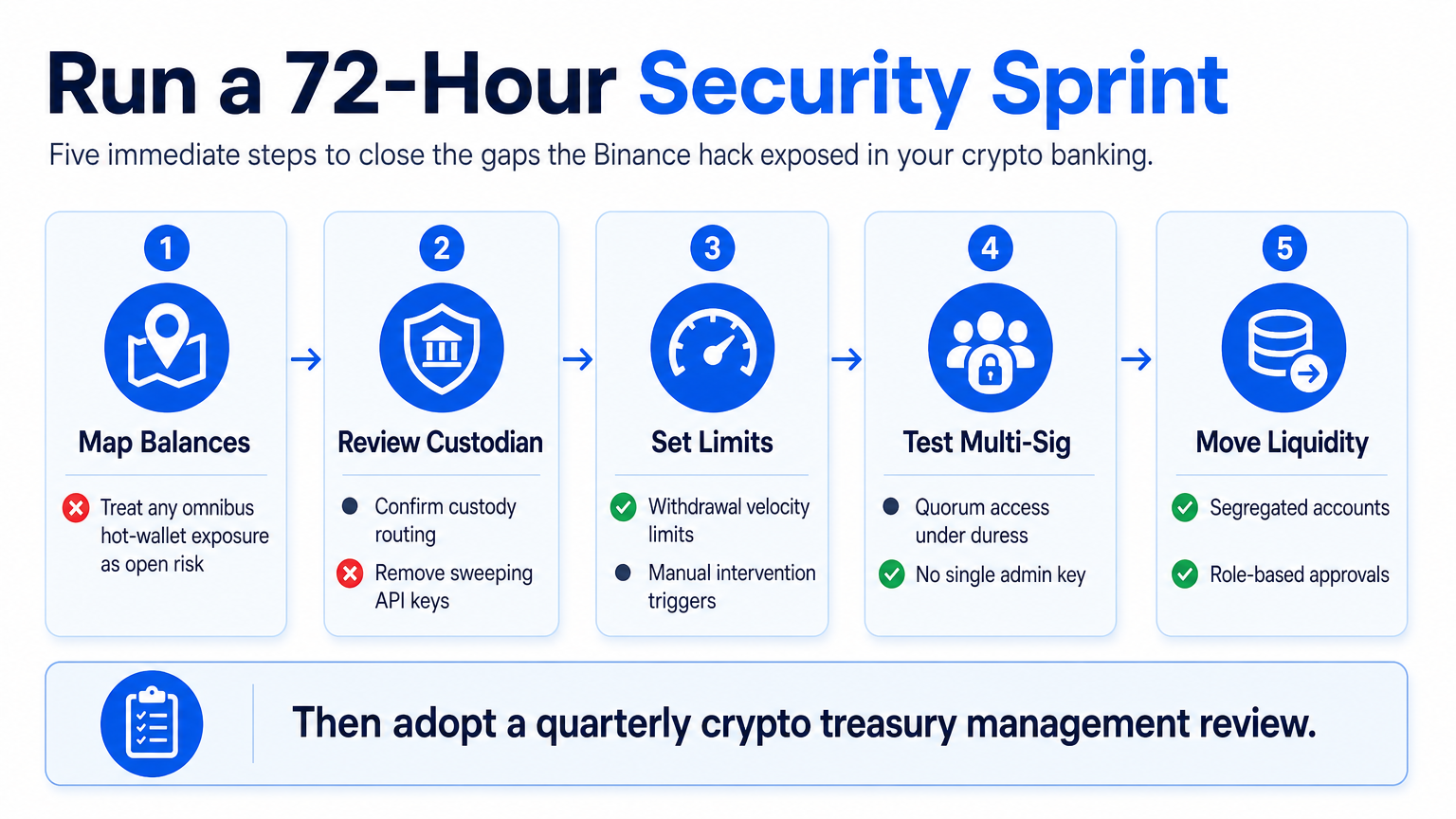
Run a 72-hour security sprint:
- Map fiat and crypto balances. Treat any omnibus hot-wallet exposure as open risk.
- Review custodian posture. Confirm custody routing and remove sweeping API keys.
- Set withdrawal velocity limits with manual intervention triggers.
- Test multi-signature under duress to ensure quorum access without a single admin key.
- Move operational liquidity to a neo-banking platform for startups that separates custody from trading, with segregated accounts and role-based approvals.
Then adopt a quarterly crypto treasury management review.
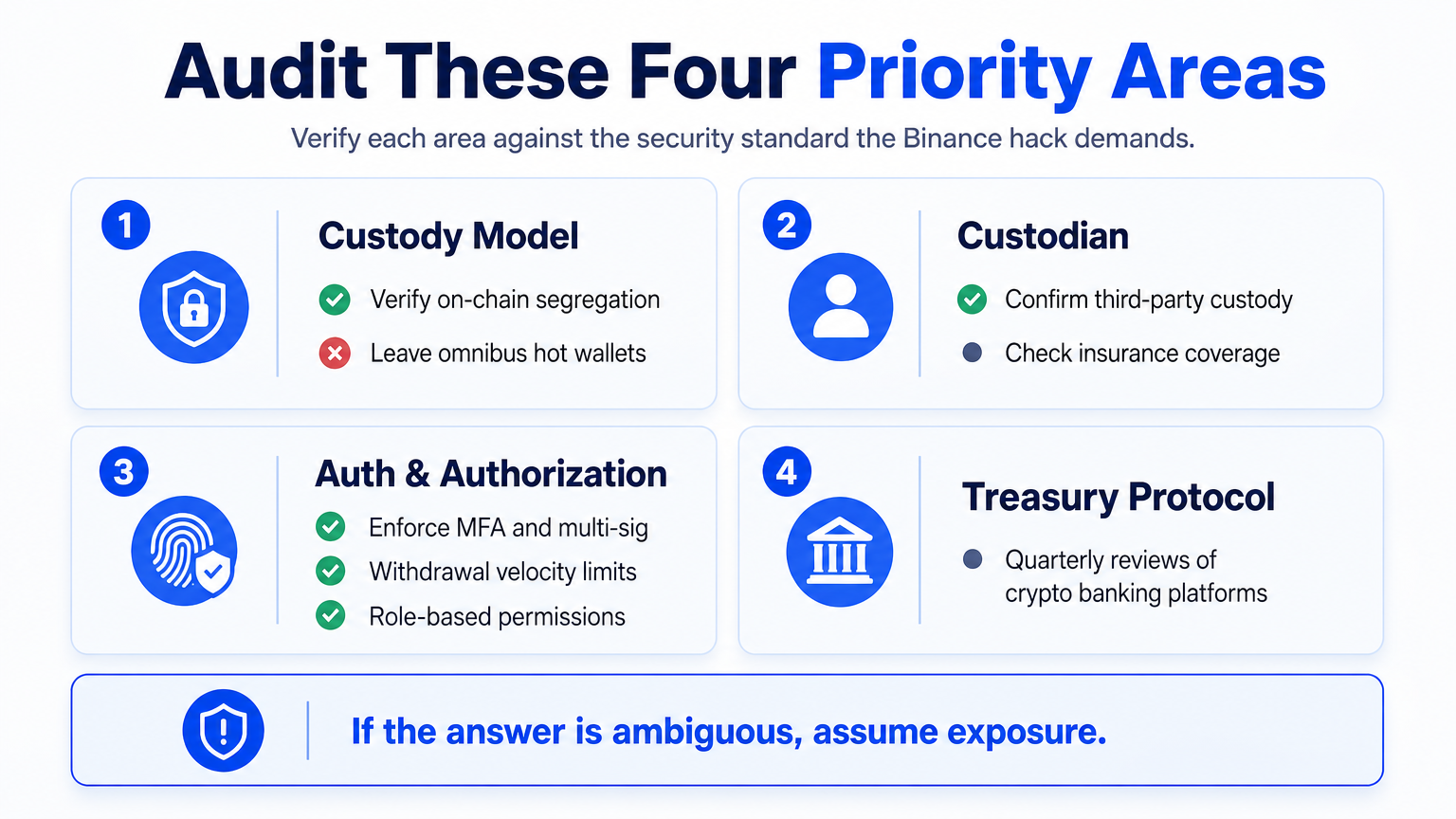
| Priority Area | Action | Why It Matters After Binance |
|---|---|---|
| Custody model | Verify on-chain segregation; leave omnibus hot wallets | Prevents a single-wallet compromise from sweeping all business funds |
| Custodian | Confirm third-party custody and insurance coverage | Shifts key management to a hardened, audited platform with theft coverage |
| Auth & Authorization | Enforce MFA, multi-sig, withdrawal velocity limits, role-based permissions | Phished credentials cannot move excess funds without approvals |
| Treasury protocol | Quarterly reviews of crypto banking platforms | Attack surfaces evolve; custody models can change |
Audit your current platform’s custody and insurance coverage
Request SOC reports, penetration test results, and the actual insurance policy. Ask whether crypto assets are held 1:1 in segregated wallets. If the answer is ambiguous, assume exposure.
Move to security-first neo-banking platforms with on-chain transparency
The hack accelerated a flight to platforms where proof of reserves and custody transparency are default. A business crypto banking platform should offer real-time on-chain verification of segregated addresses.
Implement operational controls: multi-sig, permissions, withdrawal limits
Configure transaction policies so any payment above a threshold requires confirmation from at least two officers using separate hardware devices. For DAO banking, combine smart-contract multi-sig with platform permissions so governance votes are respected on-chain.
What to Watch Next: Regulation, Enforcement, and Platform Responses
Expected tightening of crypto banking regulation
Within weeks, U.S. and EU regulators will likely propose rules requiring exchanges and neo-banks to separate customer funds into isolated on-chain addresses, hold capital against digital asset risk, and submit to real-time monitoring. Similar to how stablecoin regulation is already reshaping bank disintermediation, this will force any platform holding customer crypto to meet qualified custodian standards. Unlicensed offshore platforms will face banking access restrictions.
How platforms like OneSafe are proactively hardening before mandates
OneSafe embeds Fireblocks custody as a default, not a premium add-on, and extends role-based permissions for DAOs and remote-first startups. Its architecture assumes a breach is “when,” not “if,” using segmentation and interlocking auth layers to quarantine anomalies before funds move. This positions it for regulatory demands around demonstrable resilience.
The long-term effect on DAOs and global businesses that rely on crypto rails
The days of a DAO keeping runway on a single exchange are over. The shift is toward platforms with native multi-sig governance, automated payments with role-based controls, and on-chain proof of treasury allocations—capabilities that crypto treasury management strategies increasingly demand. As global regulatory clampdowns on crypto payments intensify, security-first providers will avoid payment disruptions.
Will regulation change how crypto banking works for startups and DAOs?
Yes, mostly for the better. Clearer rules will help startups and DAOs that bank with platforms already using institutional crypto custody, KYB compliance, and transparent reporting. Friction will fall hardest on personal exchange accounts for corporate activity, which will become practically impossible. The hack accelerates professionalization of crypto banking into a governed sector where security is the price of entry.
As the regulatory landscape evolves, Joyrise: your blog, written and published every day can help keep your team informed. Joyrise plans, writes and publishes illustrated SEO articles to your Webflow blog every day, and you can read your first article before you pay.
Key Takeaways
- The November 1, 2026 Binance breach—the largest crypto theft in history—demands an immediate review of where and how you bank.
- Crypto banking security depends on segregated custody, third-party custodians like Fireblocks, and multi-layer transaction controls, not brand size.
- Business funds on exchanges are commingled and exposed; neo-banking for startups with native segregation and role-based permissions reduces attack surface.
- Finance teams should run a 72-hour audit, enforce multi-sig and withdrawal limits, and migrate liquidity to a platform separating custody from exchange activity.
- Regulation will tighten quickly; only providers with institutional crypto custody and transparent compliance will keep serving startups and DAOs smoothly.
Ready to move your business crypto banking to a platform that prioritizes security from the ground up? Open a OneSafe account today.