Discover the best neobank for business USA with multi-currency business account USA features, plus US neobank for non-residents. Compare fee structures, crypto support, and onboarding speed in 2026.
Table of Contents
- Executive Summary
- What is a neobank?
- How Neobanks Work in the USA
- The Real Value of Neobanks for Businesses
- Options, Approaches, and Tradeoffs
- Practical Implementation
- Common Mistakes, Myths, and Limitations
- Choosing Your Neobank: A Business Operator’s Checklist
- How secure is mobile banking?
- Can I open a neobank account as a non‑resident?
- What are the main advantages of a neobank?
- Are there any fees with a neobank?
- How do I choose a neobank?
- What is the difference between a neobank and an online bank?
- Who are neobanks good for?
- Do neobanks offer loans or credit cards?
- What about customer service with neobanks?
- Key Takeaways
Executive Summary
A business neobank is a fintech layer that wraps checking, international payments, and crypto custody into one dashboard. The real value comes from a multi-currency business account USA, streamlined non-resident onboarding, and the ability to hold dollars and stablecoins without three platforms. Tradeoffs: no branches, FDIC insurance applies only to fiat at a partner bank, and crypto is never insured. This guide gives a framework for evaluating any crypto neobank USA, a fee breakdown, and a checklist starting with whether fiat and crypto are treated equally.
What is a neobank?
A neobank is a fintech company that delivers banking services—checking, debit cards, ACH, wires—through an app, without a bank charter. It partners with a licensed, FDIC‑insured bank to hold deposits. Examples: Mercury, Brex, Novo. The neobank builds the interface and underwriting; the partner bank supplies the rails and insurance. So the partner bank, not the neobank, safeguards your cash.
Neobank vs. Online Bank vs. Traditional Bank
- Online bank – A chartered bank (e.g., Ally, Capital One 360) with its own FDIC insurance, often offering loans, all digital.
- Traditional bank – Chartered, physical branches, full product suite.
- Neobank – A technology wrapper around a partner bank’s charter; you get the digital experience, but the partner bank holds your money.
How Neobanks Work in the USA
Every US neobank relies on a partner bank (e.g., Mercury uses Evolve Bank & Trust). Your fiat balances sit in an account at that bank, insured up to $250,000 per ownership category. The neobank itself isn’t FDIC‑insured, but your funds are protected at the partner if recordkeeping is solid.
FDIC insurance has limits: it covers only fiat, never crypto. Large deposits may exceed the cap, and pass‑through coverage isn’t guaranteed. For crypto, neobanks typically use custody providers like Fireblocks—institutional‑grade security, not deposit insurance. When choosing a crypto neobank USA, confirm exactly where fiat and crypto sit. The Kansas City Fed’s research explains this “interface” model separates the experience from the balance sheet.
The Real Value of Neobanks for Businesses
Multi‑Currency and Global Payments
A multi-currency business account USA lets you hold USD, EUR, CAD, and more, send domestic wires at a flat $25, or SWIFT at 0.35% + $50—versus traditional banks that can charge $45 plus 2‑3% FX spread. Some neobanks support stablecoins, so you can pay a European supplier in USDC and skip SWIFT entirely. Stablecoin regulation is solidifying, making on-chain settlement a treasury tool.
Onboarding as a Non‑Resident
A US neobank for non‑residents accepts a US‑formed LLC, EIN, and photo ID online. KYB checks are digital; approval can take under a week. Platforms like OneSafe onboard businesses from 30+ countries within that window, provided they aren’t on sanctions lists. This lets founders in Singapore, Lagos, or Berlin invoice US clients and pay contractors the same day.
Options, Approaches, and Tradeoffs
- Fiat‑only neobanks (Mercury, Brex) offer great checking, ACH, cards, but no crypto. You’ll need separate exchange and bank accounts.
- Crypto‑native neobanks (OneSafe, Multis, Juno) treat USDC and EUR as native currencies, unifying fiat and crypto in one interface. Tradeoffs: sometimes higher card FX fees, but conversion rates are competitive.
Evaluation framework:
- Core rails: ACH, wires, multi-currency, on-chain capabilities.
- Fee transparency: flat or percentage? FX markup disclosed?
- Security: partner bank name, MFA, crypto custody (e.g., Fireblocks).
- Integrations: QuickBooks/Xero, DAO role permissions.
- Support: test live chat response time on a weekday.
DAO‑Native Treasury Tools
DAO banking USA now includes customizable roles, approval workflows, and compliance reporting. For example, a treasury manager can require two of three signers for a stablecoin transfer, automatically logging the transaction for taxes. Platforms like OneSafe combine secure custody with business‑grade permissions—ideal for serious DAOs. For more on treasury risk, see crypto treasury management shifts.
Practical Implementation

From Application to First Payment
Gather formation docs, EIN letter, and IDs; submit online (~15 minutes); complete digital KYB (sometimes a selfie); approval typically arrives within a week. Fund via ACH, wire, or USDC. Set team permissions, then pay vendors by ACH or wire, or convert crypto for payroll.
A Day in the Life
A Web3 agency receives $10,000 in USDC on Monday. The dashboard offers instant conversion to USD at 0.25% FX. Tuesday, they pay a US freelancer via ACH, wire a German hosting provider, and cover SaaS subscriptions with a corporate card—all in one interface. That’s the crypto neobank USA workflow in action.
Common Mistakes, Myths, and Limitations
Crypto is never FDIC‑insured. Fiat coverage caps at $250,000 per account category; complex structures can leave gaps. Verify pass‑through coverage with the partner bank. For crypto, custody (like Fireblocks) protects against theft, not market loss.
Most business neobanks don’t offer loans, credit lines, or interest. If you need a term loan or cash deposits, keep a traditional bank relationship. A neobank is your operating core; plug in credit providers or local accounts for gaps.
Choosing Your Neobank: A Business Operator’s Checklist
- Verify partner bank name and FDIC coverage for your entity type.
- Unbundle fees: domestic wire, SWIFT cost, FX markup.
- For crypto, ask: Which custody provider? Segregated wallet?
- Test integrations—Xero, QuickBooks, DAO tooling.
- Support is digital‑only; test chat before committing.
- If non‑resident, confirm eligibility and documents upfront.
- Check that corporate cards offer spend controls and virtual cards.
How secure is mobile banking?
Neobank apps use bank‑grade encryption, mandatory MFA, and compliance protocols. Fiat deposits are FDIC‑insured through the partner bank. Crypto is secured via institutional custody (e.g., Fireblocks) but uninsured. Always enable MFA and use a hardware token for large transfers.
Can I open a neobank account as a non‑resident?
Yes. A US neobank for non‑residents accepts a US‑registered entity (LLC or C‑Corp), an EIN, and a government‑issued ID. Platforms like OneSafe onboard from 30+ countries within a week, provided no OFAC sanctions apply.
What are the main advantages of a neobank?
Fast digital onboarding, lower fees, multi-currency support, and unified fiat/crypto management. For global startups and DAOs, it’s one dashboard instead of separate bank, exchange, and custodial accounts.
Are there any fees with a neobank?
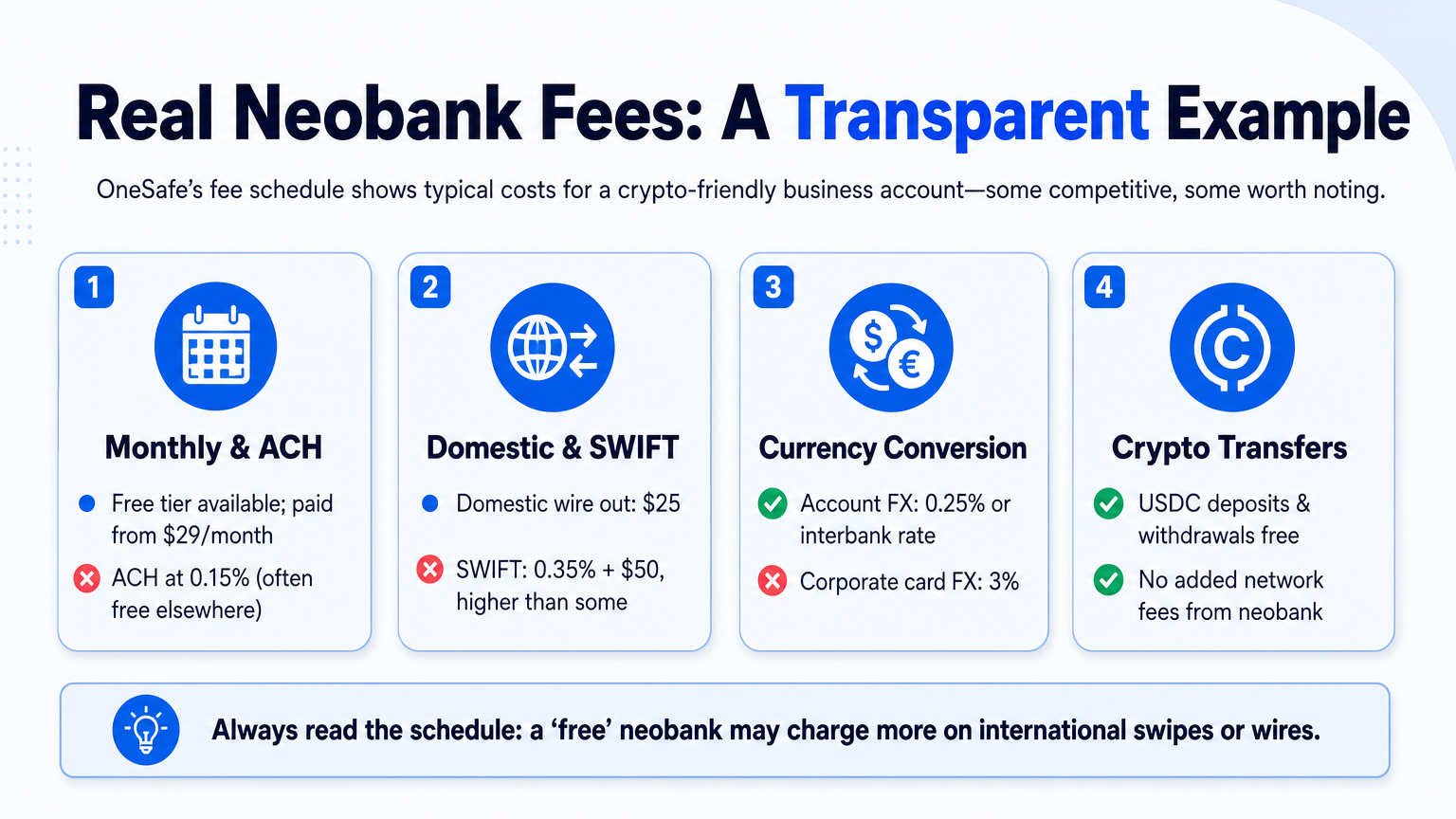 Neobank fees and security vary. Below is a real‑world example from a crypto‑friendly neobank:
| Transaction Type | Example Fee (OneSafe) | Industry Notes |
|---|---|---|
| Monthly subscription | $0 (free plan) to $29+/month | Most business neobanks offer free tiers |
| ACH / fiat deposit‑withdrawal | 0.15% | Often free at fiat‑only neobanks |
| Domestic wire (outgoing) | $25 | Typical range $5‑$30 |
| Domestic wire (incoming) | $10 | Often free at traditional banks |
| SWIFT transfer (in/out) | 0.35% + $50 | Can be $15‑$50 at other platforms |
| FX conversion (account) | 0.25% or interbank rate | Wise charges ~0.4‑0.7% |
| Corporate card FX | 3% | Some competitors charge similar; some don’t |
| Crypto deposit/withdrawal (USDC) | Free | Exchange withdrawals usually carry network fees |
Even a “free” neobank may charge 1‑3% on international card swipes. Read the fee schedule. See our guide to business bank accounts with no fees for more.
How do I choose a neobank?
Use the framework: check partner bank, tally transaction fees, test security and integrations, verify geographic support. If crypto matters, pick a platform that treats on-chain assets as native.
What is the difference between a neobank and an online bank?
An online bank (Ally, Capital One 360) is a chartered bank’s digital division with its own FDIC insurance. A neobank is a fintech company that layers its interface on a partner bank’s charter—it innovates faster but doesn’t hold your money directly.
Who are neobanks good for?
Digital‑first businesses, international startups, e‑commerce, Web3 teams, and DAOs needing multi-currency and crypto support. Less suitable for cash‑intensive firms, loan‑dependent businesses, or those requiring in‑person service.
Do neobanks offer loans or credit cards?
Most don’t offer loans or credit lines. Some issue corporate charge cards (Brex, Ramp, OneSafe) that settle daily. True credit cards are rare because neobanks lack lending licenses; they rely on bank partnerships for such products, but business lending remains a gap.
What about customer service with neobanks?
Support is digital‑only: email, in‑app chat, tickets. Phone support is rare. Response times vary—test the support channel on a weekday before moving operating capital.
Key Takeaways
- A US neobank is a fintech interface—your fiat sits at a partner bank that provides FDIC coverage. Know which one.
- Crypto is never FDIC‑insured, and fiat coverage has limits. Separate custody from deposit protection.
- Multi-currency accounts and stablecoin rails slash cross‑border payment time and cost.
- DAO‑native treasury tools with role‑based permissions make neobanks viable for decentralized organizations.
- Evaluate with a simple checklist: partner bank, fee transparency, custody partner, support responsiveness.
For a financial operating system that unifies fiat and crypto operations in one dashboard, explore OneSafe.