Vendor management fails when procurement treats suppliers as paperwork rather than operational dependencies. Finance and operations teams working across fiat and crypto rails must account for payroll interruptions, supplier-payment delays, weak KYB, uncontrolled corporate cards, and unavailable crypto liquidity. Each failure can affect compliance, cash flow, settlement timing, or counterparty exposure.
Treat vendors as financial infrastructure. A practical control system links vendor criticality to onboarding depth, approval authority, payment-method routing, monitoring, contract terms, and tested failover workflows. That includes choosing between bank transfers, ACH, wires, SWIFT, corporate cards, FX conversion, and crypto settlement, while documenting wallet permissions, custody responsibilities, and fallback providers where relevant.
The framework covers ten disciplines for international SMEs, web3 companies, DAOs, and teams paying contractors across jurisdictions. Risk tiers determine where manual judgment is required; workflow technology keeps recurring checks, evidence collection, approvals, and remediation on schedule.
Prioritization matters because assessment capacity is limited. A historical benchmark placed typical third-party risk assessment capacity at about 50 vendors annually, with a reported vendor-to-staff ratio of about 50:1. Under that benchmark, a team overseeing 200 vendors would need roughly four dedicated staff equivalents for assessment, monitoring, and remediation, as documented in the Mastercard third-party risk report. OneSafe fits this operating problem by bringing multi-currency accounts, ACH, wires, SWIFT, corporate-card policies, and crypto-compatible payment workflows into one interface, giving teams a single place to coordinate fiat and crypto payment controls.
Table of Contents
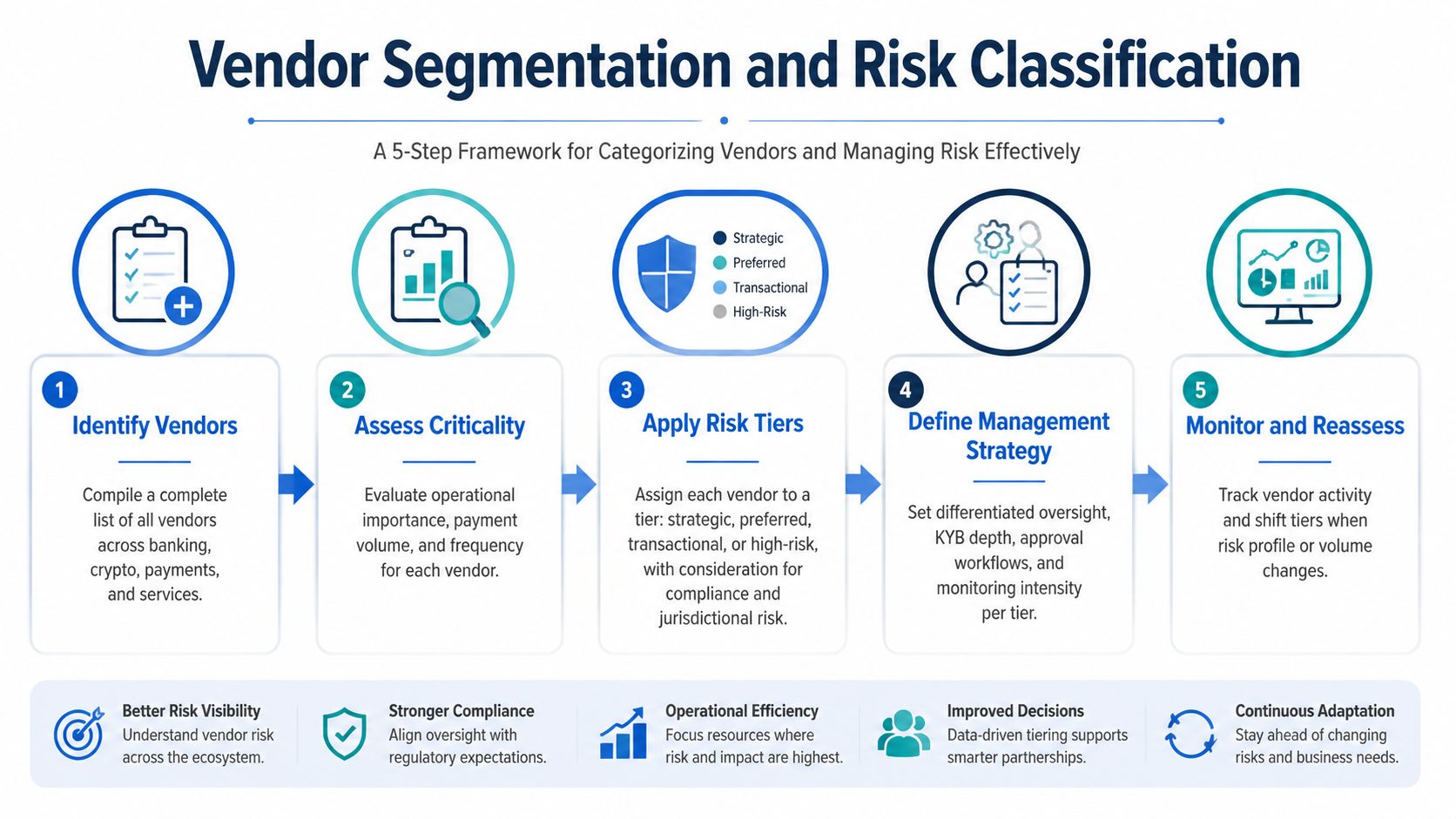
1. Vendor Segmentation and Risk Classification
A vendor register is useful only when it tells the team what to do next. Classify each supplier by operational criticality, payment exposure, data access, geographic footprint, and regulatory risk, then attach a defined treatment to every tier.
A contractor receiving occasional low-value payments shouldn't follow the same process as a banking partner, payment processor, crypto exchange, or custody provider. For a global business, geography matters too. A vendor incorporated in one jurisdiction may deliver services through another, while a crypto provider may introduce wallet, custody, sanctions, and licensing considerations that a conventional software vendor doesn't.
Build a decision-ready risk matrix
Score vendors against practical questions:
- Can failure stop a core process? Consider payroll, customer settlement, treasury, banking access, and invoicing.
- How much money moves through the relationship? Review payment volume, frequency, currency, and reversibility.
- What can the vendor access? Include customer data, payment credentials, wallets, APIs, and internal systems.
- Where does the vendor operate? Record incorporation, service delivery, banking, and regulatory jurisdictions.
- What changes the tier? A sudden increase in transaction activity, new data access, or subcontracting should trigger reassessment.
Use the result to set review frequency, approval requirements, security evidence, and escalation paths. OneSafe's multi-currency accounts and spending policies can support differentiated approval workflows, but the policy must come first. Technology can enforce a classification, not invent a defensible one.
2. Automated Vendor Onboarding and KYB Integration
Vendor onboarding should produce a reliable payment identity, not just a completed form. Collect the legal name, registration details, ownership information, tax data, settlement account, approved currencies, contact details, and expected transaction profile before the first payment. For web3 entities, add wallet ownership, supported chains, custody arrangements, and a clear relationship between the wallet and the legal entity.
The most common operational bottleneck is evidence collection. In a 2025 survey, 45% of respondents ranked obtaining vendor documentation as a top daily challenge, while 20% cited analyzing documents and 19% cited tailoring requests by vendor risk level, according to the Venminder State of Third-Party Risk Management report. Automating reminders, document status, screening, and exception routing addresses the work that slows teams down.
Use tiered evidence requirements
- Low-risk transactional vendors: Collect core registration and payment data, then screen before approval.
- Operational vendors: Add service scope, insurance, security information, and subcontractor details.
- Strategic or high-risk vendors: Require full KYB, beneficial-owner review, licensing evidence, financial information, security documentation, and senior approval.
- Crypto-native vendors: Verify wallet control and screen relevant addresses or transaction relationships where appropriate.
Design a manual-review path for newly incorporated entities, unusual ownership structures, and vendors without conventional banking history. Keep the status visible to the vendor and internal owner. For broader AML and KYC governance, see AML and KYC procedures for businesses.
A workflow demonstration can help teams translate the policy into daily actions.
3. Multi-Tier Approval Workflows and Spend Controls
Approval controls should reflect risk, not merely payment size. A modest payment to a new vendor using an irreversible international rail may deserve more scrutiny than a larger recurring payment to a thoroughly reviewed strategic partner.
Separate recurring invoices from one-time requests. Recurring payments should require evidence that the underlying contract, purchase order, and vendor bank details remain unchanged. One-time payments need stronger controls against duplicate invoices, changed account instructions, and urgent requests sent outside the normal process.
Route payments by method and exposure
Set approval logic around:
- Vendor tier: Strategic banking, liquidity, and infrastructure providers receive enhanced review.
- Payment method: ACH, wires, and SWIFT should have distinct controls because settlement characteristics differ.
- Converted value: Approve the amount the business will spend after FX conversion, not only the invoice currency.
- Wallet destination: Require independent verification for crypto addresses and apply dual or multi-signature controls where the treasury design supports them.
- Exception status: Allow urgent payments only with documented reason, named approver, and post-transaction review.
Corporate cards need the same discipline. Set merchant categories, spending limits, virtual-card assignments, and expiration rules for vendor subscriptions and recurring services. OneSafe offers roles, spending policies, configurable card controls, and approval workflows that can help centralize these rules. Don't let a convenient card become a bypass around accounts-payable governance.
Practical rule: Urgency can change the approval route, but it shouldn't erase the audit trail.
4. Continuous Compliance and Risk Monitoring
A vendor can pass KYB on Monday and become a different risk on Friday. Ownership can change, licenses can lapse, sanctions exposure can emerge, a subcontractor can be added, or a security incident can alter the relationship's risk profile. Point-in-time onboarding is therefore only the first control.
Create a baseline for each tier. A low-risk service provider may need periodic identity and sanctions checks. A banking partner, payment processor, crypto exchange, or liquidity provider may require license tracking, adverse-event monitoring, financial-health review, security updates, and documented management responses.
Turn alerts into decisions
Monitoring becomes useful when each signal has an owner and response:
- Informational alert: Record the change and confirm whether it affects the vendor profile.
- Escalation alert: Pause new exposure or request evidence from the vendor while a risk owner reviews it.
- Relationship review: Restrict payments, involve legal or compliance, and decide whether to remediate, replace, or exit.
The need for continuous oversight is financial as well as regulatory. Reporting cited 30% of breaches in 2024 as involving a third-party vendor, double the prior year's level, and placed the average global cost of a third-party breach at about $4.91 million, according to the 2025 Impact Report. Use sanctions screening, license checks, public incident monitoring, and, for crypto relationships, appropriate on-chain analysis. Record the alert, investigation, vendor response, decision, and approver.
5. Vendor Security and Data Protection Standards
Security requirements should match the access a vendor receives. A supplier that handles no sensitive information doesn't need the same evidence as a cloud provider, payment processor, banking partner, or crypto custodian. Overly broad requirements waste review capacity. Weak requirements leave the business exposed.
For vendors with ongoing access to systems or data, request independent assurance evidence, such as a current SOC 2 Type II report where appropriate. Review the scope, exceptions, complementary user-entity controls, and report period instead of treating the logo on a vendor's website as proof of security.
Put controls into the contract
A usable agreement should address:
- Access and encryption: Define least-privilege access, authentication, encryption expectations, and privileged-user controls.
- Data lifecycle: Specify retention, return, deletion, and verification requirements at termination.
- Incident response: Set notification, cooperation, evidence-preservation, and remediation obligations.
- Resilience: Require backup, recovery, business-continuity, and service-availability information proportionate to criticality.
- Crypto custody: Review key management, segregation, insurance, withdrawal controls, and custody architecture.
Don't accept security evidence without checking whether it covers the actual service your business uses. For crypto teams, the lessons from BadBox 2.0 and cybersecurity risks reinforce the value of layered controls, MFA, and clear responsibility boundaries. OneSafe identifies Fireblocks-based digital-asset custody and mandatory MFA among its security controls, but every organization should still assess how those controls fit its own risk model.
6. Payment Method Optimization and Vendor Preferences
Payment routing is a control decision, not an accounts-payable afterthought. Ask each vendor where it can receive funds, which currencies it prefers, whether it accepts corporate cards or stablecoins, and how it handles fees and reconciliation. Store the answer as structured vendor data, then route payments according to documented rules.
ACH may suit a US vendor with predictable recurring invoices. A wire may be appropriate when timing or amount matters. SWIFT can support cross-border banking relationships, while crypto settlement may fit a vendor that can manage wallet controls and digital-asset accounting. The cheapest nominal route isn't always the lowest-cost route after FX, failed payments, manual reconciliation, and counterparty exposure.
Document the routing logic
Before automating, define:
- Corridor: Origin currency, destination currency, vendor jurisdiction, and available rails.
- Urgency: Required delivery time and the consequences of delay.
- Total cost: Fees, FX spread, intermediary charges, and operational handling.
- Control burden: Approval, screening, wallet verification, and reconciliation requirements.
- Fallback: The approved alternative if the preferred method is unavailable.
For a useful comparison of bank rails, review ACH versus SWIFT. OneSafe supports ACH, domestic and international wires, SWIFT, USDC deposits and withdrawals, crypto payments, and fiat-crypto conversion workflows. Those capabilities can simplify routing, but finance should still monitor settlement outcomes by corridor rather than assuming that a supported rail is automatically optimal.
7. Vendor Performance Monitoring and SLA Management
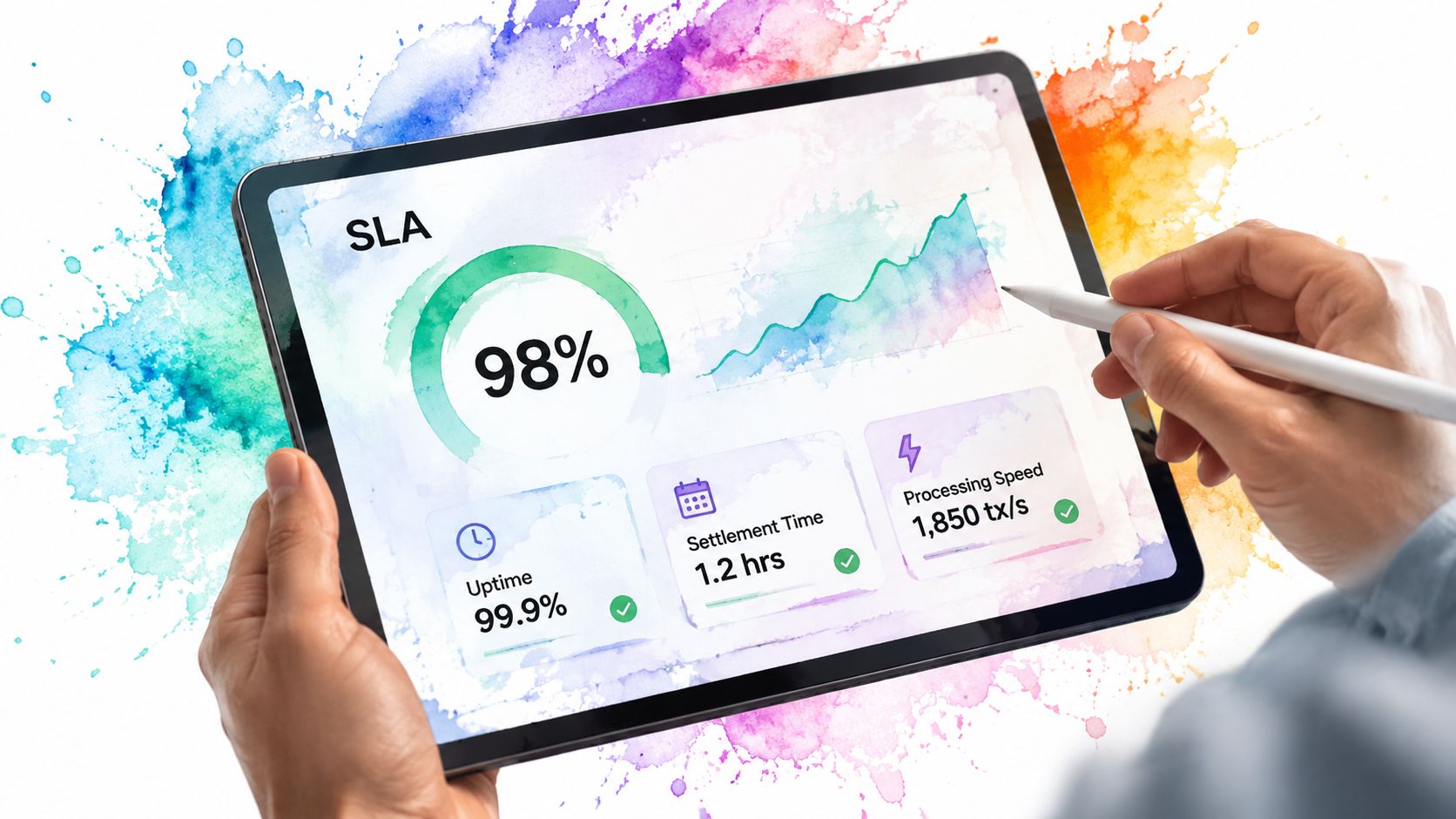
A signed SLA doesn't improve performance unless someone measures it. For payment and financial infrastructure vendors, track settlement completion, rejected transactions, API availability, incident response, support responsiveness, reconciliation quality, and fee accuracy. For other suppliers, use delivery quality, turnaround time, defect rates, and issue resolution.
Set the metric at the service boundary the business experiences. A provider may advertise platform availability while your payment workflow still fails because a bank connection, compliance review, or liquidity source is unavailable. Record dependencies so that a vendor scorecard doesn't hide a weak link elsewhere in the chain.
Combine dashboards with judgment
Use a concise scorecard for each critical relationship:
- Service outcome: Did the vendor deliver the required result?
- Reliability: Did failures occur, and were they contained?
- Financial outcome: Did actual fees and FX match the contract?
- Risk outcome: Were audits, filings, and remediation actions completed?
- Relationship outcome: Did the vendor communicate clearly and resolve issues?
Review strategic vendors in structured business reviews with documented owners and actions. Don't reward a low price when the vendor creates manual work or settlement uncertainty. Conversely, don't demand perfect performance from a low-risk supplier when a practical remediation plan is sufficient.
8. Cost and Contract Negotiation Management
Price negotiations work better when finance understands the full transaction path. Compare not only the quoted fee, but also FX treatment, intermediary charges, minimums, account costs, implementation work, support, reconciliation effort, and the cost of maintaining a fallback provider.
Build a total-cost model by vendor category. For a banking partner, examine payment fees, currency conversion, settlement timing, account requirements, and service levels. For a crypto vendor, review custody charges, transaction costs, network-fee treatment, withdrawal terms, API limits, and the operational cost of monitoring wallet activity.
Trade concessions deliberately
Prepare a negotiation brief with:
- Leverage: Expected volume, strategic relevance, term length, and credible alternatives.
- Priorities: Fees, service levels, data access, support, exit rights, and reporting.
- Concessions: Terms you can trade without weakening controls.
- Walk-away conditions: Pricing, jurisdiction, security, or resilience requirements that aren't negotiable.
- Review triggers: Volume changes, service deterioration, regulatory developments, or new payment corridors.
Contract management continues after signature. Reconcile invoices against agreed terms, track credits and rebates, and review renewal clauses before the deadline. OneSafe publishes plan and fee information for its account, payment, card, and FX services. Treat published pricing as an input to comparison, not as a substitute for reviewing the total cost of your own payment mix.
9. Vendor Diversification and Supply Chain Resilience
A backup vendor listed in a spreadsheet isn't a resilient operating model. If the team hasn't tested credentials, data flows, approval permissions, settlement limits, and reconciliation procedures, the backup may fail precisely when the primary provider is unavailable.
Start with the services that can stop the business: fiat banking, ACH, wires, FX conversion, crypto liquidity, custody, payment processing, and critical infrastructure. Map each dependency, including fourth parties and shared infrastructure. Then decide where redundancy is worth the cost and where a documented manual workaround is enough.
Test failover as an operational process
A practical failover exercise should:
- Choose a failure scenario: For example, a banking partner outage, frozen account, unavailable liquidity source, or API interruption.
- Confirm decision rights: Name the person who can activate the fallback and the approvals still required.
- Execute the alternate route: Move a controlled workflow through the secondary provider.
- Measure friction: Record cutover time, rejected payments, reconciliation gaps, and customer communication needs.
- Fix the design: Update contracts, credentials, limits, documentation, and ownership.
Maintain active relationships with alternate providers. A second bank account or liquidity relationship costs money, but so does an outage that blocks payroll, vendor settlement, or customer withdrawals. Contracts should also cover data export, termination assistance, API access during transition, recovery expectations, and the handling of assets or records.
10. Vendor Relationship Management and Strategic Partnerships
Not every vendor needs executive attention. Strategic relationship management belongs with the providers whose roadmap, reliability, pricing, or regulatory posture materially affects your business. That may include a banking partner, payment processor, crypto liquidity provider, custody platform, or core infrastructure vendor.
Assign an internal owner and an executive sponsor. Finance may lead the commercial relationship with a banking partner, while technology leads an infrastructure relationship and compliance owns regulatory evidence. The vendor should know who can resolve an operational issue, approve a change, and escalate a material risk.
Make reviews useful
A structured business review should cover:
- Performance: Service levels, incidents, remediation, and customer impact.
- Commercials: Spend, fees, volume changes, and upcoming negotiation points.
- Risk: Security posture, licensing, ownership, subcontractors, and open findings.
- Planning: New jurisdictions, currencies, chains, products, and integration needs.
- Actions: Named owners, deadlines, evidence, and escalation status.
Share forward-looking requirements without exposing unnecessary confidential information. A vendor that understands your settlement flows may help design a better fiat-to-crypto process, but strategic closeness shouldn't weaken independent review. Keep exit rights, alternative options, and objective scorecards in place even for trusted partners.
15-Point Vendor Management Best Practices Comparison
| Item | Implementation complexity 🔄 | Resource requirements ⚡ | Expected outcomes 📊 | Ideal use cases 💡 | Key advantages ⭐ |
|---|---|---|---|---|---|
| Vendor Segmentation and Risk Classification | Medium 🔄🔄, data analysis and periodic reassessment | Medium ⚡⚡, analytics and governance | Targeted oversight; prioritized risk management 📊 | Global multi-currency platforms; mixed fiat and crypto vendor sets 💡 | ⭐ Efficient resource allocation; faster low-risk onboarding; regulatory alignment |
| Automated Vendor Onboarding and KYB Integration | High 🔄🔄🔄, integrate KYB/KYC flows and APIs | High ⚡⚡⚡, identity providers, infrastructure, privacy controls | Faster onboarding; consistent compliance; audit trails 📊 | Marketplaces, high-volume fintechs, web3 onboarding 💡 | ⭐ Less manual work; scalable compliance; shorter time to vendor |
| Multi-Tier Approval Workflows and Spend Controls | Medium-High 🔄🔄🔄, rules, roles and system integrations | Medium ⚡⚡, policy configuration and role management | Controlled spend; fewer fraud incidents; auditability 📊 | DAOs, distributed teams, corporate finance with multi-currency needs 💡 | ⭐ Prevents unauthorized payments; preserves operational speed; supports multi-signature approvals |
| Continuous Compliance and Risk Monitoring | High 🔄🔄🔄, multiple data feeds and alerting logic | High ⚡⚡⚡, monitoring services and analysts | Earlier warnings; lower regulatory and reputational risk 📊 | Cross-jurisdictional fintechs; regulated crypto platforms 💡 | ⭐ Timely sanctions and breach alerts; stronger audit evidence |
| Vendor Security and Data Protection Standards | Medium 🔄🔄, policies, audits and contractual clauses | Medium-High ⚡⚡⚡, audits, assessments and contractual enforcement | Lower breach risk; stronger regulatory readiness 📊 | Fintechs handling personal or financial data; custody vendors 💡 | ⭐ Protects customer data; supports SOC 2 and ISO alignment; improves resilience |
| Payment Method Optimization and Vendor Preferences | Medium 🔄🔄, routing logic and corridor mapping | Medium ⚡⚡, FX tools and routing engine | Lower fees; faster settlement; easier reconciliation 📊 | Multi-currency payouts; global vendor networks; FX-sensitive flows 💡 | ⭐ Lower payment costs; faster cash flow; vendor satisfaction through preferred rails |
| Vendor Performance Monitoring and SLA Management | Medium 🔄🔄, metric collection and dashboards | Medium ⚡⚡, integrations and observability tooling | Earlier issue detection; SLA enforcement and remediation 📊 | Critical payment rails, banks, custody and liquidity providers 💡 | ⭐ Data-based vendor decisions; objective SLA evidence; earlier remediation |
| Cost and Contract Negotiation Management | Medium 🔄🔄, benchmarking and playbooks | Medium ⚡⚡, procurement expertise and market data | Lower total cost of ownership; better pricing and contract terms 📊 | Treasury and procurement teams at high-volume fintechs; vendor-heavy spend 💡 | ⭐ Cost reduction; standardized contracts; stronger position for better terms |
| Vendor Diversification and Supply Chain Resilience | High 🔄🔄🔄, orchestration, failover playbooks and testing | High ⚡⚡⚡, multiple integrations and accounts | Fewer single points of failure; higher uptime and continuity 📊 | Mission-critical payment rails; global operations requiring redundancy 💡 | ⭐ Operational resilience; stronger negotiating position; continuity during outages |
| Vendor Relationship Management (VRM) & Strategic Partnerships | Medium 🔄🔄, governance and executive sponsorship | Medium-High ⚡⚡⚡, senior time and joint planning | Stronger service levels; co-innovation; preferred access 📊 | Strategic banking and crypto partners; long-term integrations and DAOs 💡 | ⭐ Access to roadmaps; improved terms; faster issue resolution and co-development |
Turn the Framework Into a Working Control System
Vendor-management practices create value only when they operate as one control system. A vendor register without payment controls is a directory. KYB without monitoring becomes stale evidence. A scorecard without an accountable owner becomes a report nobody uses. A backup provider without a tested cutover remains an assumption.
Start with a single register covering banking partners, payment processors, contractors, software providers, crypto exchanges, liquidity sources, custodians, and material subcontractors. Record the business owner, service scope, payment methods, currencies, jurisdictions, data access, contract status, and current risk tier. The historical benchmark of approximately 50 vendors assessed annually and a vendor-to-staff ratio of about 50:1 show why teams need segmentation and standardized workflows instead of equal manual treatment for every relationship, as reported in the Mastercard benchmark.
Apply KYB, sanctions screening, security evidence, and contract requirements by tier. Request evidence that matches the vendor's role. A low-risk service provider may need a limited review, while a banking partner or crypto liquidity provider requires closer examination of ownership, licensing, custody, resilience, and payment exposure. Store documents, decisions, exceptions, and renewal dates in a shared system, with access limited by role.
Configure approvals around the movement of money. Set role permissions, corporate-card limits, merchant restrictions, payment-method rules, wallet verification, and escalation paths. Document when ACH is acceptable, when a wire or SWIFT transfer requires senior approval, and when crypto settlement is permitted. Approve the converted value when FX exposure affects the decision. Require an independent check before changing bank details or wallet addresses.
Monitoring should trigger decisions, not create noise. Use scorecards for high-risk vendors, assign owners to sanctions or licensing alerts, track settlement and service performance, and schedule formal reviews for strategic relationships. Dedicated vendor-management technology is increasingly used, with 64% of respondents used dedicated TPRM software platforms and spreadsheet-based methods declining by 29%, according to industry reporting on supplier-management software. That survey found a hybrid operating model was most common. Automate evidence collection and routing, then reserve human judgment for exceptions and material decisions.
Run one failover exercise for a critical banking, payment, FX, or crypto-settlement dependency. Trace the process from an alert to an alternate payment. Confirm that staff can access credentials, approvals remain available, customer and vendor communications are prepared, and reconciliation can be completed. Assign every corrective action, retain exercise evidence, review exceptions, and revisit the risk tier when transaction volume, jurisdictions, service scope, ownership, or technology changes.
Teams assessing an integrated finance stack may consider OneSafe for multi-currency business accounts, ACH, wires, SWIFT, corporate-card controls, role permissions, approval policies, and crypto-compatible settlement workflows. Suitability depends on the organization's jurisdictions, permitted activities, control environment, vendor mix, and treasury requirements. Assess the platform with the same discipline applied to any other critical financial vendor, supported by broader guidance on mastering vendor relationships in IT.
For global vendor operations, OneSafe brings multi-currency accounts, ACH, wires, SWIFT, corporate cards, spending controls, and crypto-compatible payment workflows into one interface. Visit OneSafe to evaluate whether its account, approval, and settlement capabilities fit your vendor-governance and treasury processes.