The largest exchange heist in history—the $6.3 billion Binance breach—has just redefined the security standards businesses must demand from any crypto banking partner. Treasury managers, DAO operators, and startup founders are now confronting an uncomfortable truth: the model that treats a centralized exchange as both trading venue and asset custodian is no longer defensible. This analysis connects the breach directly to the concrete criteria you should apply when evaluating crypto banking platforms, from custody architecture to insurance fallbacks.
Table of Contents
- What Just Happened
- Why This Matters Now
- What ‘Crypto Banking’ Actually Means Today
- Post-Breach Standard for Secure Crypto Banking Platforms
- What to Watch Next
- Common Questions, Answered Quickly
- Key Takeaways
- Sources
- Further reading
What Just Happened
In late October 2026, Binance suffered a security breach that drained an estimated $6.3 billion, linked to North Korea. The attack dwarfs all previous exchange heists. According to Reuters via Global Banking & Finance Review (November 2, 2026), Binance resumed service shortly after, but the damage was immediate: customers withdrew $3.64 billion—2.1% of assets—before outflows stabilized. Binance has since covered 95% of the stolen funds from its own reserves. While the exchange’s financial firepower appears intact, the breach exposes the inherent risk of pooled exchange wallets and mixing custody with trading in a single organization.
Why This Matters Now
The Binance Hack Business Impact
The Binance hack business impact extends well beyond Binance itself. When the industry’s largest exchange can lose billions in minutes, counterparty risk must be priced into every treasury decision. Organizations that treat an exchange like a combined brokerage and bank now face a single point of catastrophic failure, no matter the size of their balance. The breach forces a hard separation between trade execution and custody—exactly what a business crypto banking platform delivers. For any team holding operational funds in crypto, holding those assets on an exchange is no longer a defensible shortcut; it’s an unmanaged liability.
Crypto Custody for Startups and DAOs
DAOs and early-stage startups carry unique exposure. A DAO storing community funds on an exchange risks the entire governance treasury if that platform is compromised. Similarly, a startup depending on an exchange to hold working capital might find its runway erased overnight. Crypto custody for startups must move from a checklist item to a non-negotiable foundation. A dedicated crypto banking partner provides segregated, off-exchange accounts and role-based permissions, insulating operational cash from any single venue’s vulnerabilities.
What ‘Crypto Banking’ Actually Means Today
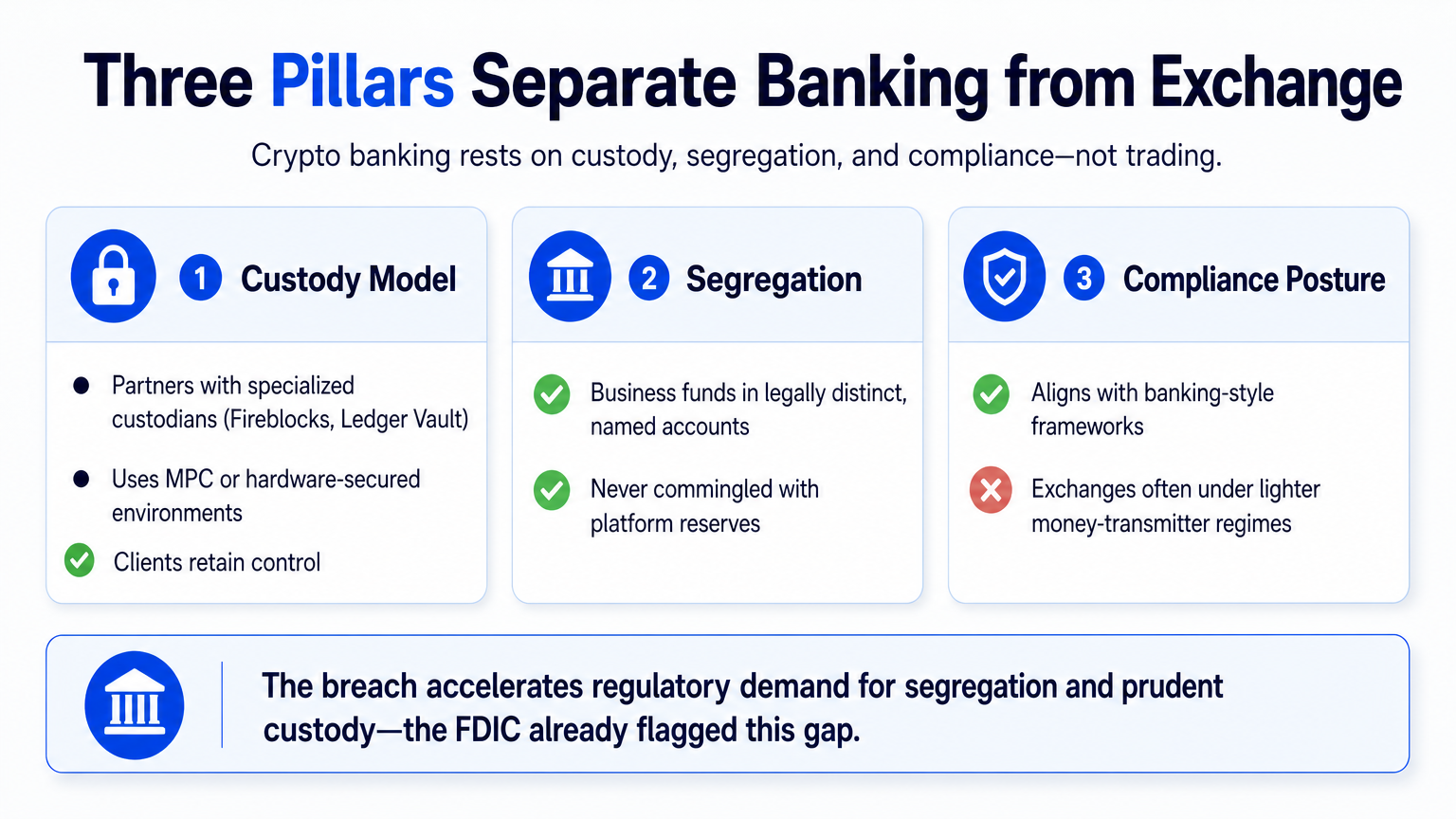 Crypto banking vs exchange is the first crucial distinction. An exchange is a trading venue; its primary job is matching buy and sell orders, and it often holds client assets in commingled hot wallets. A crypto banking service, by contrast, is a financial operations platform built around institutional-grade custody and treasury management. It merges fiat services (multi-currency accounts, wires, ACH) with digital asset capabilities (custody, on/off-ramps, stablecoin payments) while keeping client funds segregated from the platform’s own reserves.
This separation rests on three pillars:
- Custody model: Banking platforms partner with specialized custodians (e.g., Fireblocks, Ledger Vault) using multi-party computation (MPC) or hardware-secured environments, with clients retaining control.
- Segregation: Business funds sit in legally distinct, named accounts, never commingled.
- Compliance posture: Crypto banking providers align with banking-style frameworks, while many exchanges operate under lighter money-transmitter regimes.
The Binance breach will accelerate regulatory demands for segregation and prudent custody—the FDIC’s interagency guidance on crypto-asset safekeeping already flagged this gap.
Post-Breach Standard for Secure Crypto Banking Platforms
Separate Trading from Custody—No Exceptions
The single most important rule: never store business treasury on an exchange’s trading wallet. Trading should happen on an exchange; retained value must sit in segregated, off-exchange custody managed by a secure crypto banking platform. This mirrors traditional finance, where a brokerage executes trades and a custodian bank holds assets. Verify that your provider delivers dedicated accounts legally distinct from its own holdings, with assets moved to a qualified custodian immediately after conversion.
Demand Institutional Infrastructure and Insurance
The Binance attackers likely exploited hot-wallet weaknesses. Secure crypto banking platforms mitigate this by relying on Fireblocks MPC-CMP technology that eliminates single private keys. Demand proof of regular penetration testing, SOC 2 reports, and adherence to frameworks like FS-ISAC. OneSafe, for example, secures all digital assets under management through Fireblocks custody, ensuring no single exchange’s surface can jeopardize your funds. As traditional banks like Deutsche Bank enter the custody space, the baseline for enterprise-grade security will only rise.
Insurance is equally fragmented. Exchanges often rely on self-funded safety nets (like Binance’s SAFU) with no legal obligation to make depositors whole. Crypto banking services typically secure commercial crime policies from third-party insurers, but coverage caps and exclusions vary. After the breach, verify policy terms directly—“fully insured” does not mean unlimited protection.
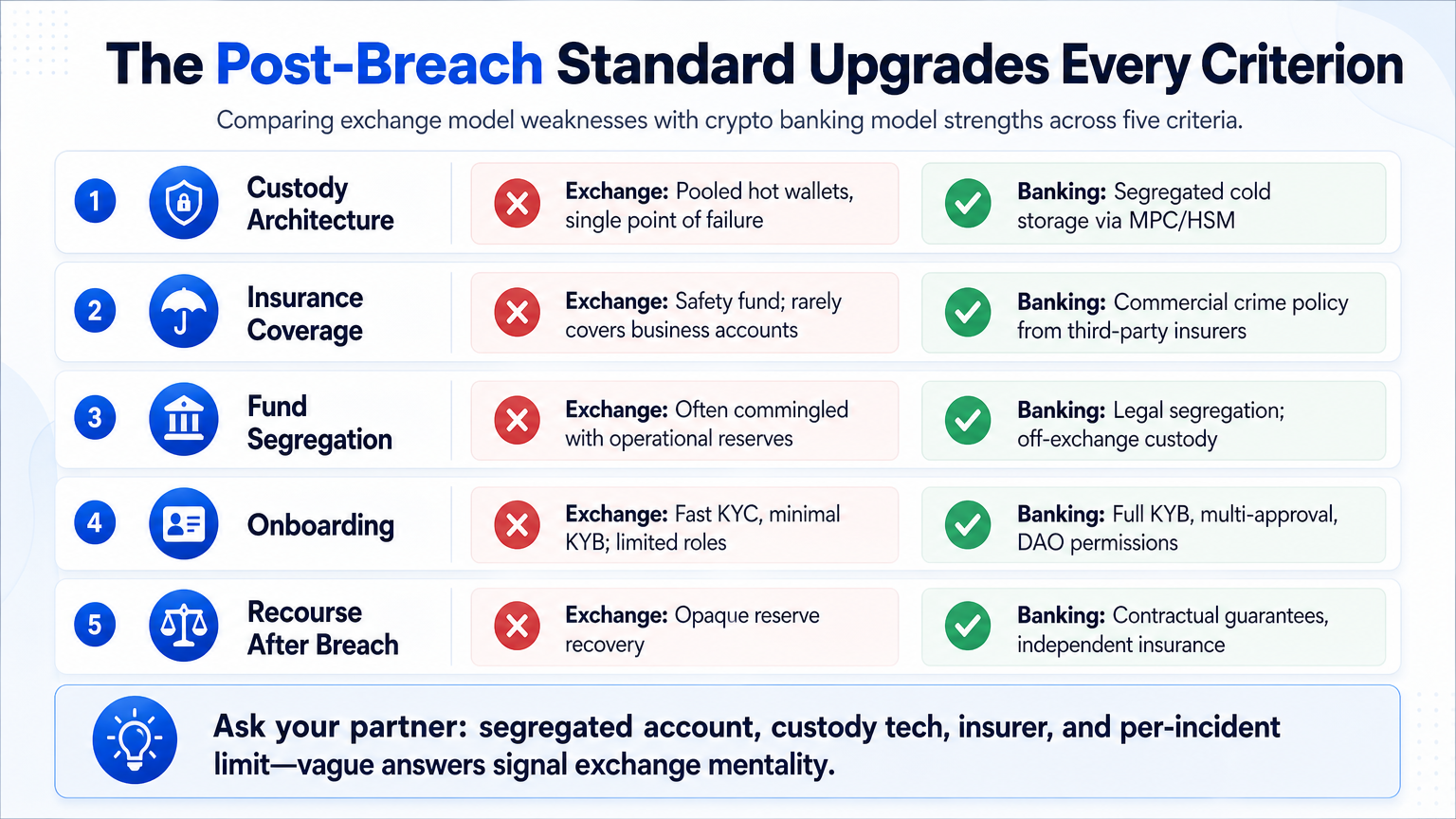
The table below captures the shift to the crypto banking after breach standard.
| Criterion | Exchange Model (Pre-Breach) | Crypto Banking Model (Post-Breach) |
|---|---|---|
| Custody architecture | Pooled hot wallets, single point of failure | Segregated cold storage via MPC/HSM |
| Insurance coverage | Exchange-run safety fund; rarely covers business accounts | Commercial crime policy from third-party insurers |
| Fund segregation | Often commingled with exchange operational reserves | Legal segregation; off-exchange custody with bank-grade partners |
| Onboarding | Fast KYC, minimal KYB; limited role permissions | Full KYB, multi-approval workflows, customizable DAO permissions |
| Recourse after a breach | Recovery depends on exchange’s opaque reserves | Contractual guarantees, independent insurance, assets held externally |
Ask your prospective partner: Is business treasury held in a segregated account? What custody technology sits behind it? Who insures the assets, and what is the per-incident limit? Vague answers signal lingering exchange mentality.
What to Watch Next
The Binance breach will fast-track mandatory custodial insurance akin to traditional banking. The FSOC already flagged this gap, and the $6.3 billion loss makes voluntary funds look fragile. Expect U.S. and European regulators to propose minimum coverage. Separately, specialized non-bank custodians are emerging—Google’s custody move exemplifies how trust is shifting to the custody layer. For businesses, tools to separate trading from storage are more accessible than ever, and soon they may be required.
As the landscape evolves, keeping your stakeholders current is critical. Joyrise plans, writes and publishes illustrated SEO articles to your Webflow blog every day, handing you your first article before you pay.
Common Questions, Answered Quickly
What happened with Binance?
On November 2, 2026, Reuters via Global Banking & Finance Review reported a $6.3 billion breach linked to North Korea. Binance resumed service while customers withdrew $3.64 billion (2.1% of assets); outflows have since stabilized, and Binance says it covered 95% of stolen funds from its reserves.
Why does the breach matter for my business?
It proves that even the world’s largest exchange is a single point of catastrophic failure. Treasury sitting on an exchange is directly exposed. The new standard demands that trade execution and custody be handled by separate entities.
How can I tell if a crypto banking platform is secure enough?
Look for three non-negotiables: (1) off-exchange, segregated custody using institutional technology like Fireblocks; (2) commercial insurance explicitly covering theft for business accounts; and (3) rigorous onboarding that enforces KYB and role-based permissions. Request a security architecture diagram and proof of SOC 2 or equivalent.
What’s the difference between a crypto exchange and a crypto banking service?
An exchange is a trading venue that pools assets in hot wallets. A crypto banking service is a financial operations platform built around segregated, off-exchange custody and treasury management, integrating fiat and crypto rails.
Does insurance fully protect my treasury after a breach of this size?
Insurance is a patchwork. Exchange safety funds have no legal obligation to make you whole. Crypto banking platforms obtain commercial crime policies, but coverage limits typically cap out in the tens of millions per incident. For large treasuries, diversify custody providers and verify policy details directly.
Key Takeaways
- The $6.3 billion Binance breach makes off-exchange custody a non-negotiable baseline for any business treasury.
- Business crypto banking platforms that provide segregated, institutional-grade custody now define secure treasury management.
- DAOs and startups must prioritize crypto custody for startups and role-based control to mitigate single-platform risk.
- Insurance remains fragmented; verify policy specifics, not marketing claims.
- The regulatory aftermath will raise the bar further—separating trading from custody is the only defensible posture today.
For a crypto banking platform that provides segregated accounts, Fireblocks-powered custody, and a single interface for fiat and crypto operations, explore how OneSafe helps businesses and DAOs secure their treasuries post-breach—get started today.
Sources
- Crypto: What We Need to Protect
- Crypto-Asset Safekeeping by Banking Organizations
- Crypto Secure: Protect Digital Assets and Crypto Payments
Further reading