Digital Euro 2026: What It Means for Crypto Banking
The European Central Bank (ECB) is advancing its plans for a digital euro, with a launch now projected no earlier than 2029. For finance leads and founders who depend on crypto banking, that timeline makes one thing clear: the window to future-proof your financial operations is narrowing. The digital euro will redraw the border between traditional fiat and programmable money, forcing businesses that hold or transact in both to demand a platform that unifies them natively—not one that bolts crypto on as an afterthought.
Table of Contents
- What Just Happened: The Digital Euro’s November 2026 Status Update
- Why It Matters Now: Crypto Banking Isn’t Just About Bitcoin Anymore
- Background: Crypto Banking From Niche to Mainstream
- Concrete Implications for Finance Leads and Founders
- Recommended Actions: Getting Ready Without Overpanicking
- What to Watch Next: From Pilot to Reality
- Key Takeaways
What Just Happened: The Digital Euro’s November 2026 Status Update
What is the digital euro and when will it launch?
The digital euro is a central bank digital currency (CBDC)—a digital liability of the Eurosystem, issued by the ECB, designed to complement physical cash as public money in electronic form. According to the ECB, it would be legal tender across the euro area, accessible to households and businesses for everyday payments, and backed by the full faith of the central bank (ECB, Digital Euro).
As of November 2, 2026, the ECB is running active pilots to test distribution, offline payments, and holding limits. CryptoTicker.io reported on that date that the digital euro is projected to complement cash no earlier than 2029, with a holding limit and built-in privacy features currently being piloted (CryptoTicker.io). No official launch date has been set; the 2029 window is the earliest likely scenario, subject to legislative approval and technical readiness.
What are the holding limits and privacy features of the digital euro?
Two design choices dominate the pilot phase:
- Holding limits are being tested to prevent large-scale flight from commercial bank deposits into the CBDC. The ECB has not fixed a final cap, but early signals point to a per-user limit in the range of a few thousand euros, with an optional “waterfall” mechanism that could sweep excess holdings into a linked commercial bank account.
- Privacy trade-offs are central. The ECB states that low-value, low-risk transactions would offer cash-like privacy—neither the central bank nor commercial intermediaries would see individual transaction details. Larger or higher-risk transfers would require identity and anti-money-laundering checks.
These parameters are not final, but they highlight the balancing act: the digital euro must remain attractive enough to use, yet not so anonymous that it becomes a tool for illicit finance.
Why It Matters Now: Crypto Banking Isn’t Just About Bitcoin Anymore
How will the digital euro affect crypto banking for businesses?
The arrival of a major CBDC fundamentally changes the crypto fiat integration landscape. Until now, crypto banking for business meant managing Bitcoin, Ethereum, and stablecoins alongside fiat, with fiat rails separate, slower, and run by traditional banks. The digital euro 2026 timeline makes visible that a new asset class will soon sit inside the eurozone’s monetary infrastructure—natively digital, programmable, and central-bank guaranteed.
A treasury operating across USDC, Bitcoin, and euros will soon have to account for a digital euro that settles on a distributed ledger. That means the same platform must handle on-chain assets and central bank liabilities without friction. This blurring is already visible in the stablecoin market, where bank disintermediation makes a unified operating system for money clearer (Stablecoin Regulation: Bank Disintermediation Is Here). Soon, the most efficient way to move value between crypto, stablecoins, and a sovereign digital currency will be on a single platform that can convert, settle, and reconcile all three in near real time.
For finance leads, the practical takeaway is sharp: vet your provider’s ability to integrate new currency forms. A multi-currency business account with USD, EUR, CAD alongside crypto holdings—and seamless crypto on-ramp off-ramp flows—isn’t a luxury; it’s the minimum viable stack. Platforms like OneSafe, with corporate cards, wire support, and crypto conversions under one interface, illustrate what businesses should demand as the baseline.
Background: Crypto Banking From Niche to Mainstream
How crypto banking evolved for businesses and DAOs
Crypto banking started as custodial wallets for individual traders, but Web3 startups and Decentralized Autonomous Organizations (DAOs) forced rapid maturation. By 2026, a credible crypto-friendly platform for business must provide bank-grade security, multi-signature controls, and fiat payment rails under rigorous compliance.
The landscape fragmented quickly: incumbents offered custody as a premium add-on; crypto-native platforms delivered speed but rarely covered ACH, wires, and corporate cards. When major tech players entered with key custody solutions, fragmentation deepened, pushing businesses toward neobanking for web3 platforms that consolidate everything (Google Enters Crypto Banking: Key Fragmentation and What’s Next). Security crises like the $6.3B Binance heist reinforced that multi-layer protection and institutional custody are non-negotiable (Crypto Banking After the $6.3B Binance Hack).
The current toolset: multi-currency accounts, crypto on/off-ramps, corporate cards
A modern crypto banking platform for business typically bundles:
- Multi-currency business accounts in USD, EUR, CAD and others, often segregated and held with partner banks.
- Crypto on-ramp and off-ramp capabilities that convert between fiat and cryptocurrency in the same interface—replacing the old workflow of moving funds between an exchange and a bank.
- Corporate cards with spend limits, physical and virtual, for vendor payments, subscriptions, and operational expenses.
- DAO banking features: customizable roles, permissions, secure multi-signature custody, and automated payment workflows that reflect governance structure.
These tools already exist—the 2026 review of best crypto business accounts highlights unified fiat/crypto services as a standard, not a differentiator (Zengo, Best Crypto Business Accounts Reviewed (2026 Guide)). The missing piece, until now, was a clear CBDC rail.
Concrete Implications for Finance Leads and Founders
Does my business need a crypto banking platform that handles CBDCs?
If your business operates in or trades with the eurozone, and holds any crypto or stablecoin positions, the answer is increasingly yes. The digital euro will function as a programmable, central-bank-backed asset held and transferred on a ledger. Your treasury will soon have three categories—traditional fiat, decentralized crypto, and a CBDC—and moving between them efficiently will be a competitive requirement.
Ignoring the CBDC rail until 2029 risks fragmented operations: one bank for fiat, one platform for crypto, and a separate CBDC wallet. That friction adds cost, latency, and reconciliation headaches. By contrast, a platform that already unifies fiat and crypto can add CBDC as an additional currency module—no separate login, no separate compliance stack. The banking partner you choose now shapes how easily you absorb that third category.
Can a single platform handle fiat, crypto, and future CBDCs?
Technically, yes—if the platform is built as a financial operating system rather than isolated services. A well-architected neobank platform connects to partner banks for fiat, blockchain nodes and custodians for crypto, and eventually the dedicated CBDC settlement infrastructure. Because the digital euro is likely to use permissioned distributed ledger technology, integration is an incremental engineering step for platforms that already manage on-chain assets and multi-currency ledgers.
OneSafe demonstrates that pattern: it handles ACH, wires, SWIFT, and crypto conversions in a unified interface, backed by Fireblocks custody. Extending that stack to a digital euro would mean adding a settlement rail—not rebuilding the entire treasury architecture. For DAOs and global businesses, DAO banking can evolve naturally, with programmable money flowing between governance-controlled wallets and CBDC accounts under the same permission model.
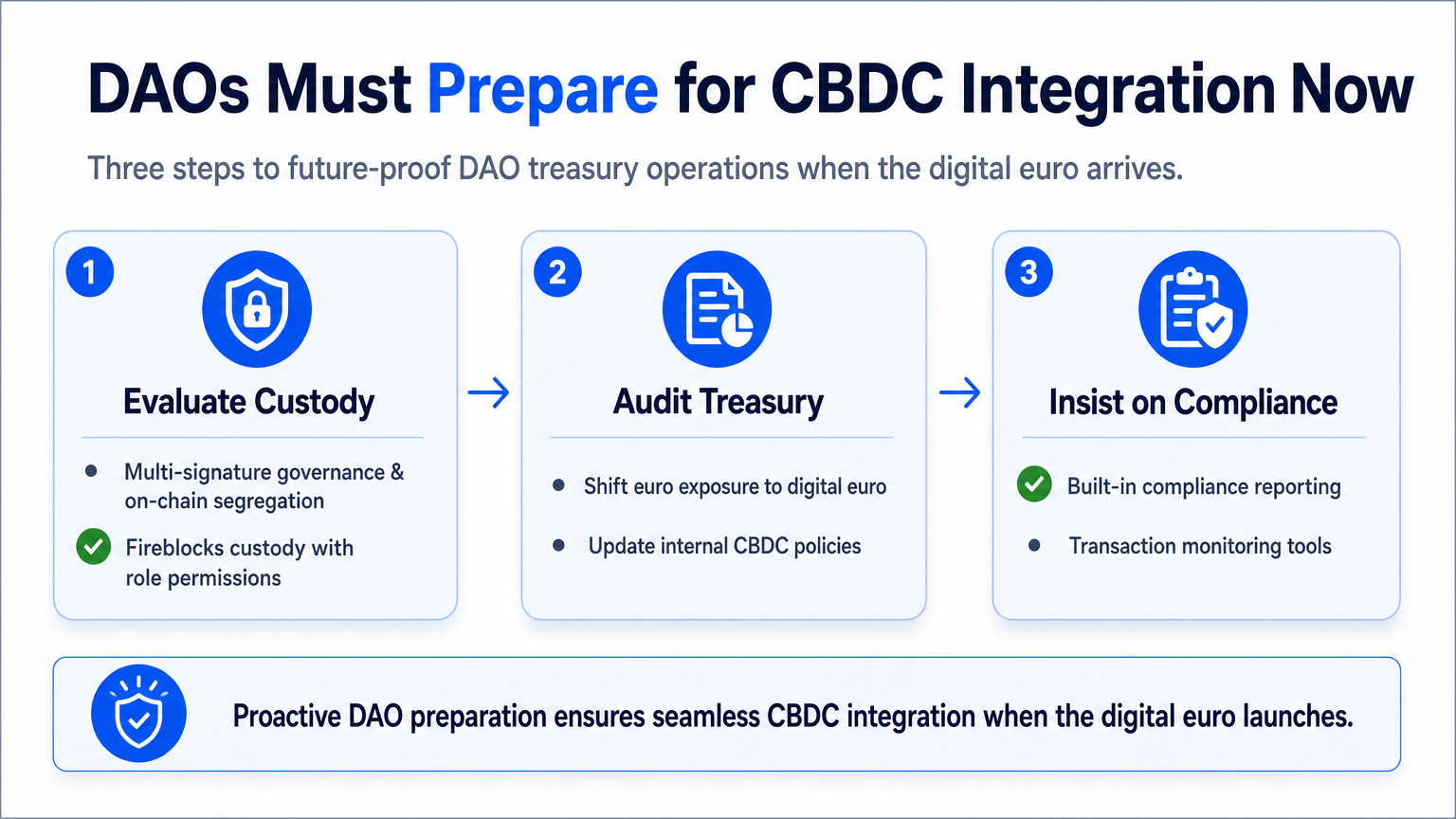
How should DAOs prepare for central bank digital currencies?
DAOs face unique exposure. Many hold treasury reserves in stablecoins and convert to fiat for payroll, vendors, and grants. A digital euro offers a natively digital, euro-denominated central bank liability that could reduce reliance on a single stablecoin issuer and cut eurozone conversion costs.
To prepare, DAOs should:
- Evaluate custody architecture: ensure multi-signature governance, on-chain segregation, and the ability to hold crypto and future CBDC tokens. Fireblocks custody with role-based permissions is a strong readiness indicator.
- Audit treasury composition: consider how much euro exposure could shift into the digital euro once available, and update internal policies for CBDC assets.
- Insist on compliance clarity: use platforms with built-in compliance reporting and transaction monitoring to adapt without disrupting operations.
The broader crypto regulation 2026 environment supports this proactive posture. As india tightens rules on offshore crypto cards, cross-border complexity grows (Web3 Payments Under Fire as India Bans Offshore Crypto Cards). A CBDC under clear ECB oversight could become a stable anchor for DAOs with eurozone operations.
Recommended Actions: Getting Ready Without Overpanicking
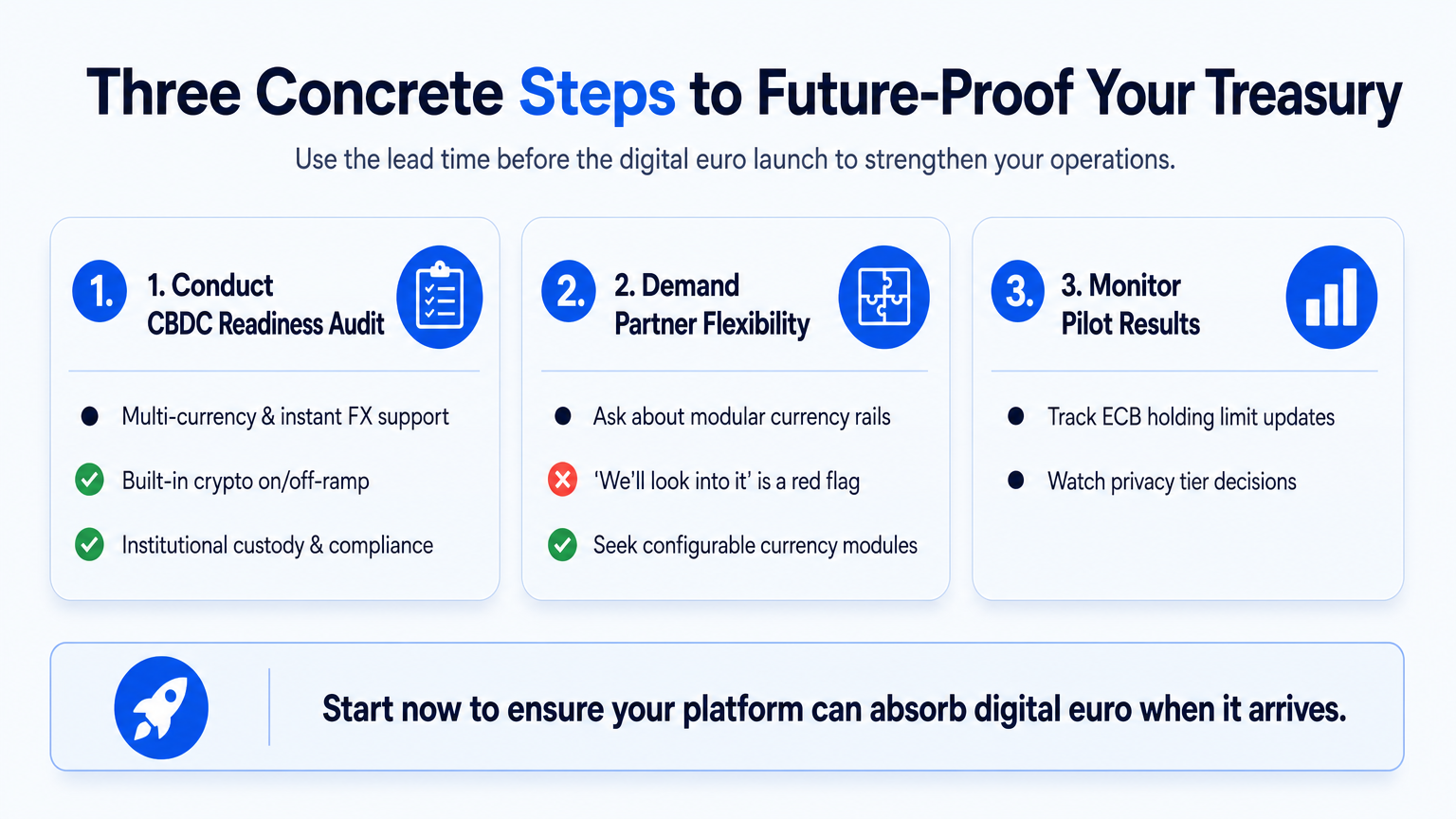
What concrete steps can I take now to future-proof my company's financial operations?
The digital euro won’t upend your treasury overnight, but use the lead time to strengthen your position.
1. Conduct a CBDC readiness audit of your current crypto banking stack.
Check for:
- Multi-currency support: EUR, USD, and key operating currencies with instant FX.
- Crypto on/off-ramp: built-in fiat-crypto conversion without external exchanges.
- Custody architecture: institutional-grade infrastructure such as Fireblocks, with MFA.
- DAO governance: role-based permissions and multi-signature treasury controls.
- Compliance and reporting: transaction logs suitable for regulatory filings.
- CBDC integration pathway: modular currency rails or a public stance on CBDC support.
2. Demand flexibility from your banking partners.
Ask whether their technology can accommodate a new currency form without forcing a migration. If the answer is “we’ll look into it,” treat that as a warning sign. Crypto treasury management in a world with programmable money requires a platform that treats currencies as configurable modules, not hard-coded products (Crypto Treasury Management After the Binance Hack).
3. Monitor the pilot results and regulatory drafts.
The ECB will release periodic reports on holding limits, privacy tiers, and settlement finality—data that directly affects treasury design. To track developments without adding headcount, Joyrise—your blog, written and published every day—plans, writes, and publishes illustrated SEO articles to your Webflow blog every day; you can read your first article before you pay.
What to Watch Next: From Pilot to Reality
2027–2028 milestones to track
- Legislative proposal phase: The European Commission is expected to formalize a legal framework by late 2027, defining legal tender status, merchant acceptance, and privacy standards.
- Pilot expansion: Watch for broader pilots involving financial intermediaries and real businesses—these will reveal integration requirements for crypto banking platforms.
- Interoperability standards: Any published technical specification for APIs or smart-contract interfaces will be a critical signal for crypto-friendly platforms.
Open questions on interoperability and global adoption
- Will the digital euro’s ledger interface with existing blockchain networks, enabling direct swaps between digital euros and stablecoins? Interoperability choices will determine whether a single platform can unify fiat, crypto, and CBDC without bridges.
- How will other jurisdictions respond? If the US, UK, or Asian economies launch rival CBDCs, multi-currency business accounts spanning sovereign digital currencies become urgent.
- What are the final digital euro holding limits? A low cap could force treasuries to mix CBDC, stablecoins, and bank deposits—adding complexity a unified platform must manage clearly.
Key Takeaways
- The digital euro is projected to launch no earlier than 2029, with holding limits and tiered privacy features currently being piloted. Businesses operating across crypto and fiat should treat that timeline as a countdown to reevaluate their banking stack.
- The line between fiat and digital currencies is dissolving. Unified crypto banking for business platforms with multi-currency accounts, crypto on/off-ramps, and future CBDC rails are becoming non-negotiable for treasury efficiency.
- DAOs should audit custody architecture and governance workflows now, ensuring their banking partner can support on-chain assets and a potential digital euro under one permission model.
- A practical readiness audit—checking multi-currency support, institutional custody, compliance reporting, and CBDC integration pathways—helps finance leads avoid being flat-footed when the digital euro arrives.
- Today’s strategic choice is whether your financial platform can absorb new currency rails or merely cope with them.
Start bridging your fiat and crypto operations on a single platform at OneSafe.