
Crypto treasury management is confronting a macro force most digital-native teams never planned for: a shift in long-end U.S. Treasury supply. In May 2025, the Treasury’s quarterly refunding announcement set off a softer dollar and a jump in yields on 10‑ and 30‑year bonds. For businesses holding reserves across USDC, Bitcoin, and multiple fiat currencies, that one policy move immediately rewrote FX assumptions, stablecoin opportunity cost, and the timeline for converting crypto back to cash.
Table of Contents
- What Just Happened: U.S. Treasury Boosts Long-Term Bond Supply
- Why the Bond Shift Matters for Crypto Treasury Managers
- Old Playbooks Break: From Static Fiat Buffers to Dynamic Hedging
- How a Unified Platform Compresses the Macro-Reaction Cycle
- What to Watch Next: Central-Bank Rhetoric and Crypto-Specific Catalysts
- Essential Crypto Treasury Management Questions
- Key Takeaways
What Just Happened: U.S. Treasury Boosts Long-Term Bond Supply
The May refunding announcement explained
On May 7, 2025, the U.S. Treasury confirmed in its quarterly refunding statement that it would increase the size of upcoming auctions of 10‑year and 30‑year notes and bonds. The decision, widely anticipated after months of debate about funding the federal deficit, surprised the market in scale: the boost was larger than the prior quarter’s modest uptick, signaling a deliberate shift toward terming out government debt. Cobo’s enterprise guide to crypto treasury management notes that macro-driven repricing events like this are exactly what catch under-prepared treasury teams off guard.
Why bond yields and the dollar are reacting
A larger supply of long-duration bonds pushes their prices down and yields up—simple supply mechanics. At the same time, the dollar softened. In the hours following the announcement, the U.S. Dollar Index dipped as traders priced in that the additional supply would keep long‑term rates elevated and potentially weigh on the currency’s relative attractiveness. The dollar’s drop wasn’t a crisis move, but it marked a clear break from the tight-range trading of April. For anyone managing a multi‑currency treasury, it meant that hedges calibrated to a stable dollar were suddenly offside.
Why the Bond Shift Matters for Crypto Treasury Managers
The dollar-crypto link (it’s not always negative)
Conventional wisdom says a weaker dollar is automatically bullish for crypto. But the relationship is more nuanced when yields rise at the same time. Higher Treasury yields raise the opportunity cost of holding non‑yielding assets like Bitcoin or even stablecoins that don’t pass through interest. In late May 2025, analysts noted a rotation of Bitcoin traders into short‑term Treasury bonds as yields became more attractive relative to crypto’s flat carry. A crypto treasury manager can’t treat “dollar down” as a blanket buy signal; they have to weigh the yield gap, duration risk, and their own need for near‑term fiat liquidity. For teams evaluating banking partners that support both asset classes, understanding what is a neobank and how modern platforms bridge fiat and crypto is a practical starting point.
Volatility wakes up: managing stablecoin and token exposure
When bond yields jump, volatility tends to rise across risk assets—including crypto. The dollar’s slide adds another layer of FX risk to crypto positions held as dollar‑denominated stablecoins. USDC might hold its peg, but a treasury that had 40% of its runway in USDC suddenly has an asset whose purchasing power is declining against a basket of other currencies the business actually needs (euros for payroll, yen for a vendor). That is the moment when a stablecoin treasury strategy must account for the fact that stablecoins are currency substitutes, not interest‑rate hedges.
Liquidity stress and the risk of flight-to-quality
A bond‑market dislocation can trigger a rapid flight‑to‑quality in traditional markets, sucking liquidity out of speculative positions. In 2023’s regional bank stress, for example, USDC temporarily de‑pegged. If 10‑year yields spike further—say, past 5%—crypto lending venues and decentralized exchanges could see sudden liquidity dry‑ups. The treasury that cannot quickly convert crypto to fiat or rebalance across multi‑currency accounts risks being caught in a squeeze where the only available exit is at a wide spread. This is where specialized crypto treasury management solutions that emphasize liquidity and rapid settlement become operationally essential.
Old Playbooks Break: From Static Fiat Buffers to Dynamic Hedging
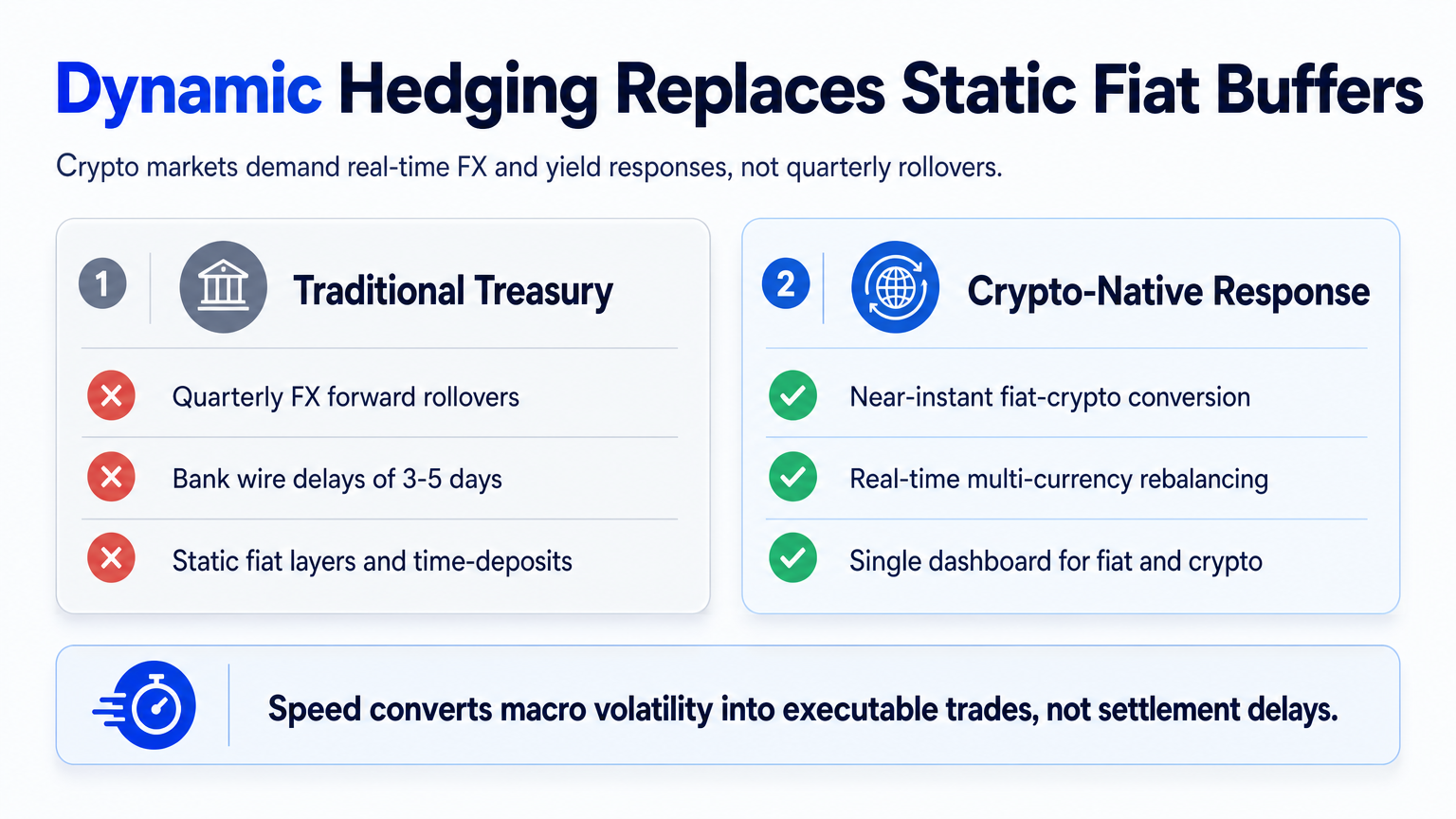
Traditional treasury vs. a crypto-native response
Classic corporate treasury management relies on layers of time‑deposits, commercial paper, and FX forwards rolled on a quarterly schedule. That cadence is too slow when crypto markets move 24/7 and bond‑market news can reprice the dollar in a single New York afternoon. A macro crypto hedging response requires near‑instant conversion and the ability to shift between fiat rails and stablecoin settlements without waiting for a bank wire to clear.
Multi-currency rebalancing: when USD, EUR, and USDC mix
Consider a DAO with a treasury denominated 50% in ETH, 30% in USDC, and 20% in fiat USD. After the refunding news, the dollar weakened against the euro. If the DAO’s largest operational expense is a EUR‑denominated cloud services bill, its effective runway just shrank. A manual rebalance—sell ETH, convert USDC to USD, wire USD to a EUR account, convert to euros—could take three to five business days. During that time, the euro might strengthen further. Instant conversion between crypto and fiat currencies within a single interface compresses that window to minutes.
Instant conversion as a first line of defense
When macro signals flip, speed is the hedge. A platform that supports native crypto fiat conversion lets a treasury team move value from USDC to euros directly—without hopping between an exchange, a bank, and a currency broker. That workflow turns a volatile morning into an executable trade rather than a series of delayed settlement legs. Bitwave’s analysis of crypto treasury management reinforces that real-time conversion capability is no longer a nice-to-have—it’s the foundation of a responsive treasury.
How a Unified Platform Compresses the Macro-Reaction Cycle
Why stitching bank + exchange + custody slows you down
Most crypto‑native organizations still rely on a patchwork: a traditional bank for fiat, a separate exchange for conversions, and a custody provider for on‑chain assets. Each leg introduces settlement delays, counterparty limits, and manual reconciliation. During the May 2025 shift, a treasury manager who needed to move six figures of USDC into EUR wire might have hit a bank cutoff, an exchange withdrawal limit, and a custody co‑signing delay—all while the euro was climbing. A unified platform that houses fiat and crypto accounts side‑by‑side removes that multi‑hop friction. Founders evaluating providers often find it useful to study the drawbacks to neo banking so they can distinguish platforms built for crypto-native needs from generic digital banking tools.
OneSafe in practice: one dashboard for fiat and crypto moves
OneSafe, a financial technology company that partners with regulated banking providers, operates exactly this model. It offers multi‑currency accounts in USD, Euro, and CAD, alongside on‑chain USDC custody via Fireblocks. When the refunding news broke, a finance lead could have moved USDC balances into euro accounts instantly—without a two‑day wire—and locked in an FX rate while still in the middle of a market swing. That same dashboard also shows liquidity positions across fiat and crypto in real time, so the team can see exactly how much is where before executing a rebalance. (Banking services are provided by OneSafe’s partners; the platform itself is not a bank.)
DAO governance at speed: automated rules for FX triggers
DAO treasury management during macro volatility strains decentralised governance. Waiting for a multi‑day snapshot vote to approve a simple USDC‑to‑EUR conversion can be commercially damaging. OneSafe gives DAOs role‑based permissions and automated payment workflows, so a pre‑approved multisig team can execute a conversion when a defined trigger is hit—say, a 2% intraday EUR/USD move—without bypassing the group’s authority. It turns the governance structure from a brake into a control mechanism that still works at market speed.
What to Watch Next: Central-Bank Rhetoric and Crypto-Specific Catalysts
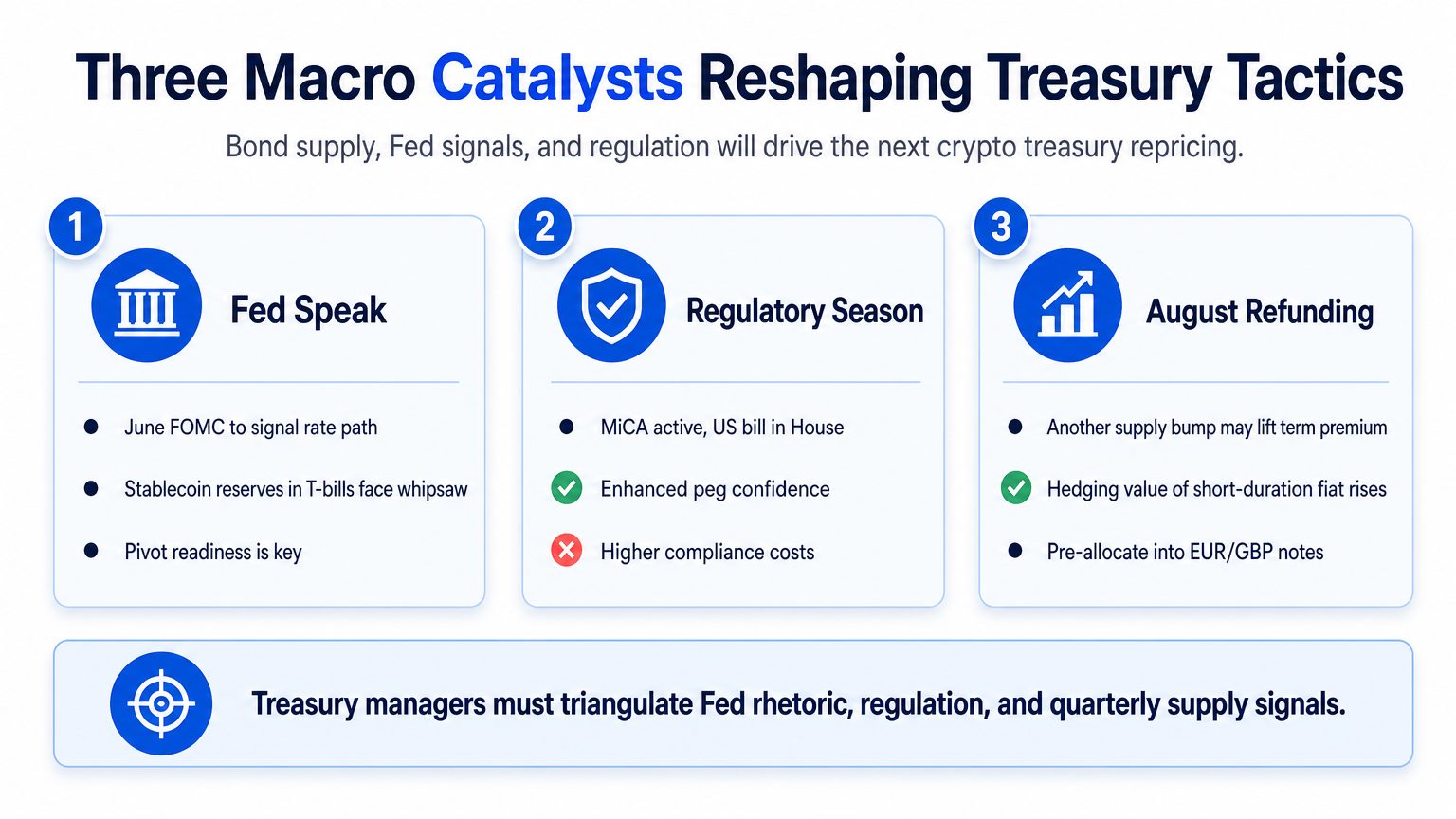
Fed speak and its effect on stablecoin flows
The next FOMC meeting in June 2025 will be the first chance for the Federal Reserve to comment on the refunding-driven yield move. If Chair Powell signals concern about tightening financial conditions, short‑term yields could whipsaw, and stablecoin treasuries that had shifted into T‑bills may need to pivot again. Every Treasury‑market wobble now feeds directly into bond market crypto impact because stablecoin reserves—both those of issuers and of corporate treasuries—are heavily allocated to short‑dated government paper.
Regulatory season: MiCA, new U.S. stablecoin bills
On the regulatory side, the EU’s MiCA framework is already operational, requiring stablecoin issuers to hold higher‑quality liquid reserves. In the U.S., the House Financial Services Committee advanced a stablecoin bill in early 2025 that would mandate one‑to‑one backing and detailed audits. Both frameworks reduce de‑peg tail risk, but they also introduce compliance costs that could slow down on‑chain settlement. Treasuries that rely on stablecoins for near‑instant payments should watch whether the U.S. bill passes before the summer recess—it could change the availability and cost of on‑off ramps. For a broader view on how global banking infrastructure is evolving to accommodate these shifts, platforms like what is the best global bank account for business become relevant as teams search for accounts that work across both fiat and digital asset rails.
What the next quarterly refunding implies for the back half of 2025
If the August refunding shows another increase in long‑end supply, the market may begin pricing a structurally higher term premium for the dollar. That would make holding large unhedged USDC balances more expensive in opportunity‑cost terms, while simultaneously increasing the hedging value of short‑duration fiat instruments. Savvy multi‑currency treasury managers will likely pre‑allocate a portion of stablecoin reserves into short‑term EUR and GBP notes, using automated conversion rails to stay liquid without sitting entirely in a weakening dollar. Fortris covers this dynamic in depth in its bitcoin treasury management guide, particularly the interplay between yield curves and crypto reserve allocation.
Essential Crypto Treasury Management Questions
What is crypto treasury management?
Crypto treasury management encompasses the policies, tools, and workflows a business uses to hold, deploy, and account for digital-asset reserves. It covers everything from wallet security and multisig signer policies to daily decisions about how much of the runway sits in stablecoins versus fiat.
How is treasury management for crypto different from traditional treasury management?
The two biggest differences are settlement speed and market hours. Crypto settles in seconds to minutes, not days, and markets never close. That means a treasury team must have real‑time visibility and execution capability around the clock. It also demands on‑chain proof of control—auditors and partners often require wallet attestations, not just bank statements.
What are some risks associated with crypto treasuries?
Price volatility is the headline risk, but operational failure, counterparty concentration, and FX risk crypto are equally dangerous. If a team holds USDC but all liabilities are in euros, a sharp dollar move can erode runway just as quickly as a token sell‑off. Regulatory ambiguity and smart‑contract bugs round out the core risk set. Teams assessing global accounts to manage these exposures should review what are the risks of a global account before committing to a provider.
How can finance leaders build controls for crypto treasuries?
Start with layered custody: hardware wallets for core reserves, a qualified custodian for operational assets, and a unified platform for fiat and crypto monitoring. Enforce multi‑signature approval for any transaction above a threshold, and use role‑based permissions that limit who can initiate conversions or wires. Finally, run a weekly reconciliation that marks all positions to a single reference fiat currency so you see the net FX exposure.
Can stablecoins replace traditional payment rails during macro stress?
They can absorb much of the load—stablecoins settle on weekends and after banks are closed, which is when macro stress often peaks. However, the 2023 USDC de‑peg showed that a bank failure in the issuer’s reserve portfolio can break the dollar peg temporarily. The prudent view: stablecoins are a powerful parallel rail, not a full replacement. Treasuries should maintain fiat fallback accounts and never route 100% of operational payments through a single stablecoin, no matter how liquid it looks.
How do bond-market moves impact a crypto treasury’s value and risk profile?
Through three channels: the dollar, yield, and volatility. A rise in long-end Treasury yields strengthens the dollar—or, as in May 2025, can also weaken it if supply overwhelms demand. That changes the local-currency value of stablecoin holdings and any fiat allocations. Higher yields increase the opportunity cost of holding non‑yielding crypto. And volatility spikes in the bond market tend to propagate into crypto, widening spreads and making it harder to exit positions cleanly. A treasury manager who monitors Treasury auctions and refunding calendars alongside crypto price feeds can front‑run these repricings.
| What moves | Immediate Treasury Impact | Tactical Response |
|---|---|---|
| U.S. Treasury boosts long-bond supply | Long yields rise; US dollar may soften | Convert a portion of USDC into non‑USD fiat accounts or short‑term EUR notes |
| Yields on 10‑year spike above 5% | Opportunity cost of holding stablecoins jumps; risk‑off sentiment spreads | Reduce stablecoin allocation in favor of on‑chain T‑bill tokens or direct fiat placements |
| Dollar strengthens in a flight-to-quality | Non‑USD fiat holdings lose value; crypto prices typically fall | Pre‑build a fiat ladder in the primary expenditure currency and rebalance when the dollar index crosses a defined threshold |
| Regulated stablecoin bill passes (e.g., U.S. stablecoin act) | Enhanced peg confidence but higher compliance burden | Review issuer reserve reports monthly; diversify across at least two regulated issuers |
Key Takeaways
- The May 2025 U.S. Treasury refunding boosted long‑end bond supply, driving yields higher and weakening the dollar—a combination that directly re‑prices multi‑currency crypto treasuries.
- When yields rise and the dollar moves, a crypto treasury’s stablecoin and fiat positions must be weighed against both opportunity cost and the currency mix of upcoming liabilities.
- Relying on siloed bank, exchange, and custody setups can add days of settlement delay when macro signals demand same‑day repositioning; a unified fiat‑and‑crypto platform compresses that reaction cycle.
- Stablecoins serve as a reliable parallel rail during macro stress, but de‑peg risk and regulatory gaps mean they should be one tool in a broader, multi‑currency liquidity strategy—not the only tool.
- Finance leaders who monitor quarterly refunding calendars, set automated FX triggers, and pre‑approve conversion rules for DAO governance give their organizations a head start when the next bond‑market dislocation hits.
Ready to bring your crypto treasury onto a single dashboard that moves at the speed of global markets? Open a OneSafe account and start managing fiat and crypto from one secure, real‑time platform.