The case for crypto payroll just got a hard, public data point. On October 5, 2026, CryptoRank reported that Visa’s payment volume across its stablecoin-linked cards grew nearly 200% year over year. That’s settled transaction data showing people who receive value in stablecoins are spending it through mainstream card rails at a pace nobody predicted. For employers weighing whether to pay employees in crypto, the message is straightforward: the spending infrastructure has arrived, and the gap between receiving a USDC salary and buying a coffee is shrinking fast.
Table of Contents
- What Just Happened: Visa's Stablecoin Card Volume Exploded
- Why It Matters for Crypto Payroll Right Now
- The Background a Newcomer Needs to Follow
- Concrete Implications and Recommended Actions
- What to Watch Next and Open Questions
- What are the advantages of crypto payroll?
- What are the disadvantages of crypto payroll?
- Is it legal to pay wages in crypto?
- How is crypto regulated?
- How is crypto taxed?
- Is crypto payroll safe?
- Which blockchains are supported?
- What tokens are supported?
- Key Takeaways
What Just Happened: Visa's Stablecoin Card Volume Exploded
The nearly 200% growth was surfaced by CryptoRank on October 5, citing Visa’s own data. The metric covers payment volume across Visa’s stablecoin-linked card programs—cards from fintechs and neobanks that let holders spend stablecoin balances anywhere Visa is accepted, with the issuer converting behind the scenes. The volume surge shows stablecoin card spending has moved beyond crypto-native niches into broad commercial use.
Why It Matters for Crypto Payroll Right Now
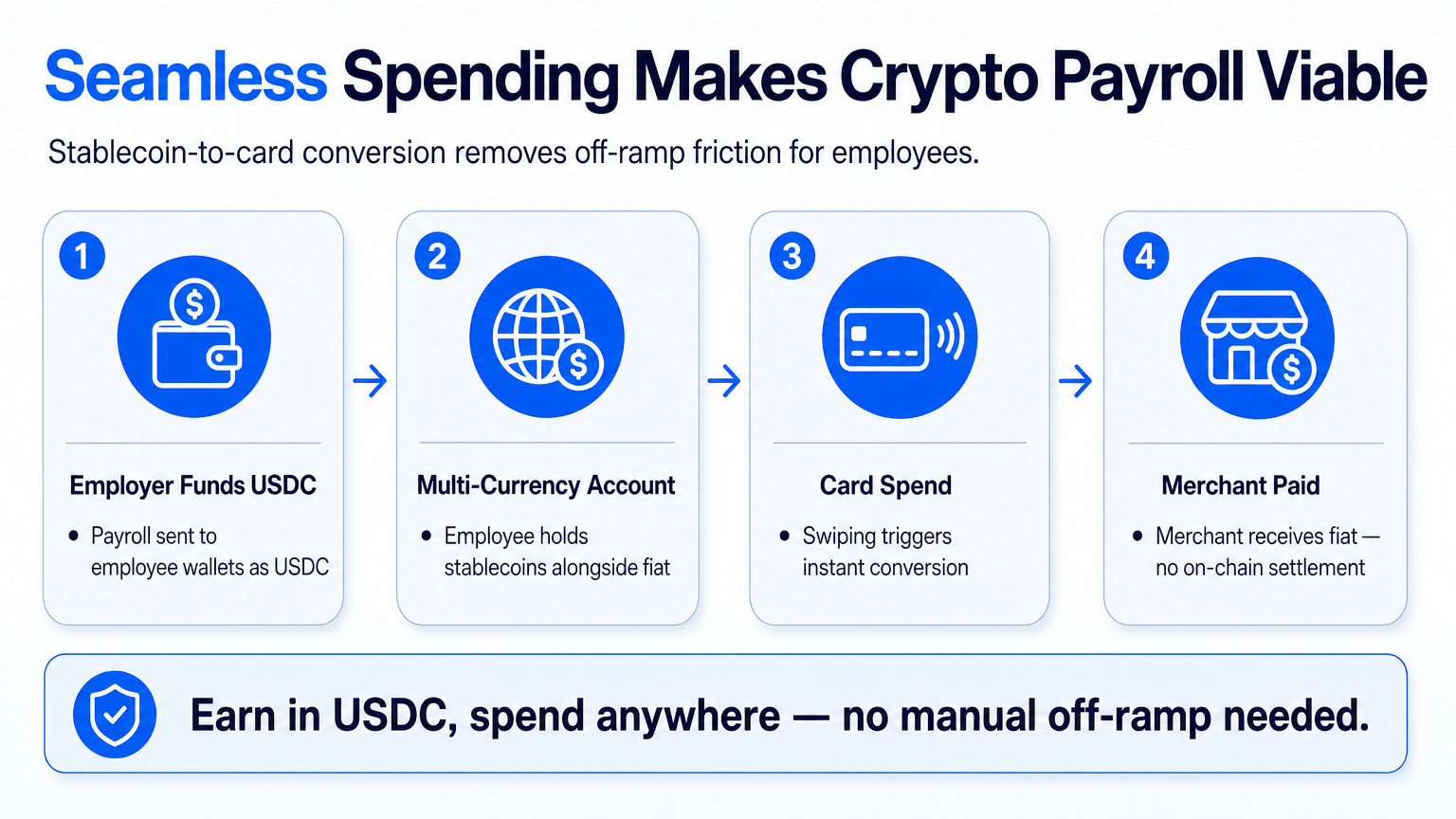
For years, the objection to stablecoin payroll was practical: after receiving USDC, employees had to off-ramp to a bank account, wait days, and pay fees. That friction killed the value. Visa’s data changes this. When employees receive USDC payroll and spend it directly via a card, the experience is as seamless as a bank account—near-instant and crypto-native. This closes the most persistent gap: fungibility at the point of sale.
The Visa numbers validate an architecture now being productized: employer pays salaries in USDC, employee holds balances in a multi-currency account connected to a corporate card, and swiping the card triggers real-time stablecoin-to-fiat conversion. Neither employee nor merchant deals with on-chain settlement. This earn in stablecoins, spend via card loop is what makes crypto payroll viable. Employers using it are moving toward platforms that unify global payroll crypto workflows with cards, multi-currency treasury, and fiat off-ramps in one interface.
The Background a Newcomer Needs to Follow
Crypto payroll means paying employees—full-time, contract, or freelance—in cryptocurrency instead of (or alongside) fiat. A typical implementation: the employer funds a wallet with a stablecoin like USDC, then the platform disburses to employee wallets on schedule. Some platforms handle tax withholding; others leave compliance to the employer.
Stablecoins solved the volatility problem. USDC payroll is the default, with USDT as a common alternative and DAI in DAO contexts. MoonPay’s 2026 guide explains that stablecoin payroll eliminates price fluctuation risk while preserving the speed and cost benefits of on-chain settlement, making it viable for monthly salary runs.
Tax and regulation vary dramatically. In the US, the IRS treats crypto as property; wages paid in crypto are subject to income tax withholding and payroll taxes at fair market value on the pay date. Platforms that automate crypto payroll tax calculation and reporting are gaining traction. The EU’s MiCA framework brings stablecoins under regulatory oversight, while Singapore and the UAE have issued specific guidance. Any employer needs jurisdiction-specific legal review—no platform replaces that.
Concrete Implications and Recommended Actions
For employers: integrating payroll with corporate cards
Link your crypto payroll workflow to a corporate card program that supports stablecoin top-ups. When salary lands in USDC, a portion becomes immediately spendable without manual conversion. One platform that fits this model is OneSafe, which combines multi-currency accounts, crypto on/off-ramps, and corporate cards. For a DAO paying contributors globally, you could fund a segregated USDC account, schedule payments, issue virtual cards, and let team members spend in real time—with fiat wires and ACH also available for those preferring traditional rails.
What to look for in a crypto payroll partner
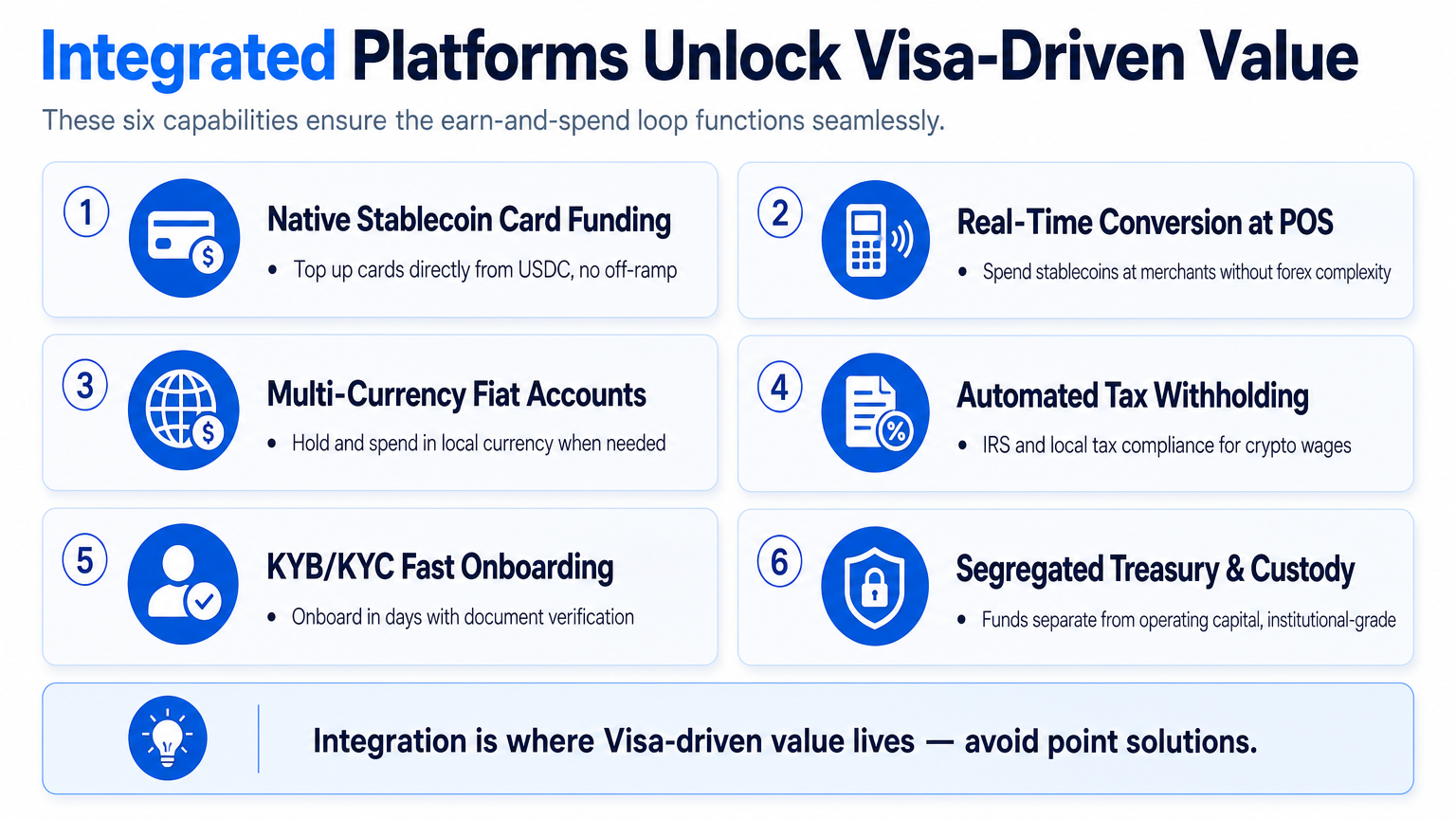
| Capability | Why it matters in light of the Visa data |
|---|---|
| Native stablecoin card funding | Top up cards directly from USDC or USDT balances; no manual off-ramp required |
| Real-time conversion at point of sale | Employees spend stablecoins at merchants without understanding the forex path |
| Multi-currency fiat accounts | Team members in different countries can hold and spend in local currency when needed |
| Automated tax withholding and reporting | IRS and local tax authority compliance for crypto-denominated wages |
| KYB/KYC with fast digital onboarding | Onboard in days, not weeks, with document verification that meets regulatory standards |
| Segregated treasury and custody | Payroll funds kept separate from operating capital; ideally with institutional-grade custody |
| Multi-token support for funding | Employers can fund payroll from USDC, USDT, or other approved stablecoins |
Actionable steps for Q4 2026
- Audit your current payroll friction. Identify payees with the highest cross-border costs, slowest settlement, or worst FX spreads—those are your crypto payroll candidates.
- Select a platform that combines payroll, cards, and multi-currency accounts. Avoid stitching together separate tools; the integration is where the Visa-driven value lives.
- Run a pilot with contractors first. Fewer withholding requirements and clearer 1099 reporting make contractors a lower-risk starting point.
- Document your tax positions. Work with a crypto-knowledgeable CPA or tax attorney to establish fair market value methodology and reporting before the first payroll run.
What to Watch Next and Open Questions
The US stablecoin legislation that stalled in Congress could resurface. Any federal framework clarifying issuance and redemption rights would reduce legal uncertainty for holding and paying in USDC. The stablecoin regulation landscape in 2026 already shows a trend toward bringing dollar-pegged tokens inside the regulatory perimeter, making payroll use cases more defensible in an audit.
Mastercard hasn’t released comparable volume data, but competitive pressure may accelerate merchant acceptance. On the tax front, the IRS continues to scrutinize crypto income reporting, but practical guidance on stablecoin payroll remains thin. Until clarity arrives, conservative compliance is the only safe posture.
What are the advantages of crypto payroll?
Crypto payroll offers near-instant settlement—minutes instead of days for cross-border ACH or SWIFT transfers—and dramatically lower fees than correspondent banking rails. For employers with globally distributed teams, paying in USDC can eliminate per-transfer wire fees, reduce FX spread costs, and provide a single funding mechanism that works across dozens of jurisdictions without maintaining local bank accounts. Employees gain faster access to funds and the option to hold value in a dollar-equivalent instrument that isn’t tied to a specific bank’s solvency.
What are the disadvantages of crypto payroll?
The chief disadvantages are regulatory complexity and uneven infrastructure. Tax withholding rules differ by country and require active management; getting it wrong carries legal risk. Many employees still lack the crypto literacy or wallet infrastructure to receive and manage stablecoins comfortably. And while card-spending infrastructure has improved—validated by Visa’s volume growth—it’s not yet universal. Employees in some regions may still need to off-ramp manually, incurring fees and delays.
Is it legal to pay wages in crypto?
Yes, in most jurisdictions, with conditions. The FLSA in the United States requires that wages be paid in “cash or negotiable instrument payable at par,” and the Department of Labor has indicated that crypto can qualify if it meets fair market value tests. Many countries treat crypto as a permissible form of compensation subject to the same labor law requirements as fiat—minimum wage rules, pay frequency, and itemized pay statements still apply. Employers should always confirm with local counsel, as some jurisdictions restrict or prohibit crypto-denominated salary payments.
How is crypto regulated?
Crypto regulation varies significantly by jurisdiction. In the US, multiple agencies assert authority: the SEC over securities, the CFTC over commodities, FinCEN over money transmission, and the IRS over taxation. The EU’s MiCA framework, fully in effect for stablecoin issuers by mid-2025, created a single rulebook for crypto-asset service providers operating across member states. For crypto payroll specifically, the relevant regulatory layer is often employment law and tax administration rather than securities regulation, though money transmission licensing may apply to payroll platforms depending on how they custody and transfer funds.
How is crypto taxed?
In the US, the IRS treats cryptocurrency as property. Wages paid in crypto are subject to federal income tax withholding, Social Security, Medicare, and FUTA taxes at the fair market value on the pay date. Employers report crypto wages on Form W-2 for employees and Form 1099-NEC for contractors. The fair market value must be determined in USD, typically using the exchange rate from a reputable exchange at the time of payment. Employees who later sell or spend the crypto may realize capital gains or losses depending on price movement between receipt and disposition. Many other countries follow similar “taxable at receipt” frameworks, though specifics around valuation timing and capital gains treatment differ.
Is crypto payroll safe?
Safety depends entirely on the custody and operational security practices of the employer and any platform involved. On-chain transactions are irreversible; if payroll is sent to the wrong wallet address, recovery is usually impossible. Platforms that use institutional-grade custody—such as OneSafe’s integration with Fireblocks for digital asset security—reduce the risk of loss from hacks or internal malfeasance. Multi-signature approval workflows, address whitelisting, and mandatory multi-factor authentication (MFA) are table stakes for any payroll implementation handling meaningful volume. Crypto payroll compliance requires not just tax reporting but robust operational controls against fraud and human error.
Which blockchains are supported?
Support varies by payroll platform. Ethereum remains the dominant network for USDC payroll due to its deep liquidity and broad wallet support. Solana is gaining traction for high-volume, low-cost payroll disbursements. Polygon and Arbitrum see use for lower-fee on-chain salary runs. Most platforms that support stablecoin payroll work across multiple EVM-compatible chains; some also integrate with non-EVM networks like Solana for specific token support. Employers should verify which chains a platform supports for both funding and disbursement, as they may differ.
What tokens are supported?
USDC dominates crypto payroll implementations due to its regulatory posture, full reserve backing, and broad exchange support. USDT is widely supported but carries more controversy around reserve composition. DAI sees use in DAO and DeFi-native teams. Some platforms support native tokens like ETH or SOL for payroll, but stablecoin payroll is the practical default for employers who need predictable, reportable wage values. The crypto payroll platforms compared in 2026 largely converge on USDC as the primary rail, with varying secondary token support.
Key Takeaways
- CryptoRank’s October 5, 2026 report on Visa’s nearly 200% year-over-year stablecoin card volume growth signals that spending infrastructure for crypto-earned wages is now commercially mature.
- The payroll-to-spending loop—earn in USDC, spend via a stablecoin-linked card—is the operational breakthrough that makes paying employees in crypto practical for mainstream teams.
- Employers should prioritize integrated platforms that combine payroll, corporate cards, multi-currency accounts, and automated tax reporting rather than stitching together separate point solutions.
- USDC payroll is the clear default for 2026, with tax compliance and custody security remaining the two non-negotiable areas to get right before launching any program.
- Regulatory and tax rules vary by jurisdiction; conservative compliance and jurisdiction-specific legal review are essential, especially while stablecoin legislation remains in flux.
For global teams ready to unify crypto payroll, multi-currency accounts, and stablecoin-linked corporate cards in a single platform, explore OneSafe’s neo-banking solution for businesses and DAOs.