Table of Contents
- What Just Happened: The Polygon Stablecoin Shift
- Why This Matters for Global Businesses and DAOs Now
- The Background: A Stablecoin Payments Primer
- Concrete Implications: How to Turn the Polygon Trend into a Competitive Advantage
- What to Watch Next: The Future of Stablecoin Payments
- Key Takeaways
What Just Happened: The Polygon Stablecoin Shift
Polygon’s payment infrastructure is telling a story the price charts haven’t caught up with yet. On August 31, 2026, the crypto payment provider Mercuryo reported a dramatic change on the network: nearly every dollar flowing through its onboarding rails now arrives as a stablecoin rather than Polygon’s native MATIC token or other volatile assets, signaling that stablecoin payments have become the default entry mode for new users (Cryptonomist, August 31, 2026). This isn’t a marginal preference. It’s an overwhelming signal that users entering Polygon’s ecosystem today are there to transact, not speculate.
The Data: Mercuryo’s Onboarding Report
Mercuryo, which partners with Polygon to provide fiat-to-crypto on-ramp services, disclosed that Polygon stablecoin onboarding now dominates its transaction composition. Users are choosing USDC and other dollar-pegged assets to move value onto the chain, bypassing volatile native tokens entirely at the point of entry (Bitget News, August 31, 2026). This is a structural shift, not a seasonal blip. The marginal dollar entering Polygon is utility-seeking capital—payroll for a DAO, a vendor settlement, a cross-border invoice—rather than risk capital chasing token appreciation.
Mercuryo sits at the critical juncture where traditional fiat meets on-chain value. If the onboarding composition flips this decisively, the dominant use case for the network is becoming payments, not trading. This shift mirrors broader patterns captured in stablecoin payments 2026 trend analyses: total stablecoin transfer volumes have continued growing even as speculative crypto trading volumes have fluctuated.
The Context: Stablecoin Demand Amid Market Uncertainty
The shift arrives during a period of recalibration in the broader crypto market. While speculative appetite for volatile tokens has been uneven, stablecoin demand has held firm. The BVNK Stablecoin Utility Report 2026 notes that businesses are increasingly using stablecoins for treasury operations and cross-border settlement, not just as a parking lot between trades. Meanwhile, Nacha—the organization governing the US ACH network—devoted a dedicated track to stablecoins at its Smarter Faster Payments 2026 conference, underscoring how deeply the topic has penetrated traditional payment infrastructure circles (Nacha).
What’s new is the network-specific data. Polygon’s onboarding numbers make the trend concrete: stablecoin payments are no longer a theoretical promise. They are the default behavior for an entire L2 ecosystem’s new users.
Why This Matters for Global Businesses and DAOs Now
If your business handles cross-border payments, manages a distributed workforce, or operates a DAO treasury, the Polygon data should reset your assumptions. The infrastructure for stablecoin payments has matured past the early-adopter phase, and user behavior has already caught up. Waiting another year means ceding an efficiency advantage to competitors integrating these rails today.
The End of Volatile Token Dominance in Payments
For years, the crypto payments narrative was hampered by an uncomfortable reality: businesses didn’t want to receive payments in assets that could lose 20% of their value before settlement cleared. Stablecoins solved the volatility problem on paper, but adoption was fragmented across networks. The Polygon data shows the market is self-correcting. Users are voting with their wallets, choosing stable value instruments at the point of entry. Businesses that have hesitated because they associate crypto payments with price risk now have clear evidence that stablecoin payment infrastructure has separated from speculative token trading.
Stablecoin Payments Go Mainstream—What’s Driving the Shift
Several forces are converging. The GENIUS Act, advanced through the US legislative process in 2025 and early 2026, has given payment stablecoin issuers a federal framework, reducing the licensing uncertainty that previously kept large payment processors on the sidelines (Fintech Weekly). Payment orchestration platforms like Stripe have published detailed guidance on stablecoin payments for businesses, normalizing the conversation for CFOs who wouldn’t have considered the option eighteen months ago (Stripe). The cost differential for cross-border transactions has become impossible to ignore when treasury teams compare a $25 wire fee plus FX spread against near-instant USDC settlement at a fraction of the cost.
The Polygon surge is a byproduct of these currents, and it’s unlikely to be the last network to report such a shift. Businesses that treat it as a one-off anomaly rather than a leading indicator will find themselves reactively scrambling.
The Background: A Stablecoin Payments Primer
For teams new to the space, understanding why this shift matters requires a short tour through the mechanics.
How Stablecoin Payments Work (and Why They Beat Traditional Rails)
A stablecoin payment is a blockchain-based transfer of a token pegged to a fiat currency—most commonly the US dollar (USDC, USDT). The sender holds a stablecoin balance; the recipient provides a wallet address. The transaction settles on-chain, typically in seconds to minutes, and the recipient can either hold the stablecoin or convert it to fiat through an exchange or banking partner.
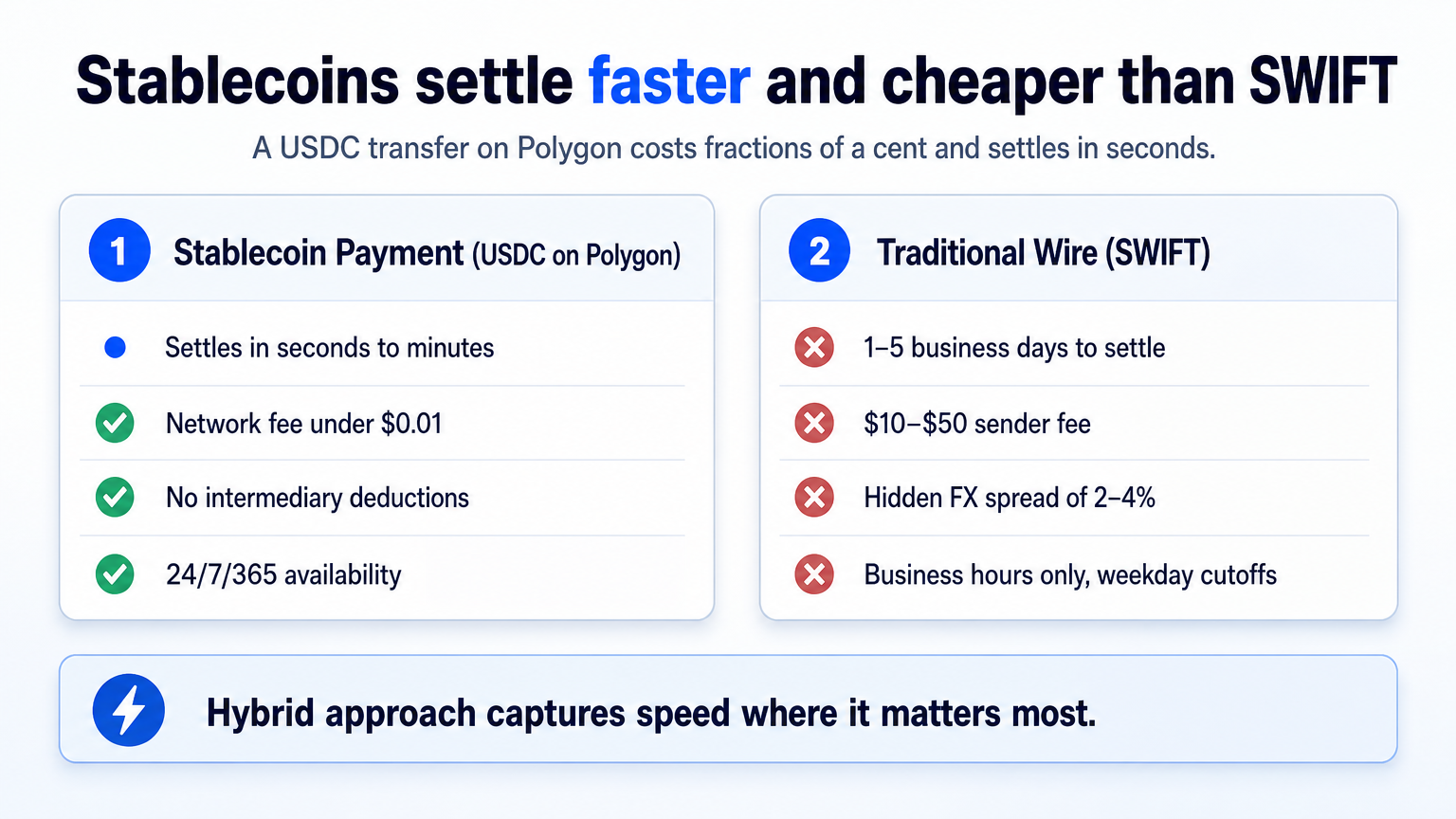
Contrast this with SWIFT: correspondent banking relationships, intermediary fees, multi-day settlement windows, and weekend cutoff times. For stablecoin cross-border payments, settlement is final when the block is confirmed—no intermediaries, no correspondent bank holds. A USDC transfer on a low-cost network like Polygon costs fractions of a cent regardless of amount. A traditional international wire can cost $25–$50 in explicit fees, plus a foreign exchange margin that often hides 2–4% in additional cost. The cumulative savings for businesses processing frequent cross-border transfers are material.
This efficiency is why crypto payment rails built on stablecoins are gaining traction over legacy correspondent banking infrastructure.
The Regulatory Landscape: From GENIUS Act to Global Clarity
The GENIUS Act established a federal framework for payment stablecoins, creating a licensing path that does not require a full banking charter—the single most important catalyst for institutional adoption. Internationally, jurisdictions have moved at different speeds. The UK’s approach, updated in 2025, emphasized an innovation mandate alongside financial stability requirements (UK Stablecoin Regulation Shift: What It Means for Businesses). The European Central Bank has advanced work on an on-chain euro, acknowledging that the private stablecoin market has achieved scale central banks cannot ignore (ECB’s On-Chain Euro: A Turning Point for Crypto Banking).
The net effect in 2026: regulatory clarity is no longer the bottleneck. The remaining questions are operational—how to integrate, which platforms to use, and how to manage compliance obligations.
Concrete Implications: How to Turn the Polygon Trend into a Competitive Advantage
Data without action is trivia. The Polygon stablecoin shift suggests specific moves for businesses that want to capture efficiency gains before they’re priced in.
Rethinking Your Payment Stack: Fiat + Stablecoin in One Platform
Most businesses operate two separate financial stacks: a traditional banking layer for fiat payroll and vendor payments, and an ad hoc crypto layer managed through a standalone wallet and exchange account with limited controls. When stablecoins are the dominant value-transfer mechanism on major networks, the overhead of maintaining separate systems erodes the very efficiency stablecoin payments are supposed to deliver. Businesses need a single interface to hold USD and EUR balances, send ACH and wire transfers, and receive, hold, and convert USDC—without manually shuttling funds between a bank portal and an exchange.
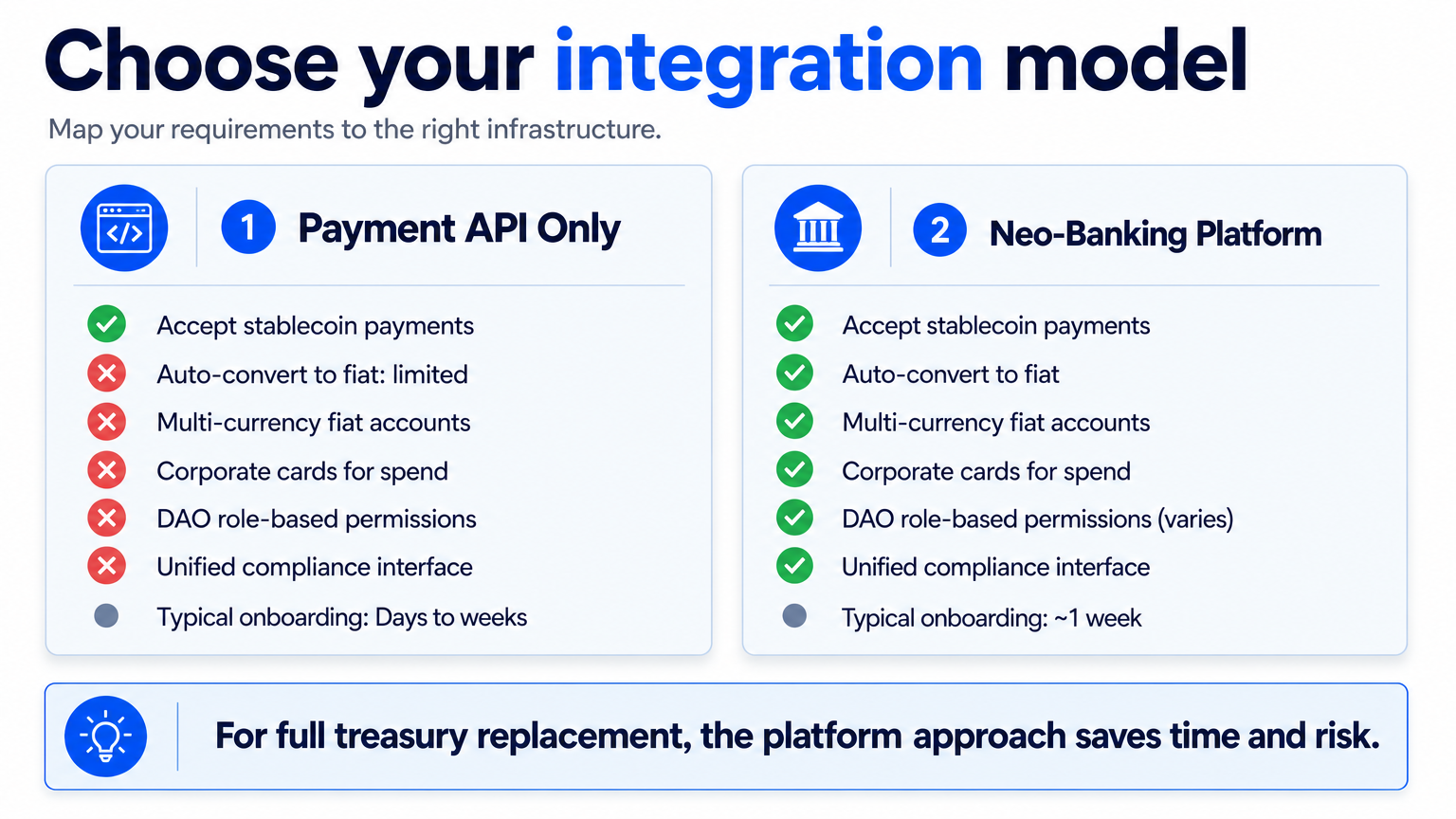
This is where the distinction between a stablecoin payment API and a unified neo-banking platform becomes sharp. Payment APIs handle the accept-and-settle part. They don’t handle treasury management, multi-currency accounts, corporate cards for vendor payments, or the compliance workflow a growing business needs. OneSafe stablecoin capabilities, embedded in a neo-banking layer for global businesses, handle both fiat and crypto rails natively—invoicing a client in USDC, holding proceeds in a segregated account, paying a European supplier via SEPA from a Euro balance, and issuing virtual corporate cards, all inside one compliance perimeter.
The trade-off: a payment API is lighter if you only need an acceptance endpoint. A neo-banking platform replaces fragmented banking relationships with a single operating system for global treasury. For businesses managing multi-currency payables and receivables across borders, the platform approach saves more time and reduces more operational risk.
Action Steps for Founders and Finance Leads
If you’re reading the Polygon data as a signal to act, here is a concrete sequence.
1. Audit your cross-border payment flow. Identify every payment stream that currently routes through SWIFT or a correspondent bank. Categorize by frequency, amount, and destination corridor. The highest-ROI candidates for switching to USDC business payments are recurring, mid-value transfers to regions with slow banking infrastructure.
2. Choose your integration model. Map your requirements:
| Requirement | Payment API Only | Neo-Banking Platform |
|---|---|---|
| Accept stablecoin payments | ✅ | ✅ |
| Auto-convert to fiat | ✅ (limited) | ✅ |
| Multi-currency fiat accounts | ❌ | ✅ |
| Corporate cards for spend | ❌ | ✅ |
| DAO role-based permissions | ❌ | ✅ (varies) |
| Unified compliance interface | ❌ | ✅ |
| Typical onboarding time | Days to weeks | ~1 week |
| Best for | Single-payment-stream integration | Full treasury replacement |
If your use case is a single acceptance flow (e.g., adding a USDC checkout option), a payment API may suffice. If you’re managing payroll, vendor payments, and treasury across jurisdictions, a platform that handles fiat and crypto natively eliminates reconciliation complexity.
3. Set up a parallel test flow. Open a platform account (digital onboarding typically completes within a week), fund it with a small amount, and run test transactions—send USDC, convert to fiat, issue a wire. Monitor settlement time and all-in cost to generate internal data for your finance committee.
4. Define your stablecoin policy. Decide which stablecoins you’ll accept (USDC is the safest starting point given its regulatory posture), what percentage of treasury you’re willing to hold in stablecoin form, and what conversion triggers you’ll use. The Stablecoin Payments vs. Tokenized Deposits analysis offers a framework for the custody and counterparty distinction.
5. Plan your multi-chain posture. Polygon’s surge doesn’t mean other networks are irrelevant. Significant USDC activity exists on Ethereum L1, Solana, and Arbitrum. Your payment infrastructure should support stablecoins on the networks your counterparties use, not just the one making headlines.
What to Watch Next: The Future of Stablecoin Payments
The Polygon data is a snapshot, not a final chapter.
What does the Polygon stablecoin surge mean for my business?
It means the operational window for gaining a cost advantage is open but narrowing. When network-level data shows a fundamental shift from speculation to utility, businesses that act on the signal before it becomes conventional wisdom capture the margin benefit. Those that wait will be playing catch-up on cost structure and payment speed. For a global business paying cross-border invoices, contractor payroll, or DAO contributor rewards, the Polygon surge is proof the infrastructure works, the users are there, and the regulatory path is clear.
How can I start accepting stablecoin payments?
Open an account on a platform supporting both fiat and stablecoin rails, complete KYB verification (typically under a week), and generate a USDC receiving address. Start by adding a stablecoin payment option to existing invoices alongside traditional bank details. Then integrate automated conversion rules so received USDC can be held or converted per your treasury policy. For programmatic acceptance, stablecoin payment APIs provide embeddable checkout flows, but evaluate against the full treasury picture—accepting payments is one leg; managing balances, paying suppliers, and handling compliance is the rest.
What are the risks of stablecoin payments?
De-pegging risk: A stablecoin losing its peg can create short-term value discrepancies. Mitigation: hold only regulated, transparently reserved stablecoins and set conversion triggers to limit exposure. Counterparty risk: The issuer’s reserve composition matters. USDC publishes monthly attestations; less transparent stablecoins carry unknown reserve risk. Compliance risk: Receiving payments from sanctioned addresses creates regulatory liability. A platform with integrated compliance screening reduces this burden; a standalone wallet does not. For deeper analysis, see what are the risks of a global account.
How do stablecoin payments compare to traditional cross-border payments?
| Dimension | Stablecoin (USDC on Polygon) | Traditional Wire (SWIFT) |
|---|---|---|
| Settlement time | Seconds to minutes | 1–5 business days |
| Fee (sender) | <$0.01 network fee | $10–$50 |
| Intermediary deductions | None | Variable, often opaque |
| FX spread (if applicable) | Exchange rate at conversion | 2–4% hidden in bank rate |
| Availability | 24/7/365 | Business hours, weekday cutoffs |
| Reversibility | Irreversible once confirmed | Possible in limited windows |
The comparison is stark, but the optimal approach is hybrid: fiat rails for domestic payroll and regulated supplier relationships, stablecoin rails for cross-border payments where speed and cost differentials are largest. The question isn’t “which should I use” but “how do I manage both from one dashboard?”
What are the benefits of using a neo-banking platform for stablecoin payments?
Using a neo-banking for stablecoins platform collapses the distance between receiving a crypto payment and using those funds in the traditional financial system. Without it, a USDC payment lands in a wallet; conversion requires a transfer to an exchange, a trade, and a withdrawal—three steps, each with delay, fee, and reconciliation points. A unified platform lets the same account hold fiat balances, convert stablecoins near-instantly, send wires, pay bills, and issue corporate cards. For Web3 startups and DAOs, platforms like OneSafe also offer role-based permissions and multi-signer workflows that a traditional bank account cannot replicate natively. When comparing stablecoin vs fiat payments, the operational benefit isn’t just the transaction cost—it’s the reduction in platform count, faster cash-to-cash cycles, and simpler audit trails.
What is the regulatory outlook for stablecoin payments in 2026?
The outlook is the most favorable it has ever been. The GENIUS Act created a federal licensing framework in the US. The UK shifted toward an explicit innovation mandate. The EU’s MiCA framework is live, providing passportable licensing. Meanwhile, the ECB’s on-chain euro work signals recognition that stablecoins are a permanent feature of the payment landscape. The remaining uncertainty is at the margin—specific custody requirements, capital treatment, tax classification—not at the level of whether businesses can use stablecoins. This is a green light for finance teams.
Multi-Chain Expansion and Stablecoin Wars
Will stablecoin volume concentrate on a few dominant networks or fragment across dozens of L1s and L2s? The Thunes stablecoin trends analysis points to a multi-chain reality where businesses need USDC support on at least three or four networks. Simultaneously, the “stablecoin wars” are heating up. USDC and USDT dominate, but regional stablecoins (Euro-pegged, Yen-pegged) are gaining traction. The Stablecoin Payments: Asia’s Hubs Lead the Way analysis highlights how Asian financial centers are developing their own settlement infrastructure. A business building its payment stack today should design for stablecoin optionality.
Open Questions: De-Pegging Risks, CBDCs, and the Role of Neo-Banks
Several questions remain unresolved. CBDCs promise 24/7 settlement with sovereign backing, but their rollout remains slow and domestically siloed—private stablecoins will continue serving the cross-border use case better than any CBDC likely to launch before 2028. Peg resilience during systemic stress remains a concern: diversify stablecoin holdings across issuers and set explicit exposure limits. Neo-banks appear to complement rather than replace traditional banks—a traditional account for regulated domestic operations, a platform like OneSafe for cross-border, crypto-native, and multi-currency workflows. The Crypto Banking Redefined by Cross-Border Unbundling piece details how unbundling creates a new financial stack. The winning approach is a curated set of providers, not a single all-or-nothing relationship.
Key Takeaways
- The Polygon stablecoin surge, reported by Mercuryo on August 31, 2026, confirms user behavior has decisively shifted from speculative trading to real-world payments on major L2 networks.
- Businesses integrating stablecoin payment rails now capture a cost and speed advantage in cross-border payments before the practice becomes an industry baseline.
- A unified neo-banking platform handling both fiat and stablecoin transactions eliminates reconciliation and compliance overhead that makes standalone crypto wallets operationally expensive for growing teams.
- The regulatory environment in 2026 provides sufficient clarity for compliant adoption; the remaining bottleneck is operational integration, not legal uncertainty.
- The optimal strategy is a hybrid treasury: fiat rails for domestic regulated flows, stablecoin rails for cross-border, contractor, and crypto-native payments—managed from a single interface.
Start managing fiat and stablecoin payments from one unified platform at OneSafe—built for global businesses, Web3 startups, and DAOs.