Table of Contents
- description: "ECB’s on-chain euro proposal targets wholesale settlement and could reshape crypto banking, forcing treasuries to rethink reliance on stablecoins."
- What Just Happened: ECB Proposes On-Chain Euro for Settlement
- Why This Matters Now for Your Global Business
- Background: How We Got to a Blockchain Euro
- Concrete Implications for Crypto Banking Users
- Recommended Actions: Future-Proofing Your Treasury
- What to Watch Next: Open Questions and Timelines
- Key Takeaways
description: "ECB’s on-chain euro proposal targets wholesale settlement and could reshape crypto banking, forcing treasuries to rethink reliance on stablecoins."
ECB’s On-Chain Euro: A Turning Point for Crypto Banking
On August 30, 2026, the European Central Bank moved the crypto banking debate from consumer apps to settlement infrastructure: Executive Board member Isabel Schnabel argued at Jackson Hole that the euro should be issued directly onto a blockchain for interbank settlement. For founders and finance leads running payroll, vendor payments, and treasury on stablecoins, the proposal changes the risk map even before any code ships.
What Just Happened: ECB Proposes On-Chain Euro for Settlement
As reported by Yahoo Finance / BeInCrypto, the ECB wants to issue euros directly onto a blockchain. Schnabel made the case at the Jackson Hole symposium on Friday, with the report published August 30, 2026. The key distinction: she is talking about money banks use to settle with each other, not the euros in a consumer account.
Schnabel’s Jackson Hole Speech: The Key Arguments
Schnabel’s central claim is that tokenized markets need an asset only a central bank can create. She accepts that a stablecoin can be built to be almost perfectly safe. Her objection is what happens next: in a panic, everyone wants cash at once. A central bank can create more of it. A stablecoin issuer cannot.
Her precedent is the banking panic of 1907, when money was tied to banks’ holdings of government bonds and the money supply could not expand; the Federal Reserve Act of 1913 was the fix. As quoted in the report: “Stablecoins are best understood as complements to central bank money, not substitutes for it.”
Why Stablecoins Aren’t Enough to Settle the Tokenized Economy
The supply numbers explain Europe’s urgency. Dollar-pegged stablecoins circulate about $304 billion, while euro-pegged tokens hold under $1 billion, according to DeFiLlama data cited on August 30, 2026. If private tokens become the default settlement asset for tokenized markets, Europe settles in dollars. That is a monetary sovereignty problem, not only a payments problem.
What exactly did the ECB announce about putting euros on blockchain?
The ECB announced a policy direction, not a launch. The proposal is an ECB blockchain euro for wholesale settlement: central bank money on blockchain rails, available to banks for settling tokenized asset trades. It is separate from the retail digital euro project the ECB has been developing. No implementation date was given. This matters because it moves the conversation from consumer payments to the final settlement layer of tokenized markets.
Why This Matters Now for Your Global Business
The on-chain euro is not a retail convenience story. It is a question of which asset sits at the final settlement layer of web3 finance.
The Dollar Dominance Problem Europe Is Trying to Solve
The ECB blockchain euro proposal is, in part, a response to dollar stablecoin dominance. The data points from the August 30 report—$304 billion in dollar-pegged stablecoins versus under $1 billion in euro-pegged tokens—show a structural gap. For a European business or any company with euro-denominated costs, the current on-chain settlement path often routes through a dollar instrument even when the underlying obligation is in euros. Europe has a clear incentive to avoid permanent dollarization of tokenized wholesale markets.
How an On-Chain Euro Threatens Your Current Stablecoin Reliance
The threat is not that stablecoins disappear overnight. It is that the safest, most liquid settlement layer may migrate to an instrument your current treasury workflow does not yet support. The distinction between stablecoin payments and tokenized deposits becomes more pressing: bank-issued tokenized deposits may slot into the same rails as a central bank euro, leaving non-bank stablecoins with narrower use cases.
Why does the ECB want to issue a digital euro, and how does it differ from stablecoins?
The ECB wants an on-chain euro because central bank money carries two things a private issuer cannot replicate: finality and crisis liquidity. A stablecoin is a claim on an issuer, no matter how well collateralized; a digital euro would be a claim on the central bank. In ordinary conditions, both may settle trades efficiently. In a liquidity crunch, the difference becomes decisive. This is why stablecoins regulation is shifting toward the settlement question, not just consumer protection.
How will an on‑chain euro affect businesses using stablecoins for international payments?
In the short term, little changes: stablecoins keep working. But the medium-term calculus for crypto business banking shifts. If European banks adopt an on-chain euro for wholesale settlement, treasury teams face new choices about which instrument to hold for euro exposure: a private euro stablecoin, a bank deposit token, or the central bank asset. B2B flows may also face new interoperability and compliance questions, similar to Korea’s B2B stablecoin pilot. The most likely path is coexistence, not instant replacement.
Background: How We Got to a Blockchain Euro
Crypto banking has moved from custodial wallets to multi-currency platforms that bridge fiat and crypto; NerdWallet describes the sector as a spectrum of services around digital assets, while Coinbase explains that stablecoins are designed to track a reference asset so they can function as payment rails. The ECB’s proposal sits at the intersection of those two tracks: the tokenized economy now needs a settlement asset with central-bank backing. The digital euro concept has evolved from a retail payment tool into a broader question of whether central bank money should be natively on-chain.
Concrete Implications for Crypto Banking Users
This is not a debate about technology for its own sake. It is about which balance-sheet item ends your settlement.
Euro Stablecoins vs. a Central Bank Digital Euro: A New Choice
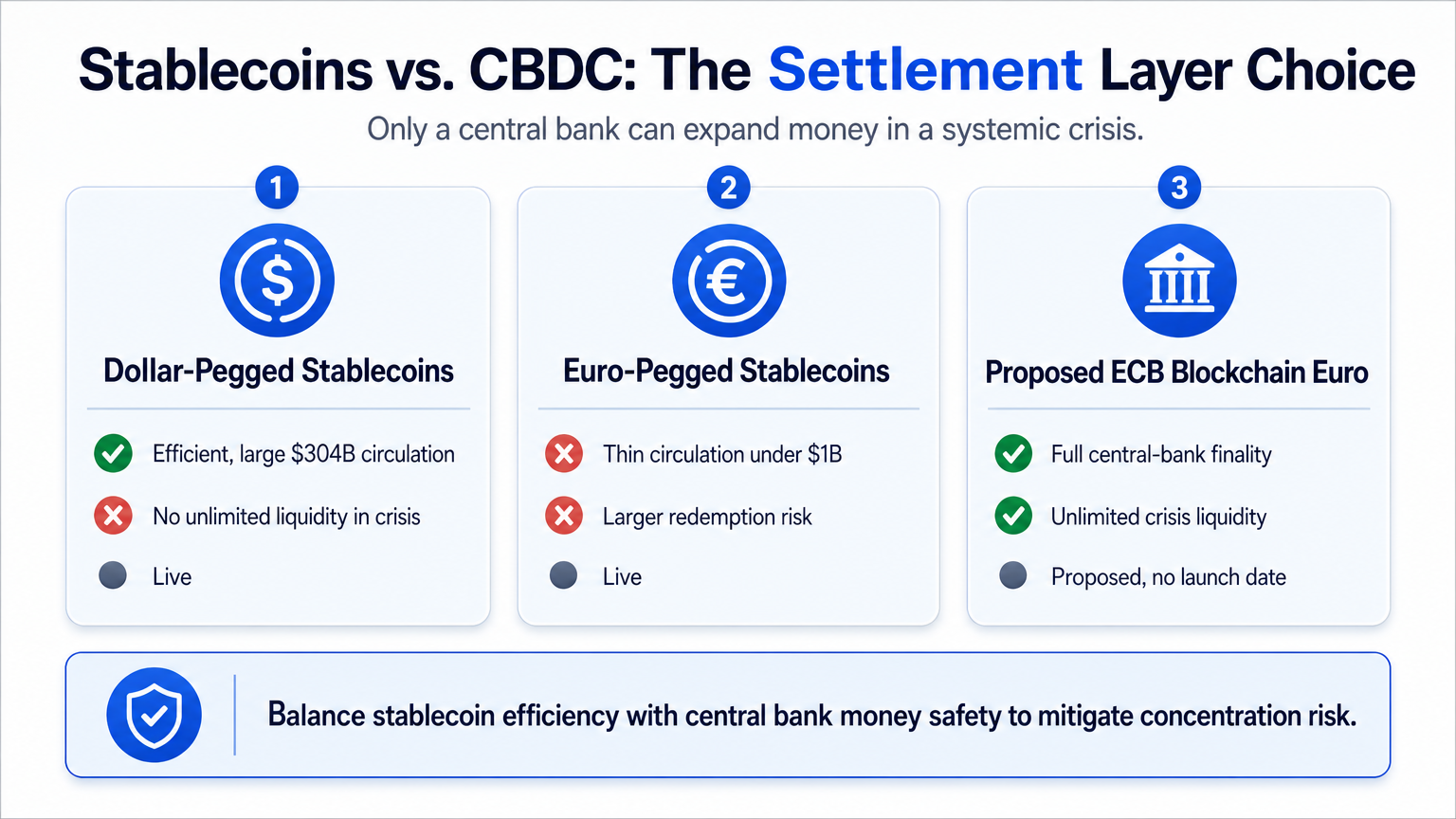
The table below condenses the options as of August 30, 2026.
| Settlement asset | Normal-times behavior | Crisis behavior | Status |
|---|---|---|---|
| Dollar-pegged stablecoins | Efficient, large circulation (~$304 billion) | Issuer cannot create unlimited liquidity; redemption risk | Live |
| Euro-pegged stablecoins | Thin circulation (under $1 billion) | Liquidity and redemption risk likely larger | Live |
| Proposed ECB blockchain euro | Central-bank finality for tokenized trades | Central bank can expand base money | Proposed; no launch date |
The choice is not “stablecoin or nothing.” It is increasingly “which instrument sits at the final settlement layer for each currency.”
Settlement Risk and the ’1907 Problem’
What are the risks of relying on stablecoins for settlement, according to the ECB?
The ECB’s risk argument is about tail events, not everyday performance. In a panic, everyone wants cash at once. A central bank can create unlimited liquidity; a stablecoin issuer cannot. The 1907 analogy is specific: money tied to banks’ bond holdings could not expand, and the Fed was created to fix that gap. The unresolved systemic risk is that private stablecoin issuers may function as money in normal times but face a structural liquidity limit in a crisis.
Sources disagree here. One view holds that stablecoins are safe, liquid settlement assets that can reliably function as money because they are overcollateralized and settle on-chain. The opposing view—Schnabel’s view—is that stablecoins can never be substitutes for central bank money because, in a panic, a central bank can create unlimited liquidity while a stablecoin issuer cannot. The ECB’s argument is based on the panic of 1907 and the rationale for creating the Federal Reserve. The balanced position for a business treasury is: stablecoins are efficient in normal times, but their systemic risk in a crisis remains unresolved. That means treating large, single-issuer stablecoin holdings as a concentration risk and diversifying settlement asset types. This is the core stablecoin settlement risk treasury teams should now model.
Recommended Actions: Future-Proofing Your Treasury
The proposal is early enough that the right response is operational readiness, not panic.
Diversify Your Settlement Assets Beyond Single Stablecoins
What are the practical steps to diversify settlement assets in a corporate treasury?
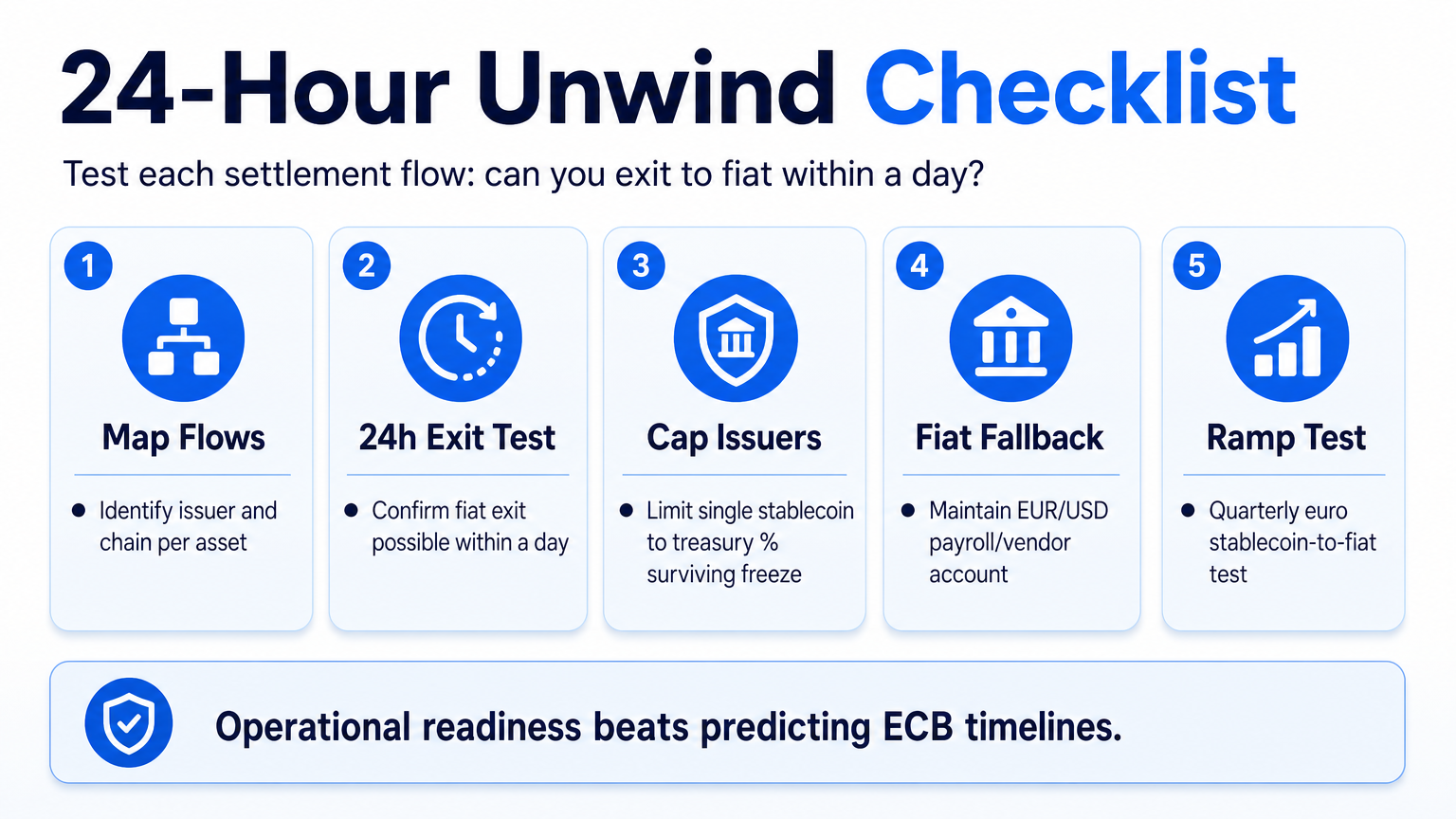
Use this short 24-hour unwind checklist for every settlement asset your business holds:
- Map each settlement flow to its issuer and chain.
- Record whether you could exit the position into fiat within 24 hours.
- Cap any single stablecoin issuer at a percentage of treasury that survives a redemption freeze.
- Maintain a fiat EUR or USD fallback account for payroll and vendor runs.
- Test the on/off-ramp from euro stablecoin to fiat at least quarterly.
This practical framework matters more than predicting whether the ECB blockchain euro ships in two years or five.
Leverage a Crypto Banking Platform That Bridges Both Worlds
How can a crypto banking platform like OneSafe help manage both fiat and digital euros?
OneSafe is a financial technology company, not a bank; banking services are provided by its partners. It supports fiat and crypto transactions in a single workspace, including ACH, domestic and international wires, bill payments, and instant crypto-to-fiat conversion. Multi-currency accounts are available in USD, Euro, and CAD, and USDC deposits and withdrawals carry no platform fee. It cannot custody a central bank digital euro that does not yet exist, but it can already bridge fiat EUR and on-chain assets—the operational layer a treasury will need while the ECB’s plans take shape.
Monitor Regulatory Timelines and Compliance Requirements
The U.S. side is moving too. The FDIC’s 2025 clarification outlines how banks can engage in crypto-related activities, and the UK stablecoin regulation shift shows how jurisdictions are building innovation mandates into stablecoin oversight. Add a compliance owner to track ECB publications, MiCA implementation, and any U.S. federal stablecoin framework.
What should a Web3 startup or DAO do now to prepare for a potential on‑chain euro?
Start by treating settlement assets as a treasury-layer decision, not a payments afterthought. A DAO with large stablecoin holdings should diversify across issuers, test fiat fallbacks, and document which counterparties would be exposed in a redemption freeze. The crypto treasury management playbook is shifting: liquidity, issuer concentration, and jurisdiction now matter as much as yield.
What to Watch Next: Open Questions and Timelines
No launch date was announced in Schnabel’s August 30, 2026 remarks. The open questions are larger than the speech: Will the ECB Governing Council formally adopt an on-chain euro for wholesale settlement? How will MiCA treat euro stablecoins if a central bank alternative exists? Will banks bridge tokenized deposits to the new rail? And will U.S. dollar stablecoin issuers push back with their own settlement-grade assurances?
Key Takeaways
- The ECB’s on-chain euro is a wholesale settlement argument, reported August 30, 2026, not a retail launch.
- Schnabel’s 1907 logic: stablecoins are complements to central bank money, not substitutes.
- Dollar-pegged stablecoins at $304 billion versus euro-pegged under $1 billion explain Europe’s urgency.
- Treasuries should treat large single-issuer stablecoin holdings as concentration risk and diversify settlement assets.
- Hybrid platforms can bridge fiat and on-chain rails, but must be evaluated as fintech partners, not banks.
If your treasury needs a single workspace for fiat, stablecoins, and whatever an on-chain euro becomes, open an account with the platform built for that transition.