On September 23, 2026, SoFi Bank began settling debit and credit card transactions on Mastercard's network with SoFiUSD, moving its entire card program—expected to process more than $25 billion in annualized volume—to live stablecoin settlement on the blockchain, according to The Globe and Mail. For finance teams, that turns stablecoin payments from a pilot talking point into an operational variable: same-day liquidity, 24/7 cash withdrawal, and a new set of questions about settlement, disputes, and treasury risk.
Table of Contents
- What Just Happened: Mastercard and SoFi Go Live With Stablecoin Payments
- Why This Matters for Business Payments Teams Now
- The Background: How Stablecoin Payments Reached a Card Network
- What Changes—and What Does Not
- What Operators Should Do About It
- What to Watch Next and Open Questions
- Key Takeaways
What Just Happened: Mastercard and SoFi Go Live With Stablecoin Payments
The $25B SoFiUSD settlement in plain terms
According to The Globe and Mail's September 23, 2026 report, SoFi Bank is now settling debit and credit card transactions on Mastercard's network with SoFiUSD, using Mastercard's existing payment infrastructure. SoFi is moving its entire card program, expected to process more than $25 billion in annualized volume, to SoFiUSD settlement, with transactions already live on the blockchain.
SoFiUSD is redeemable 1:1 for U.S. dollars and backed primarily by cash. Through SoFi's Big Business Banking platform, merchants can receive funds instantly and withdraw cash around the clock at zero cost. That is a real-time merchant settlement feature attached to a card program, not a standalone crypto wallet.
What the announcement actually says—and what it does not disclose
Zacks Investment Research, writing in The Globe and Mail on September 23, 2026, characterized Mastercard's positioning as a move from testing stablecoin settlement to using it in a live payments environment. The idea, in the report's framing, is simple: add stablecoins as another settlement choice rather than replace traditional payment rails.
The same report says the near-term financial impact for Mastercard is hard to measure because no revenue or earnings details were disclosed. It also does not name the settlement blockchain, the dispute and chargeback mechanics under the SoFi program, or the merchant fee schedule outside SoFi's stated zero-cost cash withdrawals. Those omissions matter for a finance team deciding whether to build against this rail.
Why This Matters for Business Payments Teams Now
What does Mastercard's SoFi stablecoin deal actually change?
The Mastercard SoFi deal changes the proof point, not the core card-network settlement architecture. A live, $25 billion annualized card program now settles in SoFiUSD rather than in a test audit or a niche pilot. That moves stablecoin settlement from feasibility to operational reality at card-network scale.
For a merchant, the near-term change is liquidity. Funds available instantly through SoFi's platform reduce the cash-flow gap that previously sat inside next-day or batch settlement timing. For a treasury team, the change is reconciliation: the settlement boundary shifts closer to the customer transaction, which can simplify same-day cash reporting but also requires new controls around stablecoin balances.
From test environment to live card network settlement
Visa announced a stablecoin settlement pilot in the United States in 2025, and OneSafe covered the Visa Direct stablecoin payments pilot at the time. What is different in the SoFi announcement is the word "entire": SoFi is moving its full card program, not a subset or a controlled experiment. A more detailed breakdown of the announcement is available in OneSafe's Mastercard-SoFi stablecoin payments explainer.
The cash-flow shift for merchants: instant funding and 24/7 zero-cost withdrawals
Merchants on SoFi's Big Business Banking platform can receive funds instantly and withdraw cash around the clock at zero cost. That becomes a real-time merchant settlement feature: funds that previously arrived on a card-settlement schedule can now be available as soon as the transaction settles on the blockchain.
The operational consequence is not that all reconciliation disappears. It is that the finance team now reconciles an available balance that updates continuously instead of matching a daily batch file. For global businesses, that can reduce idle cash held against settlement float.
| What the September 23, 2026 report says | Detail |
|---|---|
| Settlement asset | SoFiUSD, redeemable 1:1 for U.S. dollars, backed primarily by cash |
| Program scale | Entire SoFi card program; more than $25 billion annualized volume |
| Merchant cash access | Instant funding; 24/7 zero-cost cash withdrawals via SoFi Big Business Banking |
| Network posture | Additive settlement choice, not a replacement for traditional rails |
| Mastercard financial impact | Not disclosed |
| Settlement blockchain | Not disclosed |
The Background: How Stablecoin Payments Reached a Card Network
Which stablecoins and blockchains are involved in stablecoin payments?
SoFiUSD is the stablecoin at the center of the Mastercard SoFi deal. The September 23, 2026 report does not name the blockchain or blockchains on which settlement is recorded. That absence is a reminder that "on the blockchain" is not enough for due diligence.
For stablecoin payment rails more broadly, the supported stablecoin and chain depend on the processor or issuer. Stripe's stablecoin payments guide describes stablecoin payment flows with provider-defined supported assets, and Mastercard's own stablecoin primer explains the general structure. USDC payments support and supported blockchains vary by provider, so a business should confirm the exact asset, chain, and settlement oracle with its processor before integrating.
Existing stablecoin payment rails: Stripe, Paxos, and API infrastructure
Payment providers already sell API-based stablecoin payment infrastructure. Stripe documents stablecoin payments for businesses, and Circle describes stablecoin payments as the next phase of digital commerce. The Fireblocks glossary defines stablecoin settlement as the use of stablecoins to settle obligations between parties. Provider deals such as the Circle-Tazapay stablecoin payments partnership pointed the same direction before the SoFi announcement.
What the Mastercard-SoFi deal adds is a card-network distribution layer. Instead of a merchant accepting stablecoins through a standalone app, the card program itself settles in a stablecoin behind the scenes. That is a different integration surface for most finance teams.
What the Fed's FEDS note adds to the regulatory picture
There is a real disagreement in how stablecoin payments are framed. Federal Reserve FEDS research treats payment stablecoins cautiously as a potential disruption to monetary policy implementation. Payment providers, by contrast, market stablecoin payments as a straightforward faster-payments rail.
The Mastercard-SoFi announcement supports the narrower claim: stablecoin settlement is additive, not a replacement for traditional payment rails. It does not resolve the broader question of whether payment stablecoins scale into money-like liabilities outside the banking perimeter. For a treasury team, that means the product may move faster than the regulatory treatment.
What Changes—and What Does Not
How do refunds and chargebacks work with stablecoin payments?
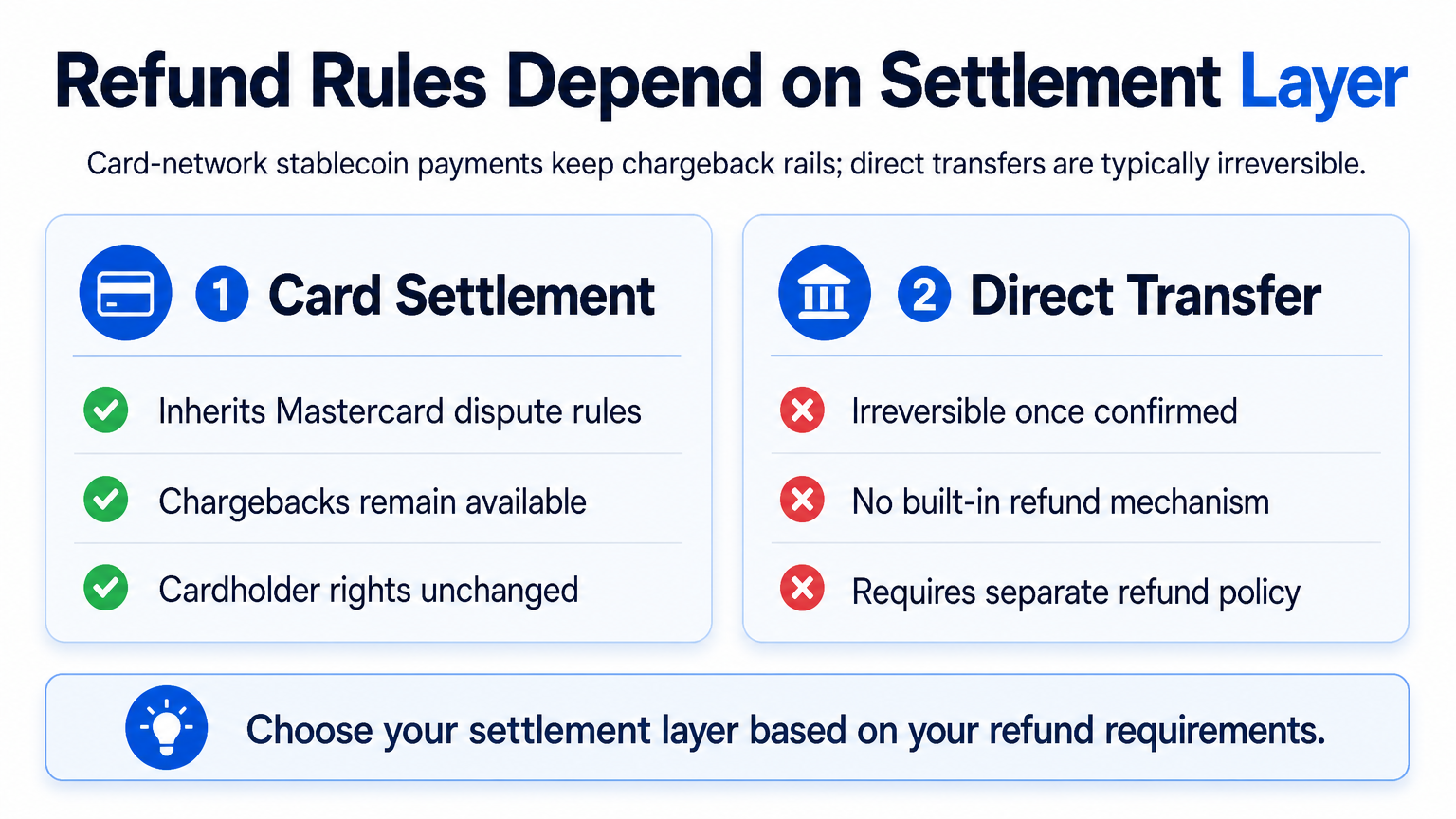
The answer depends on which layer you are using. In the SoFi deal, Mastercard card transactions are still card transactions. They inherit Mastercard's existing dispute and chargeback rules; SoFiUSD changes the settlement asset between the issuing bank and the network, not the cardholder's dispute rights.
By contrast, direct stablecoin transfers on a blockchain are typically irreversible once confirmed. Stripe's stablecoin payments documentation describes refunds and disputes as built into the payment flow, while crypto-native infrastructure often treats direct transfers as final.
The practical rule: card-network stablecoin settlement keeps chargeback rails; direct stablecoin transfers generally do not. A business accepting stablecoins directly needs a separate refund policy because the chain will not reverse a payment for you.
Is stablecoin settlement a replacement for traditional payment rails?
Mastercard's stated position in the September 23, 2026 report is additive: add stablecoins as another settlement choice rather than replace traditional payment rails. The Fed's cautious note reinforces that reading; a larger replacement of bank settlement layers would raise monetary-policy and liquidity questions that this announcement does not claim to answer.
For now, the evidence supports additive settlement, not replacement. That matters for adoption decisions: a finance team can evaluate stablecoin settlement as an efficiency layer without betting that the existing banking stack disappears.
What Operators Should Do About It
How do stablecoin conversions and fees work?
In the SoFi program, SoFiUSD is redeemable 1:1 for U.S. dollars, and merchants can withdraw cash at zero cost through SoFi's Big Business Banking platform. That removes one conversion fee in that specific flow, but it does not make stablecoin conversions free everywhere.
For a business using a stablecoin on/off ramp, fees usually sit in three places: the deposit or withdrawal leg, the stablecoin-to-fiat conversion or FX spread, and any wire or ACH charge. For example, OneSafe does not charge for USDC deposits or withdrawals, while its fiat deposit and withdrawal fee is 0.15% and FX conversion is 0.25% or the prevailing FX rate. The relevant question is not whether fees exist, but whether the total cost of settlement beats the float and processing cost being replaced.
What should a business do to accept or settle stablecoin payments now?
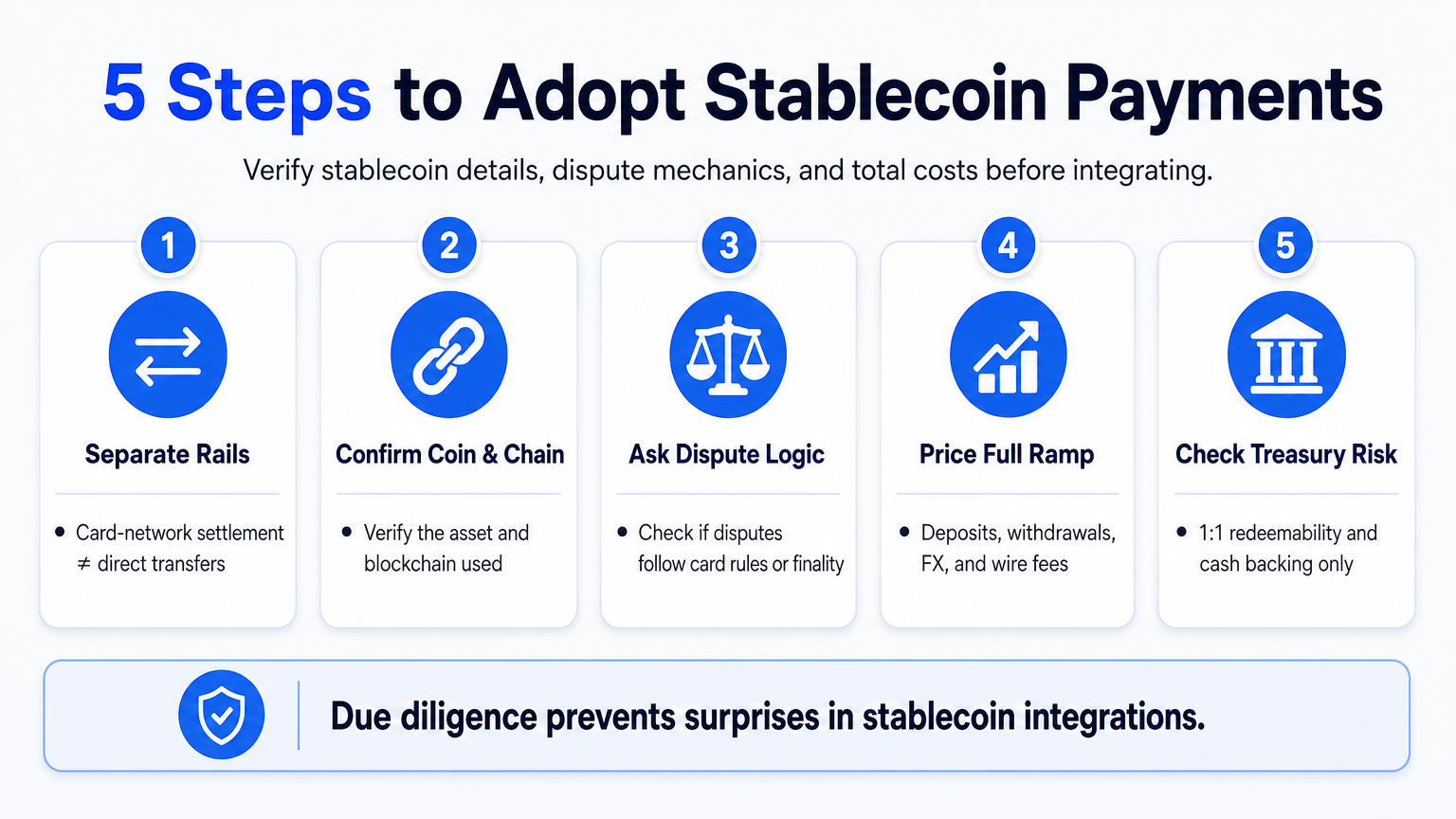
A practical checklist before adopting stablecoin payment rails:
- Separate the settlement rail from the customer payment interface. Card-network stablecoin settlement is not the same as accepting direct stablecoin transfers.
- Confirm the exact stablecoin and blockchain. The SoFi announcement does not name the settlement chain; do not assume one.
- Ask whether disputes inherit card chargeback rules or blockchain finality. The refund answer changes depending on the layer.
- Price the full on/off ramp. Deposit fees, withdrawal fees, FX spreads, wire charges, and conversion costs.
- Check treasury risk. A stablecoin backed primarily by cash and redeemable 1:1 differs from holding unbacked crypto assets.
Questions to ask before using stablecoin payment rails
Before signing with any provider, a finance team should ask:
- Does settlement occur on a blockchain I can audit, or an internal ledger?
- What happens if the stablecoin depegs or pauses redemptions?
- Are refunds and chargebacks processed through the card network or through the blockchain?
- Who bears FX and conversion fees on the stablecoin on/off ramp?
- What are the daily limits, counterparties, and custody arrangements?
Where a crypto-friendly business account fits: multi-currency accounts and free USDC rails
For crypto payments for business, the relevant comparison is often not whether to replace a bank with a stablecoin issuer. It is whether a single account can handle both legs of settlement: the stablecoin leg and the fiat payables leg.
A platform that offers multi-currency accounts, on/off-ramps, and no-fee USDC deposits and withdrawals reduces the operational overhead of moving between stablecoin settlement and fiat payments. OneSafe positions itself as that kind of unified platform, though it is a financial technology company, not a bank; banking services are provided by its partners. For global businesses and DAOs, business banking stablecoin flows are easier to manage when the fiat and crypto accounts sit in one interface.
What to Watch Next and Open Questions
Revenue, scale, and issuer disclosures still missing
Mastercard's near-term financial impact is hard to measure because no revenue or earnings details were disclosed. The September 23, 2026 report also leaves open whether other issuers follow SoFi, and at what cost. Until fee schedules and issuer uptake are public, the SoFi launch is a proof point, not a P&L.
Non-USD stablecoins and whether more card programs follow SoFi
Most stablecoin payment rails still center on U.S. dollar stablecoins, and the SoFiUSD launch does not change that. Whether more card programs follow depends on issuer demand, regulatory clarity, and the economics Mastercard eventually discloses. Payments teams should watch for named settlement blockchains, audit or proof-of-reserve practices, and whether non-USD stablecoins enter card-network settlement. The emerging pattern is not limited to U.S. card networks; Nubank's stablecoin move shows similar dynamics at a digital bank.
Key Takeaways
- A live $25 billion annualized card program now settles in SoFiUSD, moving stablecoin settlement from testing to operational reality.
- The Mastercard SoFi deal is additive, not a replacement: card transactions still follow card-network rules, and only the settlement asset changes.
- Refunds and chargebacks differ by layer: card-network stablecoin settlement keeps dispute rails, while direct stablecoin transfers are typically irreversible.
- Fees are not zero just because settlement is on-chain; price the full stablecoin on/off ramp, including conversion, withdrawal, and wire costs.
- Before adopting stablecoin payment rails, confirm the stablecoin, blockchain, dispute mechanics, redemption backing, and total settlement cost.
If you are evaluating stablecoin payment rails for a global business or DAO, open a OneSafe account to manage fiat and crypto settlement in one place.