You've got two payments to make this week. A Shenzhen factory wants its invoice settled in CNY, while a contractor wants USDC. Sending both through the same bank workflow feels tidy, but it can create unnecessary conversion steps, extra review, and avoidable failure points. The right money transfer to China starts with the payment's currency, the beneficiary's receiving capability, and the evidence that proves why the funds are moving.
China is a major remittance and cross-border payments market, but business payments don't behave like family transfers. A DAO treasury, hardware importer, and software company paying a mainland contractor face different questions about settlement, documentation, custody, and foreign-exchange controls. The cheapest headline fee matters less than whether the selected rail can deliver the right currency to the right account without triggering a preventable rejection.
Table of Contents
Why China Is a Different Payments Problem
Consumer remittance guides usually assume a sender is paying an individual. A business treasury team has a different operating problem. The payer may hold USD, EUR, CAD, or USDC, while the supplier invoices in RMB and the beneficiary bank expects a specific purpose, account format, and supporting document. The transfer must arrive as an acceptable commercial payment, not merely leave the sender's account.
China's scale makes routing decisions consequential. The World Bank's 2024 estimate places personal remittance receipts to China at about $48 billion, putting the country among the five largest global recipient markets alongside India, Mexico, the Philippines, and Pakistan (World Bank remittance data). The same source's longer-run series records $63.9 billion in 2015 and $49.5 billion in 2023, with the available series running from 1982 through 2023. Remittances represented about 0.13% of China's GDP in 2024, a small national-output share that still translates into a large absolute market because the economy is so large.
That inbound figure is only one side of the corridor. World Bank-linked data put personal remittance payments from China at about $20 billion in 2024, and one compiled series shows outward payments rising from roughly $5 million in 1990 to about $20 billion in 2024 (China remittance outflow statistics). The country also sits inside a much broader banking network, with Chinese banks holding about $1.98 trillion in cross-border claims outstanding in Q4 2025, equal to 4.30% of the global total and ranked seventh among reporting systems (cross-border claims and remittance data).
Treasury rule: Treat China as a controlled payment environment with multiple settlement paths, not as a destination selected from a dropdown.
For a supplier, the key question is often whether the beneficiary can receive CNY directly through a bank route. For a contractor, the question may be whether USDC is acceptable, whether the contractor can legally and practically convert it, and what records the business needs to retain. For a DAO, governance approvals and wallet controls matter alongside bank compliance.
The routing decision therefore has four inputs: currency, beneficiary readiness, urgency, and documentation. Fees come after those inputs, because a low-cost transfer that gets returned is expensive in staff time, missed production, and reconciliation work.
The Rails That Move Money Into China
The wrong rail can leave a supplier unpaid even when the transfer shows as sent. Start with the settlement path, not the headline fee.
The payment system has three layers. The first is messaging. SWIFT carries standardized payment instructions between financial institutions, but it does not provide final RMB settlement. The second is settlement. CIPS supports China's interbank clearing and settlement for yuan payments. A bank can send instructions through SWIFT while CIPS completes the RMB settlement, so the systems serve different roles (analysis of SWIFT and CIPS).
The third layer is local clearing. After funds enter the relevant domestic banking path, local systems complete the credit to the beneficiary. The sender may see an international wire interface, while the recipient sees a domestic bank deposit. Confirming both views prevents a routing mistake.
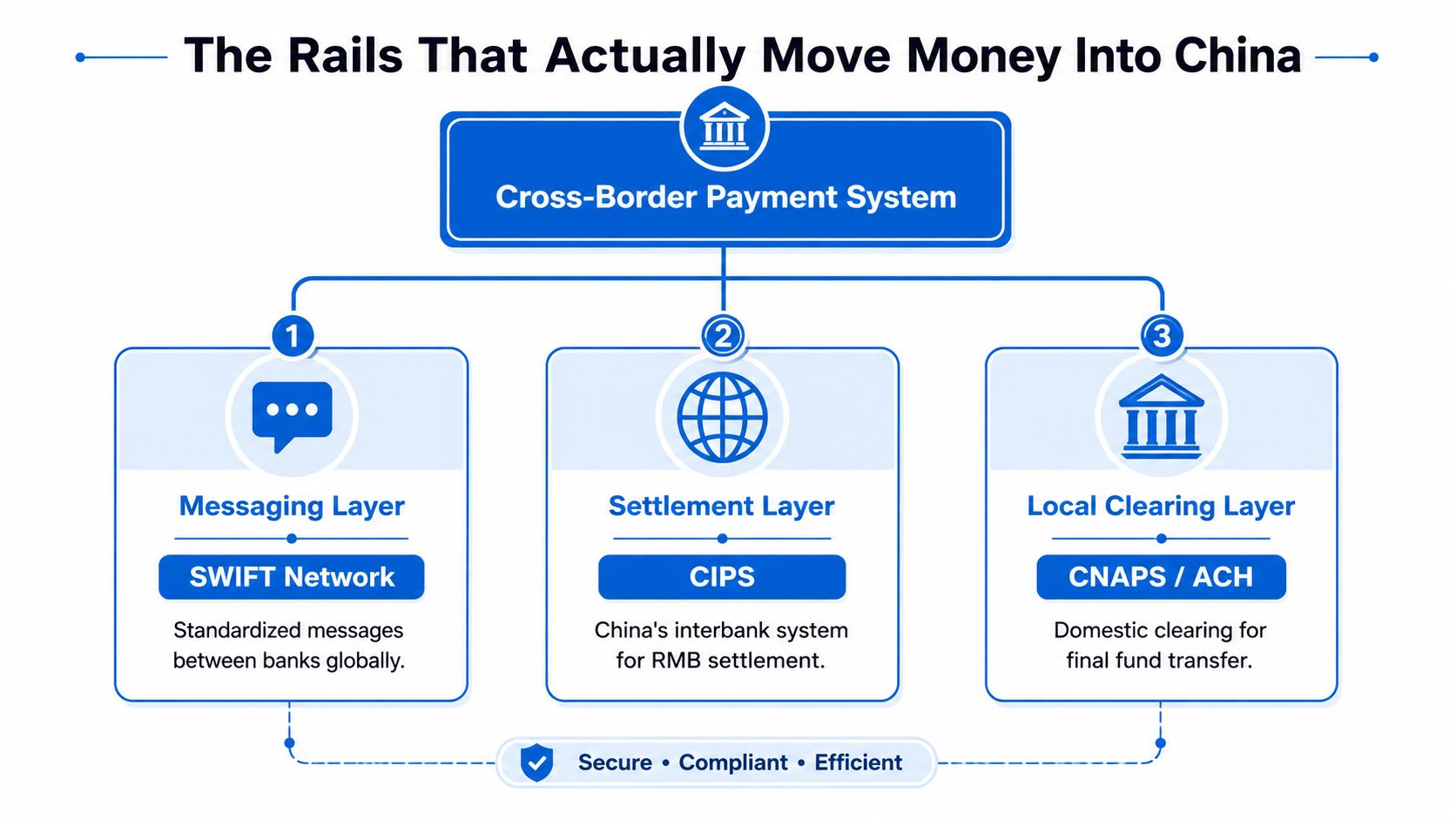
How the layers fit together
A USD payment to a mainland supplier may begin as a bank wire, use SWIFT messaging and correspondent institutions, then undergo conversion and beneficiary credit through China-side bank processes. A CNY payment may use SWIFT for instructions and CIPS for RMB settlement. Ask the provider two questions: which currency reaches the beneficiary, and which intermediary chain carries the instruction?
Partner-bank rails support another route. A provider can fund a local payout to Alipay or WeChat Pay through a regulated partner, but eligibility, wallet registration, and payment purpose determine whether it works. This option can suit certain individual or low-complexity payouts. It is not a default substitute for a factory invoice.
Crypto creates a separate settlement path. USDC can move from a treasury wallet to a recipient wallet on a supported chain, after which the recipient decides whether to hold or convert it. That reduces reliance on correspondent banks, while leaving KYB, tax, accounting, sanctions, and local conversion requirements in place. For a DAO, wallet controls and approval records belong in the payment file.
OneSafe's cross-border payment infrastructure brings multi-currency accounts, bank payments, crypto balances, and conversion workflows into one interface. Its USD, EUR, and CAD accounts can simplify funding before a business selects a bank or USDC route. The receiving bank, beneficiary eligibility, and applicable controls still determine whether the payment completes.
System activity reinforces the routing point. Non-bank cross-border receipts and payments reached USD 9.2 trillion in H1 2026, up 21% year over year, while CIPS handled RMB 180.2 trillion in payment transactions in 2025 and continued expanding in 2026 (SAFE and CIPS activity reporting). Those figures measure network scale, not approval of an individual transfer. For treasury teams, SWIFT messaging, CIPS settlement, SAFE-related controls, and local clearing determine the route. Fees come after those constraints.
Comparing the Four Main Routes Businesses Use
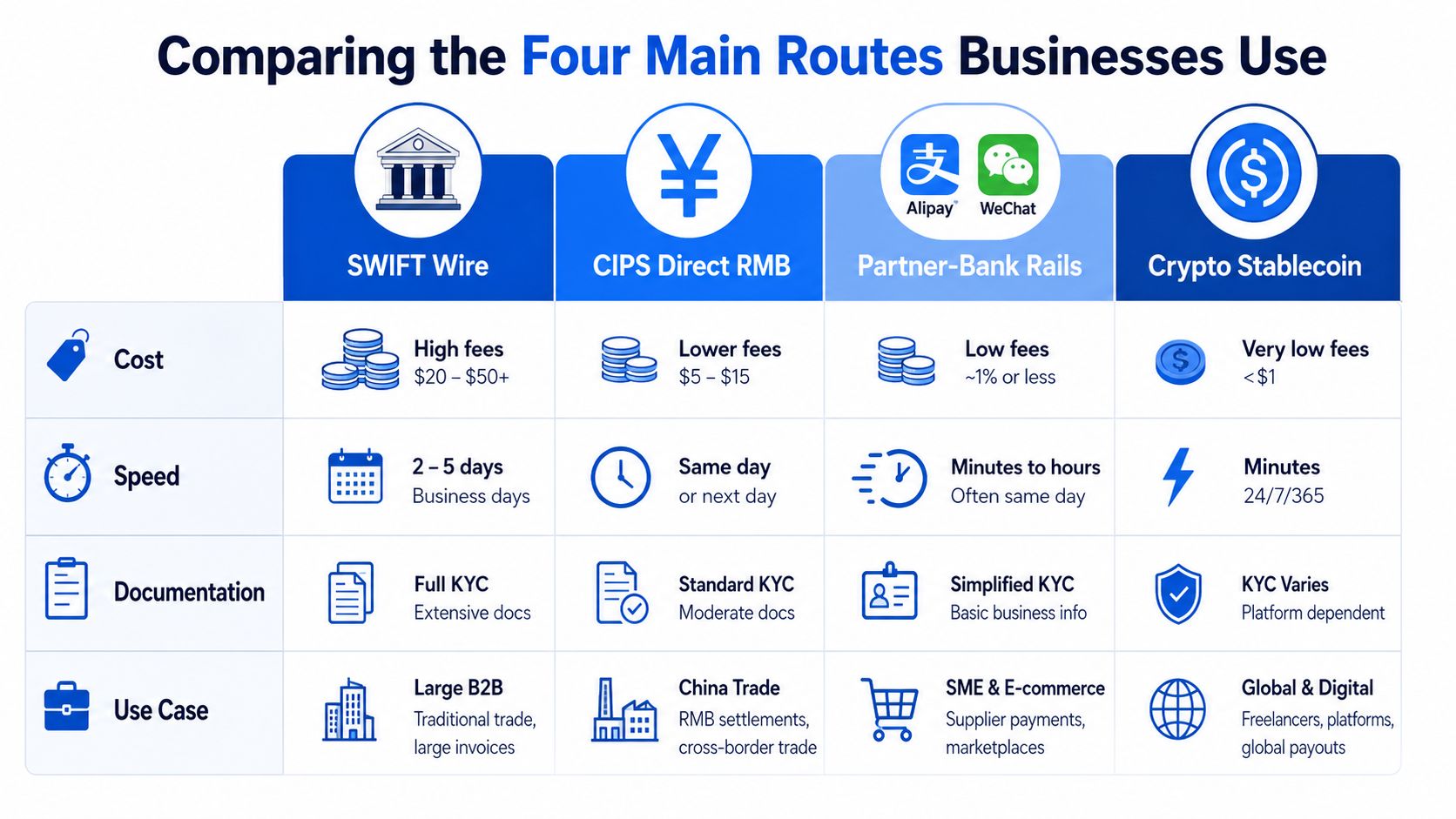
There isn't one universal winner. I'd choose the route by the beneficiary's required currency first, then by the receiving institution's capability.
SWIFT wires
SWIFT is the default for formal B2B payments when the supplier expects a bank transfer in a foreign currency or when the transaction needs a conventional bank audit trail. It handles large invoices well, but the path can include correspondent banks, intermediary fees, FX conversion, and manual review. The documentation burden is high, yet that's often a benefit for an importer that needs clean records for procurement, accounting, and trade files.
I'd use a SWIFT wire for a factory supplier that invoices in USD and has confirmed it accepts international wires. I wouldn't send USD by default when the supplier has clearly requested CNY and a supported direct RMB route is available.
CIPS direct RMB
CIPS is the stronger choice when the invoice is denominated in RMB, the beneficiary bank can receive the payment, and the payer has a reliable conversion route. It can make the settlement path more direct for China-linked yuan flows, but “direct” doesn't mean documentation-free. Purpose, beneficiary details, and bank-side validation still determine whether the payment is accepted.
For a Hong Kong entity paying a mainland vendor in CNY, CIPS is my first choice when the bank confirms coverage. It avoids forcing the recipient to manage an unwanted USD receipt and reduces dependence on a longer correspondent chain.
Partner-bank wallet rails
Alipay and WeChat Pay routes can be useful for eligible individual recipients and selected service providers. Their practical advantage is recipient familiarity and local wallet access. Their weakness is recipient eligibility, transaction-purpose restrictions, and weaker fit for formal supplier invoices.
Use this path only after confirming the exact recipient type and payout rules. Don't treat a wallet payout as a substitute for commercial bank settlement without checking the recipient's accounting and compliance requirements. For teams comparing account and wallet workflows, this Airwallex and WeChat Pay comparison provides useful context around how business payment products differ from consumer wallet access.
Crypto stablecoins
USDC wins when the recipient explicitly prefers it, has a compatible wallet, and understands the conversion and reporting obligations. It's particularly useful for crypto-native contractors and DAO operations, where the treasury already holds digital assets and the recipient can receive them without an unnecessary fiat detour.
It's the wrong choice when the supplier needs a bank-confirmed CNY receipt, the recipient has no compliant conversion workflow, or the company lacks a documented crypto payroll process. Stablecoin settlement changes the payment rail, not the need for a defensible business purpose.
A founder evaluating this stack may also benefit from a curated list of payments angel investors United States when looking for specialist advice or funding in payments infrastructure. The resource is relevant because rail strategy, compliance tooling, and treasury automation are now connected operating decisions.
My scenario picks are straightforward:
- Guangzhou factory, USD invoice: SWIFT, provided the beneficiary bank confirms the exact receiving details.
- Hong Kong entity, CNY invoice: CIPS direct RMB, when the payer and beneficiary banks support the route.
- Remote contractor, USDC preference: USDC, with wallet, conversion, tax, and approval records prepared first.
- DAO funding a Beijing subsidiary: Fiat bank rails for the subsidiary's operating account, with crypto conversion handled in a controlled treasury workflow rather than mixed into the vendor payment without documentation.
What a Transfer Really Costs After FX and Fees
The advertised transfer fee is only one line in the landed cost. A proper quote separates the FX spread, platform or bank fee, network charge, correspondent deduction, recipient crediting fee, and the charge-allocation method.
The FX margin often matters more than the visible wire fee. If a provider gives a less competitive conversion rate, the difference applies across the transferred amount. A transparent quote should show the reference rate, the applied rate, the conversion amount, and whether the recipient receives the invoiced currency or an intermediary currency.
Bank schedules illustrate how quickly costs layer. Bank of China Vietnam publishes remittance pricing that can combine percentage-based charges with SWIFT fees and optional OUR or FULL PAY treatment (Bank of China Vietnam remittance tariff). Hong Kong Bank of China tariff materials also distinguish correspondent-bank and crediting charges. That's why a “low fee” transfer can still produce a short payment at the beneficiary end.
Reading charge allocation
- OUR: The sender attempts to cover the transfer charges, but the final path still needs confirmation from the provider.
- SHA: Charges are shared, so the recipient may receive less than the invoice amount.
- BEN: Charges are deducted from the transferred amount, which is usually a poor fit for a supplier expecting the full invoice value.
Card networks belong in a separate category. They're convenient for operational spending, but card conversion and merchant pricing aren't the same as a bank settlement quote. Don't compare a card purchase fee with a supplier wire without defining the payment objective.
| Rail | Base fee | FX margin | SWIFT or network | Correspondent | Total cost % |
|---|---|---|---|---|---|
| SWIFT wire | Provider or bank charge | Quoted by provider | May apply | May apply | Calculate from the all-in quote |
| CIPS direct RMB | Provider or bank charge | Applies when converting into RMB | CIPS settlement path | Depends on bank route | Calculate from the all-in quote |
| Partner-bank rail | Provider charge | Applies when converting | Partner network | Usually embedded or separately disclosed | Calculate from the all-in quote |
| USDC transfer | Provider or network charge | Applies when converting to or from fiat | Blockchain network | No correspondent bank in the crypto leg | Calculate from the all-in quote |
OneSafe publishes 0.25% FX pricing, 0.35% SWIFT pricing plus $50, and 0.15% fiat deposit and withdrawal pricing as reference points for its own services, while other providers publish different schedules. Those figures are not a universal China transfer total. They're useful because they show the level of line-item disclosure a finance team should demand before approving a payment.
For ACH background, the ACH payment processing guide can help distinguish domestic account movement from international settlement. ACH may be useful for funding a transfer before the China leg, but it isn't a replacement for the recipient-side route.
Compliance and Capital Controls That Delay Transfers
A delayed China payment usually fails operationally before it fails technically. Banks need to establish who is sending, who is receiving, and why the payment has economic substance.
For outbound transfers from China, banks must verify sender identity for transfers above RMB 5,000 or the foreign-currency equivalent of USD 1,000, and newer control rules require transaction records to be retained for up to 10 years (China foreign-exchange control requirements). The practical lesson is simple. A fast network can't rescue an incomplete purpose, mismatched beneficiary name, or unsupported invoice.
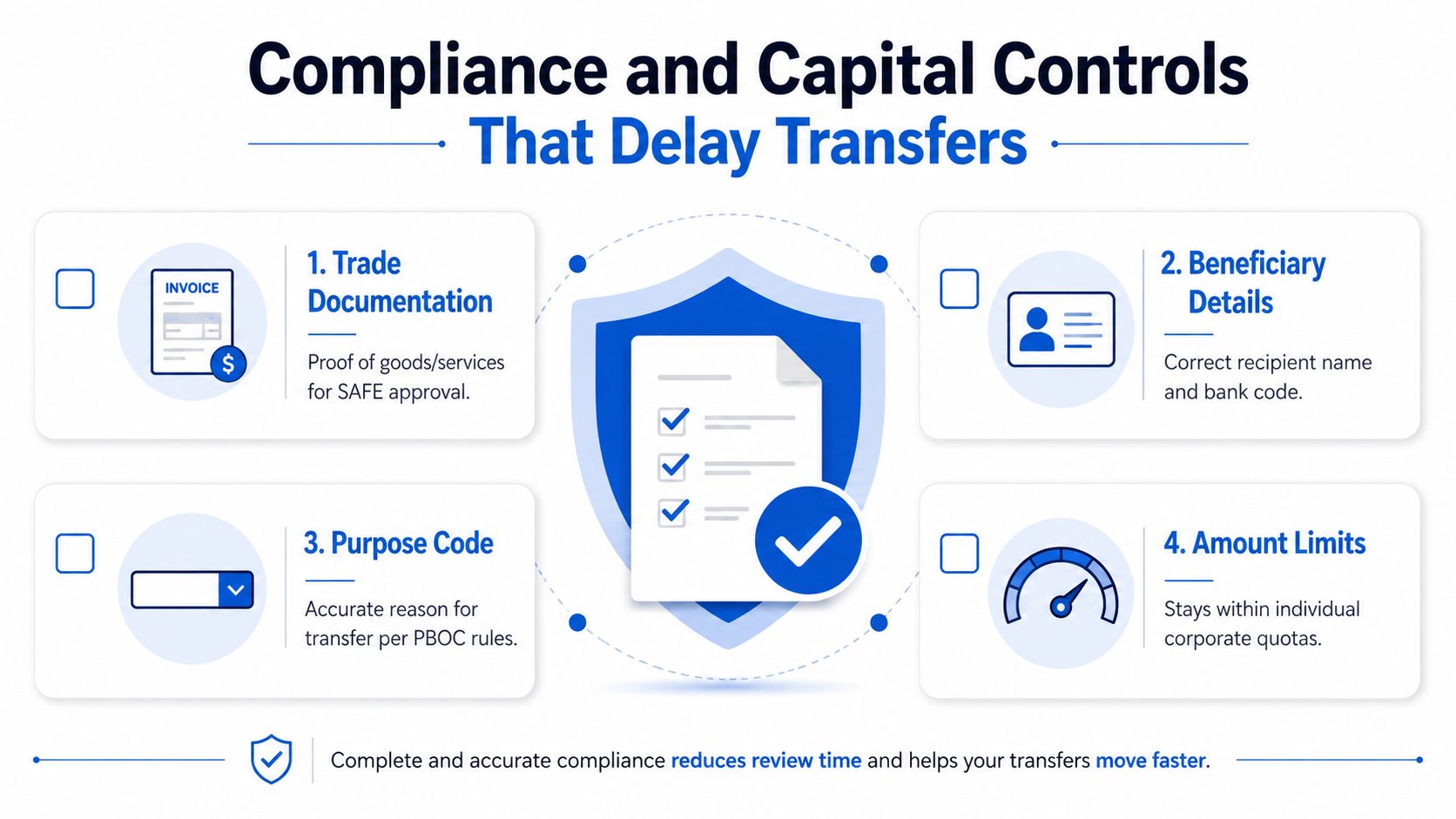
Build the document packet first
Prepare the packet before submitting the instruction:
- Contract: Show the commercial relationship, obligations, currency, and payment terms.
- Invoice: Match the legal entity names, amount, currency, description, and due date.
- Shipping evidence: Include purchase orders, shipping documents, or customs material when goods are involved.
- Beneficiary data: Confirm the legal account name, bank name, branch information, account number, and required bank code.
- Purpose explanation: Use a precise description that matches the invoice and the underlying transaction.
- Entity records: Keep tax, registration, KYB, and approval records available where the bank or provider requests them.
Crypto-native companies often get stuck because their paperwork describes a token transaction while the beneficiary bank expects a service invoice. A contractor agreement should identify the work, compensation terms, wallet destination where relevant, and the conversion or fiat-payment process. A DAO should also preserve the governance approval that authorizes the expense.
Practical rule: Don't submit the transfer and start collecting documents afterward. Assemble the evidence packet before the payment leaves your treasury.
The bank may ask follow-up questions even when the amount is legitimate. Missing documents, inconsistent names, vague descriptions, and unexplained third-party funding create avoidable review. Store the final invoice and transaction record together so the payment can be explained during reconciliation or later review.
Three Real Workflows for Sending Money to China
The hardware supplier
A hardware importer receives a 30-day net invoice from a Shenzhen supplier in USD. The supplier's bank confirms it accepts the currency and provides the required international banking details. The importer schedules a SWIFT wire several business days before the due date, keeps the purchase order, invoice, and shipping record together, and confirms whether the supplier expects OUR, SHA, or another charge arrangement.
The chosen rail is SWIFT, because the invoice and beneficiary capability align with a conventional bank payment. The main risk isn't just the transfer timeline. It's FX timing between invoice approval and settlement, plus the possibility that an intermediary deduction leaves the supplier short. The importer should ask for the expected net receipt and reconcile the bank confirmation against the invoice.
The DAO contractor
A DAO pays a full-time contractor who prefers USDC. The treasury approves the payment, verifies the wallet through a controlled process, records the work agreement and payment purpose, and sends USDC on the chain the contractor can receive. The contractor then handles conversion through an available and compliant process, while the DAO records the token amount, transaction hash, valuation method, and any required tax information.
The chosen rail is USDC, because the recipient has requested it and the DAO already operates a digital-asset treasury. The failure mode is sending to an unsupported chain, using an unverified wallet, or treating the stablecoin payment as exempt from payroll, contractor, accounting, or tax responsibilities. Stablecoin denomination doesn't remove the need for an auditable compensation record.
The Hong Kong subsidiary
A Hong Kong subsidiary pays a mainland vendor in CNY. The vendor's invoice is denominated in RMB, both banks confirm the supported payment route, and the treasury converts the required amount before submitting the instruction. The packet includes the vendor agreement, invoice, beneficiary details, and the purpose information requested by the bank.
The chosen rail is CIPS direct RMB, because the settlement currency matches the invoice and the beneficiary's bank can receive it. The practical advantage is avoiding an unnecessary USD receipt and conversion at the supplier's side. If the subsidiary skips bank confirmation or submits a name that differs from the beneficiary's registered account, the payment can still be delayed even though the rail is appropriate.
How OneSafe Fits Into a China Payment Stack
OneSafe fits on the treasury side of the corridor. It provides USD, EUR, and CAD business accounts, supports international wires and SWIFT withdrawals, accepts and sends USDC, and offers stated 0.25% FX pricing. That combination addresses the common problem of holding funds in one currency while paying a counterparty in another.
For a hardware importer, the platform can hold operating fiat and prepare an international bank payment without forcing the team to manage every currency in separate systems. For a DAO, USDC support and crypto-to-fiat conversion can separate treasury custody from the final vendor or subsidiary payment. The China-side beneficiary bank still determines whether it can receive the selected currency and route.
The control layer matters as much as the payment button. OneSafe describes Fireblocks-based digital-asset custody, mandatory MFA, KYB onboarding, multi-currency account management, and approval controls for business workflows. Those features map directly to the risks already identified, wallet verification, treasury authorization, conversion timing, and document retention.
I wouldn't position any platform as a replacement for the beneficiary's China bank. The useful role is different: consolidate the funding currency, control when FX happens, preserve the payment trail, and route the final transfer through an available banking or crypto path. That's especially relevant for companies that otherwise move between an exchange, a bank portal, a wallet, and a spreadsheet every time they pay China.
Choosing the Right Rail for Your Next Transfer
Use this order:
- Start with currency. If the invoice is CNY, check CIPS or another supported RMB route first. If it's USD, confirm the beneficiary bank's wire capability. If it's USDC, verify the wallet and conversion workflow.
- Check the recipient. Confirm the legal name, bank details, wallet network, and whether the recipient can accept the chosen asset.
- Match urgency to certainty. Don't choose a supposedly fast route that has weak documentation or uncertain recipient eligibility.
- Price the landed payment. Include FX, base fees, network charges, correspondent deductions, and charge allocation.
Before submitting, verify three things: the beneficiary details match the invoice, the purpose documents are complete, and the recipient has confirmed the currency and rail. That checklist prevents more failures than chasing a marginally lower headline fee.
If your business needs USD, EUR, or CAD accounts, USDC movement, controlled FX, and international wire or SWIFT workflows in one treasury interface, visit OneSafe and assess whether it fits your China payment process. Set up the document packet and beneficiary checks before your next transfer, then use the platform to keep the fiat, crypto, conversion, and approval trail together.