Reported crypto banking scams in the United States hit a staggering $15.9 billion in 2026, with the real annual toll likely reaching $500 billion, according to Fortune on September 2, 2026. For businesses that mix fiat and digital assets, the numbers are a wake-up call. Traditional banking protections were never designed for the speed, irreversibility, and pseudonymity of on-chain finance. This article unpacks the report, what it means for founders and DAOs, and how purpose-built neo-banking platforms can harden financial operations by design.
Table of Contents
- What Just Happened: Crypto Banking Scams Hit a Record $15.9 Billion
- Why This Matters Now for Founders and Finance Leads
- The Background Every Business Newcomer Needs
- The Great Safety Debate: Regulated Custody vs. Purpose-Built Platforms
- Concrete Implications and What to Do This Week
- What to Watch Next: The Fallout and the Open Questions
- FAQ
- Key Takeaways
What Just Happened: Crypto Banking Scams Hit a Record $15.9 Billion
On September 2, 2026, the Associated Press and Fortune published an investigation showing reported scams reached $15.9 billion in the U.S., with estimates up to $500 billion annually when unreported losses are included. The figure spans romance scams, investment fraud, and business email compromise (BEC) attacks that abuse crypto rails. The report highlights Simon, a widower tricked into sending $800,000 to a fake online companion: the theft left him with $185,000 in debt and a crushing tax bill, showing the aftermath often does more damage than the initial theft.
Former prosecutor Erin West, founder of Operation Shamrock, told the AP: “What happens after the scam might even be worse than the scam itself.” For businesses, that can mean frozen accounts, regulatory scrutiny, liability for fraudulent transactions, and reputational harm. Unlike consumers, a company that loses operating capital may miss payroll, breach contracts, or face insolvency. For crypto-native organizations, a single compromised wallet can drain a treasury.
Fraudsters increasingly impersonate legitimate crypto banking platforms, create spoofed interfaces, and manipulate wire and on-chain instructions. They exploit fragmented traditional banking: a business may use one bank for USD, an exchange for crypto, and a separate wallet for DeFi, multiplying touchpoints an attacker can target. Even platforms holding regulated custody licenses are not immune to social engineering that tricks teams into rerouting funds.
Why This Matters Now for Founders and Finance Leads
The $15.9B headline is not retail-only. BEC scams cost businesses billions annually, and crypto makes recovery nearly impossible. A successful phishing attack on a finance lead can drain a Web3 startup’s runway in minutes, with no chargebacks on most blockchains. Crypto fraud prevention must be a board-level priority, not a compliance checkbox.
DAOs and Web3 startups face distinct threats. Multisig wallets are often managed by pseudonymous contributors who can be socially engineered. Treasury transactions are broadcast on-chain, exposing balances and payment patterns. Without DAO treasury management controls—role-based permissions, transaction limits, and forced multi-party approval—one compromised key can liquidate the treasury.
Fragmentation also matters. A traditional bank for fiat, an exchange for crypto, and a third-party wallet for DeFi means each account is a potential entry point and harder to monitor. A unified fiat and crypto unified platform shrinks the attack surface and reduces the logins, dashboards, and API keys that must be secured.
The Background Every Business Newcomer Needs
Crypto banking for businesses is not one product but a suite of services for holding, sending, receiving, and converting fiat and digital assets—often through a single interface. It can include ACH and wire transfers, corporate cards, crypto custody, and on/off-ramps. Current account comparisons, such as Best Crypto Business Accounts Reviewed (2026 Guide) and a Crypto-Friendly Business Bank Account: A Web3 Guide, show that crypto business account security must handle irreversibility and private key management.
Crypto banking regulation 2026 remains fragmented. The U.S. lacks a unified federal framework; some states such as Wyoming have created special-purpose depository institutions. In the EU, the Markets in Crypto-Assets (MiCA) regulation is being phased in, and the ECB’s on-chain euro trials signal a shift toward regulated digital assets. The UK is also reshaping its stablecoin rules. A business’s banking partner jurisdiction dictates which protections apply—and which don’t.
Many crypto banking platforms for business bolt a crypto wallet onto a traditional banking interface, creating disjointed user experiences and security gaps where fiat and crypto workflows don’t share a permissioning layer. OneSafe, a neo-banking platform for global businesses, takes a different approach: a single interface for fiat and crypto with Fireblocks custody for business digital assets, mandatory multi-factor authentication (MFA), and segregated accounts. It has processed over $800 million in transaction volume for more than 1,000 businesses across 30+ countries. OneSafe is a financial technology company, not a bank; banking services are provided by its partners.
The Great Safety Debate: Regulated Custody vs. Purpose-Built Platforms
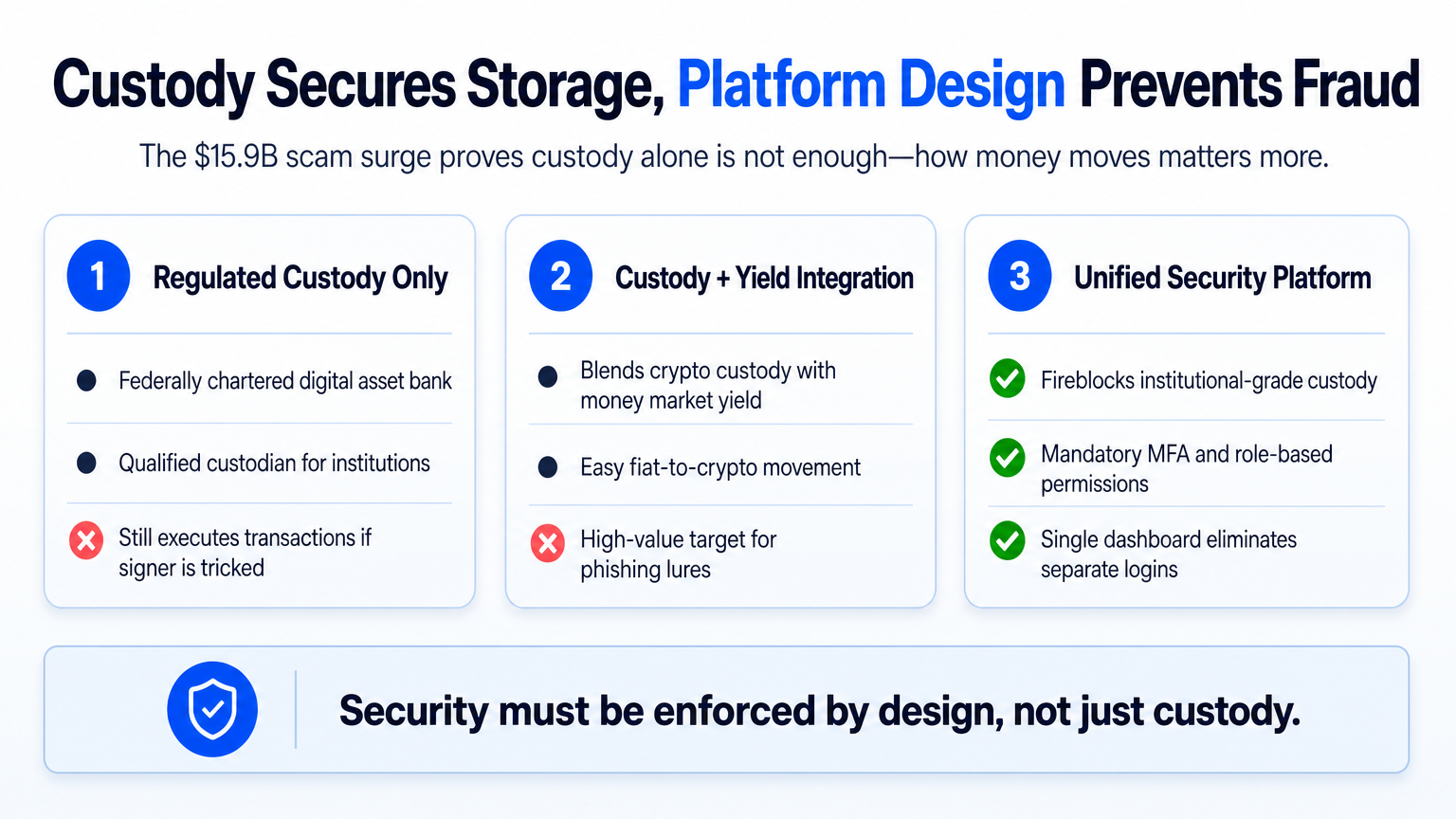
Anchorage Digital became the first federally chartered digital asset bank in the U.S., positioning itself as a qualified custodian for institutions. The theory: regulatory oversight and strict asset segregation make funds safer. But the $15.9B report shows custody alone does not prevent fraud. A qualified custodian can still execute a transaction if an authorized signer is tricked into approving it. Custody secures storage, not fund movement.
FV Bank offers a “Custody Money Market Account” that blends crypto custody with yield and lets businesses hold both USD and digital assets. Its seamless fiat-to-crypto movement is appealing, but any platform that consolidates value and rapid transfers becomes a high-value target. Scammers study these interfaces to craft phishing lures. When a platform makes funds easy to convert and move, it must also impose business crypto wallet safety controls—transaction velocity limits and multi-person approval chains—enforced by design, not just policy.
OneSafe’s architecture addresses this flaw. By combining Fireblocks’ institutional-grade digital asset custody with a unified dashboard for fiat and crypto, it eliminates separate logins and disjointed permissioning. MFA is mandatory at signup, and role-based permissions can be customized for DAOs and distributed teams. Onboarding—typically within a week—includes robust KYB checks that verify business formation documents and government-issued IDs. A neobank for crypto startups should be harder to socially engineer because every critical action lives in one controlled environment.
Concrete Implications and What to Do This Week
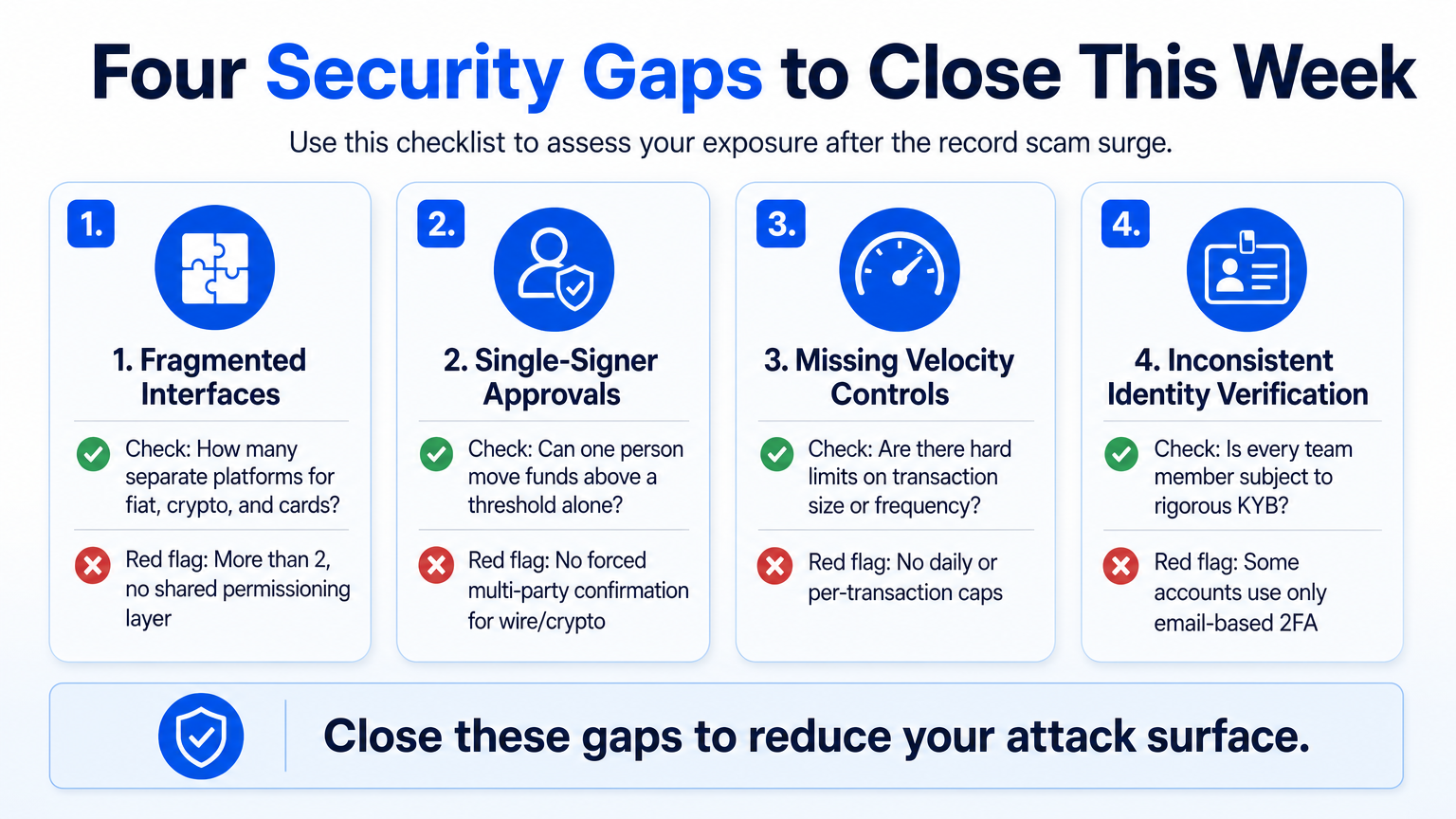
Use this checklist, built from patterns observed in the scam surge, to assess exposure:
| Security Gap | What to Check | Red Flag |
|---|---|---|
| 1. Fragmented interfaces | How many separate platforms do you use for fiat, crypto, and cards? | More than 2, with no shared permissioning layer |
| 2. Single-signer approvals | Can one person move funds above a set threshold alone? | No forced multi-party confirmation for wire/crypto |
| 3. Missing velocity controls | Are there hard limits on transaction size or frequency? | No daily or per-transaction caps |
| 4. Inconsistent identity verification | Is every team member subject to the same rigorous KYB? | Some accounts use only email-based 2FA |
A fee structure that is overly complex or charges extra for basic security features is a warning. If a platform charges extra for multi-signature wallets or MFA, security is a premium, not a default. Transparent, flat-fee models—like OneSafe’s free account with no monthly subscription, premium plans from $29/month, and clear crypto deposit/withdrawal costs with free USDC transactions—indicate economics aligned with secure, long-term usage. For further guidance on why structure matters, see Why You Should Start a Crypto Business Bank Account.
Speed is a selling point, but secure crypto banking 2026 demands friction where it counts. Instant onboarding with no identity verification is a liability. OneSafe’s fully digital onboarding typically completes within a week and requires business formation papers, a government-issued photo ID, and an EIN for U.S. companies. That deliberate pace is a safety feature: it gives compliance time to verify ownership and control, reducing impersonation accounts used to receive and launder funds.
What to Watch Next: The Fallout and the Open Questions
The record scam numbers are likely to intensify regulatory pressure. The U.S. Treasury has already signaled interest in reshaping crypto treasury management, as seen in recent bond market macro impacts. The UAE’s stablecoin regulation is winning global attention and may become a template. Expect faster movement toward mandatory licensing for crypto banking platforms and stricter transaction monitoring.
As traditional banks remain hesitant to offer FDIC insurance on crypto deposits, some custody providers now offer crime insurance or segregated insurance pools. The open question is whether protections will cover social engineering losses—most currently exclude them. Professional indemnity coverage for crypto-native businesses will be a critical space to watch.
DAOs face a governance paradox: they need code-driven execution, but treasuries are increasingly targeted. Solutions are emerging that combine on-chain multisig with off-chain role-based approvals, such as OneSafe’s customizable roles and permissions for DAOs. The next frontier is automated monitoring that pauses transactions based on anomaly detection without compromising decentralization.
FAQ
What is crypto banking?
Crypto banking is a set of financial services allowing businesses to hold, transfer, and convert fiat and digital assets through one provider. Unlike a traditional bank, it typically offers on-chain custody, stablecoin payments, and crypto-to-fiat on/off-ramps, often alongside ACH and wire transfers.
How can businesses protect themselves from crypto scams?
Crypto fraud prevention starts with a hardened operational environment: consolidate accounts on a unified platform, enforce multi-party approval and velocity limits, mandate MFA, require rigorous KYB, train finance teams to verify payment instructions through a secondary channel, and use institutional-grade custody such as Fireblocks so compromised credentials don’t automatically mean total loss.
Are crypto banking platforms regulated?
Yes, but depth varies by jurisdiction. In the U.S., some are chartered as trust companies or money transmitters at state level; others need no license unless they custody client assets. In the EU, MiCA will impose a unified licensing regime. Verify any platform is registered in a reputable jurisdiction and complies with AML and KYB requirements. Absence of clear regulation is a risk, not a feature.
What should I look for in a secure crypto banking platform?
Look for a single unified interface for fiat and crypto with integrated custody, mandatory MFA, role-based permissions, transaction limits, transparent fees, thorough KYB, segregated accounts, and real-time monitoring.
Key Takeaways
- $15.9 billion in reported scams—and up to $500 billion in estimated losses—prove that crypto banking security must be built into the platform, not left to user vigilance.
- Fragmentation is a liability: multiple banks, exchanges, and wallets multiply your attack surface; a unified fiat-and-crypto platform shrinks it.
- Regulated custody is necessary but not sufficient: custody protects assets at rest, but scams exploit the moment funds move; platform design, multi-party approvals, and velocity controls matter more.
- Onboarding speed is not a virtue without robust KYB: a week-long digital process that verifies identities and business documents is a safety feature, not friction.
- DAOs and startups need role-based treasury controls combining on-chain multisig with off-chain permissioning to prevent a single point of failure.
Open a crypto business account built for the way founders and DAOs actually move money—streamline your fiat and crypto operations with OneSafe.