Stablecoin Payments: Inside Citi & Coinbase’s New Checkout
On October 12, 2026, Citi and Coinbase outlined a stablecoin checkout for Spring by Citi that automatically converts incoming stablecoins to fiat and settles the balance to a bank account, The Defiant reported. For global businesses and DAOs running mixed fiat-and-crypto treasuries, that detail reframes how stablecoin payments work: the merchant never has to hold the stablecoin to accept it.
Table of Contents
- What Just Happened: Citi and Coinbase Unveil Stablecoin Checkout
- Why This Matters Now for Global Businesses and DAOs
- The Backstory: How Stablecoin Payments Got Here
- Inside the Citi-Coinbase Checkout: What We Know So Far
- What This Means for Your Payment Strategy
- Actionable Steps: Getting Your Business Ready
- What to Watch Next
- Key Takeaways
What Just Happened: Citi and Coinbase Unveil Stablecoin Checkout
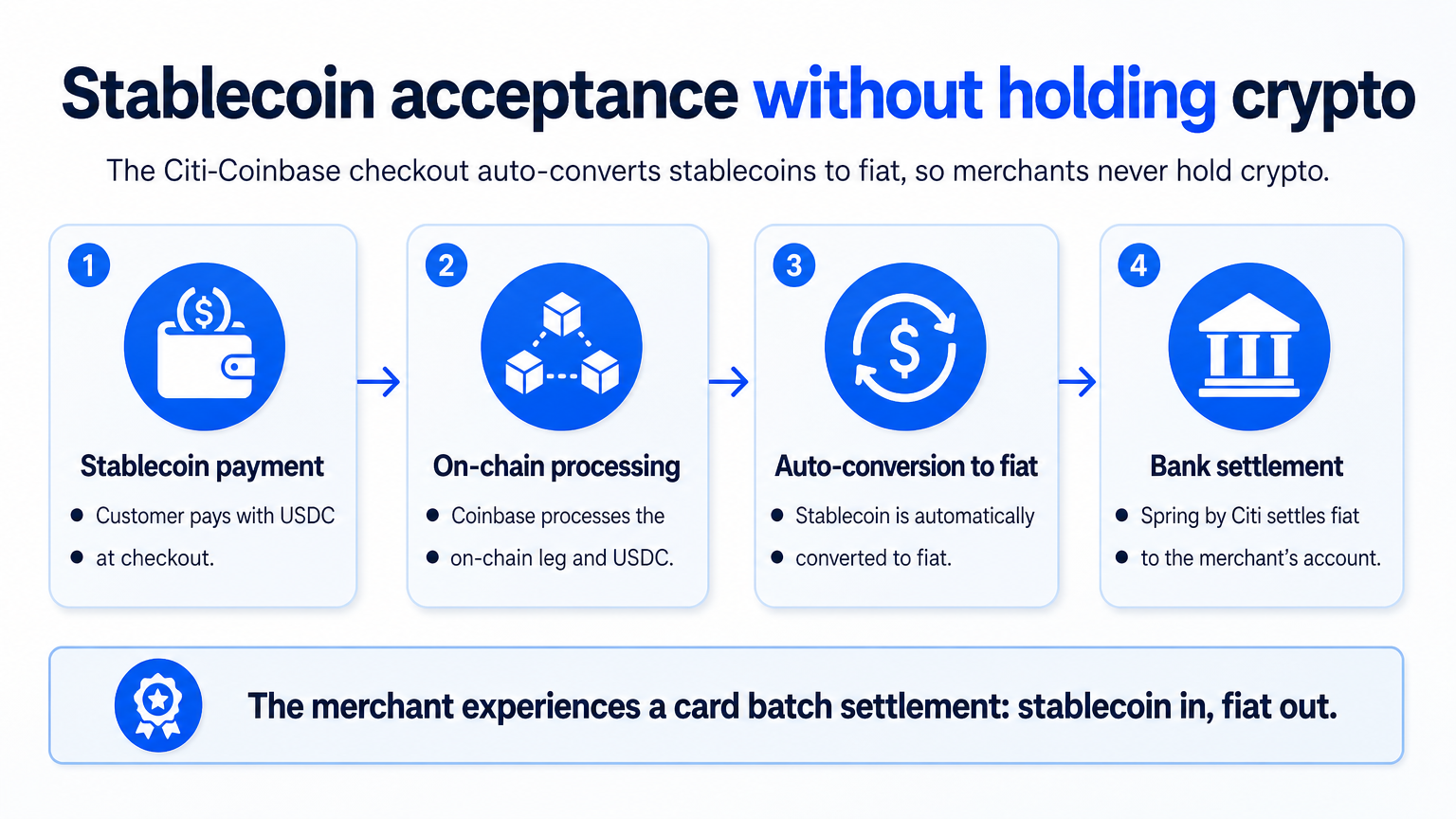
What is the Citi-Coinbase stablecoin checkout and how does it work?
The Defiant reported that Citi and Coinbase detailed a stablecoin checkout for Spring by Citi, Citi's institutional digital-asset platform. The key claim: incoming stablecoins are automatically converted to fiat and settled to a bank account (The Defiant, October 12, 2026).
A customer pays in a stablecoin at checkout. Coinbase processes the on-chain leg and handles USDC payment processing. The stablecoin is converted to fiat, and Spring by Citi settles the amount to the merchant's bank account. The merchant sees a card batch settlement: stablecoin in, fiat out.
This shifts earlier models. Before, a business either used a crypto-native processor that paid out in stablecoins, or held USDC and converted later. This moves conversion into the checkout layer.
The October 12 announcement, sourced and dated
The Defiant's October 12 report is the specific news event. Citi announced its partnership with Coinbase in 2025 to "boost digital asset payment capabilities for global clients" (Citi press release), and Coinbase framed the collaboration as "building the future of payments" (Coinbase blog). The October 2026 detail is the commercial product layer: a checkout feature, not just infrastructure.
Why This Matters Now for Global Businesses and DAOs
Why should my global business care about stablecoin payments in October 2026?
Stablecoin acceptance is no longer crypto-native niche. Checkout.com already enables stablecoin acceptance for merchants with Coinbase (Checkout.com newsroom), and Stripe lists stablecoins as a supported payment method (Stripe). What changes in October 2026 is the bank side: a top-tier US bank describes stablecoin-to-fiat settlement as a native bank product, not a pilot.
For a global business, accepting a stablecoin payment no longer requires a pure-crypto processor and custom treasury infrastructure. If a merchant bank receives dollars from a stablecoin checkout, the merchant gains a new payment channel without carrying crypto volatility.
The end of 'crypto or fiat' thinking
The Citi-Coinbase checkout decouples the customer's payment rail from the merchant's settlement currency. A global business can offer stablecoin payments while funding payroll, paying vendors, and reporting revenue in fiat. Stablecoin payments stop being a treasury allocation decision and become a payment-channel decision — like adding a card network.
Why Web3 startups and DAOs should pay attention today
DAOs and Web3 startups feel this first because receivables already arrive in stablecoins. A DAO treasury may hold USDC from token sales, protocol fees, or grants, but taxes, payroll, and auditors need fiat. Until now, that meant off-ramp steps: swap on an exchange, withdraw, wait for the wire, reconcile.
The Citi-Coinbase pattern hints where banking heads: stablecoins accepted at the front, fiat delivered at the back, automatically. For a DAO that repeatedly converts USDC to USD for operating expenses, that reduces manual treasury work. The strategic question is not whether to accept stablecoins — it is how to settle them without new operational overhead.
The Backstory: How Stablecoin Payments Got Here
Speed, cost, and the cross-border pain point
Stablecoins move money across borders in minutes and cut intermediary fees. Merchant payouts, B2B settlements, and remittances are main use cases. The conversation has shifted from why to how to integrate without creating new operational risk.
The GENIUS Act and the regulatory moment
Banks like Citi don't build checkout flows in a vacuum. The GENIUS Act has been the central US stablecoin regulatory framework. Accounting guidance is shifting too. One FASB proposal would let some businesses treat stablecoin payments as cash equivalents, changing how treasury teams book stablecoin holdings (FASB stablecoin payments analysis). Regulatory clarity is still uneven — the FSB's 2026 stablecoin bank-run warning reminds businesses that redemption risk remains live (stablecoin bank-run warning) — but direction has been toward defining stablecoins as a regulated payment instrument.
Inside the Citi-Coinbase Checkout: What We Know So Far
Spring by Citi and the Coinbase integration
Spring by Citi is Citi's institutional digital-asset platform. The stablecoin integration with Coinbase is the commercial product layer described October 12, 2026. What the announcement does not say — and what finance teams should flag — is pricing. No fee schedule, minimums, maximums, supported geographies, launch timeline, or participating merchants were specified.
How do stablecoin-to-fiat payouts actually settle?
Settlement mechanics in the model as described:
- Payment is initiated in stablecoin at checkout.
- Coinbase's payment layer confirms the on-chain transaction.
- Conversion from stablecoin to fiat happens — whether by Coinbase, Citi, or a shared conversion layer is not specified.
- Spring by Citi settles fiat to a designated bank account.
From the merchant's perspective, it looks like a card settlement. From the customer's perspective, it looks like paying with a stablecoin. Identity verification, conversion, and bank settlement sit in the Citi-Coinbase layer.
| Open question | Status as of October 13, 2026 |
|---|---|
| Which stablecoins are accepted | Not specified in The Defiant report |
| Conversion rate | Not disclosed |
| Processing fee | Not disclosed |
| Settlement timing | "Bank settlement" — precise window not stated |
| Geographic availability | Not specified |
| Launch date / live merchants | Not specified |
What This Means for Your Payment Strategy

Reducing FX friction when accepting or paying in stablecoins
CFOs should watch currency conversion, not just headline network fees. If a business accepts EUR but books USD, the FX spread is a real expense. A checkout that converts stablecoin to fiat at payment removes one conversion hop — the one between the customer's payment method and the treasury's base currency. It does not remove FX spread between currencies; that depends on the processor's rate.
Faster working capital turns with same-day settlement
The core working-capital benefit is same-day settlement. If the bank settlement leg lands same-day — a detail not specified in The Defiant's report — a payment that would take two to five business days through correspondent banks can settle in hours. For tight inventory or payroll cycles, that compresses the cash conversion cycle.
What are the real costs and currency-conversion mechanics?
Costs break into three layers:
- On-chain fees — network cost to move the stablecoin. Under a cent on low-cost networks; varies on Ethereum mainnet.
- Conversion spread — difference between market FX rate and processor rate. Not published by Citi-Coinbase.
- Processing/acceptance fee — merchant discount rate, if any. Not disclosed.
Broader market caution: stablecoin payment volume rising does not guarantee healthy per-transaction margins (Circle earnings gap analysis). Fee structure — not adoption — determines whether checkout products stick.
One platform to manage fiat and stablecoin flows (how OneSafe fits)
OneSafe is a financial technology company, not a bank; banking services are provided by partners. It supports fiat and crypto transactions — ACH, domestic and international wires, bill payments, and instant crypto-to-fiat conversions — in one account. For a business that wants to accept a stablecoin payment but pay a vendor in dollars, that removes fragmented tooling: no separate exchange account, no manual withdrawal step, no extra bank relationship.
Actionable Steps: Getting Your Business Ready
What do I need to start accepting or making stablecoin payments?
Start with a five-point checklist, not a platform decision.
- Map receivables and payables by currency. Identify counterparties already asking to pay in or receive stablecoins.
- Decide settlement currency. You don't need to hold stablecoins; you need to know where fiat must land.
- Open a multi-currency account handling both rails. Look for stablecoin on-ramp off-ramp alongside ACH and wires.
- Set conversion policy. Fix the FX rate source and acceptable spread before volume arrives.
- Turn on reporting. Ensure stablecoin inflows appear in accounting with correct date and fair-value treatment.
Audit your current cross-border and treasury workflows
Count manual touches. If a USDC inflow takes three steps — exchange convert, withdraw to bank, reconcile — that's the workflow a stablecoin checkout or unified account eliminates. Banks are expanding crypto treasury capabilities quickly, as the FNB move into crypto services shows (crypto treasury management shift), making this audit urgent.
Set up a multi-currency account that handles stablecoin on-ramp off-ramp
A multi-currency account that accepts USD, Euro, and CAD — with more currencies coming — gives a global business the base layer for this shift. The on-ramp/off-ramp capability is the key feature: stablecoin in, fiat out, without a separate exchange hop. For context on why instant crypto withdrawals are table stakes for Web3 teams, see the instant crypto withdrawals analysis.
Turn on crypto-to-fiat conversion at competitive rates
Enable conversion before you need it. Competitive-rate conversion with a published fee structure makes costs predictable. Free USDC deposits and withdrawals remove hidden costs on small treasury movements. The goal is to make the stablecoin fiat payout path routine, not an event requiring treasury committee review each time.
How does a neo-banking platform like OneSafe simplify stablecoin payment flows?
OneSafe combines ACH, wire transfers, bill payments, and crypto-to-fiat conversion in a single interface. A business can accept USDC, convert to USD at a published FX cost of 0.25% or prevailing rate, and pay a vendor via wire or corporate card — without moving funds between exchange and bank. Onboarding is fully digital and typically completed within a week. The platform serves Web3 startups, DAOs, and global businesses, having processed over $800 million in transaction volume from more than 1,000 businesses across 30+ countries. For DAOs, customizable roles, secure custody via Fireblocks, and automated payment workflows make the fiat-crypto split manageable. For a closer look at neo-banking for crypto-native companies, see the neobank crypto guide.
What to Watch Next
Which other banks will follow Citi and how fast
Citi just raised the bar for bank-grade stablecoin payments. Will other large US custodial banks build, buy, or partner into the same workflow? The Mastercard-BVNK acquisition showed established payment networks will buy stablecoin infrastructure rather than build it (Mastercard buys BVNK analysis). A bank could do the same. Expect similar announcements within a few quarters; fee transparency and geographic coverage will differentiate rather than raw capability.
Fee transparency and real-world limits
The October 12 announcement left three questions unanswered: conversion rate, fees, and availability. Those facts determine whether real adoption follows the press release. Watch for pilot merchants, supported stablecoins, and disclosed settlement timeframes.
What regulatory developments are coming that affect stablecoin payments?
The GENIUS Act stablecoins framework is the near-term headline risk and opportunity. If it provides clear federal rules for issuers and payment use, banks get permission to extend products like the Citi-Coinbase checkout. FASB proposals on cash treatment matter for treasury accounting (stablecoin cash equivalent treatment). The FSB's bank-run warning keeps redemption quality on the table. Track all three: FSB for issuer risk, FASB for how stablecoins hit the books, GENIUS Act for what banks can legally launch next.
Key Takeaways
- On October 12, 2026, Citi and Coinbase detailed a stablecoin checkout for Spring by Citi that auto-converts to fiat and settles to a bank account — the merchant never has to hold crypto.
- Stablecoin payments in October 2026 are a treasury decision, not a crypto decision: settle in dollars while accepting in USDC.
- The Citi-Coinbase report left fees, limits, supported stablecoins, and launch timing undisclosed — treat those as due-diligence questions.
- A business can act today by auditing cross-border workflows and opening a multi-currency account with stablecoin on-ramp off-ramp.
- Watch the GENIUS Act, FASB accounting, and which banks follow Citi; those three variables will set the market for stablecoin fiat payouts.
Ready to put stablecoin payments to work in your own treasury? Open a OneSafe account to manage fiat, USDC, and cross-border payments from one unified platform.