Meta description: Stablecoin businesses face a $10M crypto banking problem as instant on-chain payments still require legacy banks for payroll.
Table of Contents
- What Just Happened: Stablecoins’ $10 Million Bank Problem
- Why This Matters Now for Crypto-Native Businesses
- The Hidden Infrastructure: Why Crypto Banking Still Needs Banks
- How Forward-Thinking Platforms Bridge the Gap
- What to Watch: Regulation, Liquidity, and the Next Phase
- Key Takeaways
What Just Happened: Stablecoins’ $10 Million Bank Problem
The PYMNTS Report: How $10M Moves from Chain to Bank in Days
On October 12, 2026, PYMNTS published an analysis that crystallized a growing crypto banking reality: businesses receiving large stablecoin payments often route those funds back into traditional bank accounts within days. The report describes a scenario where a $10 million stablecoin receipt on Monday is mostly converted to fiat and deposited by Friday. The payment itself worked perfectly—instant, low-cost, borderless. The problem was everything that happened afterward, a glaring crypto banking friction.
The PYMNTS piece (“Stablecoins Have a $10 Million Problem: All That Money Is Going Back to the Bank”) highlights that while stablecoins can move money faster than businesses can use it, companies still depend on banks for payroll, supplier payments, and liquidity. That dependency limits the economic benefits of instant cross-border and digital dollar settlement. Even advanced crypto banking platforms can’t escape the last mile: fiat rails remain essential for the real-world financial operations that keep businesses running.
The FSB Warning: 24/7 Digital Dollar Risks
The same PYMNTS report references a warning from the Financial Stability Board (FSB) that 24/7 digital dollar transfers—the core promise of stablecoins—create systemic risks because they depend on traditional financial markets for liquidity and redemption. When those markets can’t keep pace—during a bank holiday or a stress event—the seamless movement of value breaks down. The FSB’s caution, first detailed earlier this year, underscores a structural tension: stablecoins are designed for a decentralized, always-on world, but their ultimate liquidity anchor is the legacy banking system with its batch processing, business hours, and capital constraints.
Why This Matters Now for Crypto-Native Businesses
The Payroll and Supplier Gap: Why Instant Settlement Isn’t Enough
The $10 million scenario is not theoretical. For crypto-native businesses—Web3 startups, DAOs, and digital asset firms—the day-to-day friction is acute, a core problem of Web3 banking. A treasury might receive payments in USDC in seconds, but when rent, salaries, and supplier invoices come due, those dollars need to sit in a bank account capable of initiating ACH, wire, or check payments. The lag is not in the blockchain; it’s in the conversion from on-chain assets to off-chain usable funds. Without a streamlined crypto-to-fiat conversion process, a business can hold significant on-chain liquidity while struggling to meet short-term fiat obligations.
DAOs and Web3 Startups Caught Between Two Financial Worlds
DAOs face an even sharper version. They often operate with contributor reimbursements, grants, and service payments spanning dozens of jurisdictions and both fiat and crypto rails. A DAO’s treasury may hold millions in stablecoins, but without a banking partner that understands DAO governance structures—a persistent challenge in DAO financial operations—the act of paying a developer in local currency becomes a manual, risky process. According to PYMNTS (October 12, 2026), these businesses find themselves caught between the speed of on-chain settlement and the unavoidable friction of traditional banking infrastructure.
The Hidden Infrastructure: Why Crypto Banking Still Needs Banks
The Legacy Rails Behind Digital Dollars
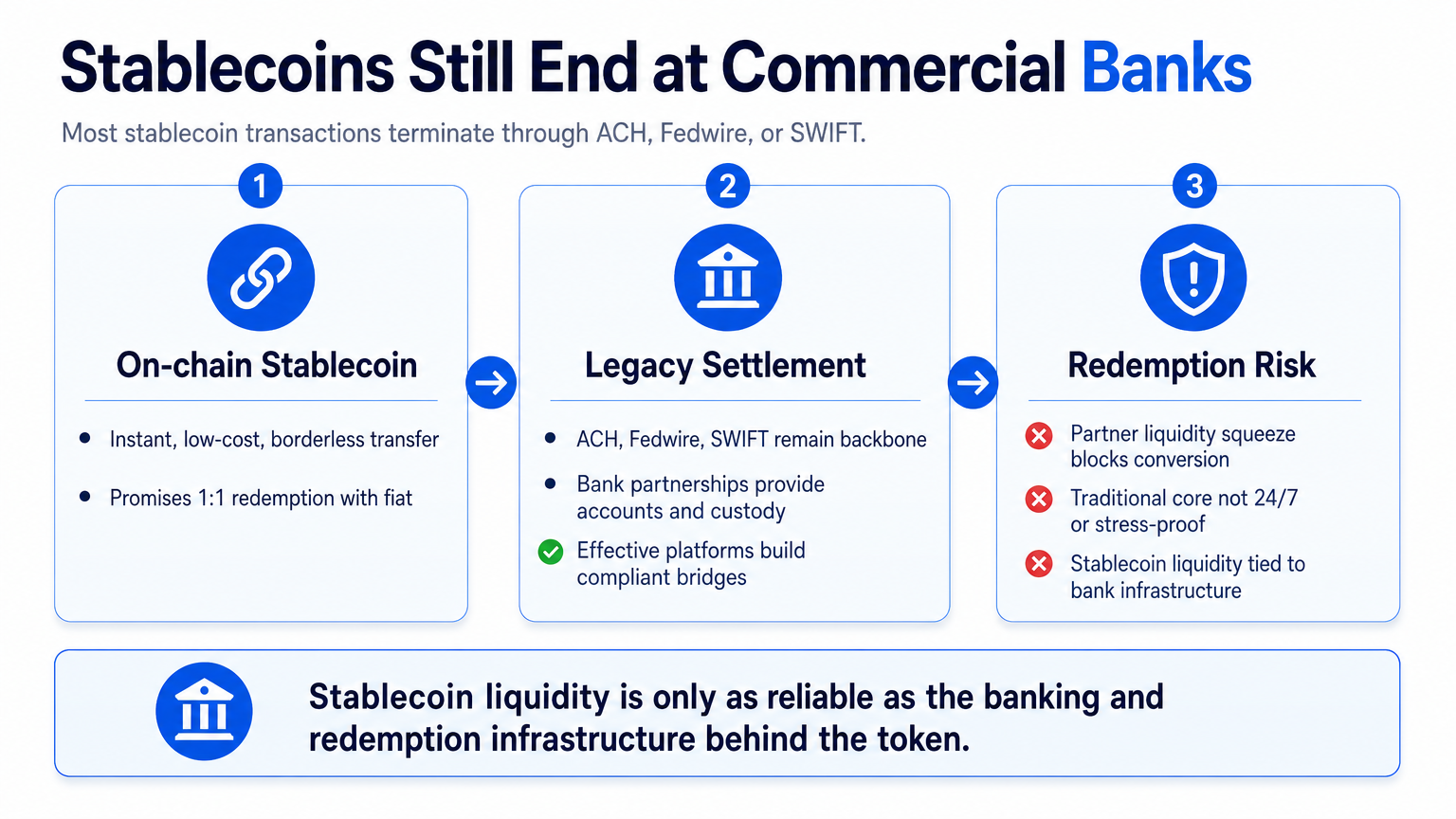
The PYMNTS report lays bare an uncomfortable truth: no matter how advanced the wallet or smart contract, most stablecoin transactions still terminate in a commercial bank account. ACH, Fedwire, and SWIFT remain the backbone of settlement. Platforms that market themselves as alternatives to banks are heavily reliant on bank partnerships for accounts, wire capabilities, and even the custody of fiat reserves. As explained in Crypto Bank and Crypto Banking 101, even crypto-native services depend on established banking infrastructure to operate. Effective crypto banking platforms don’t deny this; they build bridges that make the handoff from chain to bank as fast, compliant, and low-cost as possible.
Liquidity and Redemption: The Achilles’ Heel of Stablecoins
Stablecoins promise 1:1 redemption with fiat, but that redemption channel flows through traditional banking partners. If a stablecoin issuer’s banking partner faces a liquidity squeeze or a regulatory freeze, the ability to convert tokenized dollars at scale is compromised. The FSB’s warning flags this as a systemic concern: 24/7 digital transfers depend on a traditional financial core that is not 24/7 and not immune to stress. For a business holding a large stablecoin balance, that dependency means stablecoin liquidity is only as reliable as the banking and redemption infrastructure behind the token.
How Forward-Thinking Platforms Bridge the Gap
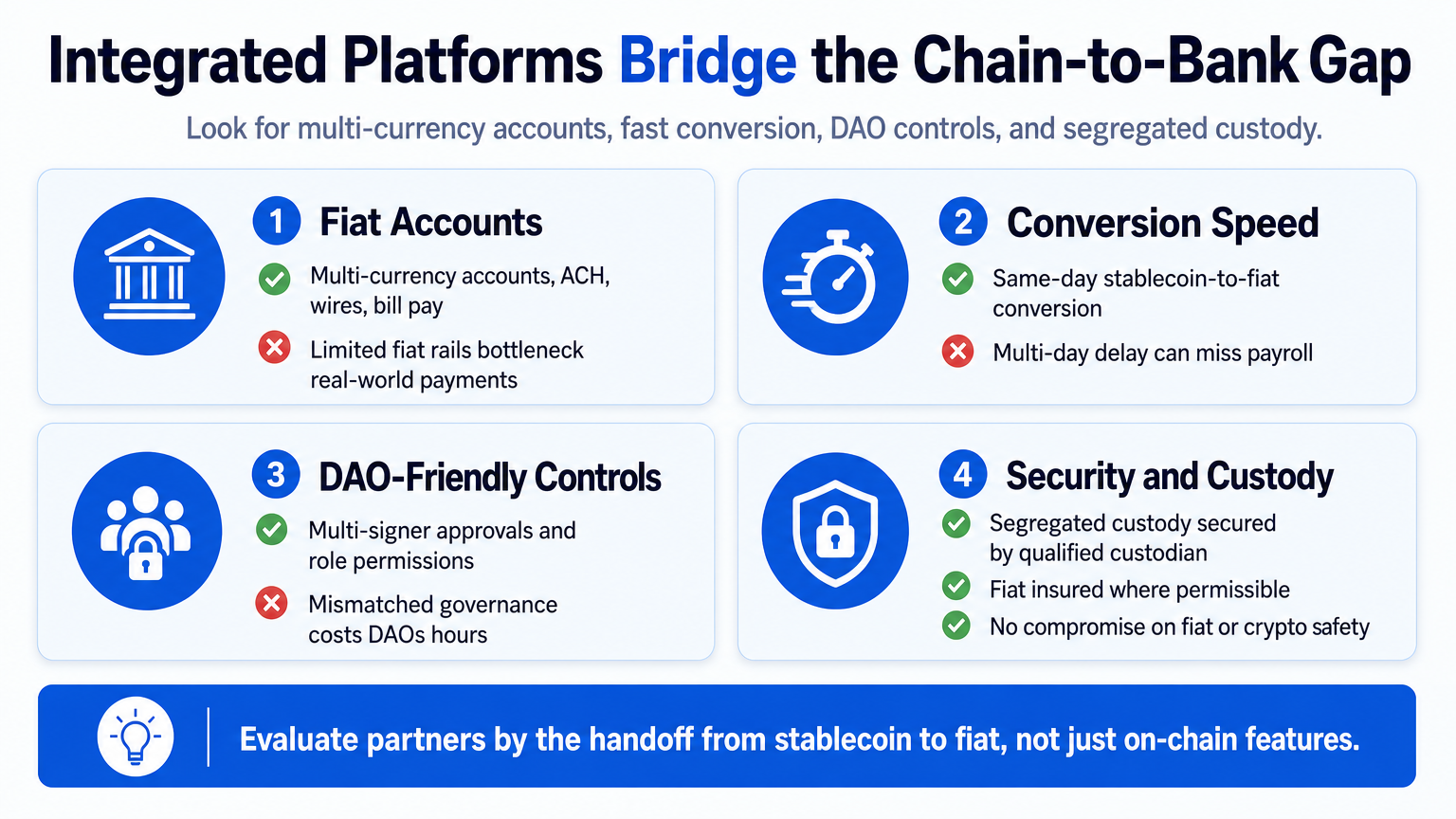
Beyond the Wallet: Integrated Neo-Banking for Crypto Treasuries
The next wave of crypto banking combines neo-banking capabilities with the operational tooling businesses need. That means a single interface where a DAO can hold USDC, pay a vendor in euros via SEPA, issue a corporate card with real-time spend limits, and instantly convert stablecoins to fiat—without juggling multiple relationships. OneSafe, for example, provides a unified experience: through bank partnerships, businesses get multi-currency fiat accounts, domestic and international wires, bill pay, and corporate cards, alongside on-chain custody (secured via Fireblocks) and native crypto-to-fiat conversion. This allows a Web3 startup to convert the necessary portion of a $10M stablecoin inflow to fiat for payroll without delays—without pretending the bank isn’t necessary.
What to Look for in a Crypto Banking Partner
The table below summarizes key criteria and what forward-thinking platforms deliver.
| Criteria | What to Evaluate | Why It Matters |
|---|---|---|
| Fiat account capabilities | Multi-currency accounts, ACH, domestic and international wires, bill pay. | Limited fiat rails create a bottleneck for real-world payments. |
| Crypto-to-fiat conversion speed | How quickly USDC, USDT, or other stablecoins can become bank-available fiat. | Same-day vs. multi-day conversion can determine whether you meet payroll. |
| Bank partner transparency | Banking services provided by a regulated institution with clear account ownership. | You must know which entity holds your funds, especially in a stress event. |
| DAO-friendly controls | Multi-signer approvals, role-based permissions, treasury reporting. | DAOs lose hours if the banking layer doesn’t match their governance. |
| Security and custody model | Digital asset custody segregated and secured by a qualified custodian; fiat insured where permissible. | One platform shouldn’t force you to compromise on either fiat or crypto safety. |
| Compliance and onboarding | Digital KYB that is thorough but fast; supports US and international entities. | Onboarding delays negate the efficiency your crypto treasury should deliver. |
| Total cost of conversion and transfers | FX markups, wire fees, hidden costs on crypto-fiat pairs. | Frequent large conversions mean even small fees erode stablecoin savings. |
For a broader list of crypto-friendly banking options, consult Crypto-Friendly Bank Accounts: Which Banks Support Bitcoin?.
What to Watch: Regulation, Liquidity, and the Next Phase
FDIC and the New Bank-Crypto Relationship
Regulatory scrutiny is reshaping how banks and crypto companies interact. Banks serving crypto businesses now demand rigorous compliance and clear segregation of assets, forcing a maturation of crypto banking. The pool of banking partners willing to support frequent stablecoin-to-fiat conversions may shrink, concentrating risk. Any formal FDIC guidance on stablecoin reserves or operational accounts could directly affect redemption speed and cost.
The Race to Close the Loop After Payment
PYMNTS distilled this moment into a competitive insight: “The next stablecoin winner will control what happens after payment.” The race is on among issuers, fintechs, and banks to own the conversion, management, and deployment of digital dollars without canceling out the savings that stablecoins deliver. Moves like Mastercard’s acquisition of BVNK and platforms that let businesses hold and spend both fiat and crypto from a single dashboard signal the direction. The winners will make moving from chain to bank feel invisible—while building the compliance and liquidity to survive a market learning that instant settlement doesn’t mean instant utility.
Key Takeaways
- The $10M stablecoin problem exposes a critical dependency: instant on-chain settlement must still feed delayed fiat rails for real-world payments, limiting stablecoins’ operational value.
- Banks remain essential to crypto banking—platforms that seamlessly integrate fiat accounts, wires, and compliance with crypto custody will win, not those pretending banks are obsolete.
- DAOs and Web3 startups need a crypto treasury management solution that combines multi-currency fiat accounts, on/off-ramps, and governance-friendly permissioning to close the chain-to-payroll gap.
- Systemic risk from stablecoin redemption fragility is real: evaluate the banking and liquidity infrastructure behind any stablecoin you hold and diversify counterparty risk where possible.
- Choosing a crypto banking partner means prioritizing fast, low-cost conversion, transparent bank partnerships, and a fee structure that preserves the savings stablecoins deliver.
If your business regularly converts large stablecoin balances to fiat for daily operations, consider a platform that treats that handoff as a core feature—explore how OneSafe unifies crypto and fiat finance.