Mastercard closed its $1.8B BVNK acquisition on October 12, 2026, putting stablecoin payments inside the card network. Here’s what it means for businesses.
Table of Contents
- What Just Happened
- Why This Is a Turning Point
- How Stablecoin Payments Got Here
- What It Means for Global Businesses and DAOs
- How to Prepare for the Next Wave
- Open Questions and What to Watch
- FAQs
- Key Takeaways
What Just Happened
Mastercard announced its intent to acquire BVNK in March 2026 and closed the transaction on October 12, 2026, according to Pluang. The deal was valued at $1.8 billion, per S&P Global Market Intelligence. BVNK built a regulated platform that lets businesses accept, send, and settle stablecoin payments directly, then bridge into fiat through existing banking channels. BVNK described the joining as a way to "bring stablecoin payments to the mainstream of global commerce" inside Mastercard’s network of 100 million-plus acceptance points.
The same Pluang report notes Stripe and Circle have been similarly active. Stripe acquired a stablecoin infrastructure provider to deepen its Stripe stablecoin API capabilities, while Circle has been absorbing complementary businesses to expand its USDC payment infrastructure. Three of the largest payment players in the world are now buying rather than building their stablecoin stacks.
Why This Is a Turning Point
Stablecoin payments are moving from a crypto-native infrastructure play to a mainstream service layer. With BVNK integrated, a merchant could accept fiat and never know a stablecoin settled behind the scenes. This removes the need for businesses to run a dedicated crypto treasury or build custom on-ramp infrastructure.
Stablecoin settlement also becomes embedded in familiar card flows. The card rail becomes the stablecoin rail without the end user noticing, expanding the addressable market for cross-border stablecoin transactions. Earlier Visa-backed programs pointed this direction; Mastercard now owns the settlement layer.
How Stablecoin Payments Got Here
The core value remains: stablecoins like USDC settle in seconds, not days, and cross-border transfers cost a fraction of SWIFT wire fees. What changed is the infrastructure to deliver that at scale. Previously a business needed a Web3 wallet, custody setup, and manual off-ramp. Now networks are building those integrations into standard payment flows.
Regulatory momentum is the enabler. The GENIUS Act is creating a federal licensing regime for payment stablecoin issuers. Axis Intelligence 2026 data shows stablecoin payment volume and transactions growing at triple-digit annual rates, while BCG’s 2026 white paper on stablecoin payments notes enterprise adoption is catching up with retail usage. That regulatory safety net lets a systemically important player like Mastercard put stablecoins inside its network.
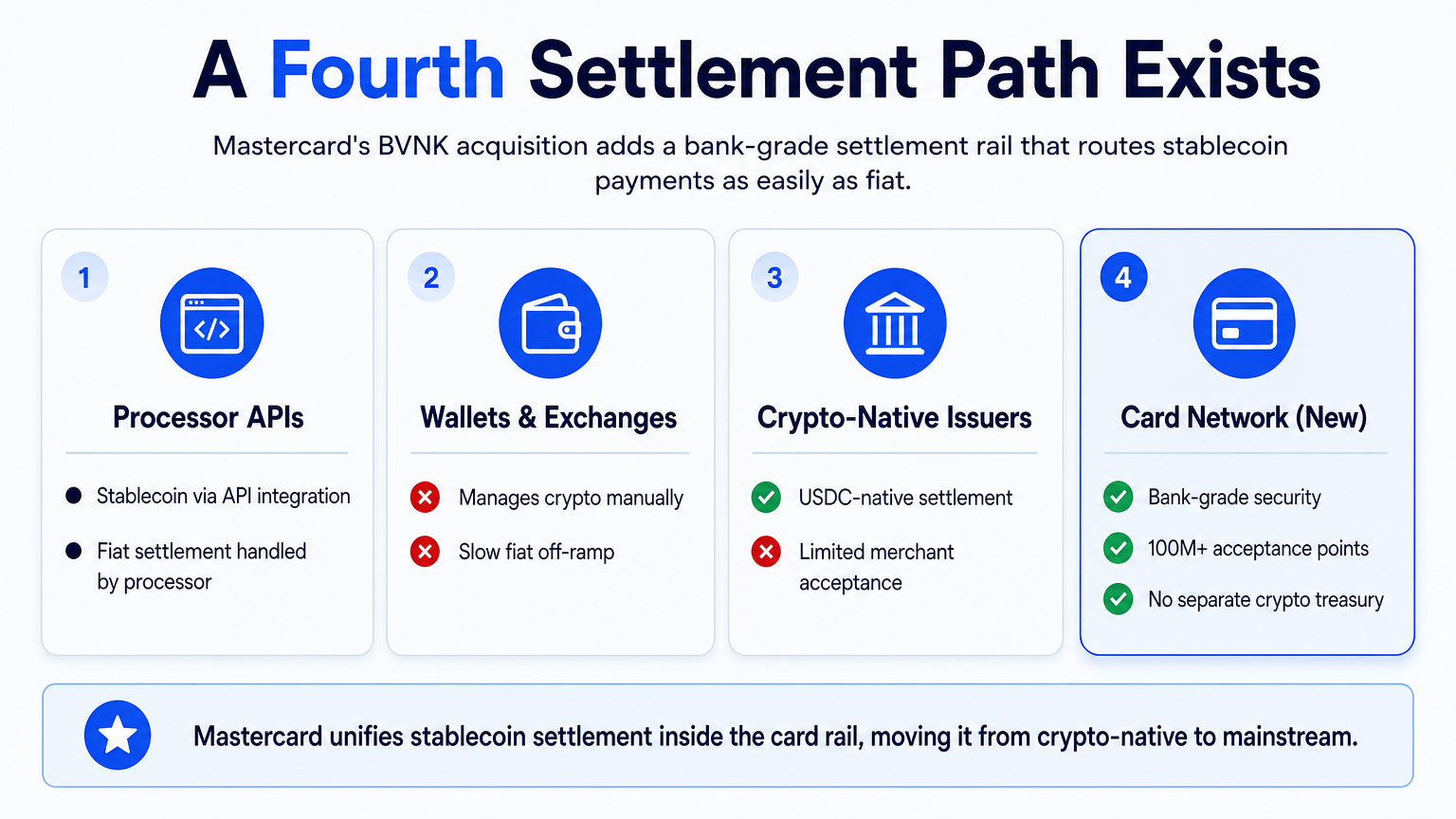
Before October 12, 2026, businesses had three main paths for stablecoin payments: processor APIs like Stripe, wallets plus centralized exchanges, or crypto-native issuers. Now a fourth path exists: a bank-grade, card-network-anchored settlement layer that can route stablecoin payments as easily as Mastercard routes fiat. For teams that want a unified interface today, neo-banking platforms like OneSafe bridge fiat and crypto in a single account—free USDC deposits and withdrawals, multi-currency accounts, and on/off-ramp conversions without separate wallet infrastructure. See Web3 Crypto: A Business Guide to Finance in 2026.
What It Means for Global Businesses and DAOs
The acquisition will compress cross-border business payment costs, but only for entities that can plug into the network. Merchants with standard merchant accounts benefit as acquirers adopt the rail; suppliers, freelancers, and DAOs without card-acceptance still need an intermediary. The fiat on/off-ramp layer remains the bridge that turns stablecoin liquidity into usable funds.
DAO payroll and vendor payments get simpler. Stablecoin payments solve the speed problem but not the accounting, compliance, and fiat off-ramp issue. With Mastercard rolling out stablecoin settlement, DAOs that use card-funded vendor payments or contributor debit cards can bypass heavy lifting. Today, platforms like OneSafe let DAOs manage fiat and crypto with customizable roles and permissions, Fireblocks custody, and automated workflows. The earlier BVNK Plasma payroll integration showed the template; Mastercard’s acquisition scales it.
The hidden challenge is fiat on/off-ramp fees. Even if settlement is nearly free, businesses still pay to convert between fiat and stablecoins. Stablecoin on-ramp off-ramp integration is the bottleneck; the Mastercard deal doesn’t eliminate it, but it incentivizes partners to drive fees lower. For now, choose a platform with competitive conversion. OneSafe’s fiat deposit/withdrawal fee is 0.15%, while USDC deposits and withdrawals are free.
How to Prepare for the Next Wave
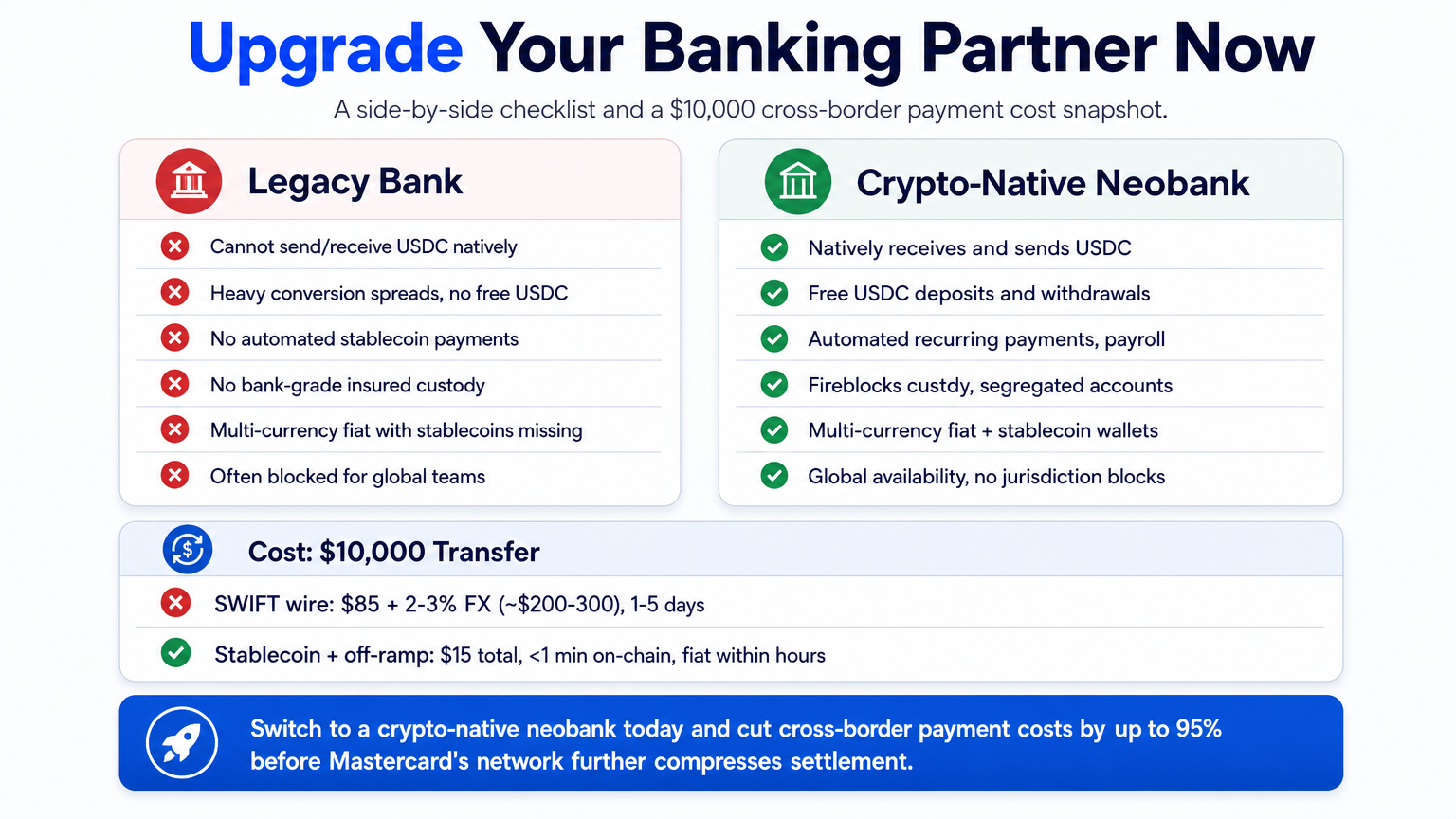
First, assess your banking partner. Use this checklist to compare a legacy bank against a crypto-native neobank:
- Can my current bank receive and send USDC natively today? (Most cannot.)
- Does it offer free USDC deposit and withdrawal, or charge conversion spreads?
- Can I automate recurring stablecoin payments, payroll, and vendor payouts from one dashboard?
- Are digital assets held in insured, bank-grade custody (e.g., Fireblocks) with segregated accounts?
- Does the platform support multi-currency fiat accounts alongside stablecoin wallets with transparent FX?
- Is it available globally, or limited to jurisdictions that may block my team or counterparties?
If most answers are “no,” a modern neobanking platform built for Web3 businesses closes the gap. For a detailed comparison, see Business Account US Bank: What Founders Need in 2026.
Here’s a concrete cost comparison for a $10,000 cross-border payment:
| Payment Method | Cost for $10,000 transfer | Settlement Time |
|---|---|---|
| Traditional SWIFT wire | 0.35% + $50 = $85, plus FX spread often 2-3% (~$200-300) | 1-5 business days |
| Stablecoin transfer + off-ramp via crypto-native platform | USDC transfer free; off-ramp 0.15% = $15; total = $15 | Under 1 minute on-chain, fiat within hours |
The stablecoin route can slash international wire costs by 80-95% even before Mastercard’s integration further compresses the settlement leg.
Security and compliance still matter. Look for qualified custodian infrastructure (Fireblocks, for example), mandatory multi-factor authentication, and segregated accounts. Regulatory clarity is improving—the GENIUS Act and the EU’s ESMA compliance deadline (see here)—but the operator still carries the compliance burden. Insist on transparent KYB/KYC and audit trails, especially for DAO grant or payroll disbursements.
Open Questions and What to Watch
Large banks now face a choice: build their own stablecoin settlement rails or watch corporate clients migrate to card networks that already offer a cheaper path. Most will partner or build on top, but that takes time.
Regulatory fatigue is real. Some jurisdictions, like Argentina, have imposed delays that stall on/off-ramps (Argentina Delays Crypto Banking). The Federal Reserve has also warned that widespread stablecoin adoption could disrupt monetary policy, even as Circle positions USDC as the safe, regulated standard. Watch whether Mastercard’s move accelerates harmonization or triggers new restrictions.
Pricing wars will push on-ramp fees toward zero. USDC is likely to become the default settlement asset for cross-border stablecoin transactions inside card networks, though regional stablecoins may carve out niches under local rules like France’s stablecoin swaps tax from 2027 (see here).
FAQs
What does the Mastercard BVNK acquisition mean for stablecoin payments?
Stablecoin payments become invisible infrastructure inside the world’s largest card network. Stablecoin traffic can ride Mastercard’s existing rails, with BVNK bridging on-chain and fiat. Businesses may not even know it’s happening.
How will this affect cross-border business payments in the next 6 months?
The near-term effect is supply-side expansion: acquirers and processors will begin certifying stablecoin settlement paths, and early merchant movers may see lower costs. The legitimacy shock will accelerate partnerships between banks, fintechs, and stablecoin issuers. Startups and DAOs should use this window to adopt unified fiat/stablecoin platforms now rather than wait for legacy banks.
What steps should a global startup take to adopt stablecoin payments today?
Open a business account with a crypto-native neobank that supports multi-currency fiat accounts, free USDC on/off-ramps, and compliance infrastructure. Integrate USDC for invoices and vendor payments, issue virtual cards for operational spend, automate workflows, and keep compliance records.
How can DAOs use stablecoin payments for payroll and vendor management?
DAOs can consolidate corporate fiat and crypto operations into a single platform with customizable roles, segregated accounts, and secure custody. Move USDC from the treasury into the platform, then pay contributors in stablecoins or off-ramp to local fiat. Automate vendor payments with virtual cards or wire transfers, with spending limits and multi-signer approvals.
Are stablecoin payments safe under current regulations?
They are as safe as the custodian and issuer you choose. The GENIUS Act mandates licensing and 1:1 reserve backing; Circle’s USDC is designed to comply. Safety is not uniform, so use platforms with qualified custody, MFA, and segregated funds.
Key Takeaways
- Mastercard’s $1.8B BVNK acquisition embeds stablecoin payments into the card network’s settlement layer.
- Stablecoin payments can already cut cross-border transfer costs by up to 95% compared to SWIFT wires.
- Global startups and DAOs should use a unified fiat/stablecoin platform now rather than wait for legacy banks.
- Regulatory clarity is improving, but macro-level central bank concerns remain; institutional-grade custody and compliance are essential.
Start managing global business finances with built-in stablecoin payments and multi-currency accounts—explore OneSafe.