The accounting treatment that has quietly blocked widespread corporate use of stablecoin payments took a decisive step toward modernization on October 12, 2026. That day, the Financial Accounting Standards Board (FASB) voted to issue a proposed Accounting Standards Update that would let companies classify certain stablecoins as cash equivalents, according to a report by BigGo Finance. For treasury teams that have been using—or want to use—digital dollars to speed up cross-border settlements and manage working capital, the proposal removes a major financial-reporting obstacle. What follows is a look at the development, what it means for business finance, and the concrete steps to prepare.
Table of Contents
- Why This Matters for Business Finance Leaders
- Stablecoin Payments: The Landscape for Businesses
- The FASB Proposal: Details and Open Questions
- What It Means for Your Payment Operations
- What to Watch Next
- Key Takeaways
Why This Matters for Business Finance Leaders
What just happened with the FASB proposal?
On October 12, 2026, the FASB issued a proposal to amend Topic 230, Statement of Cash Flows, explicitly addressing when digital assets—specifically, certain stablecoins—can meet the definition of a cash equivalent. The proposal, available on the FASB’s website, seeks public comment and would also enhance disclosure requirements around cash and cash equivalents. It is the first formal step by the U.S. standard-setter to bring stablecoin accounting rules in line with how businesses actually use the instruments—as near-cash liquidity vehicles, not speculative intangibles.
Why does it matter for businesses that use or want to use stablecoin payments?
Under the existing accounting regime, stablecoins are treated as indefinite-lived intangible assets under ASC 350. That classification forces companies to record them at cost, test for impairment, and exclude them from cash and cash equivalents on the balance sheet. For a finance leader, holding $1 million in USDC looks riskier on a statement of financial position than holding $1 million in a money-market fund—even though the stablecoin is redeemable at par the same day. The FASB stablecoin proposal would let firms classify these instruments as cash equivalents, aligning the financial statements with economic reality and making it far easier for treasury departments to justify holding stablecoins for payments, working capital, and liquidity buffers. The change directly lowers the accounting friction that has kept many CFOs away from business stablecoin treasury strategies.
Stablecoin Payments: The Landscape for Businesses
Where Business Stablecoin Payments Stand Today
Before this proposed accounting shift, corporate adoption of stablecoin rails had already accelerated—especially for cross-border stablecoin payments. Major payment processors have integrated USDC and other fully-reserved stablecoins. Stripe now supports stablecoin payouts, Visa has piloted settlement on a permissioned version of Ethereum, and Mastercard’s acquisition of BVNK in 2026 signaled that the legacy financial system views stablecoin payments as a permanent infrastructure layer. For businesses, the use cases have moved well beyond crypto-native firms: importers settle supplier invoices in USDC, overseas contractors get paid via stablecoin-based payroll platforms, and some mid-market firms park excess cash in tokenized Treasuries collateralized by stablecoins. Yet until now, accounting treatment made the case awkward for publicly reporting companies and those with GAAP audit requirements.
How can stablecoin payments improve business treasury operations?
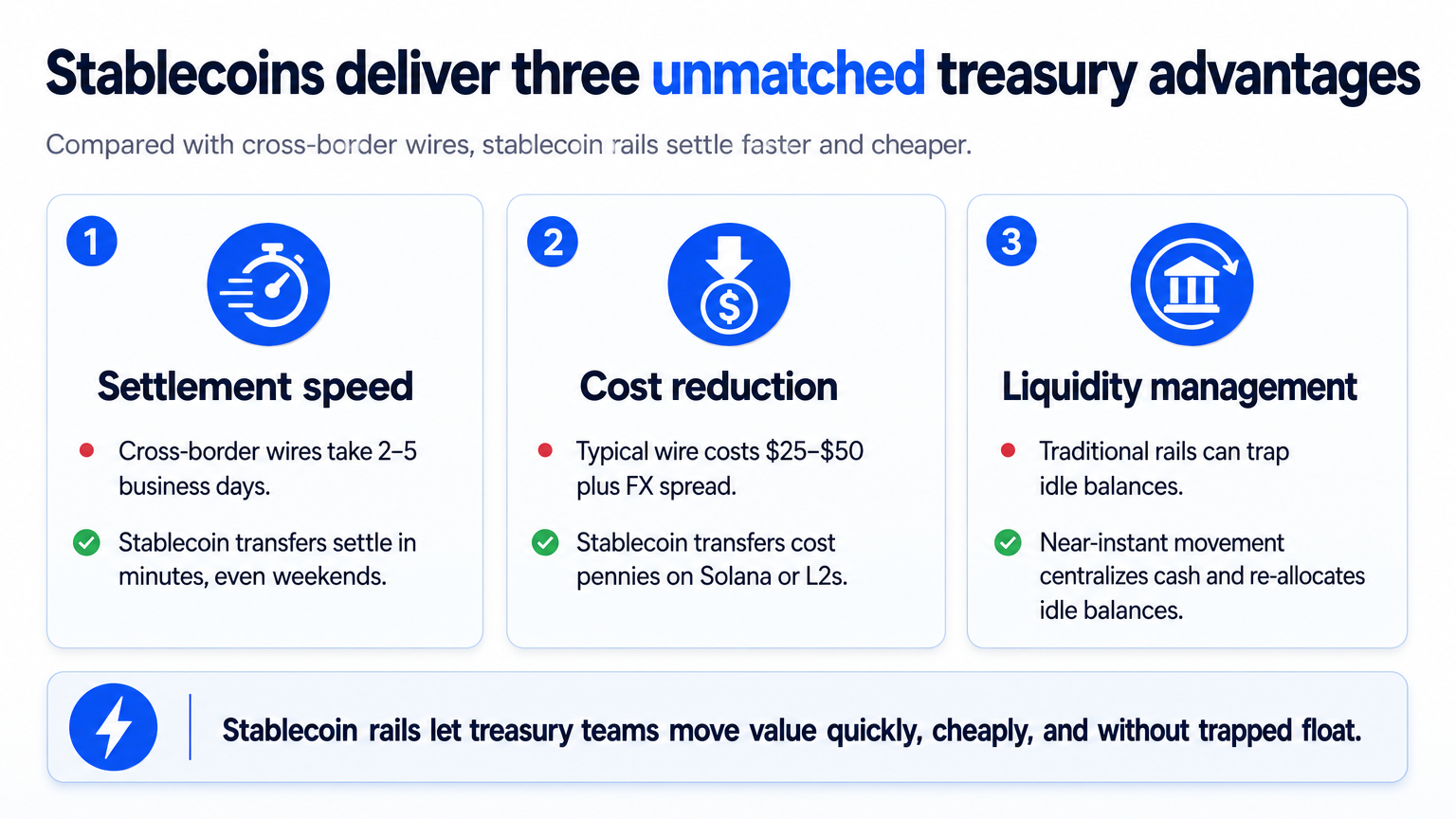
Stablecoin payments deliver three treasury advantages that traditional rails cannot match:
- Settlement speed: Cross-border wires can take 2–5 business days; stablecoin transfers settle in minutes, even on weekends.
- Cost reduction: A typical international wire costs $25–$50 plus a foreign-exchange spread; stablecoin transfers cost pennies on networks like Solana or Ethereum Layer 2s.
- Liquidity management: Because stablecoins move near-instantly, treasury teams can centralize cash from subsidiaries, fund working-capital needs across time zones, and re-allocate idle balances without trapped float.
When coupled with a neo-banking platform for crypto that natively handles both fiat and stablecoin accounts, the operational benefit expands: a single dashboard for ACH, wires, and on-chain payments, plus automated crypto-to-fiat conversion. That integration shortens the distance between booking a payment and moving money, which is precisely what corporate treasurers want.
What are the current accounting hurdles for holding stablecoins?
The core problem has been ASC 350. Stablecoins do not fit the definition of financial instruments with clearly determinable fair values under the existing guidance, so they fall into the catch-all category of indefinite-lived intangibles. That triggers:
- Impairment testing at least annually, with write-downs required if the fair value drops below the carrying amount—even temporarily. For a stablecoin pegged 1:1 to the dollar, any slight de-pegging event (even if restored hours later) forces a cumbersome accounting exercise.
- Exclusion from cash equivalents on the statement of cash flows, making it appear that the company holds less liquidity than it actually does.
- No symmetric reversals of impairment losses allowed when the price recovers, which can permanently distort equity.
These rules made stablecoin accounting rules a standing irritant for any publicly traded company that wanted to hold digital dollars for operational payments. The proposal directly addresses the classification mismatch.
The FASB Proposal: Details and Open Questions
The proposed ASU amends the existing cash-equivalents definition in paragraphs 230-10-20 and adds implementation guidance. According to a Deloitte analysis, key provisions include:
| Provision | Detail |
|---|---|
| Criteria for cash-equivalent classification | A stablecoin must be (a) redeemable at par on demand and (b) subject to only an insignificant risk of changes in value. Redemption must be possible in a liquid market, without significant restrictions. |
| Examples of qualifying assets | The proposal explicitly mentions stablecoins that are fully reserved and redeemable 1:1 for fiat currency, mirroring the structure of USDC and similar instruments. |
| Enhanced disclosures | Entities must disclose the amount of stablecoins classified as cash equivalents, the nature of any restrictions on redemption, and the policy for assessing value risk. |
| Comment period | The FASB is accepting comments for 60 days from the proposal's issuance date of October 12, 2026, per the Forvis Mazars summary. |
The proposal does not cover all digital assets. Algorithmic stablecoins or those lacking clear 1:1 redeemability would almost certainly not qualify. The CBIZ guidance notes that entities must evaluate each stablecoin based on the specific redemption mechanism and backing assets. This creates a natural adjudication of the conflict between old intangible treatment and practical use: if the proposal is finalized, stablecoins as cash equivalents become permissible, but the burden of proof shifts to the holder to demonstrate that the stablecoin meets the tight definition. Businesses should not blindly assume that every stablecoin qualifies.
What It Means for Your Payment Operations

Evaluating Stablecoin Payment Integration Now
For CFOs and controllers, the proposal changes the risk-reward calculus of integrating stablecoin payment integration into the payment stack. Previously, the accounting optics made it hard to justify holding more than a minimal working balance. Now, if the rule passes, a company could hold mid-six-figure balances in a compliant stablecoin without the impairment drag. The practical implication is that stablecoin payment integration can move from pilot to production in treasury roadmaps. Finance teams should evaluate payment processors and crypto-friendly business banking platforms that support on-chain settlement, corporate card issuance linked to stablecoin balances, and seamless on/off-ramp capabilities.
How can businesses start using stablecoin payments today?
Operationalizing stablecoin payments does not require waiting for the final rule. Here is a lightweight readiness checklist:
- Select a qualifying stablecoin: Choose a fully-reserved, widely accepted instrument such as USDC. Confirm the issuer’s attestation reports and reserve composition.
- Open a multi-currency business account: Use a neo-banking platform that fuses fiat and crypto rails. For example, OneSafe provides global businesses with multi-currency accounts that support USD, EUR, CAD alongside USDC, with instant crypto-to-fiat conversion and corporate cards—all while holding digital assets in Fireblocks-secured custody. This avoids splitting treasury operations across a traditional bank and a separate crypto exchange.
- Onboard suppliers or payroll providers: Many payment processors already support stablecoin payouts; add that as a payment method in your AP system.
- Integrate accounting: Ensure your general ledger can tag on-chain transactions as cash equivalents when the rule permits. Prepare to update accounting policies now, even if the final standard is months away.
- Test a small pilot: Move a limited amount, perhaps $5,000–$10,000, to a stablecoin wallet and execute a few cross-border payments to confirm speed and reconciliation.
What should finance teams do to prepare for the potential rule change?
Beyond the pilot steps, treasury teams can take three concrete actions today:
- Document the stablecoin risk-assessment framework: Write the criteria that will be used to evaluate whether a stablecoin qualifies as a cash equivalent—redemption terms, liquidity depth, reserve transparency. This will form the basis of your disclosure notes.
- Draft a new cash management policy: Include specific limits, authorized stablecoins, and custody arrangements. This demonstrates governance to auditors and risk committees.
- Engage with your external auditor early: Share the FASB’s proposal and ask how they would view a gradual transition of a portion of your cash buffer into USDC once the rule is final. Aligning now prevents year-end surprises.
What are the security considerations when using stablecoins for business payments?
Stablecoin payment security hinges on custody and access controls. Key considerations:
- Custody model: Use qualified custodians or platforms that leverage institutional-grade technology like Fireblocks to prevent key theft. Avoid single-signature hot wallets for operational funds.
- Multi-factor authentication (MFA): Mandatory MFA on every account, with hardware keys preferred for high-balance treasury wallets.
- Smart contract and network risk: Even fully-backed stablecoins depend on the security of the blockchain network and the stability of the issuer’s reserve. Choose networks with a proven uptime record and a large validator set.
- Regulatory compliance: Ensure the platform follows AML/KYC procedures and is not available in OFAC-sanctioned jurisdictions. Many neo-banks for crypto automatically screen transactions against sanctions lists.
For organizations like DAOs that use DAO stablecoin payments, an additional consideration is role-based access: transaction signing should require multi-signature governance, not a single admin key. Platforms that offer customizable roles and permissions—as some neo-banks do for DAO accounts—help enforce these controls without bespoke smart-contract development.
What to Watch Next
The FASB’s comment period closes approximately December 11, 2026. After reviewing feedback, the Board will decide whether to issue a final Accounting Standards Update, likely in the first half of 2027. Public companies will be watching closely, especially those with significant cross-border payment volumes. Simultaneously, the regulatory landscape for stablecoin issuers continues to evolve, with the GENIUS Act debated in Congress. If stablecoin issuers receive a clear federal prudential framework, that will further bolster the case for cash-equivalent classification. For now, the FASB’s move is the clearest signal yet that stablecoin accounting rules will align with operational reality, and treasury teams that prepare early will gain a competitive edge in speed and cost.
Key Takeaways
- The FASB proposal, dated October 12, 2026, would let firms classify fully-reserved, redeemable stablecoins as cash equivalents—removing the impairment and intangible-asset burden that has suppressed corporate treasury use.
- For businesses, this unlocks the potential to hold stablecoins in working-capital pools without distorting financial statements, making cross-border stablecoin payments a practical treasury tool.
- Finance teams should now evaluate stablecoin payment integration, draft updated cash management policies, and start a dialog with auditors—while selecting a neo-banking partner that securely unifies fiat and crypto operations.
- Security remains paramount: any custody solution must use institutional-grade key management and mandatory MFA, with role-based controls for decentralized organizations.
Open a OneSafe account to manage fiat and stablecoin payments from a single, secure platform built for global businesses.