The short answer to how do you get a Web3 account? To open a Web3 account, you open a business-grade financial account—a Web3 business account or crypto business account—at a platform that combines multi-currency fiat banking rails with crypto on/off ramps and custody, then pass a business verification check. This article is for founders, finance leads, and DAO operators who need that bridge, not another personal wallet.
Table of Contents
- What Is a Web3 Account?
- Why Your Business Needs a Web3 Account
- How to Get a Web3 Account for Your Business
- Setting Up Your Web3 Account for Daily Operations
- Fees, Security, and Compliance Questions Answered
- Key Takeaways
What Is a Web3 Account?
A Web3 account in the business context is a financial account that lets an organization hold, move, and convert both fiat and digital assets under one entity, with multi-user access, compliance checks, and banking payment rails. It is not a self-custody wallet. Understanding the web3 wallet vs account distinction is critical for business operations.
Web3 account vs. personal Web3 wallet
A personal Web3 wallet—like the one Bitvavo launched on September 22, 2026, which gives users access to over 15,000 crypto assets beyond its centralized exchange—stores private keys and lets an individual interact with dApps. It is single-user, self-custodial, and holds no fiat.
A Web3 account for a business is a different instrument. It includes a legal entity identity, know-your-business (KYB) verification, multi-user permissions, fiat account numbers for wires and ACH, and often corporate cards. The difference is not just custody—it is operational rails. A wallet can receive USDC; it cannot pay a contractor in Euros via SEPA, issue a spend-limited card to a marketing lead, or export a clean audit trail for your tax accountant.
The role of a financial account in the Web3 ecosystem
The Web3 ecosystem still settles most operating costs in fiat: payroll, SaaS subscriptions, legal retainers, landlord rent. A financial account bridges that gap. The consolidation trend is clear. The Paypers reported on September 22, 2026, that Unlimit is migrating its global accounts business to Stable.com, a unified platform combining conventional payment infrastructure with digital asset capabilities. That move signals what operators already know: the future is one account, not a wallet plus a bank plus an exchange.
Why Your Business Needs a Web3 Account
Running a crypto startup or DAO across three or four fragmented services—one wallet, one bank, one card issuer, one OTC desk—creates reconciliation debt. A single fiat crypto account removes that.
Managing fiat and crypto from one dashboard
You want to pay a vendor invoice in USDC and match it to a fiat receivable in EUR without manually swapping between platforms. A business Web3 account should offer on-ramp and off-ramp functionality, meaning you can convert crypto to fiat and vice versa within the same dashboard, then push the fiat out via ACH, domestic wire, international wire, or bill payment. Circle’s business account materials describe the same logic for stablecoin settlement as a workflow, not a trading event.
Can I manage both fiat and crypto in a single account?
Yes, a business Web3 account combines multi-currency fiat balances with supported crypto assets and conversion tools within the same dashboard.
Use cases for DAOs, startups, and cross-border teams
A DAO treasury account in USDC needs to pay core contributors in fiat monthly. A startup that raised in stablecoins needs to move part of that into USD for payroll. A cross-border team in three time zones needs virtual cards with spend limits for contractors. These are default operating patterns for Web3-native organizations. The Unlimit-to-Stable.com migration mentioned above exists because providers see demand for a single global account that holds local payment details, multi-currency balances, card issuance, and treasury tools together.
How to Get a Web3 Account for Your Business
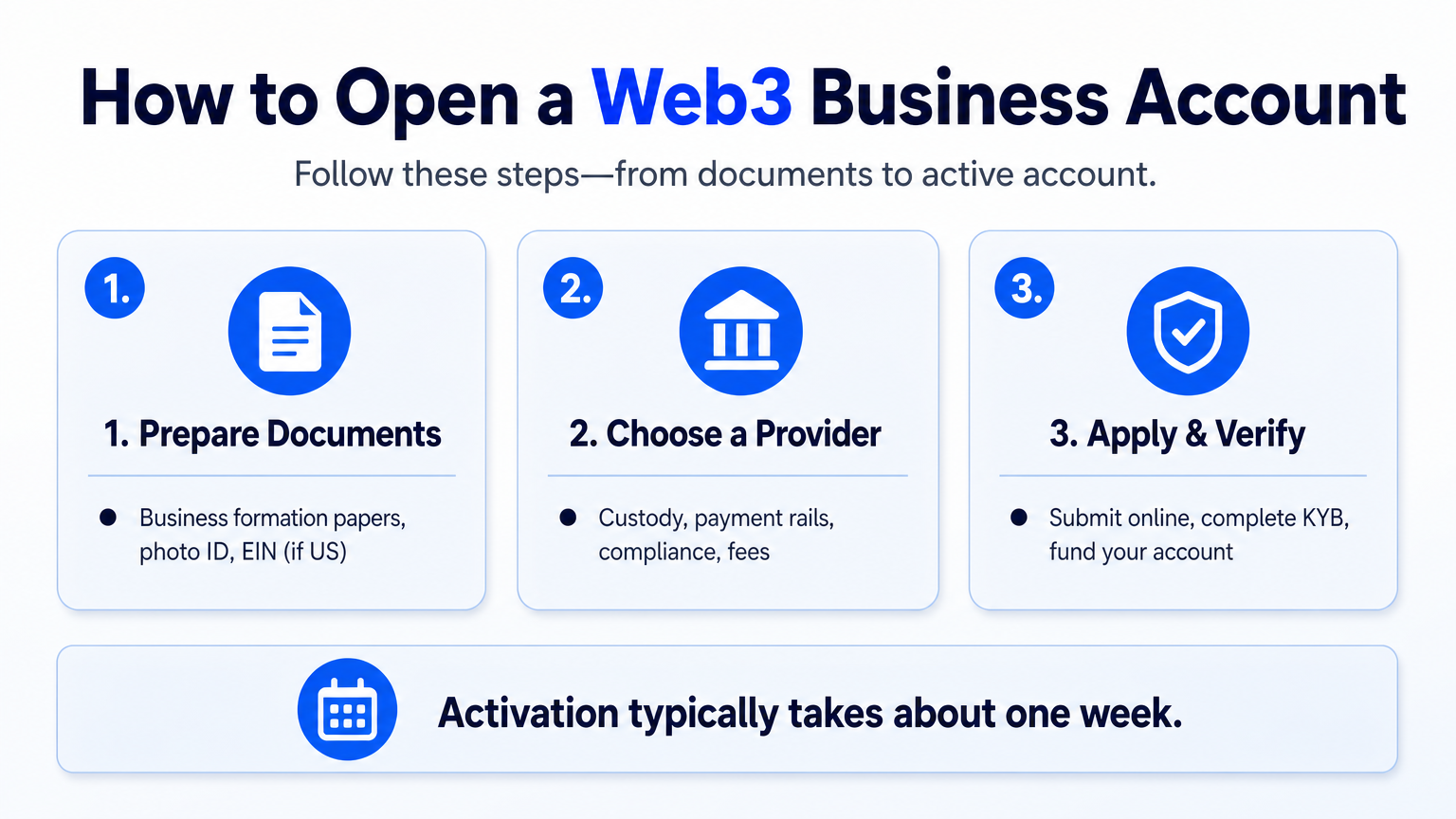
Opening a Web3 business account follows the same logic as opening a business bank account—just with crypto-native rails added. The process is usually fully digital.
Documents and information to prepare
You cannot open a crypto corporate account with just a wallet address. You need entity-level documentation. OneSafe, for example, requires business formation papers, a government-issued photo ID, and an EIN for US companies. Most providers will also ask for beneficial ownership information and a description of your business activity.
Pre-application checklist:
- Business formation certificate or equivalent (Inc, LLC, Ltd, foundation, etc.)
- Employer Identification Number (EIN) if US-registered
- Government-issued photo ID for each authorized signer
- Business email domain and operating address
- Brief explanation of your crypto and fiat activity mix
What documents are required to open a business Web3 account?
Typically, business formation papers, a government-issued photo ID for each controller or signer, and an EIN for US companies. Some providers may request proof of address, beneficial ownership schedules, or additional KYB forms depending on your jurisdiction and transaction volume.
Choosing a provider: custody, rails, and compliance
The decision should turn on four things: custody (who holds digital assets and how), payment rails (ACH, wires, SWIFT, card networks), compliance depth (KYB/KYC, sanctions screening, audit trails), and fee structure. Mercury has a dedicated Web3 business banking vertical; Wirex also markets crypto-friendly business accounts, and Reap offers a crypto-friendly bank account. You want a provider that separates customer funds from its own corporate treasury and uses institutional-grade custody. If a provider cannot name its digital asset custodian, walk away.
OneSafe is a financial technology company, not a bank—banking services come through partners, and digital assets are secured on Fireblocks. That model is common: the platform handles technology and compliance, while regulated partners hold the fiat.
How do I get a Web3 account for my business?
Apply online through the provider’s onboarding flow. You submit your legal entity details, upload formation and ID documents, complete KYB checks, and choose your account plan. Once approved, you fund the account with fiat or crypto, set up users and permissions, and begin transacting.
Application, verification, and onboarding timeline
The initial application often takes 10 minutes or less. Full activation depends on document review. OneSafe states onboarding is typically completed within a week, with robust KYB standards. That is a realistic benchmark for a web3 account onboarding run: faster than a traditional bank, slower than a self-custody wallet because a legal entity is involved.
How long does the onboarding process take?
Plan for about one week from application to active account, assuming your documents are clean. The initial form can take under 10 minutes; the remainder is review, compliance screening, and account provisioning. Rush or early-access options sometimes exist, but they do not skip identity verification.
Setting Up Your Web3 Account for Daily Operations
Once the account is open, configure it for how your team actually works.
Multi-currency accounts and corporate cards
A multi-currency business account lets you hold USD, Euro, CAD, and—depending on the provider—more currencies coming soon. You can issue multiple virtual cards at no extra cost, set spend limits per card, and use them for vendor payments in the local currency. The corporate card foreign exchange fee is a separate line item—on one platform it is 3%.
Crypto on-off ramps and cross-border payments
Daily operations depend on smooth ramps. You should be able to convert USDC to USD and send it via ACH or wire without a manual OTC desk. Stablecoin payment rails are maturing fast—for context, see our breakdown of Stablecoin Payments: Mastercard's SoFi Deal Explained and the Circle-Tazapay stablecoin payment deal. A practical test before committing to a provider: initiate a $50 USDC-to-USD conversion and count the clicks and fees.
Permissions and treasury controls for DAOs
For a DAO treasury account, the goal isn’t just a place to park funds—it’s a permissioned workflow. You need customizable roles so a treasurer can approve a payment but not change withdrawal limits, and a contributor can view balances but not transfer funds. Multi-signature controls across fiat and crypto should be native, not a bolt-on. For a deeper read on structuring that, see Crypto Treasury Management After Ripple's $13T Bet.
How do DAOs handle treasury management and permissions?
DAOs typically set role-based permissions within the account platform. One signer proposes, a second approves, and no single person can drain the treasury. Multi-signature thresholds apply to both crypto withdrawals and fiat wires, with an immutable activity log for community reporting. Custody is usually held in a segregated account or institutional wallet rather than a personal multisig.
Fees, Security, and Compliance Questions Answered
What fees should you expect?
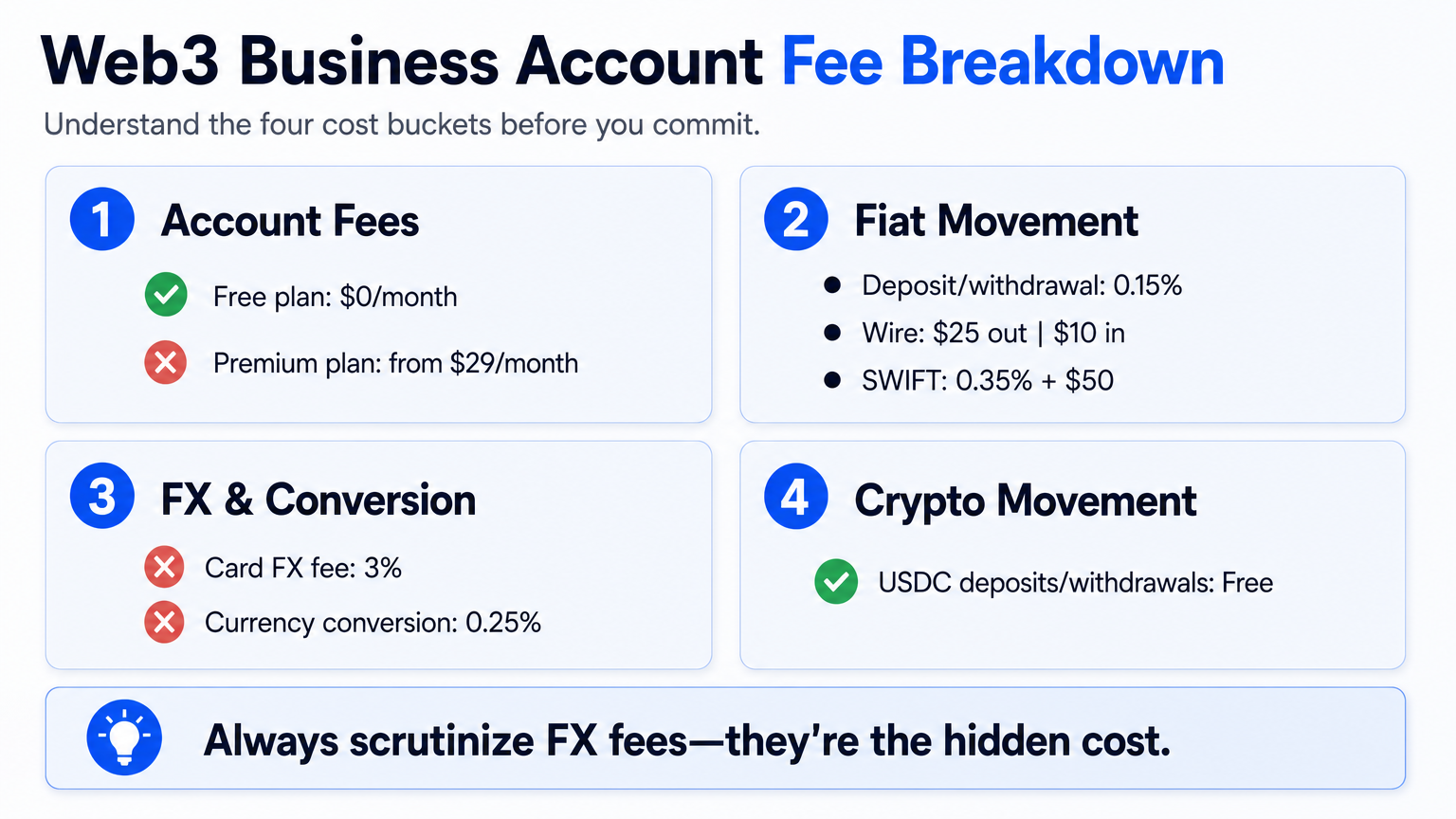
Fees split into four buckets: account, fiat movement, FX, and crypto movement. Here is a concrete schedule from a representative Web3 business account:
| Fee item | Amount |
|---|---|
| Monthly fee (free plan) | $0 |
| Premium plan monthly fee | From $29 / month |
| Minimum balance | $0 – $10,000 (varies by plan) |
| Fiat deposit / withdrawal | 0.15% |
| Wire withdrawal | $25 |
| Wire deposit | $10 |
| SWIFT deposit / withdrawal | 0.35% + $50 |
| FX on corporate cards | 3% |
| Currency conversion (FX) | 0.25% or prevailing FX rate |
| Crypto deposits / withdrawals (USDC) | Free |
Always read the FX line. A platform may advertise free crypto rails but charge 3% on card FX and 0.25% on currency conversion, which adds up on cross-border payroll.
How is digital asset custody secured?
Security is non-negotiable. A credible provider will use institutional-grade digital asset custody—OneSafe, for instance, secures assets on Fireblocks—and enforce multi-factor authentication (MFA) at signup. Encryption and compliance protocols should be standard, not premium add-ons. For broader fraud context, see Crypto Banking Scams Hit $15.9B—How to Bank Safely.
Regulatory and geographic availability
A Web3 account is available worldwide except in OFAC-sanctioned countries and certain US states. If a provider claims “everywhere,” check sanctions lists and state licenses. Italy’s new rule mandating crypto banking sanctions screening—covered here—is part of a global tightening. The account is a financial product; geography and compliance still apply. For more on the neobank model, start with Neobank vs Fintech: What Global Businesses Need to Know.
One important caveat: OneSafe is not a bank, and funds held on its platform are not FDIC-insured. The same is true for most Web3 account providers. Know who holds your fiat and whether deposit insurance applies before you park operating capital.
Key Takeaways
- A Web3 business account is a legal-entity financial account with fiat rails, crypto ramps, multi-user permissions, and KYB—distinct from a personal wallet.
- Open a Web3 account by submitting business formation docs, a government-issued photo ID, and an EIN for US entities; onboarding typically completes within a week.
- Prioritize custody, payment rails, compliance depth, and FX fees when choosing a provider; the FX line often hides the real cost.
- DAOs should require role-based permissions and multi-signature approval on both fiat and crypto movements, treating their DAO treasury account as a permissioned workflow before funding the treasury.
- Verify where your fiat is held and whether deposit insurance applies—Web3 account providers are generally fintech companies, not banks.
Start building better financial rails for your team: open your OneSafe account today.