Meta Description: SoFi Bank crypto and Mastercard stablecoin settlement launch for a $25B card program, a milestone in digital asset banking.
SoFi's Stablecoin Launch Redefines Crypto Banking
On September 24, 2026, SoFi Technologies and Mastercard went live with a settlement model that could reshape crypto banking for businesses worldwide. SoFi Bank is migrating its entire $25 billion card programme to settle via SoFiUSD, a stablecoin issued by the bank itself—making it the first nationally chartered U.S. bank to issue its own stablecoin for retail card settlement while using Mastercard stablecoin rails. This live deployment of Mastercard crypto settlement validates a bank-issued stablecoin model at a scale no previous pilot has achieved, marking a new phase for digital asset banking.
Table of Contents
- What Just Happened: SoFi and Mastercard Launch Stablecoin Settlement
- Why This Matters Now for Crypto Banking
- The Background: Crypto Banking’s Path to Mainstream Settlement
- Concrete Implications for Your Business
- What to Watch Next
- FAQ
- Key Takeaways
What Just Happened: SoFi and Mastercard Launch Stablecoin Settlement
SoFi Bank’s debit and credit card programme now settles on-chain using SoFiUSD within Mastercard’s network, processing over $25 billion in annualised volume (The Paypers, Sept 24, 2026). That volume—real cardholders, real merchants—signals that stablecoin settlement has left the experimental stage.
SoFiUSD is issued by a chartered bank and integrated into Mastercard’s four-party model. Merchants receive fiat as usual; the change is that SoFi discharges settlement obligations to Mastercard with SoFiUSD instead of correspondent banking. The result is on-chain settlement alongside conventional infrastructure. This architecture—operating within a regulated card network—gives other institutions a template that doesn’t require rebuilding compliance or acceptance stacks, as Visa's stablecoin settlement framework demonstrated in 2025.
Why This Matters Now for Crypto Banking
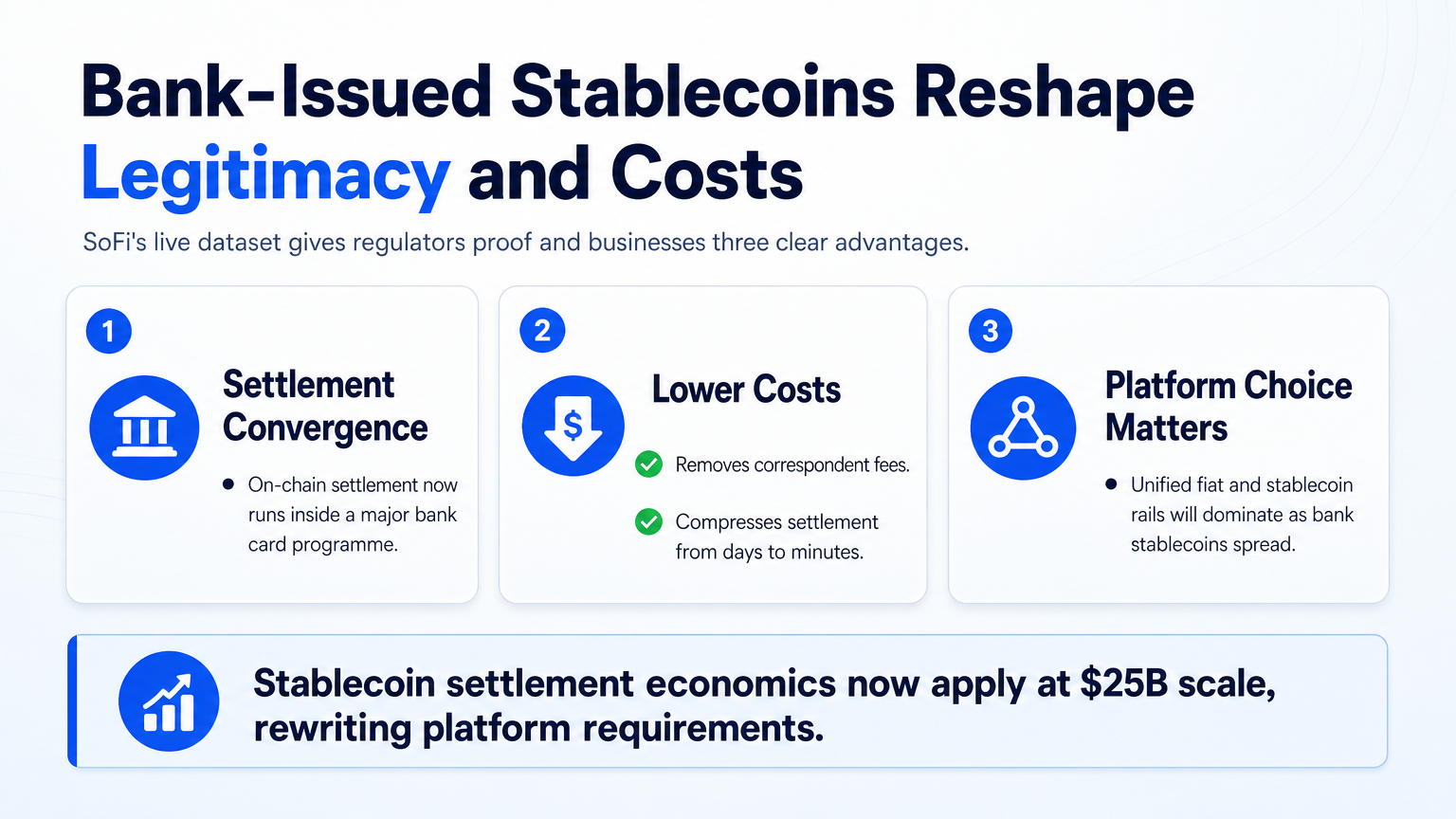
A bank-issued stablecoin changes the legitimacy picture. By absorbing issuance, custody, and redemption inside a federally supervised entity, SoFi addresses the safety question that has dogged crypto banking. A Federal Reserve note from March 2026 examined payment stablecoins; now regulators get a live dataset from a $25 billion programme.
For businesses using crypto-friendly platforms, three implications stand out:
- Settlement convergence. The same on-chain technology used by platforms for crypto-to-fiat settlement is now running inside a major bank’s card programme.
- Lower costs. Stablecoin settlement compresses time from days to minutes and removes correspondent fees—the economics that Stripe’s guide highlights now apply at institutional scale.
- Platform choice matters. Crypto banking platforms that already unify fiat rails, stablecoin conversions, and compliance will be the ones businesses turn to as bank-issued stablecoins proliferate.
The Background: Crypto Banking’s Path to Mainstream Settlement
Crypto banking evolved from simple custody into full-stack platforms combining ACH, wires, multi-currency accounts, and on-chain management—mirroring the neobank vs fintech pattern. Now the settlement rails themselves are changing. The SoFi-Mastercard launch follows a trend: 21 banks have been reported issuing or exploring stablecoins, and Visa Direct launched stablecoin settlement pilots throughout 2025–2026.
Non-bank crypto banking platforms offer flexibility that chartered banks often can’t—faster onboarding, multi-chain support, DAO tools—as explained in How Do You Get a Web3 Account?. What SoFi changes is the competitive landscape: if bank-issued stablecoins become common, non-bank platforms must integrate those instruments or risk losing clients. Those that treat stablecoin settlement as core infrastructure will thrive.
Concrete Implications for Your Business
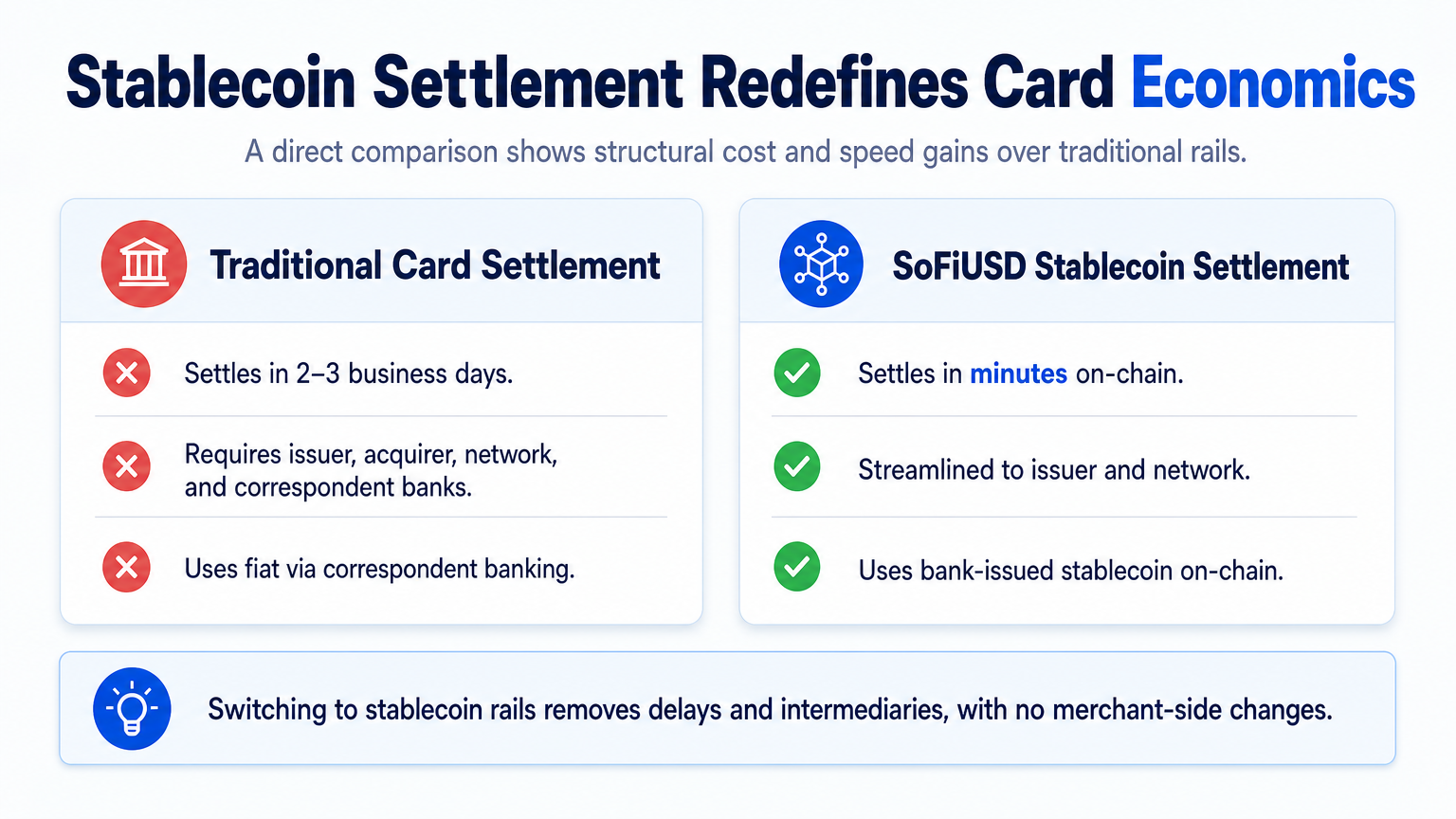
Stablecoin settlement bypasses correspondent banks, compressing a 2–3-day cycle into minutes and reducing per-transaction costs. Chainlink’s analysis details the benefits: near-instant finality, programmability, and transparent audit trails.
| Aspect | Traditional Card Settlement | SoFiUSD Stablecoin Settlement |
|---|---|---|
| Settlement time | 2–3 business days | Minutes (on-chain) |
| Intermediaries | Issuer, acquirer, network, correspondent banks | Issuer (bank), network (Mastercard) |
| Merchant requirements | Standard card acceptance | No change required |
| Settlement instrument | Fiat (via correspondent banking) | Bank-issued stablecoin (on-chain) |
For choosing a crypto banking partner, evaluate stablecoin depth, settlement speed, bank partner quality, compliance posture (see Italy’s crypto banking sanctions rules), and Web3 readiness. A platform that supports free USDC deposits and withdrawals alongside fiat, institutional custody, and role-based access is built for the post-SoFi landscape.
What to Watch Next
The precedent is set: a chartered bank issuing and settling in its own stablecoin is operationally viable. Other banks are moving— U.S. Bank’s stablecoin pilot, Nubank’s stablecoin move, and Raiffeisen’s crypto banking shift signal the trend. Regulators now face questions about FDIC treatment, capital and liquidity rules, and cross-border applicability, as seen in stablecoin regulation developments in Korea and Europe and Africa’s stablecoin rules.
FAQ
How Does SoFi's Stablecoin Settlement Work?
SoFi Bank issues SoFiUSD and uses it to settle card transactions within Mastercard’s network. Merchants continue receiving fiat; the stablecoin settlement is invisible to them, while the on-chain record provides immutability.
What Does This Mean for My Business That Uses Crypto Banking?
It confirms stablecoin settlement is becoming mainstream. On/off-ramp friction will decrease, and the experience of managing fiat and crypto side by side becomes standard. Your platform should now demonstrate readiness to integrate bank-issued stablecoins.
Is Stablecoin Settlement Cheaper Than Traditional Card Rails?
Yes. Removing correspondent bank fees and compressing settlement time lowers costs structurally. At SoFi’s $25 billion scale, even a few basis points translate to tens of millions in savings.
Are Bank-Issued Stablecoins Safer Than Third-Party Stablecoins?
They offer a different risk profile. A bank-issued stablecoin sits inside a federally regulated entity with capital and liquidity requirements, shifting the risk from issuer solvency to the effectiveness of bank supervision. SoFiUSD sets a high bar for transparency.
How Can I Access Stablecoin Settlement If I'm Not a SoFi Client?
Merchants receive fiat through existing card acceptance; no change is needed. For direct stablecoin treasury or payment use, crypto banking platforms already provide stablecoin accounts and on/off-ramps.
Will This Affect My Existing Crypto Banking Platform?
It will raise expectations for settlement speed, stablecoin coverage, and regulatory alignment. Platforms that invested in compliance and integrated fiat-and-crypto workflows are well positioned.
What Should I Look for in a Crypto Banking Partner After This News?
Check stablecoin coverage and roadmap, actual settlement speed (minutes vs. days), institutional-grade custody (e.g., Fireblocks) with MFA, robust KYB and sanctions screening, and support for DAO/Web3 governance.
Key Takeaways
- SoFi Bank’s $25 billion card programme migration to SoFiUSD on Mastercard’s network is the largest real-world deployment of a bank-issued stablecoin, validating crypto banking at institutional scale.
- Businesses using crypto banking platforms should view this as confirmation that stablecoin settlement is mainstream and evaluate their partners accordingly.
- Stablecoin settlement structurally reduces costs and settlement times by cutting correspondent banking intermediaries.
- Regulatory treatment remains fluid; monitor FDIC, OCC, and cross-border developments.
- Non-bank crypto banking platforms that integrate fiat and stablecoin rails, strong custody, compliance, and Web3 support are best positioned for this transition.
Open an account with OneSafe to manage your business’s fiat and cryptocurrency operations on a single platform built for the stablecoin settlement era—get started at OneSafe today.