Compare business bank accounts for global startups: multi-currency, crypto, compliance, fees, and traditional vs neobank trade-offs.
Most guides to compare business bank accounts start and end with a table of monthly fees and transaction limits. That’s fine if your company only ever transacts in your home currency and never touches digital assets. But if you’re building a global startup—paying contractors in euros, holding on-chain treasury, or operating a DAO—the right account is what you won’t outgrow in six months. This guide covers the criteria that matter: multi-currency rails, crypto flexibility, compliance posture, and the trade-off between traditional banks and neobanks.
Table of Contents
- What Exactly Is a Business Bank Account?
- The 4 Main Types of Business Accounts
- Critical Features to Compare (Beyond the Fee Schedule)
- Traditional Bank vs. Neobank: Making the Right Tradeoff
- Step-by-Step: Choosing and Opening the Right Account
- Mistakes, Myths, and Hard Truths
- FAQ: Quick Answers
- Key Takeaways
- Sources
What Exactly Is a Business Bank Account?
At its simplest, a business bank account is a segregated place to send, receive, and hold money under your company’s legal name. It separates personal and business funds and is required for taxes and payments. Today, “business bank account” can mean a traditional checking account, a high-yield savings pocket, a multi-currency account, or a crypto-native platform. The definition has grown because global startups need three things traditional accounts were never designed to deliver: foreign currency sub-accounts with local bank details, a native on/off-ramp for crypto, and compliance that understands web3 activity. When you compare business bank accounts today, you’re comparing entire financial operating systems.
The 4 Main Types of Business Accounts
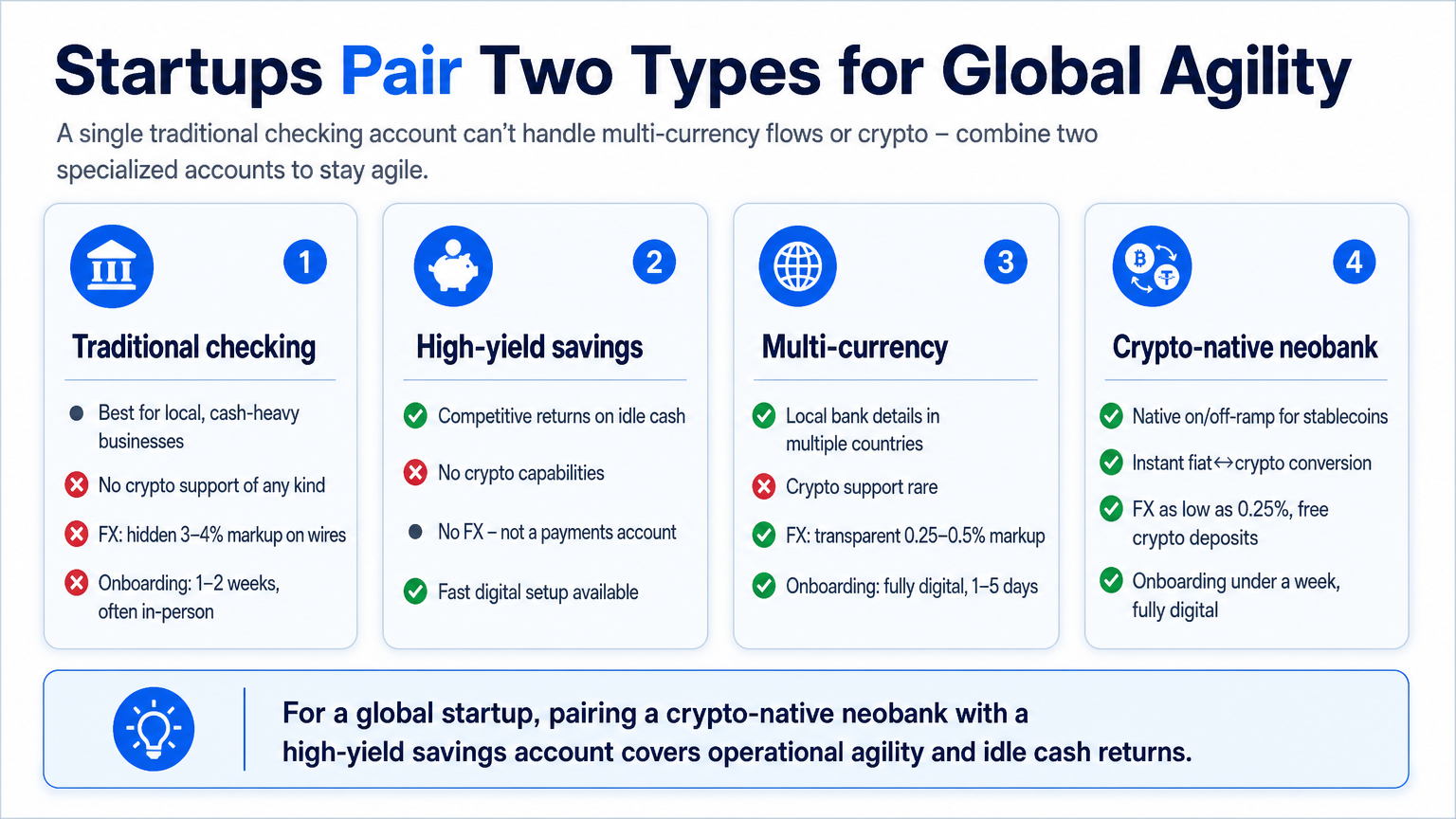 Most startups pair two of these.
Traditional business checking
Offers check writing, ACH, wire, and sometimes branch access. Business account fees—monthly maintenance, cash deposit fees, transaction caps—are the cost of entry. Big names like Bank of America and PNC offer tiered plans. Onboarding often requires an in-person visit, and international wires can carry up to $45 in fees plus hidden FX markups.
High-yield business savings
A place to park surplus cash earning competitive returns. American Express launched its high-yield business savings account just days ago (CNBC, September 19, 2026), with no minimum balance or monthly fees—a signal that even established card issuers see demand for simple, digital-first business savings. Most startups keep only enough in checking to meet immediate needs and sweep the rest into an account like this.
Multi-currency and international accounts
Built for businesses that invoice or pay suppliers abroad. These accounts give you local bank details in multiple countries, so a UK client can pay you in GBP as if you had a local Sterling account, and you convert to USD only when rates are favorable. They integrate with accounting tools and cut FX markups to 0.25%–0.5% versus the 3% hidden fee many traditional banks bake into the exchange rate. Providers range from fintechs like Wise to neobanks that add crypto.
Crypto-native neobank platforms
A small but fast-growing segment: platforms that treat fiat and cryptocurrency as two sides of one ledger. A crypto business account here means you can receive a stablecoin payment, convert to USD instantly, and pay an invoice via ACH—all without juggling three separate services. These are often built for DAO banking as well, with role-based permissions and on-chain treasury visibility. One example is OneSafe, a financial technology company (not a bank) that combines multi-currency accounts, corporate cards, and crypto custody on Fireblocks for web3 startups and global businesses. For a deeper comparison, see Neobank vs Fintech: What Global Businesses Need to Know.
| Account Type | Best for | Crypto Support | FX Costs | Typical Onboarding |
|---|---|---|---|---|
| Traditional checking | Local, cash-heavy businesses | None or extremely limited | 3%–4% markup on wires | 1–2 weeks, often in-person |
| High-yield business savings | Idle cash | None | Not applicable | Same as checking, or fast online |
| Multi-currency / international | Cross-border payroll, client payments | Rarely | 0.25%–0.5% above mid-market | 1–5 business days, fully digital |
| Crypto-native neobank | Web3 startups, DAOs, global businesses with on-chain flows | Native on/off-ramp, custody, conversion | As low as 0.25% for FX, free crypto deposits | Under a week, fully digital |
Critical Features to Compare (Beyond the Fee Schedule)
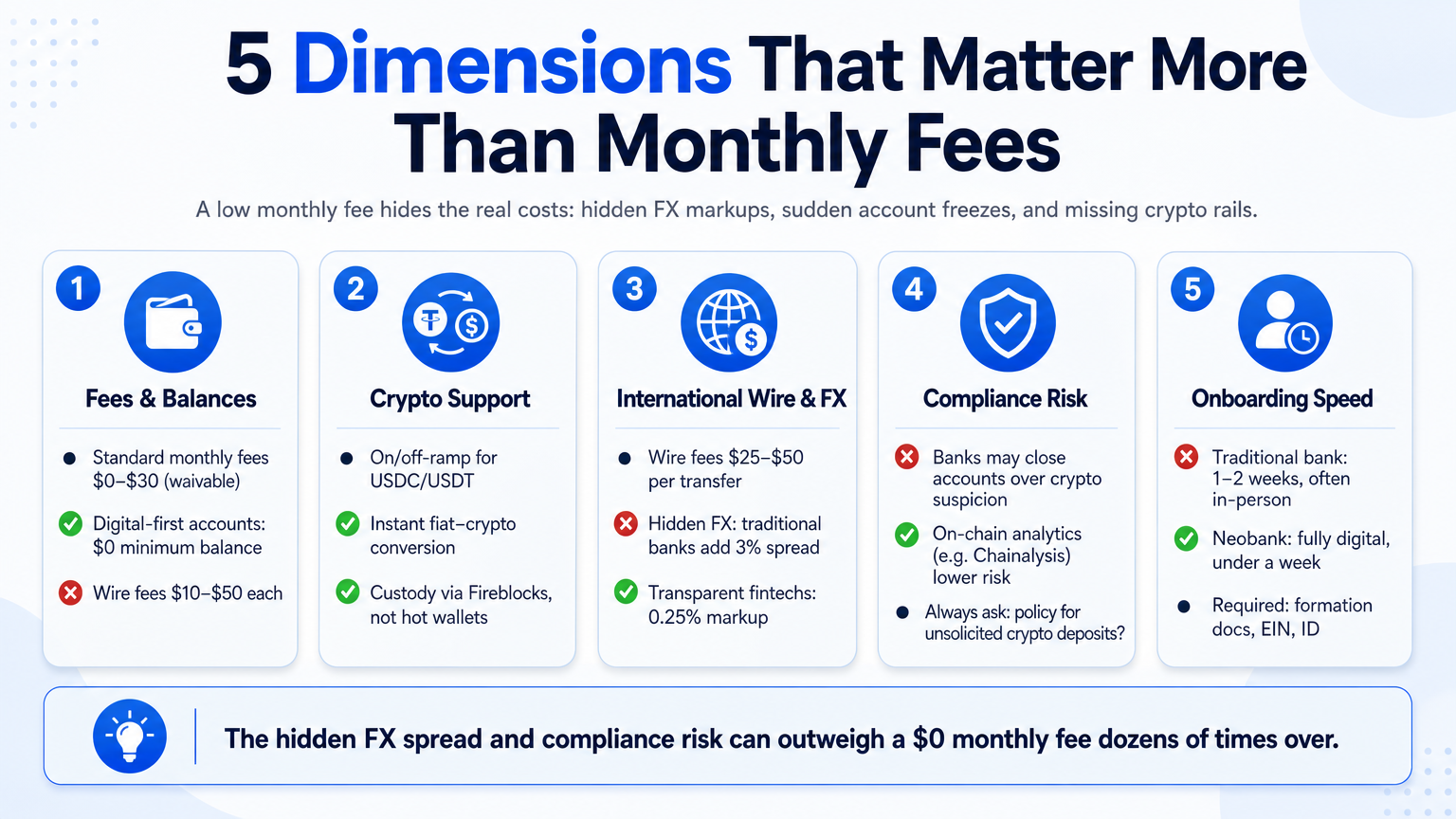 Stop staring at the monthly fee line.
Fees and minimum balances
A standard monthly maintenance fee runs $0–$30, often waivable with a minimum balance. Wire fees ($10–$50 per transfer) and cash deposit costs add up. Many digital-first options come with $0 minimum balance and low or no monthly fees. But fees alone won’t tell you if an account will support you when you land your first six-figure international deal.
Crypto and digital asset support
A crypto business account feature isn’t just “we let you buy Bitcoin.” Look for an on/off-ramp that covers the tokens you use operationally—typically USDC or USDT. The platform should allow instant conversion between fiat and stablecoins, free or low-cost crypto deposits and withdrawals, and custody that doesn’t put your entire treasury at hot-wallet risk. For DAOs, you also need a governance layer: can signers be assigned based on multisig wallets or token-weighted voting? Not many providers offer this.
International wire and FX rates
A $25 wire fee might feel trivial until you realize the exchange rate you’re getting includes a 3% spread. When you compare business checking accounts, always check the real FX cost by comparing the rate you’ll receive to the mid-market rate visible on Google. A fintech that charges a transparent 0.25% will save a growing company thousands per quarter over a traditional bank’s opaque markup. For instance, OneSafe’s fiat deposit and withdrawal are 0.15%, wire withdrawals cost $25, and FX conversion sits at either 0.25% or the prevailing FX rate, whichever is lower.
Compliance and account-closure risk
This is the nightmare nobody budgets for. On September 21, 2026, ABC7 Chicago reported that Capital One confirmed it closed hundreds of accounts belonging to President Trump’s businesses in 2021 “for anti-money laundering reasons.” The story is a blunt reminder that any bank—traditional or fintech—can freeze or close an account if its AML/KYC algorithms flag activity they can’t instantly categorize. For crypto-adjacent startups, the risk is amplified. Before opening any account, ask: “What is your policy when a large stablecoin deposit lands from an address that isn’t on a pre-approved list?” You want a provider whose compliance team understands on-chain forensics, not one that will reflexively shut you down. A crypto-native neobank that screens transactions with tools like Chainalysis and maintains clear communication is far less likely to trigger a surprise account closure than a traditional bank that sees crypto as an anomaly. For more on evolving crypto compliance, see Italy's New Rule Mandates Crypto Banking Sanctions Screening.
Onboarding speed and paperwork
When you need an account tomorrow, online business banking wins. Traditional banks often require a branch visit with physical documents. A business neobank will onboard you entirely digitally, often in under a week, requiring only your business formation papers, EIN (for US companies), and a government ID. Some platforms can start the application in 10 minutes. If your startup has a multi-signature treasury setup, ask about the review process.
Traditional Bank vs. Neobank: Making the Right Tradeoff
The choice isn’t “legacy bad, new good.” It’s about whether your financial infrastructure aligns with your business model.
When a traditional bank still wins
If you operate a brick-and-mortar store, deposit cash daily, or need a line of credit backed by a long relationship, a traditional business checking account still holds an edge. You get FDIC insurance, branch-level service, and integrated lending products. For a purely domestic, cash-heavy business with zero crypto exposure, this path is straightforward and safe. But the cost in time and fees for any international activity is substantial.
When a neobank like OneSafe is the better fit
When your business is global from day one, moves money across currencies and blockchains, or operates as a DAO, a business neobank removes friction that would otherwise force you to chain together a bank account, a money transmitter, and a self-custodied wallet. OneSafe, for example, is a financial technology company that provides multi-currency accounts, corporate cards, and crypto on-ramp services through banking partners. It’s tailored for startups and DAOs that need to pay a developer in Argentina via USDC, settle a supplier in euros by SEPA, and hold treasury in segregated accounts—from a single dashboard. The platform’s security model uses Fireblocks for digital asset custody and mandatory multi-factor authentication. For many global startups, that’s the exact tool that prevents them from outgrowing their banking setup before they’ve closed their Series A.
Step-by-Step: Choosing and Opening the Right Account
Assess your currency and crypto needs
Write down every currency you expect to receive or pay in during the next 12 months—including stablecoins. If that list includes more than two currencies or any crypto, a multi-currency or crypto-native platform is non-negotiable. A Web3 gaming startup might need USD, Euro, and USDC. A traditional checking account would fail.
List your must-have integrations and payment types
Check that the account can handle ACH, domestic and international wires, bill payments, and crypto conversion natively. If you use QuickBooks or Xero, confirm the account integrates. If you need corporate cards with spend limits, verify that these can be denominated in your base currency and top-up in crypto if needed. One missing integration means you’ll run a parallel spreadsheet forever.
What you’ll need to apply
Generally: business formation documents, EIN or local tax ID, a government-issued photo ID for each beneficial owner, and—for some providers—a business plan or website link. With a neobank, you upload these digitally; review typically completes in 3–7 business days. With a traditional bank, plan for 10–14 days and at least one branch visit.
Pairing checking with savings
Even if your primary account doesn’t offer high-yield savings, separate the two. Keep 1–2 months of operating expenses in checking and sweep the rest into a dedicated savings account like the newly launched Amex offering. This gives you liquidity and a buffer against account-closure risk: if your primary checking ever gets frozen, your operating cash isn’t entirely trapped.
Mistakes, Myths, and Hard Truths
“FDIC covers all my funds” — not on crypto
FDIC insurance protects deposits held in insured banks, up to the legal limit. It does not cover crypto assets, even if the platform holding them partners with a bank. If your crypto business account holds USDC in your name through a regulated custodian like Fireblocks, that’s custody, not deposit insurance. Understand the distinction before you assume your stablecoin balance is protected like cash.
Ignoring account closure and compliance risk
As the Capital One case shows, even established banks can and will shut down accounts over AML concerns, sometimes without detailed warning. When choosing a provider, scrutinize its compliance approach for crypto. Does it use on-chain analytics? Will it reach out to clarify a transaction before freezing funds? A platform built for web3 will have a defined process for handling high-risk flags, whereas a legacy bank may have a default “exit the relationship” policy for anything touching crypto. Read the terms, and ask support directly before you commit.
Underestimating FX markups on international payments
It’s not the $25 wire fee that hurts; it’s the 3% hidden FX spread on a $50,000 client payment—$1,500 vanished. When you compare business bank accounts, always request the total landed cost of a sample international payment in EUR or GBP. A transparent provider will quote the mid-market rate and show the markup. If they won’t, walk. This is especially relevant as stablecoin-based settlement becomes more common; see Stablecoin Payments Go Live: Mastercard-SoFi's $25B Move.
FAQ: Quick Answers
What is a business bank account?
A dedicated financial account under your company’s legal name that separates business transactions from personal finances, simplifies tax reporting, and enables commercial payments. It can be traditional or multi-currency/crypto-capable.
How do I compare business bank accounts?
Compare on five dimensions: supported currencies and crypto, international FX costs, compliance posture toward your industry, onboarding speed, and integration with your accounting stack. Don’t start with fees; start with what you’ll need operationally in six months.
Can I open a business bank account online?
Yes. Many neobanks and digital-first platforms offer fully online business banking applications. You’ll upload incorporation documents, a photo ID, and often complete identity verification via a video selfie. Traditional banks may require a branch visit.
How long does it take to open a business bank account?
With a digital-first platform, expect 3–7 business days from application to active account, assuming documents are in order. Traditional banks typically take 10–14 business days.
Do I need a business bank account for my startup?
Yes, from day one. Commingling personal and business funds creates legal mess and weakens liability protection. Even if you’re pre-revenue, a separate startup business bank account keeps your corporate veil intact.
What about multi-currency or crypto-friendly business accounts?
These are purpose-built for businesses that operate globally or transact on-chain. A multi-currency business account lets you receive, hold, and pay in multiple fiat currencies with local bank details. A crypto business account adds stablecoin and crypto wallet functionality, on/off-ramp conversions, and sometimes DAO governance controls.
Are neobanks safe?
Yes, but differently than traditional banks. A neobank provides banking services through licensed partner banks; your fiat funds are typically held in FDIC-insured accounts at those partners. Digital assets are secured through institutional-grade custody (e.g., Fireblocks) and mandatory MFA. Verify the custody model and insurance coverage.
How do I avoid unexpected account closures?
Choose a provider whose compliance team understands your business model. If you handle crypto, use a business neobank built for web3—they’re less likely to flag routine on-chain activity as suspicious. Avoid sudden activity spikes without prior notification, keep documentation current, and respond to compliance queries immediately. For a look at treasury management for on-chain assets, see Crypto Treasury Management After Ripple's $13T Bet.
Key Takeaways
- Look past the fee table: crypto support, multi-currency rails, and FX transparency matter more than a $0 monthly fee.
- A crypto-native neobank is not a luxury—it’s the only safe way to natively manage fiat and on-chain assets without triggering knee-jerk compliance actions.
- Account closures are a real, documented risk: Capital One’s AML-driven closure of President Trump business accounts shows even large banks exit relationships fast. Vet compliance posture upfront.
- Always pair checking with savings to insulate against freezing risk and earn a return on idle funds.
- Apply the 12-month currency test: if you’ll touch more than two currencies or any crypto in the next year, skip a traditional bank and open a platform that handles both fiat and digital assets seamlessly.
Sources