On September 23, 2026, CryptoRank reported that Raiffeisen Bank International will roll out Bitcoin trading to roughly 18.8 million customers across 11 Central and Eastern European countries through an expanded partnership with Bitpanda. It is a crypto banking moment that challenges a persistent assumption: that bank-grade crypto services are years away from mainstream distribution. For finance leads at global businesses and DAOs, the sharper question is whether a legacy bank adding Bitcoin changes the fiat crypto management stack they have already built around crypto-native platforms. The Raiffeisen Bitcoin rollout turns the bank into a crypto‑friendly bank and a notable crypto on‑ramp business for Bitcoin trading Europe.
Table of Contents
- What just happened: Raiffeisen’s Bitcoin Rollout
- Why this matters now for global businesses and DAOs
- The background: how crypto banking reached this moment
- Concrete implications and recommended actions
- What does Raiffeisen’s move mean for the crypto banking industry?
- How does a platform like OneSafe differ from a traditional bank offering crypto?
- How should global businesses and DAOs adapt to this changing landscape?
- What to watch next
- Key Takeaways
What just happened: Raiffeisen’s Bitcoin Rollout
The Bitpanda deal by the numbers
On September 23, 2026, Raiffeisen Bank International said it would extend Bitcoin trading across its network through Bitpanda, reaching about 18.8 million customers in 11 Central and Eastern European markets, according to CryptoRank. Bloomberg also reported the expanded deal the same day, describing it as letting 18 million customers buy crypto via Bitpanda.
The available reporting is specific on reach and asset type: this is a Bitcoin rollout, not an all-asset stablecoin or tokenized-deposit product. Pricing, custody terms, and exact country-by-country availability were not disclosed in the sources.
Why this is different from past bank crypto pilots
The analysis here is that scale and distribution are the differentiators. Earlier bank crypto services often arrived as institutional custody lines, tokenized deposit pilots, or separate apps with limited client reach. What Raiffeisen is doing is different in kind: Bitcoin trading is being distributed through an existing bank network to retail and business customers across multiple jurisdictions.
That matters because the hard part of bank crypto services has rarely been the underlying exchange integration. Visa’s guidance on crypto in banking frames the challenge as moving from isolated exploration into production-grade customer flows. A bank with millions of existing customers does not need to build a crypto audience from scratch. It only has to offer a compliant on-ramp where customers already bank.
Why this matters now for global businesses and DAOs
Validation for crypto treasury management
Raiffeisen’s move does not solve corporate treasury problems directly. A retail Bitcoin trading feature is not a treasury workstation, and it is unlikely to give a DAO the approval controls, multi-signature roles, or stablecoin settlement rails it needs. What it does is normalize crypto as a legitimate balance-sheet and payments topic for finance teams that have so far avoided it.
That validation is consequential. A DAO or global business holding crypto still needs a framework for crypto treasury management after Ripple’s $13T bet, but the optics of “crypto is fringe” become weaker when a large European bank distributes Bitcoin access to 18.8 million customers. Finance leads can use this moment to update treasury policy rather than start from zero.
The accelerating convergence of neo‑banking and legacy banking
The Raiffeisen announcement is part of a larger convergence trend in global business banking. Nubank’s stablecoin move and the U.S. Bank stablecoin pilot both point to a market in which legacy banks are adopting crypto rails without abandoning their existing infrastructure.
That convergence changes the competitive landscape for Web3 financial services. A crypto-native fintech can no longer win solely by being the only place a company can hold fiat and crypto in one interface. The new differentiation is operational fit: speed, stablecoin support, DAO-compatible controls, and whether the platform treats crypto as a core capability rather than a side feature.
The background: how crypto banking reached this moment
From crypto‑native platforms to bank‑grade custody
For newcomers, the term crypto banking has historically covered two very different setups. NerdWallet’s crypto banking explainer describes platforms that let users manage fiat and cryptocurrency in a single interface, while BitGo’s overview of crypto banks emphasizes how institutional custody became the foundation for bank-grade digital asset services.
The shift that matters most is custody. Early crypto banking leaned toward self-custody or exchange custody. Today, regulated custodians and compliance obligations have made bank-grade custody the default for many institutions. That lowers perceived risk, but it also creates a trade-off: less direct control for the asset holder.
Regulatory turning points (FDIC, MiCA) that paved the way
Regulatory clarity has been partial but directionally important. In the U.S., FDIC guidance has reduced some uncertainty around bank involvement with digital assets, though it remains fragmented. In Europe, the MiCA framework has given banks a more predictable path to crypto service delivery. Italy’s new sanctions-screening rule is a reminder that compliance obligations follow the rail: crypto banking sanctions screening is now an operational requirement, not a soft guideline.
The U.S. Bank stablecoin pilot, covered in our crypto banking maturation note, shows the same pattern from the issuer side: banks are testing digital assets under controlled regulatory conditions. Raiffeisen’s rollout is the retail-facing version of that momentum.
Concrete implications and recommended actions
Re‑evaluating your banking stack: questions for finance leads
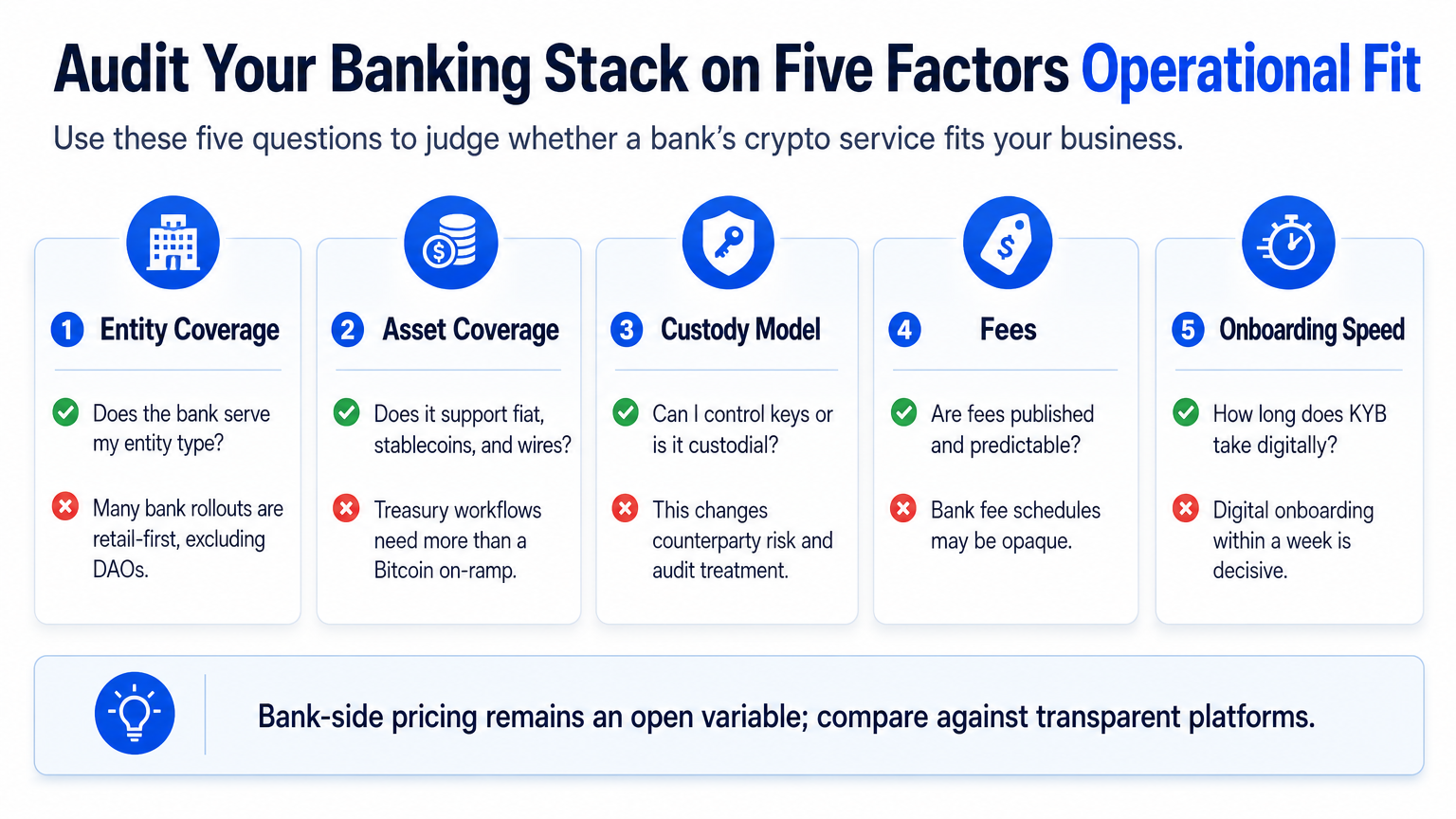
For a finance lead deciding whether to consolidate bank crypto services with an existing fiat relationship or maintain separate rails, the decision is not about trend-following. It is about operational fit.
| Decision factor | Question to ask | Why it matters now |
|---|---|---|
| Entity coverage | Does the bank serve my entity type: corporation, DAO, or cross-border startup? | Many bank crypto rollouts are retail-first and may exclude DAOs or non-local entities. |
| Asset coverage | Does it support only BTC, or fiat, stablecoins, and wire rails together? | Treasury workflows need more than a single Bitcoin on-ramp. |
| Custody model | Is crypto held in custodial bank wallets or can I control keys? | This changes counterparty risk, recovery options, and audit treatment. |
| Fees | Are fees published and predictable? | Crypto-native platforms often publish specific fees; bank fee schedules may be opaque. |
| Onboarding speed | How long does KYB take, and is it fully digital? | Digital onboarding within a week can be decisive for global teams. |
As a reference point, published OneSafe pricing as of September 23, 2026 includes a free account option, a premium plan starting at $29 per month, 0.15% fiat deposit and withdrawal fees, and free USDC crypto deposits and withdrawals. Raiffeisen’s fee schedule for the Bitpanda rollout was not disclosed in the September 23 reporting, so bank-side pricing remains an open variable.
Preparing for a multi‑rail future without over‑committing early
The recommended stance is multi-rail: keep self-custody for long-term treasury assets, keep a fiat business account for payroll and vendor payments, and treat bank crypto services as a convenience rail for operational conversions and client inflows.
The practical rule: do not unwind existing banking or self-custody because a major bank adds Bitcoin. A crypto-friendly bank is not automatically a DAO banking platform, and Bitcoin trading is not the same as fiat crypto management across stablecoins, wires, and corporate cards.
What does Raiffeisen’s move mean for the crypto banking industry?
It expands crypto banking from a category defined by Web3-native users to one with mainstream European distribution. The 18.8 million-customer reach sets a new benchmark for bank crypto services, but it also raises the bar for compliance, custody, and support expectations. Crypto-native fintechs are not made obsolete; they are pressured to differentiate on DAO-compatible controls, stablecoin settlement, and onboarding speed rather than on crypto access alone.
How does a platform like OneSafe differ from a traditional bank offering crypto?
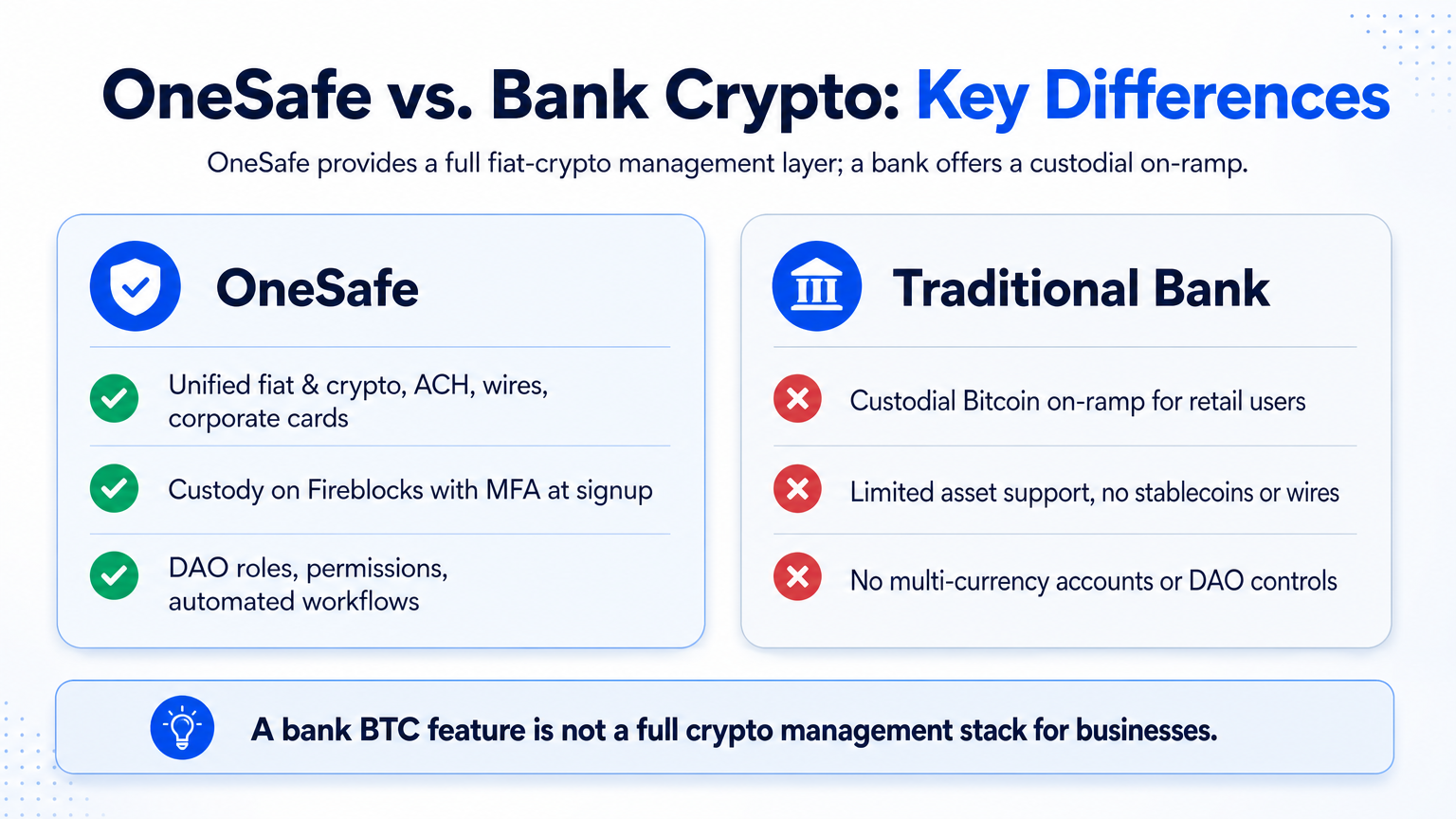
OneSafe is a financial technology company, not a bank; banking services are provided by its partners. It offers a unified platform for fiat and cryptocurrency transactions, including ACH, domestic and international wires, bill payments, corporate cards, and crypto-to-fiat conversions, with digital asset custody secured on Fireblocks and MFA enabled at signup. For DAOs, it provides customizable roles and permissions and automated payment workflows.
By contrast, a traditional bank adding Bitcoin is usually extending an existing retail banking relationship with a custodial crypto on-ramp. That can solve a narrow access problem for an individual, but it is not the same as a fiat crypto management layer built for a crypto on-ramp business or a decentralized organization that needs multi-currency accounts, segregated global accounts, and role-based payment approvals.
How should global businesses and DAOs adapt to this changing landscape?
First, audit entity coverage: confirm whether your bank or fintech can actually serve your DAO, startup, or cross-border structure. Second, separate long-term holdings from operational cash. Banks and custodial crypto services are reasonable for payments and conversions; self-custody remains the safer default for assets you do not need to spend. Third, document your compliance evidence, especially if you operate across Europe and the U.S. Finally, do not over-commit to a single rail. The market is moving toward hybrid infrastructure, and the businesses that handle the transition best will be those that keep their options open.
What to watch next
Will other systemically important banks follow?
The question is now less about whether banks can offer crypto and more about how fast they will follow Raiffeisen’s distribution model. If other large European banks pair with licensed crypto platforms rather than building in-house, the cost and compliance burden of offering Bitcoin falls sharply. That would accelerate adoption, but it would also make many bank crypto services look similar behind the logo.
The unresolved tension between compliance and decentralization
The deeper issue is unresolved. Bank crypto services are inherently custodial, permissioned, and compliance-heavy. The Web3 ethos leans toward self-custody, composability, and decentralized control. Raiffeisen’s move does not resolve that tension; it makes it a mainstream operational question for every business that holds crypto while needing a regulated bank account. Expect the next flashpoints to be custody terms, transaction monitoring, and whether DAOs can access bank-distributed crypto services without sacrificing their governance model.
Key Takeaways
- Raiffeisen’s September 23, 2026 Bitcoin rollout via Bitpanda pushes crypto banking into mainstream European distribution, reaching about 18.8 million customers across 11 countries.
- The move validates crypto as a legitimate treasury topic, but retail Bitcoin access is not a substitute for DAO banking or full fiat crypto management.
- Finance leads should evaluate bank crypto services on entity coverage, asset support, custody model, published fees, and onboarding speed before switching rails.
- A multi-rail approach is the safest default: self-custody for long-term holdings, fiat accounts for operational payments, and bank crypto access for conversions.
- Watch whether other large banks follow the distribution model and how the custodial, permissioned nature of bank crypto services collides with self-custody expectations.
Open a OneSafe account if your business is evaluating a unified fiat and crypto finance stack.