Meta Description: Discover the key differences between neobank vs fintech for global businesses, including crypto, multi-currency, and DAO banking. Make the right choice.
Neobank vs Fintech: What Global Businesses Need to Know
The neobank vs fintech distinction matters less than most guides admit—especially for companies running payroll in euros, supplier payments in dollars, and treasury in USDC. If you operate across borders or use crypto, you need a unified platform, not a category label. This guide compares both models through the lens of cross‑border, crypto‑ready operations.
Table of Contents
- Why the Neobank vs Fintech Debate Matters Now
- Definitions: What Is a Neobank? What Is a Fintech?
- Side-by-Side Comparison: Neobank vs Fintech
- The Crypto and Global Operations Gap
- Use Case Scenarios: When to Choose What
- A Closer Look at Pricing and Total Cost
- Strengths and Limitations of Each Model
- FAQ: Answering the Questions That Matter
- Conclusion: Making the Right Choice for Your Business
- Key Takeaways
Why the Neobank vs Fintech Debate Matters Now
Two shifts are converging. On September 23, 2026, Finextra Research reported that neobanks are embracing community banking and local complexity in cross-border payments. Meanwhile, Reuters noted on September 18 that Brazilian voters feel burned by Nubank’s rapid credit expansion—raising consumer-protection questions in low‑income markets.
For global businesses, the neobank vs fintech question is practical: can a provider handle multi‑currency operations, crypto on/off‑ramps, and decentralized governance under one login? Traditional boundaries are dissolving as both sides add features that blur the line.
Definitions: What Is a Neobank? What Is a Fintech?
A neobank is a digital‑first provider offering checking accounts, debit cards, and payment services through a mobile interface. Most partner with licensed banks for deposit holding and regulatory coverage, as Plaid’s resource explains.
Fintech encompasses payment processors, lending platforms, investment apps, insurance tech, and banking‑as‑a‑service infrastructure—any company applying technology to financial services, whether or not it touches customer deposits.
The practical test: if a company holds your operating cash and issues cards in its own name, it’s functioning as a neobank. If it moves, converts, or analyzes money without holding it, it’s a fintech platform in the narrower sense.
Where They Overlap—and Where They Diverge
Licensing and regulation
Neobanks typically operate under a partner bank’s charter. Revolut, for example, confirmed on September 18, 2026 that it’s considering a dual London‑New York listing—a sign of maturing neobank vs traditional bank licensing ambitions, as PYMNTS reported. Fintechs that never hold deposits may need only money transmitter licenses.
Core services and target audiences
Neobanks focus on accounts, cards, ACH and wires. Fintechs often specialize—invoicing, payroll, FX hedging. NerdWallet notes that neobanks increasingly bundle these services, collapsing the boundary.
Crypto and web3 capabilities
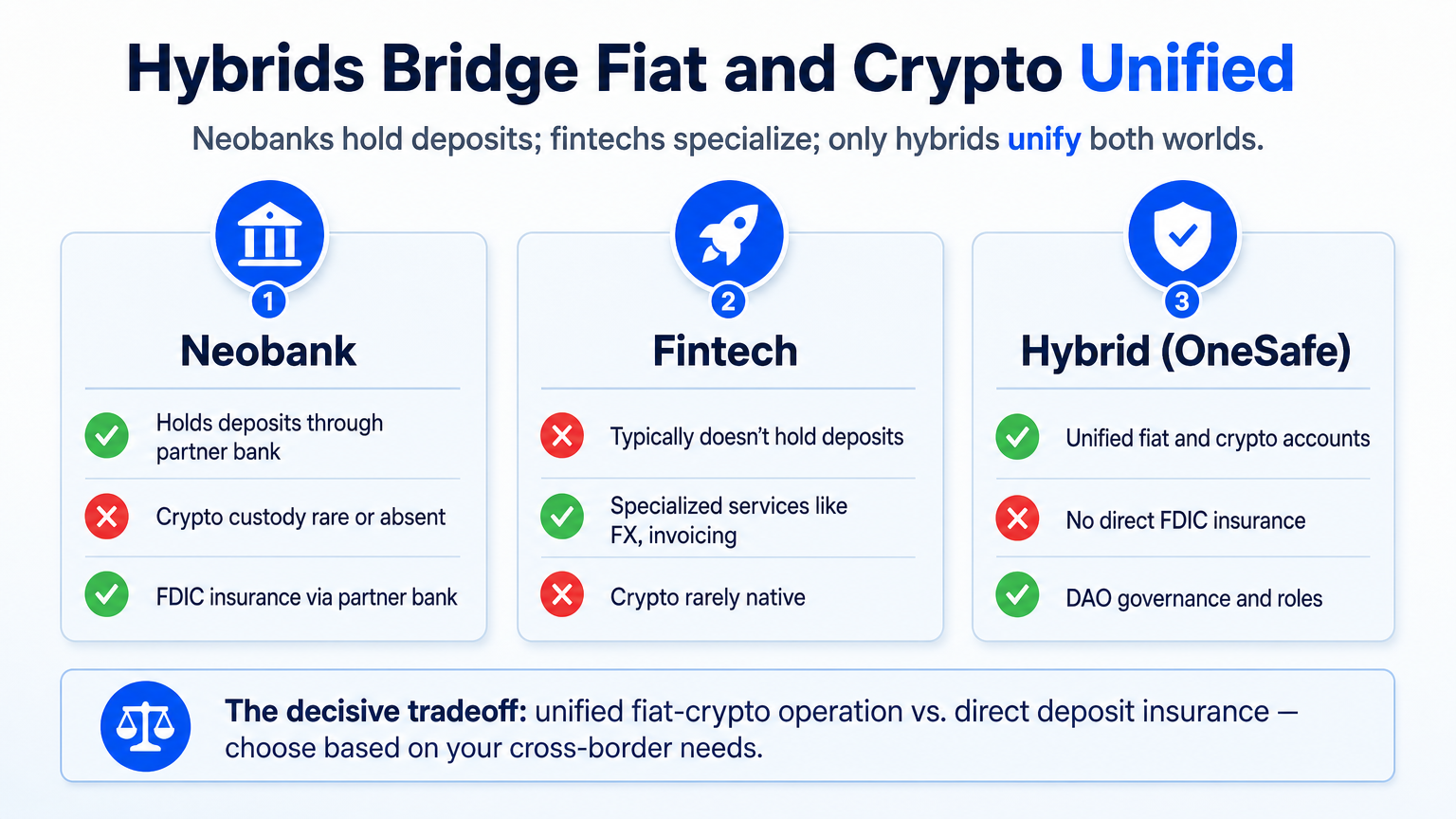
Most neobanks lack native crypto custody or on‑chain transactions. Most fintechs don’t hold deposits. A hybrid platform that handles both fiat accounts and crypto custody under one interface fills the gap neither side historically covered.
Side-by-Side Comparison: Neobank vs Fintech
| Criterion | Neobank | Fintech Platform | Hybrid (e.g., OneSafe) |
|---|---|---|---|
| Holds customer deposits | Yes, through partner bank | Typically no | Yes, through partner bank |
| Issues corporate cards | Yes | Varies | Yes |
| Regulatory framework | Partner bank charter; may pursue own license | Varies (money transmitter, etc.) | Partner bank charter; fintech compliance framework |
| Multi-currency accounts | Often limited (major currencies) | Varies widely | USD, EUR, CAD; more coming |
| Crypto custody | Rare; third‑party integrations | Rare unless crypto‑native | Yes; secured on Fireblocks |
| On/off‑ramp (fiat↔crypto) | Usually no | Payment‑focused fintechs sometimes yes | Yes, both directions |
| DAO governance tools | No | No | Yes (customizable roles and permissions) |
| FDIC insurance (fiat) | Through partner bank | Not applicable unless depository | No—partner bank coverage applies to fiat deposits, not OneSafe itself |
| Monthly fee | $0–$15 typical | Varies | $0 (free tier) or $29/month (premium) |
| Wire fees | $15–$35 typical | Not applicable | $25 outbound; $10 inbound |
| SWIFT fees | $25–$50 + FX margin | Not applicable | 0.35% + $50 |
| FX fee | 0.5%–3% typical | Platform‑dependent | 0.25% or prevailing rate; 3% on corporate card FX |
| Onboarding speed | Minutes to days | Varies | Within one week |
| Global availability | Often restricted by region | Varies | Worldwide except OFAC‑sanctioned countries and select US states |
The decisive tradeoff: neobanks provide deposit insurance via partner banks but rarely handle crypto natively. Fintechs excel at a specific function but can’t hold operating cash. A hybrid platform trades direct insurance for unified fiat‑crypto capability—the critical distinction for cross‑border teams.
The Crypto and Global Operations Gap
Multi‑currency accounts and cross‑border payments
A UK startup paying contractors in Poland and suppliers in Nigeria needs three separate relationships with traditional channels. Neobanks like Revolut have expanded multi‑currency support, yet businesses that also hold stablecoins still face a gap. A Meniga analysis acknowledges that most platforms optimize for domestic ease, not borderless treasury.
On/off‑ramp and digital asset custody
Converting between fiat and crypto without leaving your banking interface is an operational requirement for Web3 startups. Platforms offering integrated on‑ramp and off‑ramp eliminate the delay and cost of external exchange transfers. Custody matters equally: Crypto Banking Scams Hit $15.9B documents why segregated, institutional‑grade custody is non‑negotiable.
DAO governance and automated workflows
DAOs face a specific friction: multisig wallets work for on‑chain assets, but paying a landlord or conference venue requires fiat rails. The gap between stablecoin payments and real‑world obligations forces DAOs into fragmented banking. Customizable roles, automated payouts, and secure treasury solutions—features traditional fintech banking services ignore—become essential.
Use Case Scenarios: When to Choose What
Domestic small business or startup
A California startup with USD‑only operations and no crypto exposure can use almost any neobank. Pick the one with the lowest fees and best accounting integrations. The neobank vs fintech for business decision is simple: you need deposit services, so a neobank wins.
Global company or Web3 startup
A Singapore‑incorporated startup paying European contractors and Latin American suppliers, with treasury partially in USDC, needs global business banking that covers multi‑currency fiat, crypto custody, and cross‑border payments in one interface. No standalone neobank or single‑purpose fintech meets all three.
Decentralized Autonomous Organization (DAO)
DAOs require DAO banking that mirrors governance: role‑based permissions, multisig‑style approvals, and automated execution in fiat and crypto. A platform that cannot map on‑chain governance to off‑chain operations creates an audit and security gap.
A Closer Look at Pricing and Total Cost
Typical fee structures
Neobanks often advertise zero monthly fees but charge on FX (0.5%–2% over interbank) and wires ($15–$30). Fintech platforms may charge per transaction or percentage of volume. Hybrids add blockchain network fees and crypto spreads.
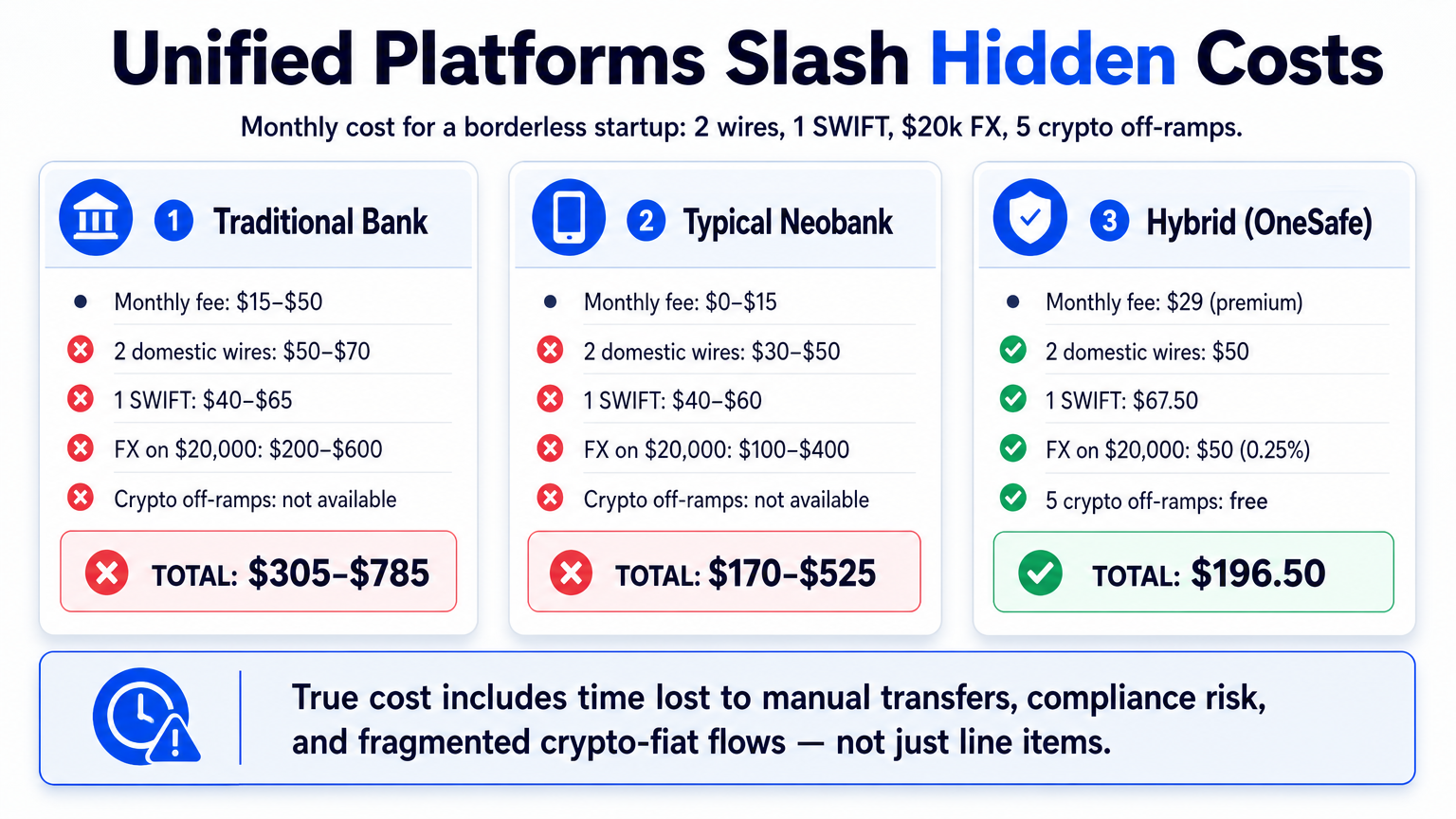
Real‑world scenario: monthly cost for a borderless startup
Assumptions: 2 international wires ($1,500 each), 1 SWIFT ($5,000), $20,000 in currency conversion, 5 crypto off‑ramps ($2,000 each), monthly account fee.
| Item | Traditional Bank | Typical Neobank | Hybrid Platform (OneSafe Premium) |
|---|---|---|---|
| Monthly fee | $15–$50 | $0–$15 | $29 |
| 2 domestic wires (outbound) | $50–$70 | $30–$50 | $50 |
| 1 SWIFT (outbound) | $40–$65 | $40–$60 | $67.50 (0.35% + $50) |
| FX on $20,000 (0.25–3%) | $200–$600 | $100–$400 | $50 (at 0.25%) |
| 5 crypto off‑ramps (USDC) | Not available | Not available | Free |
| Total | $305–$785 | $170–$525 | $196.50 |
What the table hides: the cost of maintaining a separate exchange account, time lost to manual transfers, and compliance risk of fragmented records. For crypto‑native businesses, a unified platform beats the sum of disjointed alternatives—even when individual fees look higher.
Strengths and Limitations of Each Model
Neobank strengths: deposit insurance through partner banks, regulatory clarity for fiat, mature mobile apps, lower domestic costs.
Neobank limitations: minimal crypto support, restricted multi‑currency depth, no DAO or Web3 governance tools.
Fintech platform strengths: deep specialization (FX, invoicing, lending), rapid innovation, API‑first design.
Fintech platform limitations: cannot hold deposits—you still need a separate bank account; compliance burden split across multiple providers.
Hybrid platform strengths: unified fiat and crypto operations, single compliance record, governance tools for decentralized teams, faster cross‑border settlement via stablecoin rails.
Hybrid platform limitations: no direct FDIC insurance (coverage flows through partner banks), newer operating history, limited lending or credit products, geographic restrictions.
FAQ: Answering the Questions That Matter
What is the difference between a neobank and a fintech?
A neobank is a subset of fintech that provides account and deposit services. If the platform issues an account number and card in your business’s name, it’s a neobank.
Are neobanks regulated like regular banks?
Most operate under a partner bank’s charter. Some, like Revolut, are pursuing independent charters, but as of September 2026 partner‑bank arrangements dominate.
Is my money FDIC insured with a neobank?
Fiat deposits held through the partner bank are typically FDIC‑insured up to $250,000—the neobank itself is not the insured institution. Crypto assets are never FDIC‑insured.
Which is better for small businesses: neobank or fintech?
Purely domestic, fiat‑only businesses get better value from a neobank. Multi‑currency or crypto‑needing businesses are better served by a hybrid platform.
Can neobanks handle cryptocurrency?
Most cannot natively. A few offer trading via third‑party integrations, but custody and on‑chain transfers remain rare. A crypto neobank or hybrid platform is the category to evaluate.
What are the costs of using a neobank vs a fintech platform?
Neobanks: $0–$15/month plus per‑wire and FX fees. Fintech costs depend on function. Hybrids add crypto costs but eliminate separate exchange and custody fees.
How do neobanks work for global businesses?
They provide multi‑currency accounts and cross‑border rails via partner networks, but often lack local payment depth in smaller markets, native crypto support, and governance tools.
What is a neobank?
A digital‑only provider of account and payment services, usually through a partner bank’s license, without physical branches.
What are fintechs?
Technology companies operating in financial services—spanning payments, lending, insurance, regtech, and infrastructure. Not all touch customer money.
How do neobanks make money?
Interchange fees, FX margins, subscription fees, and deposit interest shared with partner banks. Hybrids may earn from crypto conversion spreads and custody fees.
Conclusion: Making the Right Choice for Your Business
The neobank vs fintech framework breaks down exactly where global businesses need clarity. If your operations span fiat and crypto, require multi‑currency treasury, or involve decentralized governance, the relevant category is a platform that bridges both.
Recent developments reinforce this convergence: Nubank appointed former Circle General Counsel Sarah Wilson as Chief Legal Officer on September 18, 2026, signaling deeper neobank crypto focus, as FF News reported. Revolut’s dual‑listing consideration confirms neobanks are maturing into full‑spectrum financial institutions. And Stablecoin Payments Go Live developments underscore why businesses need fiat and crypto rails to converge.
For the domestic LLC, a neobank works. For the cross‑border team or Web3 organization, a hybrid platform that handles fiat accounts, crypto custody, and DAO governance in one interface is the operational standard.
Key Takeaways
- The neobank vs fintech distinction collapses for global businesses needing both fiat accounts and native crypto support—the relevant category is a hybrid platform.
- FDIC insurance applies to fiat deposits through partner banks, not to crypto assets or the platform itself; verify partner‑bank arrangements.
- Cross‑border businesses lose more to fragmented banking and manual FX than to any single platform’s fees.
- DAOs and Web3 startups cannot operate efficiently on a traditional neobank or fintech alone—governance‑aware treasury tools are a hard requirement.
- A unified fiat‑and‑crypto platform eliminates the hidden cost of separate exchange, custody, and banking relationships.
Start banking the way your business actually operates—open a global account designed for fiat and crypto operations.