Stablecoin payments stopped being a pilot story on September 23, 2026. On that date, TradingView published a Zacks Equity Research note reporting that Mastercard is positioning SoFi's live card program—not a test environment—as Mastercard stablecoin settlement at scale: SoFi Bank is now settling debit and credit card transactions on Mastercard's network with SoFiUSD, and SoFi is moving its entire card program, expected to process more than $25 billion in annualized volume, to that settlement rail. For finance leads running a fiat-crypto treasury, the practical question shifts from “does this work?” to “what do we check before moving volume?”
Table of Contents
- What Just Happened: SoFi's Card Program Moves to SoFiUSD Settlement
- Why This Matters Now for Finance Teams
- Stablecoin Payments Before This Week: The Background
- Concrete Implications for Global Businesses and DAOs
- What to Watch Next and Open Questions
- Key Takeaways
What Just Happened: SoFi's Card Program Moves to SoFiUSD Settlement
The September 23, 2026 reporting frames the launch as a move from testing stablecoin settlement to using it in a live payments environment. SoFi Bank is settling card transactions with SoFiUSD on stablecoin payment rails layered onto Mastercard’s existing infrastructure. The reported rationale is that Mastercard can add stablecoins as another settlement choice rather than replace traditional rails. This follows Mastercard's March 2026 partnership announcement with SoFi, which described enabling SoFiUSD settlement across its network; the September development is the live consequence.
Why $25 billion in annualized volume makes this different
Scale is the signal. SoFi’s entire card program—more than $25 billion annualized—is moving to card network stablecoin settlement, with transactions already live on-chain. Earlier card-network tests, like the Visa Direct stablecoin pilot, were bounded experiments. This is a production portfolio shifting its settlement leg, giving other issuers and acquirers a reference case for volume, operations, and reconciliation without running their own pilot first.
What is the Mastercard-SoFi stablecoin payments deal?
It’s a card-network stablecoin settlement arrangement, not a new consumer payment method. Mastercard continues to authorize and clear transactions on existing rails; the change is in the settlement leg: SoFi Bank settles its card obligations with SoFi Bank stablecoin (SoFiUSD) on a blockchain. SoFiUSD is bank-issued, redeemable 1:1 for U.S. dollars, backed primarily by cash. Through SoFi’s Big Business Banking, merchants can receive funds instantly and withdraw cash 24/7 at zero cost. Mastercard’s role is to support blockchain-based settlement without replacing its payment infrastructure.
Why This Matters Now for Finance Teams
For treasury leaders, a live $25 billion program proves operational tolerance. The September 23 report is explicit: Mastercard is adding stablecoins as a settlement choice, not ripping out existing rails. That’s less disruptive, but the benefits arrive in the settlement ledger, not a new checkout flow.
The most concrete merchant change is cash access. SoFi’s platform allows instant funds and zero-cost cash withdrawal, per the report—a SoFi-specific capability, not network-wide. Treat it as a benchmark for what your own issuer may offer next.
Settlement can move from batch, business-day windows toward near-instant finality on-chain. The report discloses zero-cost merchant withdrawals but does not disclose Mastercard revenue impact, so network-level economics remain open. The practical summary: settlement gets faster, but total cost still depends on conversion, custody, and banking partner fees.
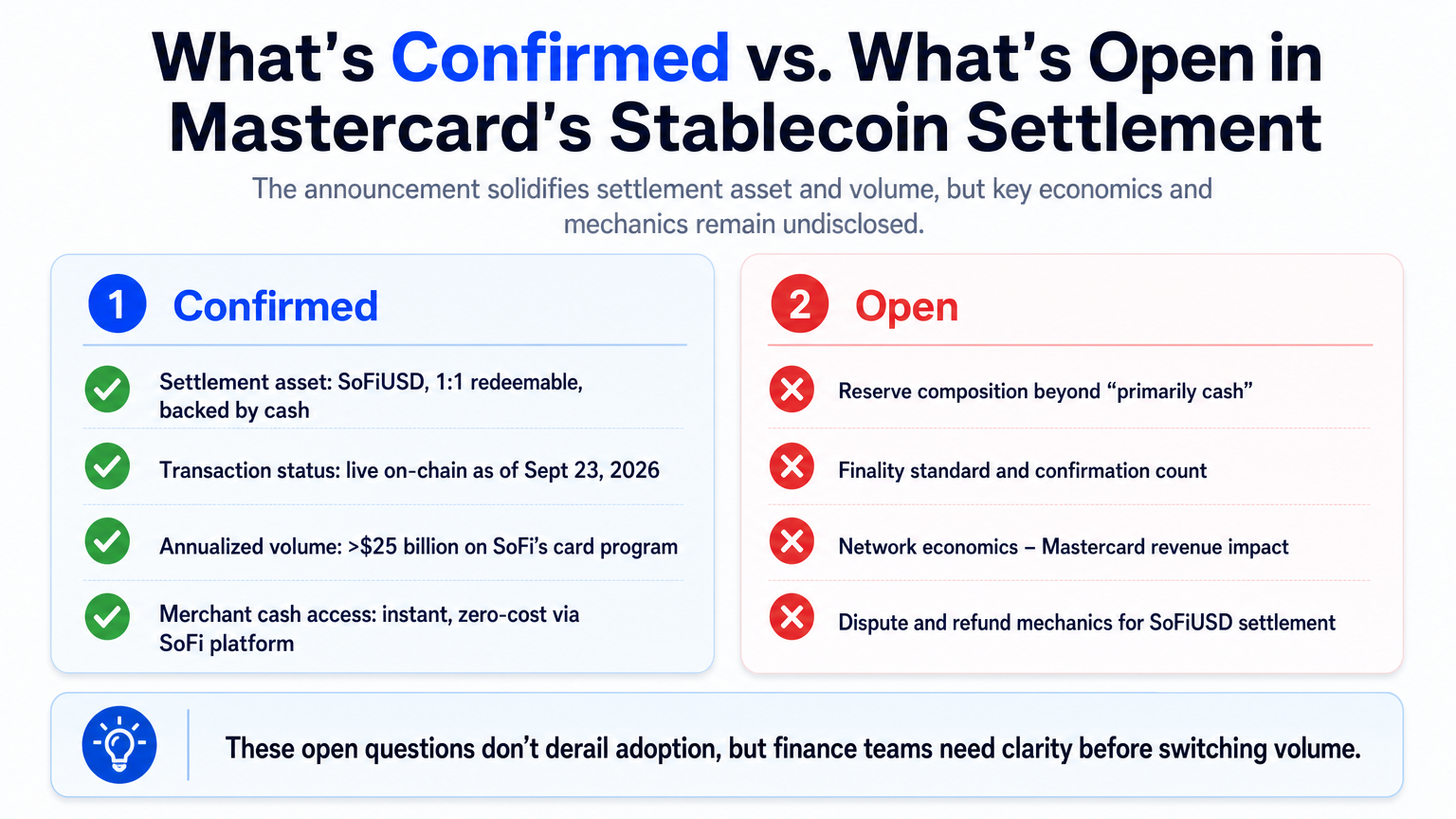
| Dimension | What the announcement confirms | What remains open |
|---|---|---|
| Settlement asset | SoFiUSD, 1:1 redeemable, backed primarily by cash | Reserve composition details beyond “primarily cash” |
| Transaction status | Live on-chain as of September 23, 2026 | Confirmation count and finality standard |
| Annualized volume | >$25 billion on SoFi’s card program | Average ticket size and cross-border share |
| Merchant cash access | Instant, zero-cost via SoFi Big Business Banking | Availability outside SoFi’s platform |
| Network economics | Not disclosed | Mastercard revenue or earnings impact |
| Dispute and refund mechanics | Not disclosed | How chargebacks settle in SoFiUSD |
Why SoFi moved its card program to SoFiUSD settlement
The stated rationale: stablecoin settlement can be added to existing rails, giving Mastercard a real example for banks evaluating digital settlement. SoFi had already positioned SoFiUSD as fully reserved, built to power financial infrastructure. Moving its own card program tests the infrastructure with the issuer’s own volume. The reporting does not say SoFi moved solely to cut interchange or replace Mastercard.
Stablecoin Payments Before This Week: The Background
In card transactions, final settlement between issuer and network/acquirer typically moves through bank money. Card network stablecoin settlement replaces that last leg with a stablecoin transfer on a blockchain. The card transaction is approved in seconds, but the issuer’s obligation discharges in SoFiUSD rather than Fedwire or ACH. Stablecoin payments and tokenized deposits are not the same: a tokenized deposit is a bank liability; SoFiUSD is a stablecoin issued by SoFi Bank, redeemable for dollars.
Card networks aren’t being replaced. Mastercard’s message: stablecoins can ride the same infrastructure as another settlement option. That layer separation is crucial. Stripe positions stablecoin payments as a distinct checkout method with different dispute flows; Mastercard’s SoFi announcement frames stablecoin settlement partners as adding a settlement-layer choice. For a business evaluating this move, the rule is: do not assume settlement-layer stablecoin support changes your merchant-facing dispute flow.
How stablecoin payments work with fiat accounts
Settlement may arrive on-chain, but fiat accounts remain essential. A business receives stablecoin settlement, then either holds it or converts to fiat via a banking partner. The workflow: receive on-chain credit, assign a finality timestamp, convert if needed, move cash into an operating account. For companies already running a USDC on-ramp/off-ramp, the new element is that the settlement leg itself arrives on-chain—potentially simplifying reconciliation if your ledger already tracks chain transactions, but creating a gap if your accounting system only tracks fiat bank feeds.
Concrete Implications for Global Businesses and DAOs
For finance leads running fiat and crypto side by side
The Mastercard-SoFi move signals that your issuer or processor may be building toward stablecoin settlement. Audit your settlement layer: can your fiat-crypto treasury handle an on-chain settlement leg without a reconciliation gap? Two changes matter: finality becomes chain-specific (a blockchain confirmation isn’t a bank ledger credit), and cash access still depends on an off-ramp. Instant stablecoin settlement doesn’t help if fiat conversion is batched through a partner that operates only during business hours.
For DAOs and Web3 startups
Cross-border stablecoin payments on card networks are a treasury signal. A card program funded and settled in a bank-issued stablecoin reduces fiat conversions for Web3 treasury teams, but increases the need for a clear bridge from on-chain settlement to a usable operating account. A DAO with a card program should watch whether its issuer can settle in USDC or a bank-issued stablecoin and whether the off-ramp is automatic.
A short checklist before switching volume to stablecoin settlement
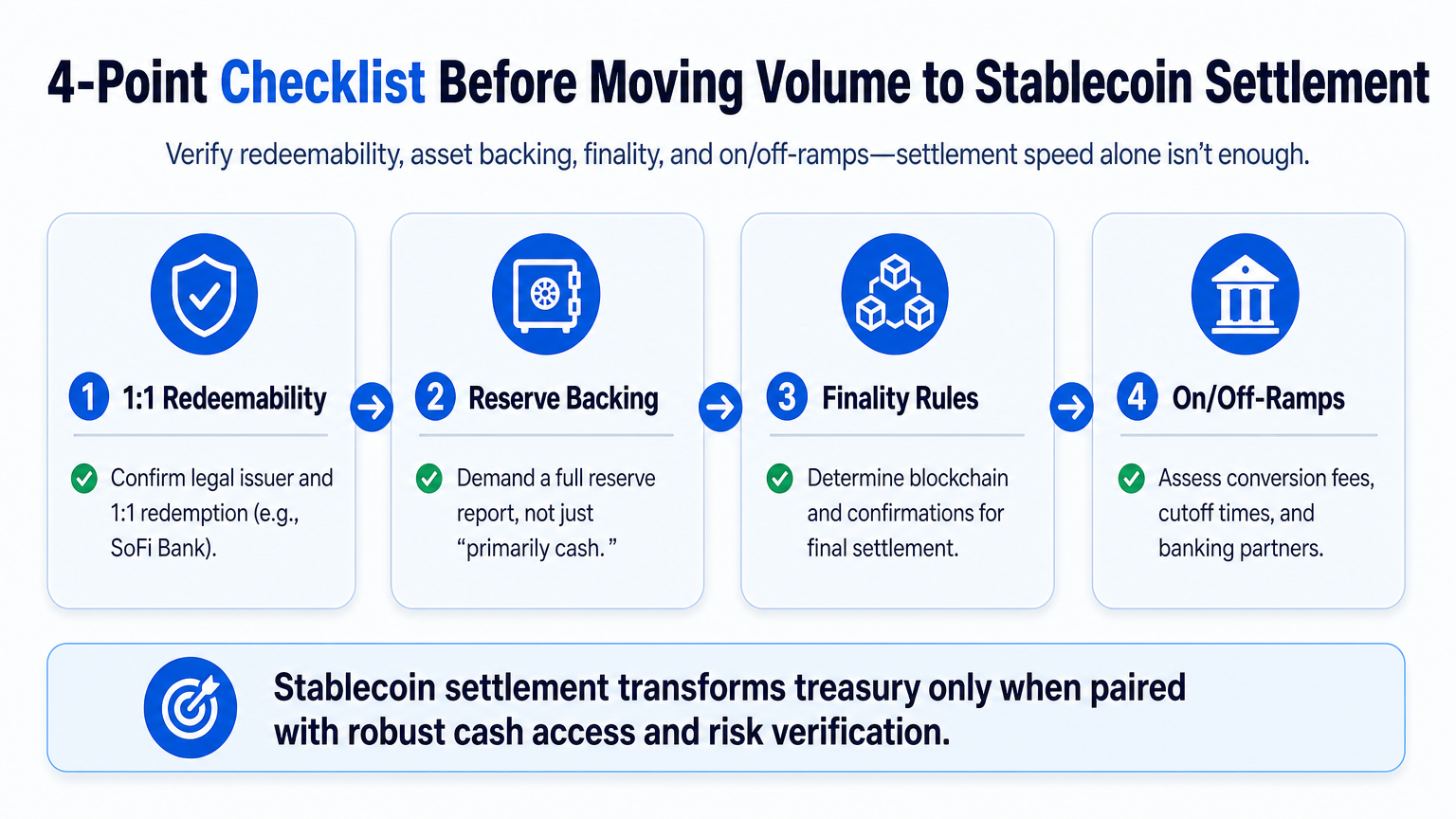
Before moving card volume or settlement activity, check four things:
- 1:1 redeemability: Confirm the legal issuer and redemption mechanism. SoFiUSD is redeemable 1:1 with SoFi Bank.
- Asset backing: Ask for the reserve report—not just “primarily cash.”
- Finality: Which blockchain, and how many confirmations count as final?
- On and off-ramps: Conversion fees, cutoff times, and banking partners. The Circle-Tazapay deal showed how an on-ramp partnership makes USDC flows usable; apply the same evaluation.
A fifth layer: dispute and refund mechanics. If you’re using stablecoin as a checkout payment method, chargeback treatment may differ. If it’s settlement behind a card transaction, card-brand rules generally still apply. Ask which layer you’re on.
Where a hybrid fiat-crypto account fits
For teams that don’t want separate ledgers for stablecoin settlement and fiat operations, a hybrid account can reduce interfaces. OneSafe, a financial technology company (not a bank), offers fiat and crypto accounts in one place, with 0.15% on fiat deposits/withdrawals, free USDC crypto deposits/withdrawals, $25 wire withdrawals, and FX at 0.25%. That structure doesn’t replace a bank partner but can make the stablecoin-to-operating-cash leg easier to reconcile.
How to evaluate a stablecoin payment or settlement provider
Run the checklist above against the provider’s documentation. Specifically ask: Is settlement in a bank-issued stablecoin or a third-party token? Reserve composition? On-chain finality? Fiat conversion fees and cutoffs? Does the platform support ACH, wire, and corporate cards without forcing a separate banking relationship? And does it clearly distinguish checkout-layer stablecoin payments from settlement-layer stablecoin movement?
What to Watch Next and Open Questions
Watch whether other issuers follow SoFi onto stablecoin settlement, whether Mastercard publishes network-level pricing, and whether the zero-cost merchant cash withdrawal expands beyond SoFi’s platform. Regulatory clarity will shape adoption: earlier 2026 coverage has tracked bank-issued stablecoins. A live $25 billion program gives regulators a concrete case to examine.
Questions to ask your payment or banking platform
- Do you offer stablecoin settlement, or only stablecoin acceptance at checkout?
- Which stablecoins/blockchains, and who issues them?
- What are fiat off-ramp fees, cutoffs, and banking partners?
- How do disputes and refunds work if settlement moves to a stablecoin?
- Can settled stablecoins be auto-converted to fiat, or must I hold the asset?
Risks of stablecoin payments
Redeemability depends on the issuer’s liquidity. Finality risk depends on blockchain and provider policy. Off-ramp risk sits with the banking partner. Regulatory risk persists across jurisdictions. The Mastercard-SoFi structure reduces some risks by using a bank-issued stablecoin on existing rails, but doesn’t eliminate them. Verify reserve backing, confirm finality rules, and maintain a fiat off-ramp that doesn’t depend on a single provider.
What DAOs and Web3 startups should do now
Separate the two layers: stablecoin settlement behind a card transaction vs. accepting stablecoins at checkout. Map your treasury flow from card spend to settlement to fiat conversion, and build the checklist into vendor reviews. Keep a fiat-crypto account structure that can handle both on-chain credits and operating cash—the goal is to remove reconciliation friction, not move everything on-chain.
Key Takeaways
- On September 23, 2026, Mastercard moved SoFi’s live card program to SoFiUSD settlement, with >$25 billion annualized volume live on-chain.
- This is a settlement-layer change on existing card rails, so merchant-facing dispute and refund rules may not change.
- The immediate merchant benefit is faster cash access through SoFi’s platform; network pricing and Mastercard revenue impact remain undisclosed.
- Before switching volume, verify 1:1 redeemability, asset backing, finality, and on/off-ramps—not just settlement speed.
- DAOs and global businesses should treat card-network stablecoin settlement as a treasury infrastructure signal, and prepare a fiat-crypto ledger that can reconcile both legs.
If your business or DAO needs a single view across fiat and stablecoin settlement, explore OneSafe’s neo-banking platform for global businesses and DAOs.