Meta description: Google's crypto custody announcement reshapes crypto banking for startups and DAOs. Learn how to evaluate your business crypto banking setup and stay ahead of regulatory shifts.
Google Crypto Custody: What It Means for Crypto Banking
On October 28, 2026, Google presented a custody service for crypto assets that splits private keys into fragments — with commercial release planned for early 2027. The announcement, reported by CryptoTicker.io on November 1, 2026, targets banks and large financial institutions and explicitly excludes retail investors. For anyone running a business on crypto rails, the more consequential question is what this shift does to crypto banking — not just who holds the keys, but how startups, DAOs, and global operators choose their entire financial stack.
Table of Contents
- What Just Happened: Google's Custody Service, Explained
- Why This Matters Right Now for Businesses
- Crypto Banking Before Google: A Fast Primer
- Direct Implications for Startups and DAOs
- Where a DAO Banking Platform Fits
- What You Should Do Now: An Action Checklist
- What to Watch Next
- Key Takeaways
What Just Happened: Google's Custody Service, Explained
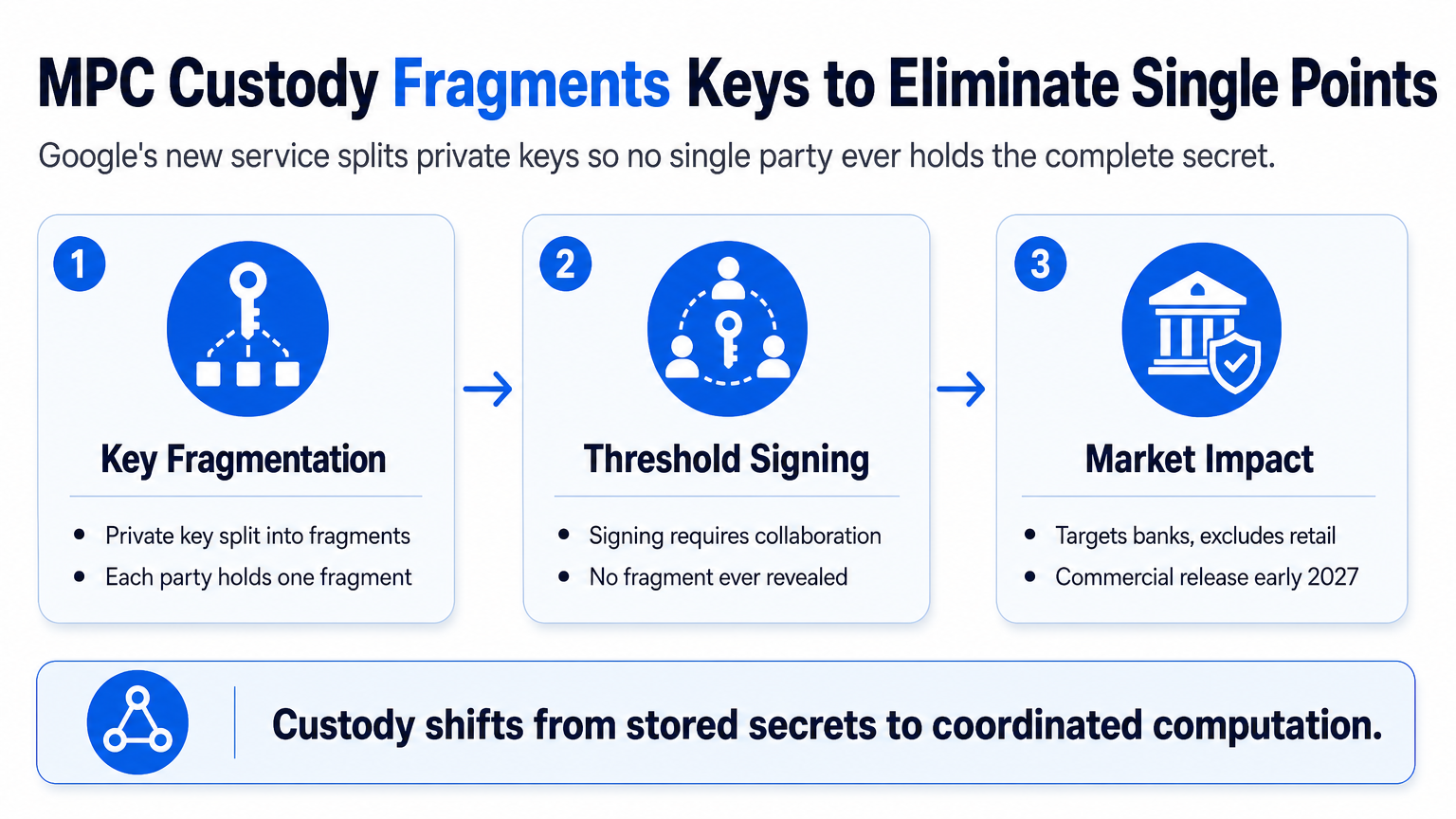
Google's custody service fragments the private key so it never arises complete in one place, using multiparty computation (MPC). Each party holds a key fragment; signing requires a threshold of fragments collaborating, with no fragment ever revealed. This structural shift — custody as a coordinated computation, not a stored secret — removes the classic single point of failure.
CoinDesk reported on October 28, 2026, that the service comes amid growing AI-driven threats to key security. The design is aimed squarely at banks; retail is not on the roadmap. Commercial release is scheduled for early 2027.
What did Google just announce about crypto custody?
On October 28, 2026, Google announced an MPC-based custody service that fragments private keys, targets banks and large institutions, excludes retail investors, and goes live in early 2027. The first detailed report appeared on CryptoTicker.io on November 1, 2026.
Why This Matters Right Now for Businesses
When a company with Google's infrastructure discipline enters institutional custody, it signals that crypto custody is now a mainstream infrastructure problem. The bar for “safe custody” is about to move upward for every market participant. For founders and DAO operators, the signal matters because banks adopting Google custody will need integration layers, compliance workflows, and client-facing rails — the exact stack that business crypto banking services already operate. That integration layer is where competition will intensify through 2027.
The announcement lands as stablecoin regulation and custody standards have been hardening. The Stablecoin Regulation After the SEC's Crypto Shift timeline shows how rapidly institutional participation expectations have shifted. Google is entering a market where regulated institutions already need credible custody infrastructure. Businesses that once accepted ad-hoc custody are now asking harder questions about key management and resilience.
Why should founders and DAO operators care right now?
Custody infrastructure decisions made in 2026 will determine which banking partners, payment rails, and treasury tools are available in 2027 and beyond. Waiting for Google's commercial release to evaluate the stack risks finding existing providers repricing, repositioning, or exiting segments as banks build on the new custody backbone. The audit window is open now and will narrow.
Crypto Banking Before Google: A Fast Primer
Crypto banking before Google meant stitching together a bank account, a separate exchange or custody provider, and manual rails between them. The Crypto Banking After the $6.3B Binance Hack analysis documented how fragmentation multiplies risk: when value moves through three platforms to complete one payment, each hop adds exposure.
This fragmentation is what Google's custody move does not solve for businesses. It solves custody for banks. The operational layer — payroll, vendor payments, treasury conversion — remains someone else's problem. Integrated fiat-crypto platforms approach it from the opposite direction, starting with the full business workflow and making custody one feature of a unified ledger.
What is crypto banking?
Crypto banking is the practice of managing traditional banking services alongside crypto custody, conversion, and payments in a single operational context. For a business, it means receiving a wire in USD, converting to USDC, paying a contributor on-chain, and reconciling without leaving one platform. The core services are custody, payments, and fiat on/off-ramps; the hard part is the integration layer that makes them behave as one system.
Direct Implications for Startups and DAOs
Google's MPC design will make fragmented-key custody a standard expectation, not a premium differentiator. That's good news: institutional-grade custody infrastructure becomes table stakes. As explored in Crypto Treasury Management After the Binance Hack, treasury resilience matters at every scale, and DAOs that historically relied on manual multisig setups can now shift resources to governance, reporting, and automation.
For crypto banking for startups, the differentiator shifts from who holds the keys to how well the rails work. Selection criteria will prioritize fiat-crypto integration, onboarding speed, fee transparency, multi-entity and multi-currency support, and DAO governance workflows — areas where legacy banks lag and where integrated platforms like Coinbase Business, which offers crypto payments, trading, and custody for businesses, are already strong.
How does Google's custody service affect non-bank crypto banking platforms?
It validates them and raises the floor. A platform that already combines fiat banking services with institutional-grade custody (secured via Fireblocks, for example) does not compete with Google's custody layer; it operates on top of it. Businesses that should be worried are those with proprietary custody lacking the scale and audit discipline to withstand direct comparison. Non-bank platforms that invested in UX, integration, and compliance will likely see demand rise as banks seek client-facing operational layers.
The trade-off: non-bank platforms must maintain partner bank relationships and can't offer the same regulatory certainty as a chartered institution. But for a startup or DAO that needs to move money today — across fiat and crypto, with role-based controls — the operational layer matters more than the custody brand name underneath.
Where a DAO Banking Platform Fits
The gap Google's announcement exposes is the operational middle. A DAO banking platform like OneSafe bridges on-chain and off-chain finance natively, offering ACH, wires, bill payments, instant crypto-to-fiat conversion, corporate cards, and DAO-specific role permissions in one interface. It partners with banks for fiat services and integrates custody via Fireblocks, collapsing the bank-account and custody-account mental models into one system. This is why infrastructure like Solana's Stablecoin Payment Rails resonates: organizations building on-chain treasuries need banking partners that treat the treasury as the bank account.
The bank-plus-custody approach forces every operational workflow to cross a boundary between two systems with different rules and settlement times. A unified platform removes that boundary, reducing failure points — a security advantage itself, as shown in the Crypto Banking Security Wake-Up Call After London Theft analysis. For global teams paying contributors in stablecoins and holding reserves across assets, operational simplicity is a control.
What You Should Do Now: An Action Checklist

Audit your current custody, banking, and payment rails
If your business holds crypto, pays in stablecoins, or manages a DAO treasury, use the October 28 announcement as a prompt. Ask three questions:
- Where do my private keys live, and who can access them? A single hot wallet or signer puts you below the standard Google is about to normalize.
- How many steps to move value from fiat to crypto and back? Three platforms and manual transfers compound operational risk.
- What happens if my custody provider fails or pauses withdrawals? No answer means a resilience gap no feature set can cover.
Prioritize platforms that combine fiat and crypto under one roof
Choose providers that treat fiat and crypto as one system, not two silos. A crypto-friendly business account should handle ACH, wires, corporate cards, on/off-ramp conversion, and role-based access — not a bank that bolted crypto onto a legacy ledger. For evaluating specific bank accounts suited to this, resources like the 7 Best Bank Accounts for Crypto Business in 2026 - Aspire US can provide a starting comparison.
What steps can I take to evaluate my business's crypto banking setup?
Here's a practical checklist to run now:
- Map every place your business holds value: bank accounts, exchange accounts, custody accounts, multisig wallets.
- For each, document who holds keys or signing authority — and what happens in a key-person scenario.
- Calculate your crypto-to-fiat friction: how long, how many steps, and how much in fees to convert and move funds.
- Review your compliance exposure: KYB documentation, transaction monitoring, and travel-rule readiness for cross-border flows. The How to safely bank a crypto business: Due diligence and ... guide from Elliptic outlines due diligence steps that can help you evaluate this exposure.
- Test your provider's responsiveness: how quickly does support answer a custody, billing, or onboarding question?
- Confirm whether your provider's custody infrastructure meets the standard Google is normalizing — fragmented or distributed key management, not single-key storage.
| Evaluation Dimension | Low-Bar Setup | Recommended Setup |
|---|---|---|
| Key management | Single private key, single location | Fragmented keys (MPC or equivalent) via institutional custody |
| Fiat-crypto conversion | Multiple platforms, manual transfers | One platform, instant conversion |
| Payment rails | Bank-only or crypto-only | ACH, wires, corporate cards, and crypto payments in one account |
| Team access controls | Shared credentials, ad hoc permissions | Customizable roles and permissions per user |
| Treasury resilience | Funds concentrated with one counterparty | Segregated accounts, documented recovery procedure |
| Onboarding speed | Weeks to months | Digital onboarding, typically within a week |
For operators also needing to keep stakeholders informed as the landscape shifts, Joyrise — which plans, writes, and publishes illustrated SEO articles to your Webflow blog every day, with the first article available before you pay — can maintain a steady stream of internal and external updates without pulling engineers off the audit work. Some businesses also look to dedicated Banking built for crypto-native companies offerings and even niche products like the Digital Future Crypto Checking Account to complement broader banking relationships, though a unified platform often reduces complexity.
What to Watch Next
Regulatory response and bank adoption speed
Google's service opens a measurable window: early 2027. Watch which banks announce custody integrations, which regulators publish new custody standards, and whether Google's entry accelerates stablecoin legislation. The Stablecoin Regulation in 2026: SEC Shift and Business Impact coverage tracks the regulatory thread; a bank custody adoption wave would likely pull it tighter.
The next wave of DAO-specific financial tools and integrations
As custody commoditizes, differentiation moves up the stack: governance-aware payment workflows, treasury reporting, compliance tooling for decentralized organizations, and automated fiat-crypto reconciliation. DAOs should watch for tools that integrate with Fireblocks custody and Google-style MPC, as buying institutional-grade custody becomes cheaper than engineering it.
Key Takeaways
- Google's October 28, 2026 custody announcement signals that fragmented-key custody will become the industry standard by early 2027, and businesses should treat single-key storage as unacceptably risky starting now.
- Banks adopting Google custody will still need client-facing operational rails, which is where integrated fiat-crypto platforms hold the advantage.
- Startups and DAOs should audit their custody and banking stack within the next quarter, before the early-2027 shift reprices or disrupts existing providers.
- Selection criteria for a crypto-friendly business account should prioritize fiat-crypto integration, role-based access, and institutional custody — not feature lists or brand names.
- Custody is commoditizing; the durable differentiator is the operational layer that moves value across fiat and crypto in one system.
If you're ready to bring your fiat and crypto operations into one stack, open a OneSafe account and see how a unified financial operating system handles your global workflows.