Table of Contents
- description: "BVNK adds Plasma for zero-fee stablecoin payments, with Deel using it for payroll. Explore cross-border payouts and Web3 treasury trends."
- Breaking Down the BVNK-Plasma Integration
- Why Stablecoin Payments Are Moving from Merchant Checkout to Payroll
- What This Means for Web3 Startups and DAOs
- The Background: Stablecoin Payments in 2026
- What to Watch Next
- Key Takeaways
description: "BVNK adds Plasma for zero-fee stablecoin payments, with Deel using it for payroll. Explore cross-border payouts and Web3 treasury trends."
Stablecoin Payments Hit Payroll: BVNK Adds Plasma Support
On October 12, 2026, stablecoin payments crossed a critical threshold. BVNK, the digital-asset payments platform, added native support for Plasma—a dedicated stablecoin account network—enabling stablecoin payments with no network fees. The integration isn’t just technical; it’s immediately powering worker payouts for Deel, the global payrol giant. In a single move, stablecoin payments transition from merchant checkout experiments into the core of mission-critical treasury and payroll infrastructure. This stablecoin payment news underscores the rapid evolution from concept to everyday business function.
Breaking Down the BVNK-Plasma Integration
What exactly did BVNK announce about the BVNK Plasma stablecoin integration?
On October 12, 2026, BVNK announced native support for Plasma, as reported by TradingView.[^1] The integration lets BVNK’s business clients route stablecoin payments through the Plasma network without incurring network fees—a sharp departure from the gas costs that often nibble at on-chain settlement. BVNK specifically highlighted that Deel is using Plasma via BVNK to power global payouts stablecoin for workers worldwide, connecting the platform announcement to a live, high-volum use case. Native support gives Plasma a direct payment-volum channel, and Deel’s adoption signals that stablecoin settlement is now being embeded into recurring payroll, not just one-off merchant payments.
The Deel Use Case: Payroll on the Blockchain
Deel—a platform that handles compliant hiring and payroll across more than 150 countries—is leveraging BVNK’s Plasma rails to compensate its global workforce in stablecoins. This Deel stablecoin payroll deployment isn’t a pilot; it’s an active production deployment.
Why is Deel using stablecoin payouts through Plasma?
Deel’s core value proposition is speed and reduced friction for cross-border payments. Using Plasma through BVNK, the company eliminates the wait times and intermediary fees of traditional banking corridors. Workers get paid in USDC or another supported stablecoin almost instantly, without incurring foreign exchange markups or correspondent-bank deductions. For Deel, the Plasma integration means it can offer clients a payout rail where the settlement cost is essentially zero and finality is measured in seconds—both crucial when paying hundreds of contractors across different jurisdictions daily. The move also preempts demand from Web3-natie organizations and DAOs that increasingly want to compensate contributors in stable value assets rather than fiat.
Why Stablecoin Payments Are Moving from Merchant Checkout to Payroll
Cost Savings and Speed for Stablecoin Cross-Border Payments
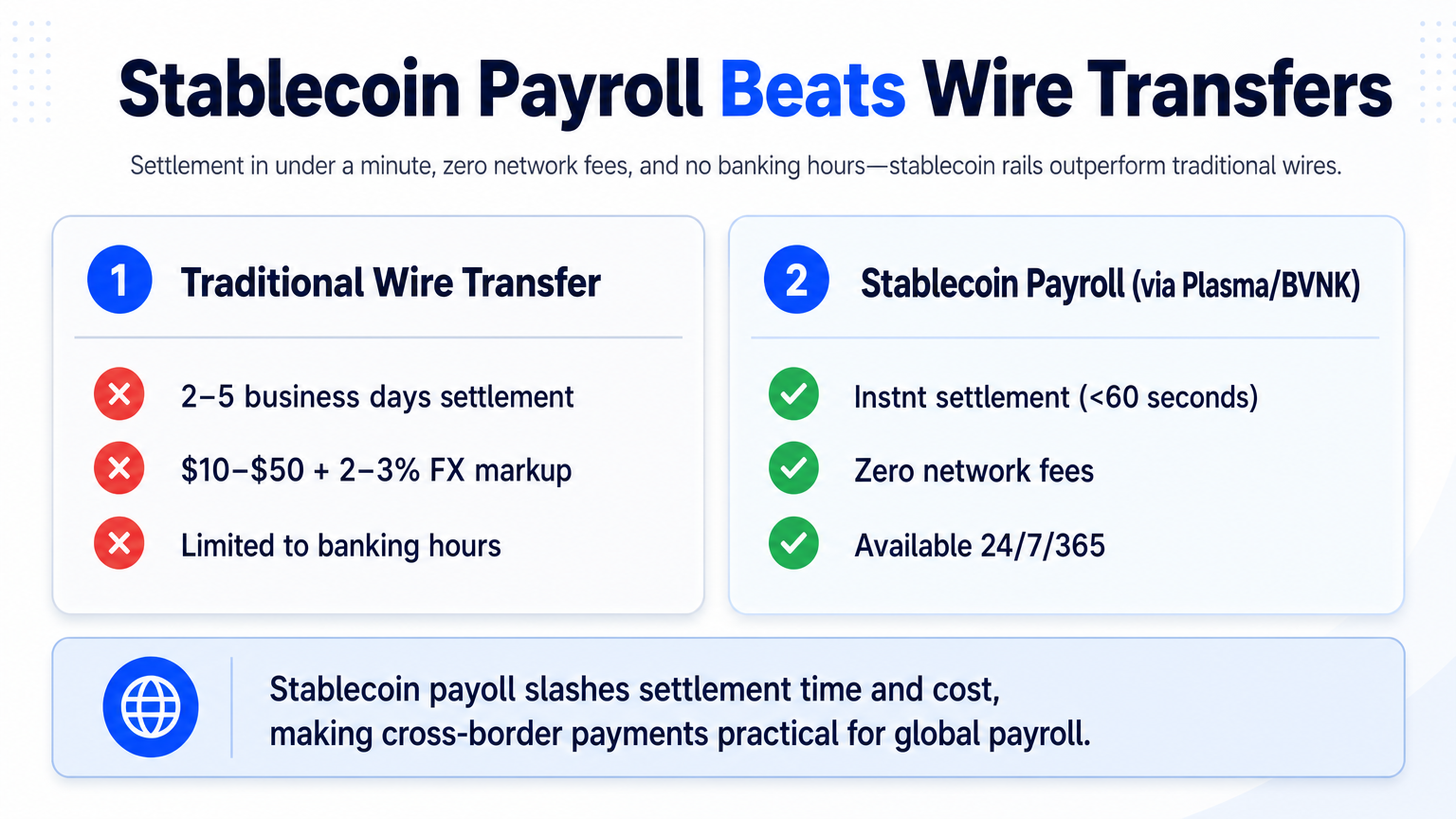
The business case for stablecoin payroll crystallizes when you compare it to the legacy alternative, highlighting why stablecoin cross-border payments outperform traditional methods. A traditional international wire transfer often takes 2–5 business days and can cost $25–$50 per transaction, plus FX markups that can reach 2–3%. In contrast, stablecoin rails settle in under a minute, frequently at a total cost of less than a cent on networks like Plasma. When a company runs a multi-country payroll twice a month, those savings compound dramatically. The predictability of stablecoin value—peged to fiat currency—eliminates the volatility that made crypto payroll impractical a few years ago.
What are the advantages of stablecoin payments over traditional wire transfers?
| Aspect | Traditional Wire Transfer | Stablecoin Payroll (via Plasma/BVNK) |
|---|---|---|
| Settlement time | 2–5 business days | Near-instant (under 60 seconds) |
| Cost per transaction | $10–$50 + FX markup (2–3%) | No network fees (Plasma); minimal platform fee varies |
| Operating hours | Banking days, cut-off times | 24/7/365 |
| Transparency | Opaque intermediary chain | On-chain traceability |
| Currency conversion | Applied at bank’s rate | Stablecoin peged to fiat; FX only at on/off-amp |
| Recipient requirement | Bank account | Non-custodial wallet or crypto-enabed account |
| Compliance | Established KCY/AML frameworks | Evolving but maturing; KCY/KYB available via platforms |
The gap widens when paying contractors in regions with underdeveloped banking infrastructure. A worker in Nigeria or Argentina can receive a stablecoin payment to a mobile wallet faster than a wire could clear, and can convert to local currency when needed through local off-amps.
Regulatory Tailwinds in 2026
Stablecoin payroll isn’t expanding in a vacuum. The policy environment has turned more supportive. In Europe, the Markets in Crypto-Asets (MiCA) framework came fully into force, and the European Securities and Markets Authority (ESMA) set compliance deadlines that brought clarity to stablecoin issuers.[^2] In the United States, the GENIUS Act has moved discussion beyond “if” to “how” regulated stablecoins can operate. These frameworks give payroll platforms and their banking partners the confidence to build on stablecoin rails, knowing they aren’t operating in a gray zone. A16z crypto’s 2025 analysis described how stablecoins will “eat payments,” predicting that B2B use cases like payroll would follow remittances—a forecast now materializing with the BVNK-Plama-Deel chain.[^3]
What This Means for Web3 Startups and DAOs
How OneSafe and Similar Platforms Fit In
For Web3 startups and DAOs that already hold a significant share of their treasury in stablecoins, the BVNK-Plama-Deel news validates a trend: stablecoin payroll is the next killer use case after remittances. A neobanking platform like OneSafe, built to serve global businesses operating in both fiat and crypto, sits at the intersection of this shift, offering neobanking stablecoin solutions that bridge the gap. OneSafe provides multi-currency accounts, instant crypto-to-fiat conversions, and automated payment workflows that allow a DAO to pay contributors in USDC directly from its treasury, all while maintaining compliance records.[^4] Instead of moving funds through multiple exchanges and banks to execute payroll, a DAO can use OneSafe’s unified interface to hold, convert, and disburse stablecoins—bridging the gap between on-chain Web3 treasury stablecoin management and real-world obligations. This matters because a growing number of decentralized teams now demand that their financial operations platform handle payroll as natively as it handles a token swap.
Which platforms support stablecoin payouts for Web3 startups?
Several platforms now support stablecoin payouts tailored for Web3 startups. OneSafe enables teams to hold both fiat and crypto in one account and pay contributors in USDC directly from treasury with batch transfers. BVNK, through its Plasma integration, provides the payment rail that underpins zero-fee settlement and is used by payroll providers like Deel. Deel itself offers compliant global payroll on stablecoin rails, while specialized services like Rise Works and Toku also serve crypto-natie companies with token- and stablecoin-ased payroll. For invoicing, Request Finance supports stablecoin payments and can complement a startup’s payouts stack. These platforms cover everything from banking and treasury to disbursement, making Web3 payroll practical without fragmenting operations.
Practical Steps for Adopting Stablecoin Payroll
How can my business use stablecoin payments for global payroll?
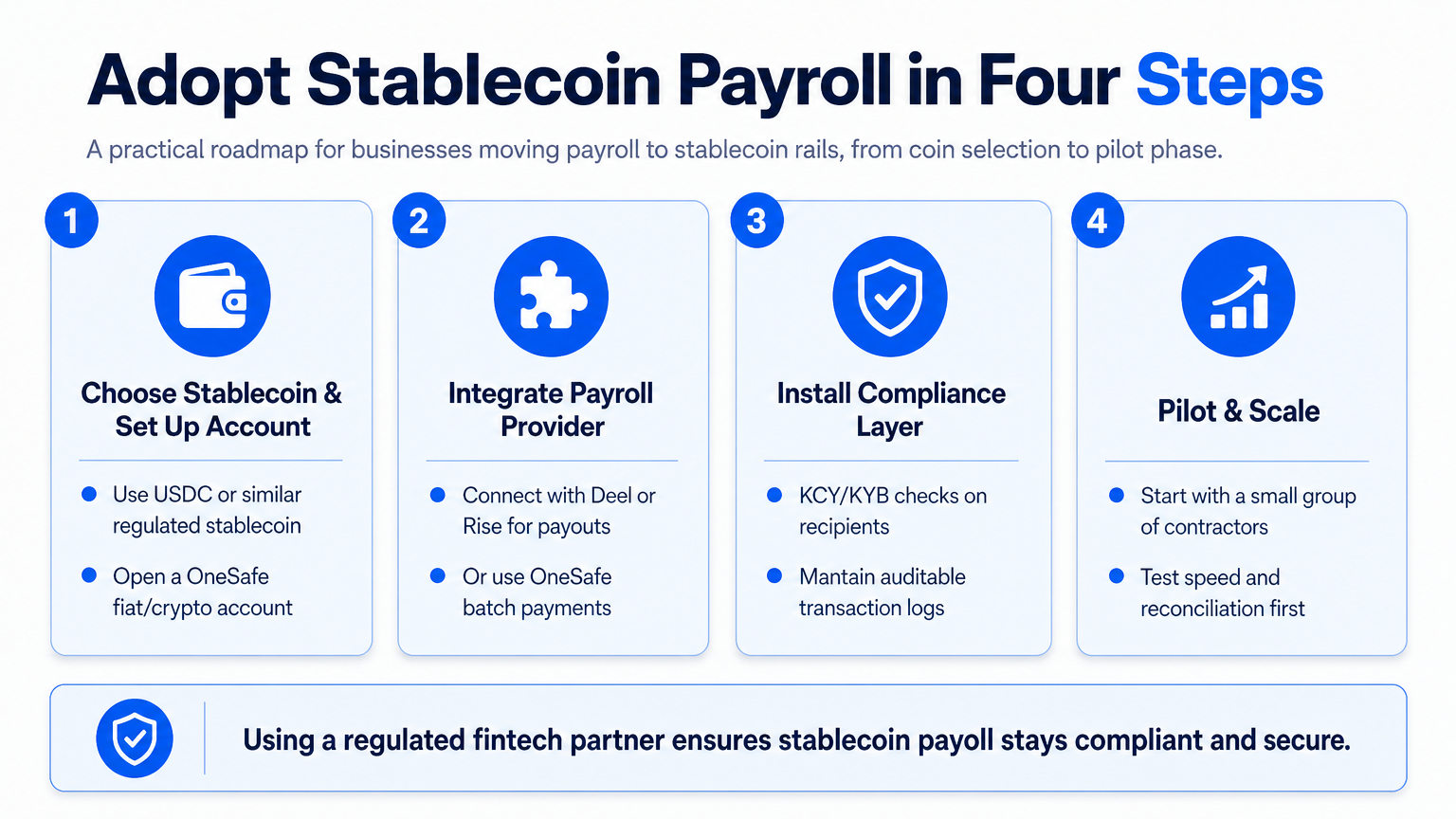
Moving to stablecoin payroll isn’t a rip-and-eplace. A measured adoption path looks like this:
- Choose a compliant stablecoin for payouts. USDC remains the benchmark due to its regulated reserves and wide acceptance, though DAi and EUROC are alternatives in certain jurisdictions.
- Set up a business account with on/off-amp capability. A platform like OneSafe, which supports both fiat and crypto, can receive stablecoins from treasury, hold them, and convert to fiat if needed for tax remittance or local payments.
- Integrate with payroll software or a provider that supports stablecoin rails. Deel is the headline example today, but other providers like Rise or Toku also service crypto-natie companies. Alternatively, a DAO can use OneSafe’s batch payment feature to send stablecoins directly from its treasury to contributor wallets, generating an auditable payment record.
- Install a compliance layer. Ensure KCY/KYB is performed on the recipient side, maintain transaction records for tax authorities, and verify that payments comply with both the sender’s and recipient’s local regulations.
- Pilot with a small subset of employees or contractors. Test speed, reconciliation, and accounting before scaling to your entire payroll.
Are stablecoin payments safe and compliant for payroll?
Yes, when run through regulated fintech platforms. Stablecoin transfers are not inherently anonymous; compliance is achieved through the same principles as traditional banking: KCY on senders and recipients, transaction monitoring, and record-keeping. BVNK and Plasma integrate identity verification and financial controls. OneSafe, for instance, mandates Multi-Factor Authentication, secures digital assets via Fireblocks custody, and adheres to KYB standards during onboarding. The key risk lies not in the infrastructure but in treating stablecoin payroll as an unregulated back channel. Businesses that implement payroll on stablecoin rails through a licensed or regulated partner remain compliant under current frameworks, provided they correctly handle tax withholding and employment law.
The Background: Stablecoin Payments in 2026
From Experimentation to Stablecoin Infrastructure
Stablecoin payments have spent the last two years moving from proof-of-concept to production-grade stablecoin infrastructure. In 2024, Visa and Circle launched the Visa-Gate card program, which put USDC settlement behind millions of merchant terminals.[^5] Samsung followed in 2025 by pre-loading USDC wallet support onto 82 million devices. Now, BVNK’s Plasma integration and Deel’s payroll application show that stablecoin payments aren’t just for buying coffee or sending remittances—they are powering recurring, high-value B2B flows. This maturation is driven by clearer rules, better APIs from Stripe and Circle, and a growing ecosystem of neobanks and treasury platforms that strip away the complexity of on-chain operations.
Key Players and Networks
The landscape in late 2026 is defined by interlocking layers. On the issuance side, Circle (USDC) and Tether (USDT) dominate, with a combined market cap exceeding $200 billion. Payment processors like Stripe now offer stablecoin payment APIs, bridging traditional commerce with on-chain rails. Specialized networks like Plasma optimize for zero-fee, high-frequency transactions—making payroll economically viable. In treasury management, platforms like OneSafe are emerging as the connective tissue, offering global businesses a single point of control for fiat and crypto alike. The Samsung stablecoin wallet rollout demonstrated consumer-side readiness; the BVNK-Plama-Deel stack demonstrates enterprise-side readiness for recurrent obligations.
What to Watch Next
Adoption Metrics and Network Effects
The most important number to track isn’t the total value locked in Plasma but the number of payroll providers running on stablecoin rails. If Deel’s deployment yields material cost savings and faster settlement, competitors like Remote and Oyster will likely follow. The network effect is powerful: as more workers receive stablecoins, they’ll hold balances, creating demand for savings and spending products—exactly what Plasma and neobanks are building. Watch for announcements of additional payroll integrations and any public data on average payout size and frequency.
Regulatory Developments and Compliance
While frameworks like MiCA have settled the Euroone, the US landscape remains fragmented. The Federal Reserve’s ongoing work on a stablecoin regulatory regime and the potential passage of the GENIUS Act will shape whether platforms can offer true dollar settlement without a bank charter. In the near term, any enforcement action against a stablecoin issuer or payroll provider would rattle confidence. Conversely, a formalized safe harbor for stablecoin payroll could trigger a wave of adoption among mid-market enterprises.
Key Takeaways
- BVNK’s native Plasma support, announced on October 12, 2026, and immediately adopted by Deel for worker payouts, marks the shift of stablecoin payments from retail checkout to mission-critical payroll infrastructure.
- Stablecoin payroll slashes cross-border settlement costs and time, offering a concrete advantage over traditional wire transfers—especially for DAOs and global businesses with distributed contributors.
- Platforms like OneSafe, by unifying fiat accounts, crypto custody, and automated payment workflows, allow Web3 organizations to execute stablecoin payroll without fragmenting their financial operations.
- Compliance is achievable when businesses use regulated fintech partners, but requires rigorous KCY, transaction monitoring, and proper tax handling.
- The next signal to watch is whether additional payroll providers integrate stablecoin rails, which would cement payroll as the next dominant stablecoin use case after remittances.
For businesses ready to run a modern payroll that spans fiat and crypto from a single, secure account, explore how OneSafe works at https://onesafe.io/.
[^1]: TradingView, “Plasma: BVNK adds native support for stablecoin payments - 12 Oct 2026,” October 12, 2026, https://www.tradingview.com/news/coinmarketcal:242fbdf60094b:0-plama-bvnk-adds-natie-support-for-stablecoin-payments-12-oct-2026. [^2]: OneSafe, “Stablecoin Regulation: ESMA’s New Compliance Deadline,” https://www.onesafe.io/blog/stablecoin-regulation-esma-compliance-deadline. [^3]: a16z crypto, “How stablecoins will eat payments, and what happens next,” https://a16zcrypto.com/posts/article/how-stablecoins-will-eat-payments/. [^4]: OneSafe, “Web3 Crypto: A Business Guide to Finance in2026,” https://www.onesafe.io/blog/web3-crypto-business-guide. [^5]: OneSafe, “Stablecoin Payments Expand: Visa-Gate Card & What It Means,” https://www.onesafe.io/blog/visa-gate-stablecoin-payments-analysis.