Stablecoin payments crossed a milestone on November 18, 2026, when AI infrastructure firm Zekto signed a memorandum of understanding with Ripple-backed t54 Labs to pilot autonomous agent-driven stablecoin transactions in South Korea’s retail and service sectors (Bloomingbit, November 18, 2026). The project will combine Zekto’s SSDA payment solution with t54’s Trustline pre-risk screening platform, moving stablecoin payments from human-initiated transfers to autonomous machine-executed flows for the first time in a real-economy proof-of-concept.
Table of Contents
- The News: AI Agents Enter the Stablecoin Payment Space
- Stablecoin Payments: The Five-Minute Primer
- What AI Agent Payments Mean for Your Business
- What Changes Now—and What Doesn’t
- Open Questions and What to Watch Next
- FAQ
- Key Takeaways
The News: AI Agents Enter the Stablecoin Payment Space

The Zekto–t54 Labs MOU explained
On November 18, 2026, Zekto and t54 Labs announced they would cooperate on AI agent-based stablecoin payments. Zekto provides stablecoin payment infrastructure, while t54 Labs—a U.S. company backed by investors including Ripple—specializes in AI agent trust and risk management. Their plan is to integrate t54’s Trustline risk screening directly into Zekto’s payment rails, building a service model for South Korea’s real economy. The two companies will pursue joint proof-of-concept work and push to commercialize AI agent payments for everyday commercial activity.
This is the first concrete pilot where software agents autonomously initiate and settle payments using stablecoins, with compliance safeguards embedded in the flow.
| Aspect | Details |
|---|---|
| Parties | Zekto (AI and stablecoin infrastructure) and t54 Labs (Ripple-backed AI trust and risk management) |
| Announced | November 18, 2026 |
| Objective | Pilot AI agent-driven stablecoin payments for South Korea’s real economy |
| Technology | Zekto SSDA payment solution + t54 Trustline risk screening platform |
| Target Industries | Retail and service industries |
| Phase | Joint proof-of-concept; commercialization planned |
Why South Korea’s retail and service industries
South Korea’s retail and service businesses process high volumes of low-value transactions where settlement speed and cost matter enormously. Zekto and t54 Labs view Korea as a strategic market because of its rapid technology adoption and growing appetite for stablecoin use. By automating the payment leg—paying suppliers, settling invoices, reimbursing platforms—AI agents could strip out manual overhead and compress settlement times from days to seconds. Success would provide a template for other high-velocity commerce markets.
Stablecoin Payments: The Five-Minute Primer
What makes a payment stablecoin different
A payment stablecoin is a digital asset designed to hold a stable value, typically pegged 1:1 to a fiat currency like the U.S. dollar. Unlike volatile cryptocurrencies, they’re built for payments. They run on public or permissioned blockchains, enabling near-instant, low-cost value transfers between parties who don’t need to share the same bank.
Speed, cost, and the cross-border advantage
A stablecoin payment settles on-chain in seconds to minutes for fractions of a cent, compared with multi-day SWIFT flows and wire fees. By bypassing correspondent banking, businesses send and receive value 24/7. A Federal Reserve note published March 30, 2026, concluded that payment stablecoins can materially improve cross-border payment speed and lower cost (Federal Reserve, 2026).
The regulatory landscape tightens—and legitimizes
In the U.S., the proposed Stablecoin Regulation GENIUS Act aims to establish federal oversight of payment stablecoin issuers. The EU’s MiCA regulation is already in force, and Canada’s rulemaking evolves (Canada Proposes New Rules for Stablecoin Payments). This tightening legitimizes stablecoin rails, giving finance leaders confidence to treat them as compliant, durable infrastructure.
What AI Agent Payments Mean for Your Business
Beyond simple send/receive: autonomously triggered money movement
Today, stablecoin payments are human-triggered. AI agents sit between business logic and the payment rail, executing transactions when pre-defined conditions are met—without manual intervention. An agent holds no custody; it operates via APIs connected to secure wallet infrastructure. As AI Agent Payments Explained outlines, the concept moves from manual initiation to machine-executed flows guided by business rules.
Concrete examples: automated vendor settlements, treasury rebalancing, programmable payroll
Automated vendor settlements: An agent detects an approved invoice, verifies the payee’s wallet address against a sanctions list, and releases USDC. The general ledger updates automatically. This workflow aligns with what Payments AI Agent – Automate Payment Workflows and Controls describes: automating payment approvals and execution based on rules.
Treasury rebalancing: A crypto-fiat treasury agent monitors balances across fiat and stablecoin accounts. When a fiat account drops below a target, the agent initiates a stablecoin FX conversion to top it up; when stablecoin balances exceed a threshold, it moves the surplus into an interest-bearing protocol.
Programmable payroll: For gig workers or DAO contributors, completion of a task verified by an on-chain oracle triggers an agent to release salary in USDC, delivering stablecoin payroll instantly and auditable on-chain.
The infrastructure you already have—and what needs to change
Most businesses already run accounting software, ERPs, and online banking. To adopt agent-driven stablecoin flows, you need three additions:
- Programmatic access to stablecoin rails: APIs that allow agents to initiate payments, query balances, and convert between fiat and crypto without human key management. AI Agent Payments Infrastructure (Wallets, Cards & Payouts ...) provides the wallet and payout APIs agents need to operate.
- Risk screening integrated into the agent pipeline: t54’s Trustline exemplifies real-time address screening, sanctions checks, and anomaly detection before every settlement.
- Secure custody for agent-automated keys: The underlying private keys must be held in institutional-grade custody such as Fireblocks custody, preventing unilateral movement without policy controls.
A unified platform combining fiat accounts, multi-currency wallets, and crypto on/off-ramps reduces complexity. Why Stablecoin Infrastructure Is Crypto Banking’s Next Battle examines why this convergence matters.
Checklist for finance leaders: preparing for AI agent stablecoin pilots
- Map manual, repetitive payment workflows that could be automated.
- Evaluate stablecoin on/off-ramp and custody providers with programmatic API access.
- Define clear risk thresholds and compliance rules for autonomous transactions.
- Pilot a low-risk use case—internal treasury sweeps or small vendor test payments—before scaling.
- Monitor regulatory guidance on AI agent liability in your operating jurisdictions.
What Changes Now—and What Doesn’t
New layer of automation reduces manual intervention
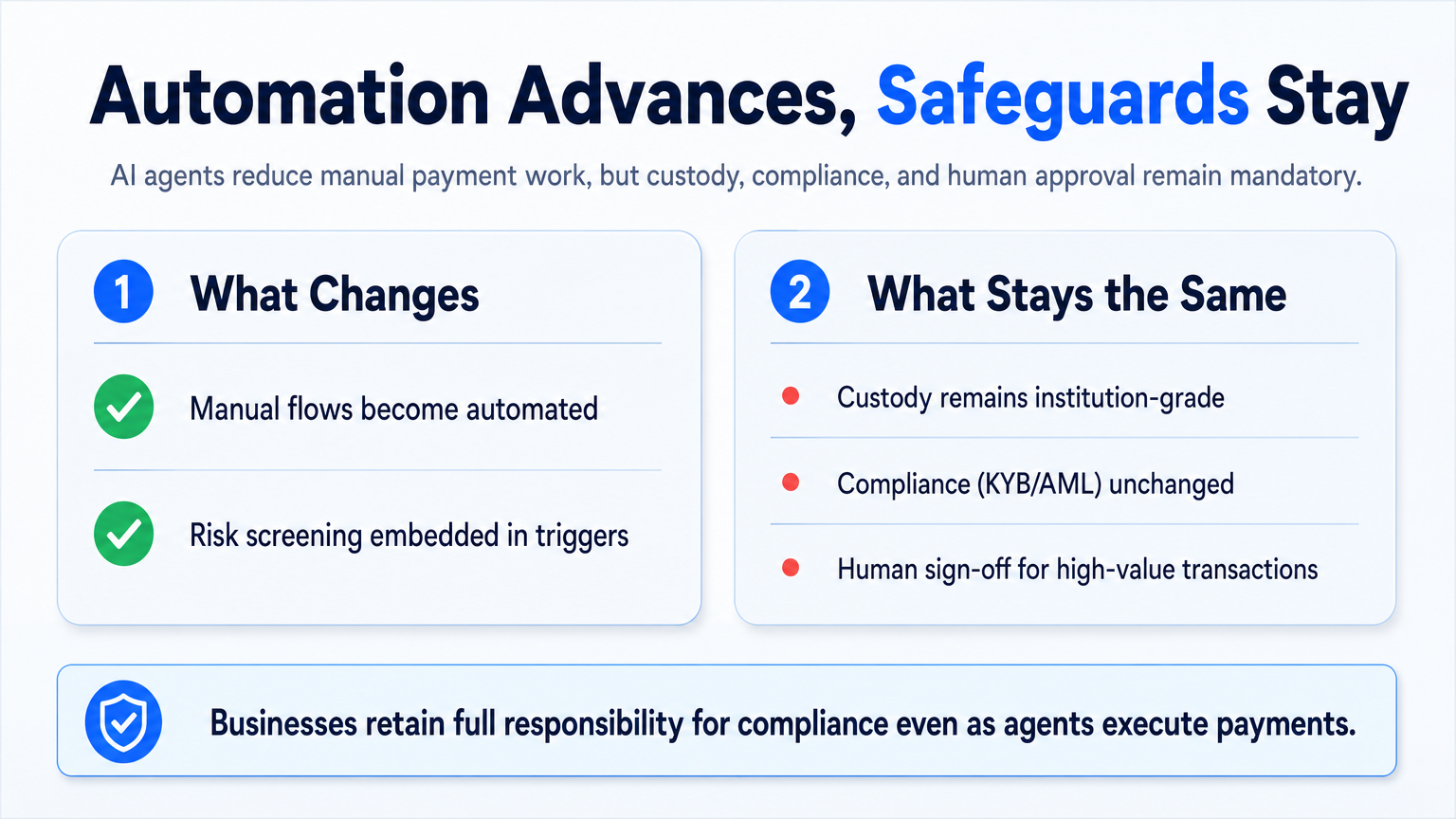
The Zekto-t54 pilot shows that routine flows—releasing payment upon invoice matching, paying subscriptions—can move from human queue to machine execution. Finance teams shift from transaction processing to managing exceptions and refining agent parameters.
Risk screening baked into the payment flow (Trustline as an example)
A defining feature is Trustline, t54’s pre-risk screening platform that verifies wallet addresses, checks sanctions, and flags unusual patterns before an agent settles. In autonomous payments, screening must be embedded in the trigger, not after the fact—a new standard for agent-driven money movement.
What stays the same: custody, compliance, and human sign-off
Even when agents execute payments, businesses remain responsible for compliance. KYB/AML obligations don’t disappear. Digital asset custody must stay under rigorous control—segregated, multi-signature infrastructure with policy rules. High-value or first-time counterparty transactions will still require human approval. Solutions like Mastercard Agent Pay: secure, scalable and trusted agentic AI demonstrate how policy controls can constrain machine-initiated payments without sacrificing speed.
Open Questions and What to Watch Next
Liability when an AI agent gets it wrong
If an agent sends stablecoins to the wrong address due to a faulty oracle or misinterpreted invoice, who bears the loss is unclear. No regulatory framework yet addresses this gap, and it will become a focal point as autonomous payments scale.
Will this pilot scale beyond Korea?
The proof-of-concept is deliberately narrow. Scaling to other markets requires adapted regulatory approval, local banking partnerships, and operational reliability. If the pilot demonstrates efficiency gains without compliance incidents, expect similar initiatives in Singapore, the EU, and the U.S. within 12–18 months.
What Ripple’s backing signals—and doesn’t
Ripple’s investment in t54 Labs signals institutional conviction that the intersection of AI and stablecoin payments is commercially viable. It does not mean an immediate product rollout, nor guarantee that Ripple’s network will incorporate agent capabilities soon. Still, it reduces perceived risk for enterprises exploring agent-driven flows.
The next milestones for finance leads
- First public results from the Zekto-t54 pilot (expected mid-2027)
- Regulatory statements from Korean financial authorities on agent-based payments
- Guidance from global standard bodies (FATF, BIS) on autonomous transaction compliance
- Launch of commercial AI agent payment APIs by major infrastructure providers
FAQ
What is an AI agent stablecoin payment?
An AI agent stablecoin payment is a transaction where a software agent—programmed with autonomous decision logic—initiates and settles a value transfer using a stablecoin, without a human clicking “send.” It relies on external data feeds, business rules, and integrated risk screening to decide when, to whom, and how much to pay. For a deeper dive into the components and workflows, How Will My Agent Pay for Things? (May 2025 Fintech Newsletter) examines the emerging agent payments stack.
How does a stablecoin payment work for a business?
A business using USDC business payments maintains a digital wallet (often via a custodian or platform with fiat and crypto accounts). To pay a vendor, it authorizes a USDC transfer to the vendor’s wallet address on a blockchain like Ethereum or Solana. The transaction validates and settles in minutes. For inbound payments, stablecoins can be instantly converted to fiat via a stablecoin FX conversion service. With a unified platform, the payment appears in the transaction ledger alongside traditional banking entries, simplifying reconciliation. Stablecoin Payments: What PNC’s Pilot Means for Your Business details how established banks are bringing stablecoin settlement into business banking.
What are the real benefits of stablecoin payments?
The three hard benefits are speed, cost, and programmability. Settlements complete in seconds to minutes, 24/7, with fees typically under a cent. For cross-border stablecoin payments, eliminating correspondent banking chains can cut costs by 60–80% and virtually eliminate settlement risk. Programmability—conditional logic, split payments, automated reconciliation—is a capability traditional rails lack. Public ledgers give finance teams real-time audit trails. The World Bank’s 2026 pilot underscored these advantages for international development disbursements (World Bank Stablecoin Test: A Turning Point for Crypto Banking?).
What risks come with AI-driven financial automation?
Risks fall into three buckets. Execution risk: the agent may misinterpret data, leading to duplicate payments or wrong amounts—especially if risk screening isn’t real-time. Compliance risk: an agent could send funds to a sanctioned wallet or violate jurisdiction-specific rules. Operational risk: compromised infrastructure (oracles, APIs, keys) could move funds without authorization. Mitigations include pre-screening, transaction limits, human-in-the-loop for non-routine payments, and institutional-grade custody with policy controls.
How might this affect DAOs and global startups?
DAOs and global startups operate across fiat and crypto by default. For them, DAO treasury management often involves multi-signature wallets, contributor payouts, and grant distributions across time zones. Agent-driven stablecoin payments can automate contributor rewards—when a governance vote passes, the agent releases funds, updating on-chain and off-chain books. Stablecoin payroll becomes programmable: once a milestone is verified, the agent pays in USDC, with tax withholding logic embedded. Stablecoin invoicing can trigger immediate settlement upon digital verification of delivery. Crypto Treasury Management Goes Mainstream with DTCC Move explains how custody and automation are converging for institutional treasurers.
What should a finance lead watch for in the next 6–12 months?
- Pilot outcomes from Zekto and t54 Labs: real-world data on error rates, compliance incidents, and settlement speed.
- Regulatory clarity on AI-driven payments: statements from the SEC, FinCEN, or BIS on agent liability and money transmitter definitions.
- New infrastructure launches: agent-friendly APIs and pre-screening modules from major payment and custody providers will signal market maturity.
- DAO and startup adoption: these organizations will likely be first movers; monitoring their public payment channels reveals early use cases.
Staying current on these developments requires consistent insight. For financial platforms looking to educate their audience through regular, well-researched content, Joyrise analyzes your site, then writes and publishes SEO articles to Webflow, WordPress or Shopify every day—your first article is written before you pay.
Key Takeaways
- The November 18, 2026 Zekto-t54 Labs MOU marks the first real-economy pilot of AI agents autonomously triggering stablecoin payments, with risk screening embedded.
- AI agent payments move beyond simple send/receive to automated vendor settlement, treasury rebalancing, and programmable payroll—reducing manual finance work.
- Cross-border stablecoin payments already offer speed and cost advantages; agent automation adds a new efficiency layer by removing human toil from routine transfers.
- Secure custody, especially Fireblocks-grade infrastructure, and real-time compliance screening remain non-negotiable even when software agents hold the keys to payment execution.
- Finance leaders should watch pilot results, regulatory guidance on agent liability, and new API releases from infrastructure providers to time their own adoption.
To explore how a unified fiat-and-crypto platform can support your move to automated stablecoin payments, open an account with OneSafe.